- The paper shows that label-only SFT outperforms rationale-based SFT, with ROC-AUC scores of 0.734 versus 0.604–0.592 for rationale formats.
- It systematically evaluates 504 configurations across two LLMs and various rationale targets to expose limitations in synthetic rationale training.
- The findings reveal a structural conflict between narrative explanation and discriminative optimization, suggesting inference-time rationales may be more beneficial.
Supervised Fine-tuning with Synthetic Rationale Data Hurts Real-World Disease Prediction: A Technical Synthesis
Problem Motivation and Experimental Overview
The dominant paradigm in interpretable clinical AI posits that models should both predict and explain. In medicine, this is operationalized via supervised fine-tuning (SFT) with synthetic LLM-generated rationales, the assumption being that learning not just the what but the why of a decision will enhance model performance, generalization, and trustworthiness. This paper rigorously tests that intuition in the context of five-year Alzheimer's disease and related dementias (ADRD) prediction from UK Biobank-derived longitudinal health histories.
The experimental grid is extensive: 504 SFT configurations spanning two open-weight LLMs (Qwen3-8B, Qwen2.5-7B-Instruct), three rationale target formats (label-only, free-form rationale, stepwise rationale), variable training sizes, learning rates, and decoding schemes. The cohort consists of 42,566 individuals, each represented by sparse event histories across 1,167 possible features (ICD-10 disease codes and lifestyle/cognitive factors), with incidence as the binary target. Critically, the structured input reflects clinically-relevant sparsity and heterogeneity, making the prediction task nontrivial and an informative stress-test for rationale-based approaches.
Main Empirical Findings
Label-only SFT decisively outperforms rationale-based SFT under all tested conditions. Models trained solely to output the final label achieve mean ROC-AUC of 0.734, compared to 0.604 for free-form rationale and 0.592 for stepwise rationale. This pronounced degradation in rationale-SFT persists regardless of model family, training size, or decoding strategy, and is robust to strong model initialization and increased data scale.
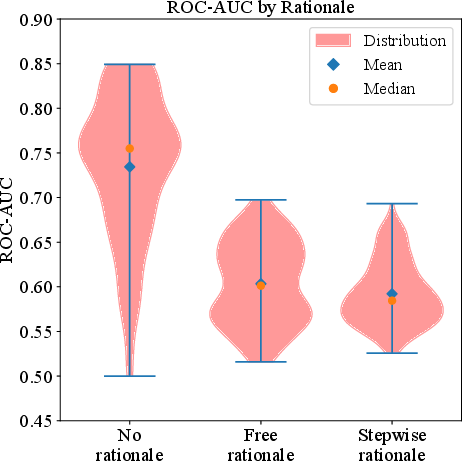
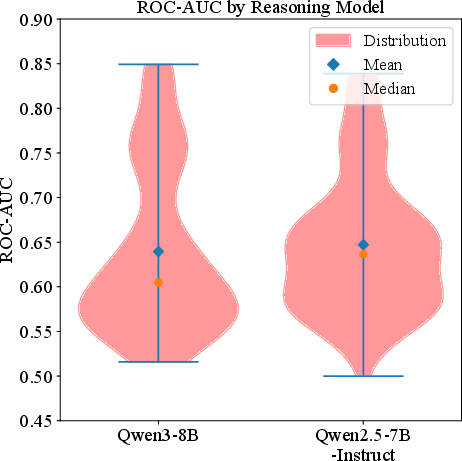
Figure 2: ROC-AUC for models trained with different rationale formats demonstrates a persistent and significant drop when training on synthetic rationales compared to label-only targets.
The degradation extends to precision-recall (PR-AUC), F1, and recall, undermining both ranking and thresholded classification performance. No configuration or hyperparameter setting of rationale-based SFT closes the gap with label-only SFT.
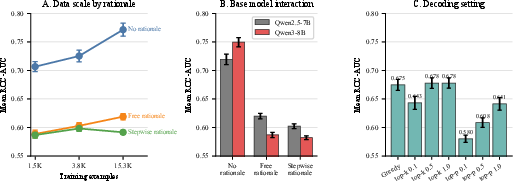
Figure 1: Parameter-level diagnostics—ROC-AUC as a function of rationale format, training sample size, base model, and decoding—show pronounced scaling benefits for label-only SFT, and persistent inferiority for rationale-based SFT across all axes.
Scaling up the training set benefits label-only SFT—ROC-AUC increases monotonically as samples grow—while rationale-based SFT exhibits weak or negligible scaling, indicating that more data does not rescue the limitations of rationale supervision in this regime. Notably, moving to a "reasoning-oriented" base model does not mitigate the degradation; in fact, Qwen3-8B, despite its putative strengths in chain-of-thought, underperforms in rationale-based settings.
A natural hypothesis is that rationale-based SFT fails because the synthetic rationales lack discriminative or clinical value. This is ruled out by two independent analyses:
- Human Expert Annotation: Clinical experts confirm that the rationales are biomedically accurate, logically coherent, and specifically reference patient-record evidence. Both male and female cases are scored highly for biomedical correctness and evidence fidelity, ruling out hallucination or irrelevance as causes.
- Few-Shot Inference with Rationales: The same rationales, when supplied as in-context demonstrations during inference (few-shot CoT prompting), improve model performance over zero-shot and zero-shot-CoT baselines by ~0.1 ROC-AUC. This demonstrates the rationales contain predictive signal but their utility is lost when they are direct SFT targets.
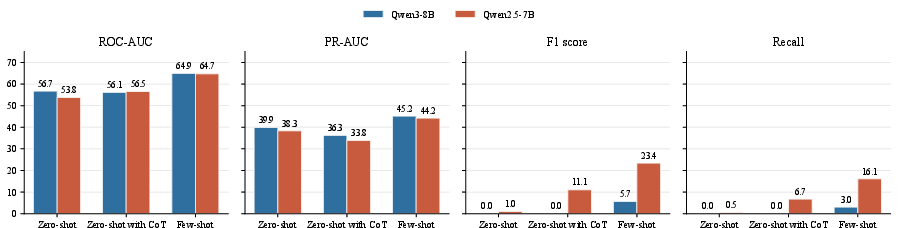
Figure 3: Few-shot ablation—showing metric improvements when rationales are used as demonstrations in the prompt rather than as SFT targets—establishes that rationale content is beneficial at inference-time but harmful during training.
Mechanistic Insights: Plausibility vs. Discriminability
The root cause of SFT performance loss with synthetic rationales, despite their quality, is a structural conflict between what constitutes a plausible clinical explanation and what maximally separates cases from controls in a discriminative model. Rationale generation is a generative, narrative-driven process; explanations tend to reference general morbidity, risk factors, and plausible disease pathways that are correlated with ground-truth, but not exclusively discriminative. Discriminative optimization, however, requires the model to sharpen its boundary on the often subtle, high-variance feature combinations actually predictive in the given population.
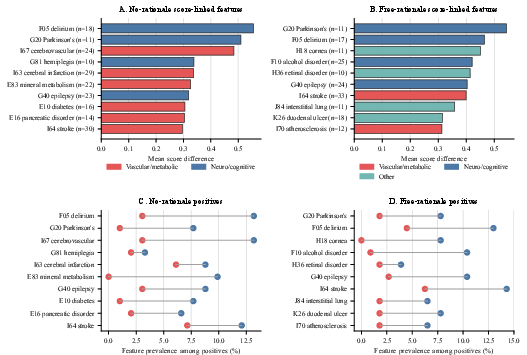
Figure 5: Error analysis—feature importance and misclassification patterns—reveals that rationale SFT models over-weight broad morbidity markers and non-discriminative conditions, leading to inflations in both false positives and false negatives relative to label-only SFT.
Error analysis reveals that rationale-SFT models (1) overclassify controls as cases based on generic cognitive, lifestyle, or comorbidity markers, and (2) under-detect genuine ADRD cases when ground-truth labels manifest via less narratively-salient but more discriminative cross-feature combinations. Consequently, although plausible narratives are generated, they misalign the model’s optimization process vis-à-vis true discriminative evidence.
Implications and Theoretical Significance
The findings have acute implications for the field of clinical AI interpretability:
- Current limitations of rationale-based SFT: In real-world, sparse, and heterogeneous clinical prediction tasks, synthetic rationales—even when high-quality—misdirect supervised learning objectives away from discriminability, directly contradicting prevailing intuition in the explainability literature.
- Supervised fine-tuning with rationales is not universally beneficial: The task, data structure, and feature-label relationships must be carefully considered; in settings where distinguishing signal is diffuse and not confined to narrative anchors, rationale SFT can degrade model calibration and discrimination.
- Inference-time rationales ≠ training targets: The utility of rationales as inference guidance (prompt demonstrations) is preserved, indicating that LLM-generated clinical explanations do encode relevant information, but should not serve as train-time supervision where discriminative objectives dominate.
Future methodological development should prioritize hybrid or filtered rationale objectives—e.g., weighting label tokens more heavily in the SFT loss, filtering rationales by discriminative alignment, or fusing generative and discriminative rationale construction—especially for tasks displaying the label heterogeneity and sparsity found in ADRD risk prediction.
Conclusion
This work delineates substantial, systematic evidence that SFT with synthetic, even clinically faithful, rationale data can impair real-world disease risk prediction. The phenomenon is robust across models and configurations, is not attributable to rationale quality, and reflects a deeper incompatibility between narrative explanation and discriminative optimization in sparse clinical contexts. For high-stakes applications, label-only SFT remains superior in such regimes, with synthetic rationale better applied for inference-time interpretability or in settings where discriminative signal is denser and more congruent with human-explainable pathways.
References
Su, B., Li, B., Qian, C., Wang, Y., Jin, J., & Zhao, B. (2026). "Supervised Fine-tuning with Synthetic Rationale Data Hurts Real-World Disease Prediction" (2606.10279).