- The paper reveals a significant gap between students’ intended SRL strategies and their actual reliance on information-request behaviors during GenAI interactions.
- The paper employs a mixed-method analysis using turn-level coding to integrate traditional SRL constructs with novel GenAI-specific codes, such as epistemic vigilance and agency.
- The paper finds that elevated extraneous cognitive load, introduced by GenAI interactions, negatively correlates with post-test mathematics performance.
Adolescent Regulation of Generative AI Tutors: Intentions, Help-Seeking, and Self-Regulated Learning
Introduction
The rapid integration of Generative AI (GenAI) in educational settings has raised central questions regarding adolescent learners’ ability to regulate AI-supported learning. "Regulating the AI Tutor: Intentions, Help-Seeking, and Self-Regulated Learning in Adolescent GenAI Use" (2606.08568) critically examines adolescents' self-regulatory and epistemic strategies during mathematics preparation using the Mistral-Large LLM. This paper systematically connects students’ stated intentions, enacted behaviors, and learning outcomes, addressing unresolved issues around agency, help-seeking, and cognitive processes within human-AI collaborative learning environments.
Study Design and Methodology
The study involved 98 Grade-9 students from German secondary schools interacting with a curriculum-aligned AI mathematics tutor. The protocol included pre/post mathematics assessments, measures of AI and learning-strategy literacy, and cognitive load inventories. The intervention required students to articulate learning goals prior to engaging in a six-turn minimum chat-based task involving real-world mathematical modeling.
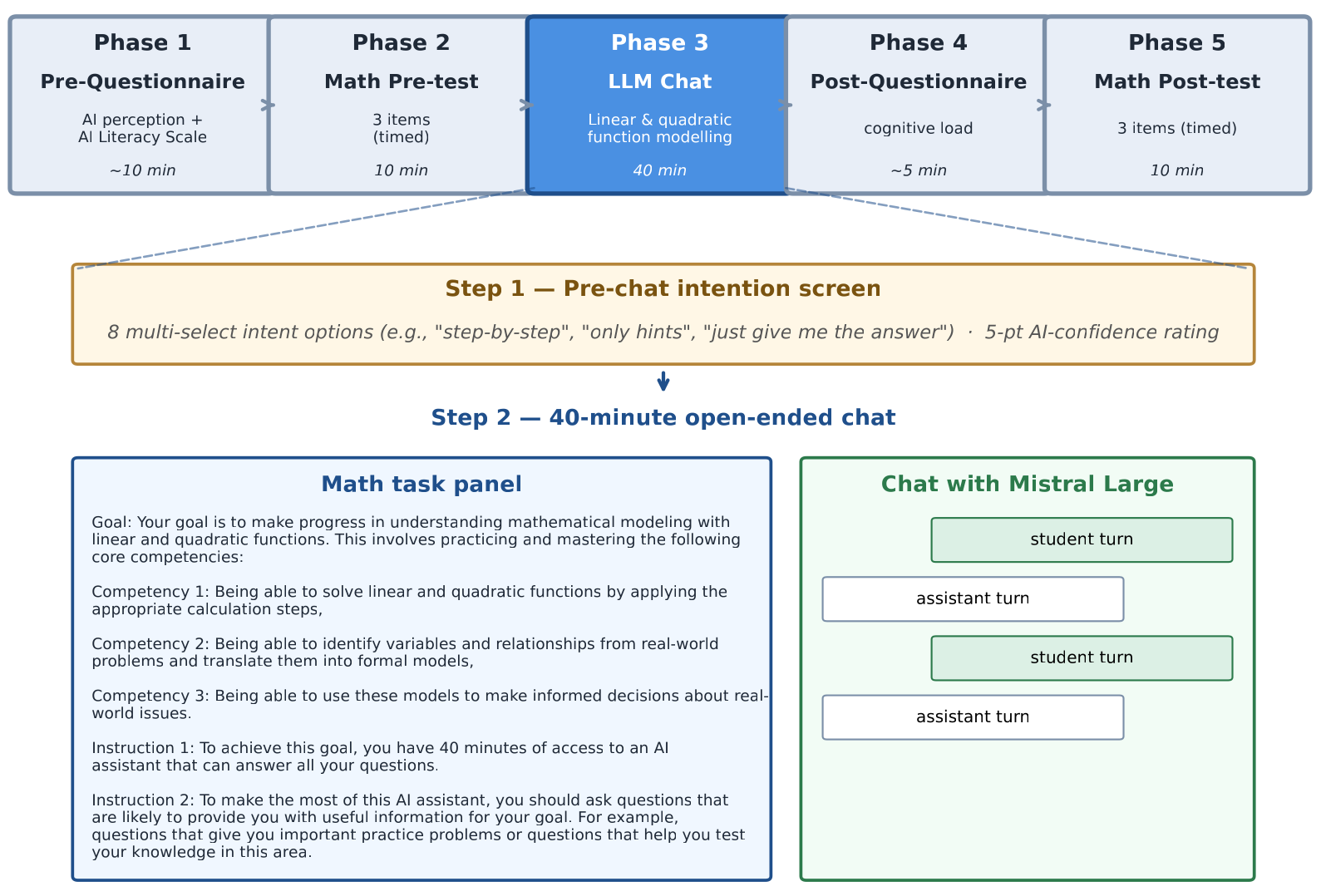
Figure 1: Timeline of the study and content of the pedagogical task.
A hybrid, turn-level coding framework was devised to annotate conversational data for SRL (self-regulated learning) and HS (help-seeking) functions by integrating established theory-driven categories with two inductive LLM-specific codes: epistemic vigilance and agency over the AI.
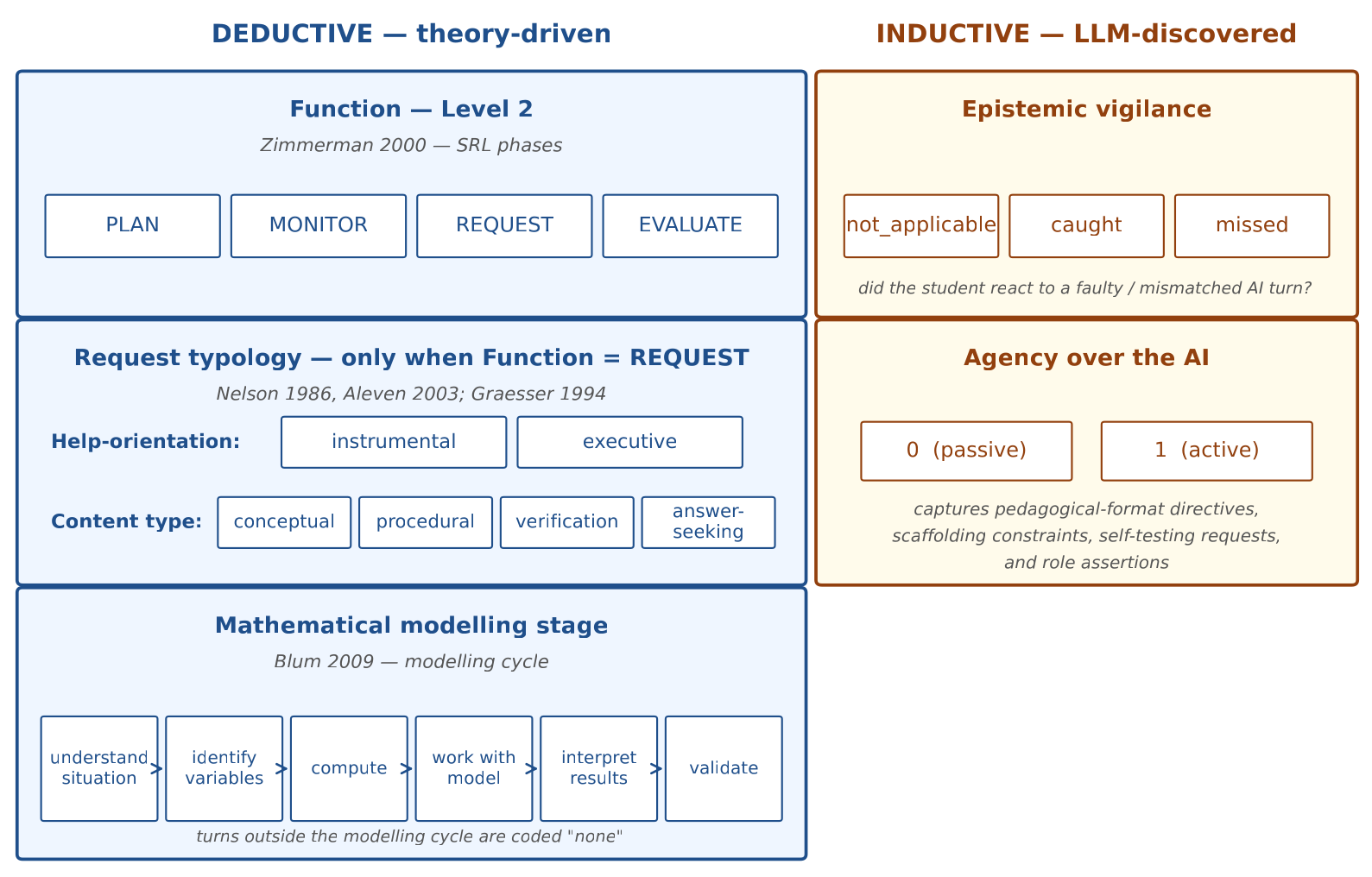
Figure 2: Proposed codebook for analyzing students' conversational data, including classical SRL/HS and LLM-specific constructs.
The dataset comprised 1,616 chat turns (808 student turns). Coding (pending full human validation) used both deductive categories from the SRL/HS literature and inductive constructs reflecting GenAI-specific interaction modalities.
Forethought: Stated Intentions vs. Enacted Behaviors
Self-report data indicated a strong preference for scaffolded support: most students selected conceptual explanations (69.7%), step-by-step examples (82.9%), and practice problems (71.1%) as goals. Only a minority (11.8%) explicitly requested mere final solutions or rapid task completion, suggesting initial orientations against executive help-seeking or shortcut strategies.
However, chat analyses reveal a substantial intention–enaction gap. REQUEST-type behaviors dominated interactions (mean: 72.9% of chat turns), with PLAN the next most prevalent (18.1%). MONITOR and EVALUATE functions—the core SRL activities facilitating comprehension tracking and iterative strategy refinement—were virtually absent (means: 5.7% and 3.4%, respectively).
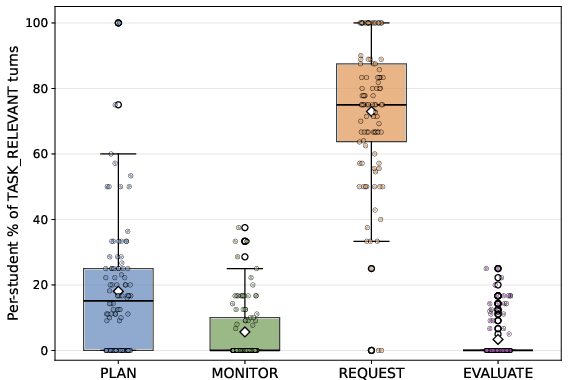
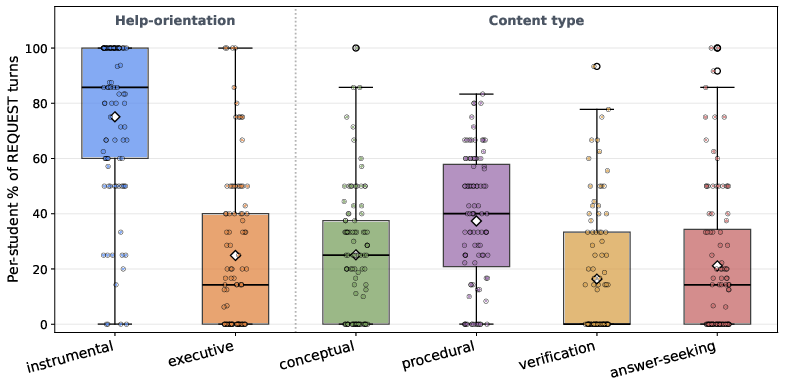
Figure 3: Distribution of students' prompt functions and request typology, highlighting dominance of instrumental requests over explicit monitoring or evaluation.
Within REQUEST turns, instrumental (learning-oriented) requests comprised the majority (75.1%), with procedures and concepts most frequent. Despite 69.7% expressing a desire for verification, only 16.3% of prompts involved verification requests. Critically, except for students who explicitly chose “just give me the final answers,” self-reported forethought did not reliably predict enacted productive behaviors (∣r∣<.18,p>.10 for learning-oriented intentions), but did for executive strategies (r=.33,p<.01 for answer-seeking).
Cognitive Load and Mathematical Learning Outcomes
A significant reduction in post-test performance was observed (pre: 67.5%, post: 56.9%, p=.014), contradicting prevailing narratives regarding effortless GenAI-enabled performance gains. Multivariate analyses established extraneous cognitive load as the only robust predictor of post-task performance (b=−.034,p=.025), indicating that interaction with GenAI systems introduces substantial processing demands not captured by content mastery alone. The results align with prior work on the costs of cognitive offloading and automation bias in human-computer interaction.
Theoretical and Practical Implications
Analyses demonstrate that productive intentions do not self-transduce into productive learning when operationalizing SRL and HS constructs in GenAI-mediated tasks. Most students defaulted to information-requesting cycles, rarely engaging in explicit metacognitive monitoring, evaluation, or strategic adaptation. This pattern suggests that LLM tutors’ low friction and responsive design may inadvertently destabilize critical SRL subprocesses, fostering shallow engagement even when strategic scaffolds are self-endorsed.
Furthermore, the dissociation between intent and enactment highlights the limits of self-report metrics and aggregate learning gains in evaluating AI learning interventions. Turn-by-turn process analytics—especially those accommodating constructs such as epistemic vigilance and agency—are essential for characterizing the interactional dynamics mediating GenAI’s effects on learning.
These findings call for the augmentation of AI tutor architectures with scaffolds that activate epistemic vigilance, promote explicit self-monitoring, and support agency over the AI’s role modulation—requirements not addressed by baseline LLM affordances.
Outlook and Future Research Directions
The study underscores the urgency of empirically grounding AI literacy, help-seeking, and learning process interventions in fine-grained behavioral data, not just outcome gains. Future work should focus on validating SRL/HS codebooks with substantial human annotation, longitudinal designs capturing strategy adaptation, and the causality of epistemic vigilance and agency.
Progress in GenAI applications for education should prioritize dynamic interface scaffolds that: (a) foster explicit monitoring and evaluation; (b) require students to justify or critique AI responses; (c) facilitate domain-appropriate forms of agency over the AI’s mode of assistance. There is clear scope for mechanistic experiments testing which prompt engineering, interface nudges, or LLM alignments best mitigate executive help-seeking and cognitive surrender without increasing extraneous load.
Conclusion
"Regulating the AI Tutor" delivers an evidence-based account of adolescents’ engagement with GenAI tutors that challenges optimistic expectations about self-regulation and productive help-seeking. The dominance of instrumental requests, minimal explicit metacognition, and negative learning outcomes reveal structural limitations of unmodified GenAI intervention designs. These data-driven insights substantiate the necessity for scaffolded regulation of help-seeking and SRL in LLM-powered educational interfaces, with broader implications for the next generation of AI-aligned pedagogy and interface design.