- The paper's main contribution is a bounded GenAI system that scaffolds process-oriented regulation in collaborative learning environments.
- It details an integrated approach combining teacher-edited activity design, in-group process prompts, and trace-based analytics for real-time support.
- Empirical findings reveal that targeted GenAI prompts enable distinct regulation motifs associated with high-performing Human–AI teams.
Building Regulation Capacity in Human-AI Collaborative Learning: A Human-Centred GenAI System
Theoretical and Practical Motivation
Collaborative learning is fundamentally dependent on groups’ capacity for distributed regulation, necessitating shared planning, monitoring, and adaptation in response to collaborative dynamics. Despite the proliferation of Computer-Supported Collaborative Learning (CSCL) and recent incursions from Generative AI (GenAI) into educational practice, most AI interventions in CSCL fail to tightly couple activity design, real-time support, and learning analytics. This gap leaves teachers with high coordination burdens and weak process-level scaffolding for critical co-regulatory (CoRL) and socially shared regulation (SSRL) processes, which are core for effective collaboration (2604.10221).
The doctoral work synthesizes regulation learning theory—emphasizing SRL extensions to CoRL and SSRL—by positioning GenAI as a bounded support, strictly limited to process-oriented scaffolding rather than content provision. The system is instantiated across three tightly integrated components: activity generation aligned with teacher goals, an in-group agent delivering regulation-targeted prompts, and a real-time analytics dashboard transforming interaction traces into actionable insights, thereby completing a closed evidence-informed feedback loop.
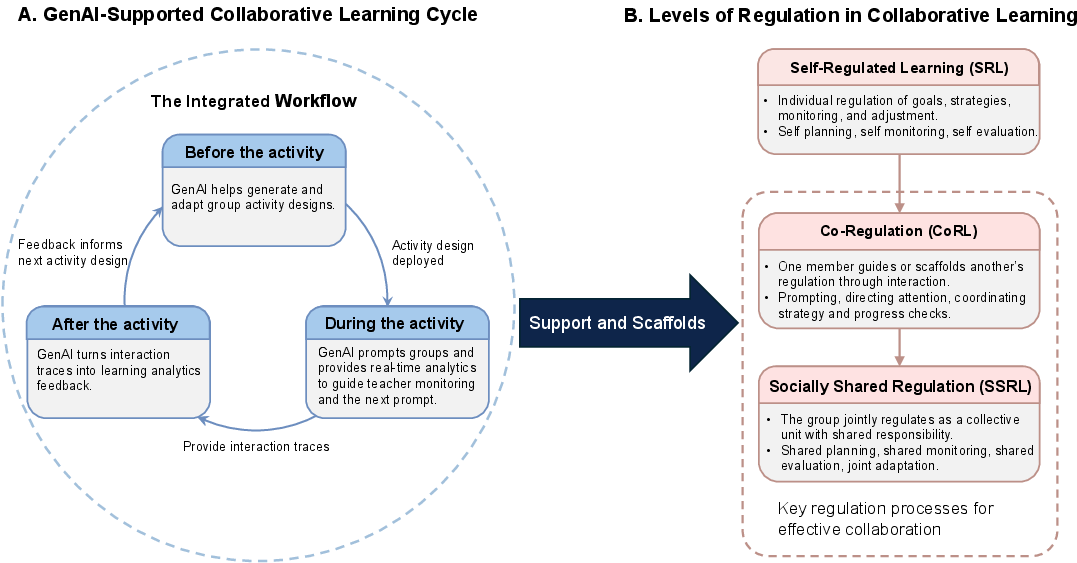
Figure 1: GenAI-supported CSCL cycle and its theoretical grounding in SRL, CoRL, and SSRL frameworks.
Research Design and Core Findings
The project unfolds over three principal research questions mapping to mechanism, system design, and evaluation.
- RQ1: How does GenAI alter socially distributed regulation and group interaction, and which collaborative patterns signal effective Human–AI teamwork?
- RQ2: What are the design principles and practicalities for an integrated GenAI-CSCL system spanning group activity generation, in-group agent support, and analytics?
- RQ3: Does such a system actually strengthen distributed regulation capacity and elevate group performance across varying AI involvement levels?
Empirical progress to date centers on RQ1, realized via a parallel-group randomized experiment (N=71, triads), contrasting Human-only and Human–AI groups. Notably, the GenAI agent (OpenAI GPT-4o mini), strictly prevented from providing domain content, issued only process-prompts targeting explanation, planning, and monitoring. Group regulation was quantified via both statistical and network-analytic approaches.
Strong Numerical and Structural Outcomes
- Human–AI groups exhibited fewer episodes of pure SSRL, shifting toward hybridized CoRL forms with heightened directiveness, obstacle-orientation, and affective regulation.
- Regulatory actions within Human–AI teams were more tightly coupled with explicit monitoring, evaluative reasoning, and metacognitive reporting, whereas Human-only groups engaged more in shared negotiation and collective action shifts.
- No significant difference in gross group performance emerged between Human-only and Human–AI conditions; however, only high-performing Human–AI groups exhibited a coherent obstacle-driven plan–monitor regulatory motif.
System Architecture and Evaluation Protocol
Building on RQ1’s empirical grounding, the proposed GenAI-supported system (Figure 2) operationalizes bounded GenAI involvement: activity design (teacher-edited), in-activity agent support (only process prompts), and a dashboard surfacing trace-driven indicators for teacher monitoring. The closed-loop design ensures actionable feedback and adaptive group activity revision. Feasibility and teacher-student acceptability will be evaluated via multi-modal feedback (interviews, interface logs, compliance, and latency metrics).
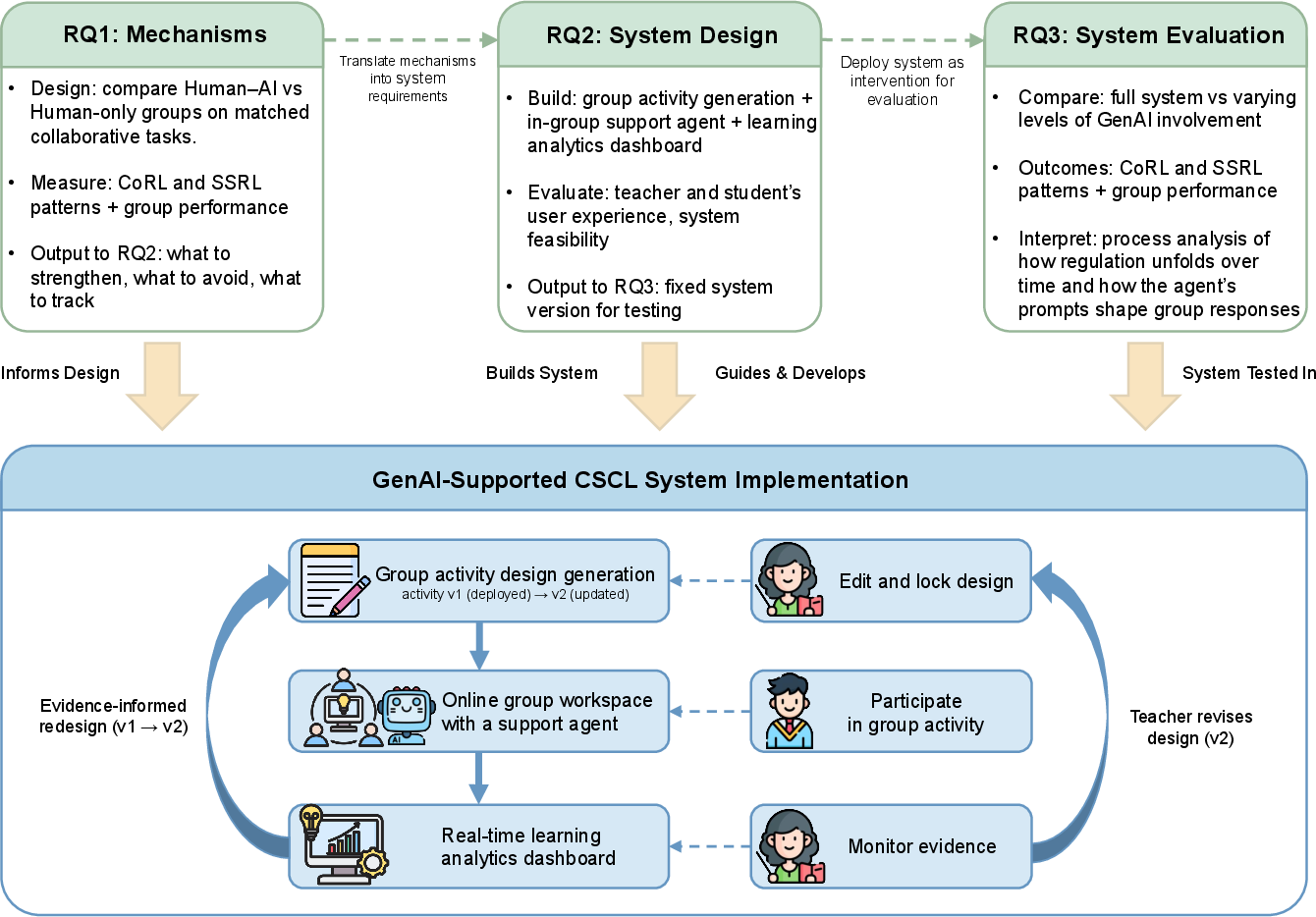
Figure 2: Mapping of research progression and the feedback-driven GenAI-CSCL system linking activity design, real-time support, and analytics.
For RQ3, a quasi-experimental protocol contrasts: (i) unstructured GenAI chatbot-only, (ii) bounded in-group support, and (iii) support plus analytics-driven teacher monitoring. The dependent variables are trace-based indicators of group regulation and collaborative efficacy, with process-level analyses contextualizing regulatory dynamics.
Implications and Theoretical Contributions
The project delivers an operationalized, teacher-in-the-loop, closed-loop GenAI system for CSCL, demonstrating that effective Human–AI collaboration does not arise from mere AI presence but requires GenAI to be bounded to scaffold, not supplant, distributed regulation. This evidence challenges assumptions that GenAI autonomy alone is sufficient for productive group work, instead underscoring the need for targeted prompts, real-time analytics, and human oversight.
From a theoretical perspective, the results highlight that GenAI’s integration tends to redistribute (rather than merely augment) regulatory agency, frequently steering groups toward more directive, co-regulation-heavy interactions. Group performance outcomes suggest that only select regulatory motifs—particularly obstacle-driven, plan–monitor patterns—are associated with high-performing Human–AI teams, sharpening the criteria for meaningful AI intervention design.
Furthermore, the system advances hybrid intelligence models in education by embedding trace-based analytics, teacher agency, and human-centered AI design into a coherent cycle. This integration is expected to offer a reference architecture for next-generation collaborative AI agents, and to inform policy regarding the role of GenAI in teacher-guided group work.
Limitations and Future Research Trajectories
While process-level distinctions are robust, the absence of gross performance differences across AI and non-AI-enabled groups raises questions about boundary conditions for capacity enhancement. Further studies can exploit multimodal analytics (e.g., physiological signals), more granular prompt design, and longitudinal interventions across domain and task complexity to better delineate when and for whom GenAI scaffolding delivers the greatest gains.
Additionally, further convergence between AI-mediated analytics and teacher dashboard interpretability is necessary to ensure teachers can both trust and act upon system recommendations with low friction.
Conclusion
This work brings clarity to the design and integration challenges of GenAI in collaborative learning settings. By constraining GenAI to process-oriented, regulation-targeted scaffolding and fusing analytics with teacher agency, the project offers both empirical and theoretical evidence on how, when, and why Human–AI collaboration reconfigures group regulation and learning trajectories. The research sets a foundation for future work on hybrid human-AI systems that do not displace, but rather amplify, the distributed regulation capacities at the heart of collaborative learning.