Fast Astronomical Transients in Archival Photographic Plates: Using optical aberrations as a tool for discerning real images, from plate artifacts
Abstract: The detection of fast astronomical transients in photographic plates from the Palomar sky surveys conducted in the 1950s, was subject to the criticism that such transients could be just the effect of otherwise unaccounted for plate artifacts. In this paper, we show that transient images exhibit the coma aberration pattern expected from off-axis point sources recorded through the telescope optics, a signature that plate artifacts cannot naturally reproduce. Although the data does not by themselves establish the physical origin of the light that generated the images, they lend support to hypotheses that do not rely on instrumental effects to explain transients.
Paper Prompts
Sign up for free to create and run prompts on this paper using GPT-5.
Top Community Prompts
Explain it Like I'm 14
What this paper is about (in simple terms)
This paper looks for very short flashes of light in old sky photos taken on glass plates (photographic plates). Some people worried that these “flashes” might not be real things in the sky at all, but just scratches, dust, or other defects on the plates. The author shows a way to tell real sky flashes from fake ones by using a special optical “fingerprint” called coma, which real star-like light sources make in certain telescopes, but plate defects do not.
The main questions the paper asks
- Are the short, one-time “blips” seen on old sky photos real flashes of light from the sky, or are they just plate defects?
- Can we use the shape of the image (specifically, the coma pattern) to tell real flashes apart from fakes?
How the researchers did it (methods explained simply)
The team used high-quality scans of many old photographic plates from the APPLAUSE archive. They focused on plates taken with a specific 0.6-meter telescope (the “Doppel-Reflektor”) known to produce a clear optical effect called coma for stars that are away from the center of the image.
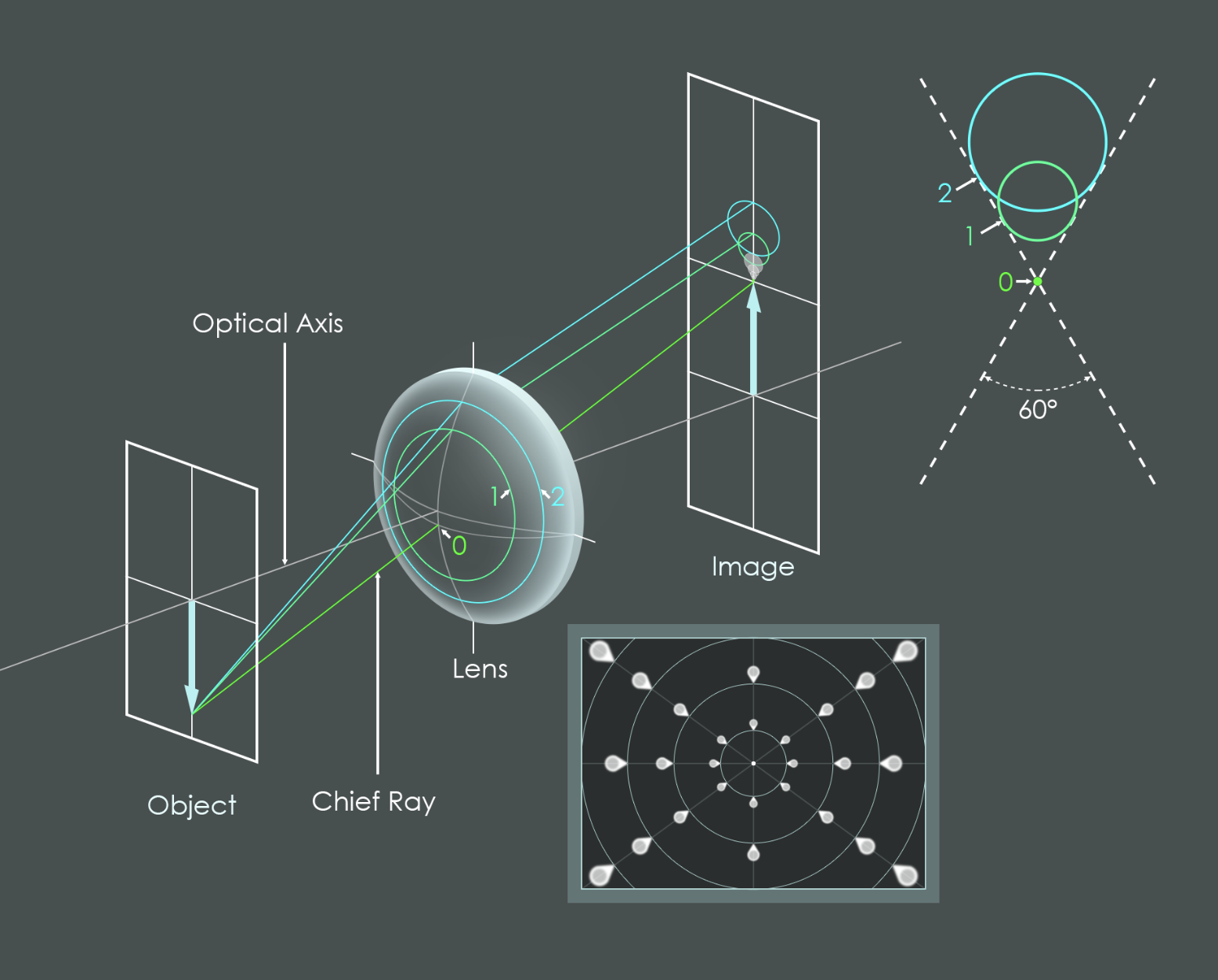
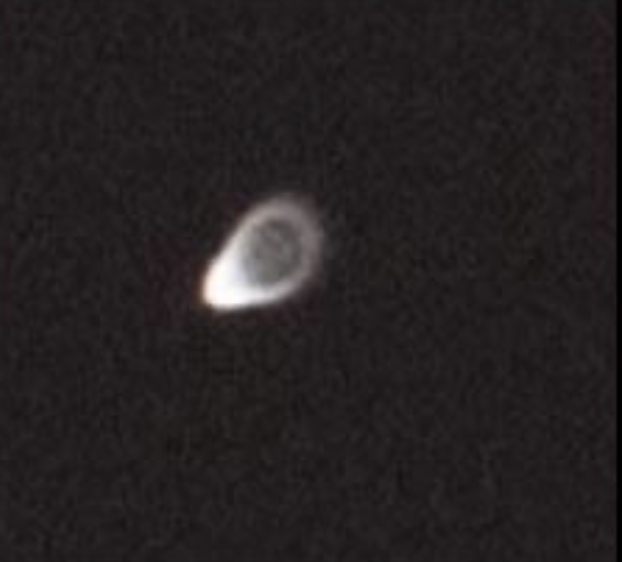
- What is “coma”? Imagine taking a photo of a bright point of light (like a star) with a simple lens. Near the center of the picture it looks round, but toward the edges it can stretch out into a tiny “comet” shape with a little tail. That tail points toward the center of the field. This pattern appears because of how light rays bend in the lens when the source is off-center. It’s a normal optical quirk in many telescopes.
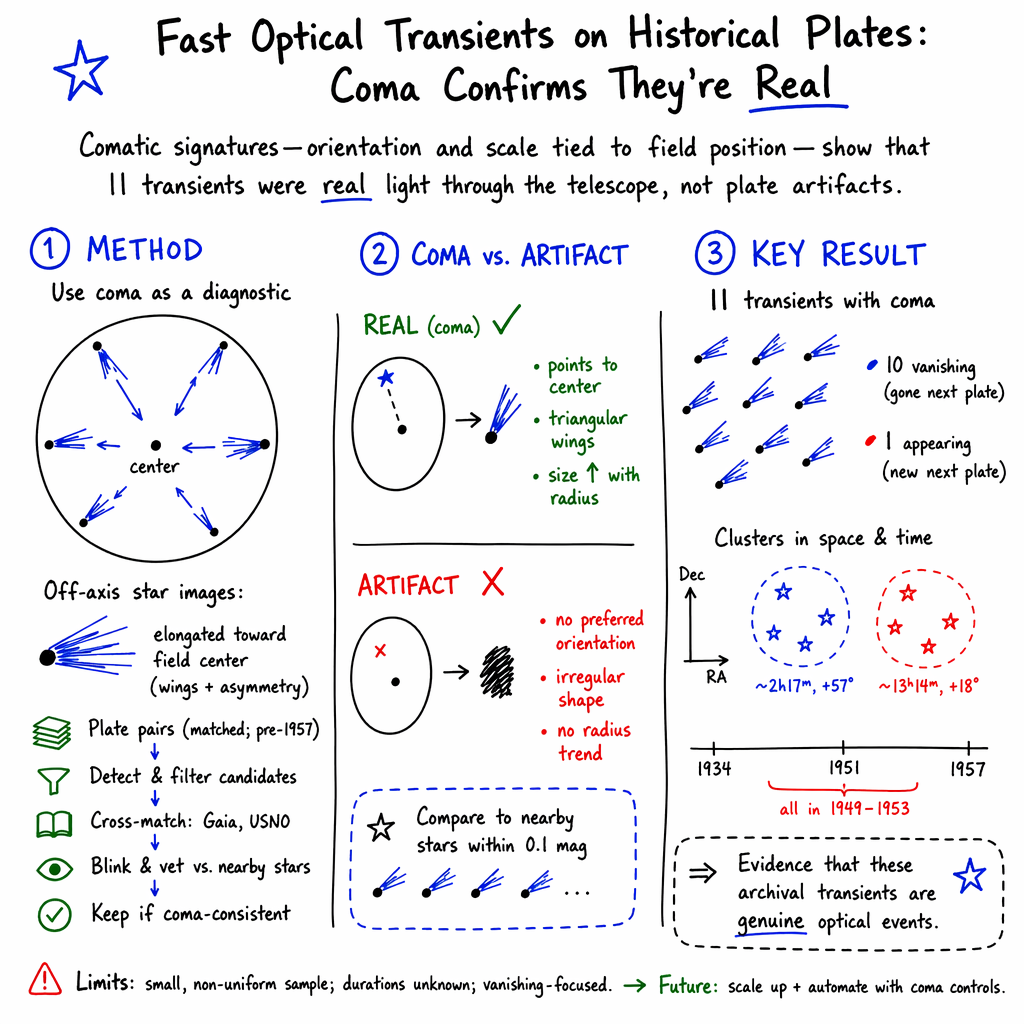
- Why does coma help? Real light from the sky goes through the telescope optics and picks up this comet-like shape in a predictable direction and size (depending on how far the point is from the center and how bright it is). A scratch, dust fleck, or chemical spot on the plate doesn’t magically line up with the field center or grow the same way. So coma acts like a “signature” of a true, off-center point of light.
What they looked at:
- Hundreds of pairs of plates taken minutes apart between 1934 and 1957 (with a cutoff at late 1957 to avoid flashes from modern space junk after Sputnik).
- They searched for “vanishing” objects (seen on one plate but missing on the paired plate) and sometimes also checked for “appearing” ones.
- Computer tools helped filter obvious defects, and then the team visually checked the most interesting candidates.
- They compared suspected flashes to nearby normal stars to see if the shape, direction, and strength of the coma matched what optics would predict.
- They also cross-checked star catalogs and modern survey images to rule out known stars, asteroids, and other simple explanations.
What they found and why it matters
The key result: They found 11 short-lived events whose images clearly show the coma signature. In other words, these were not random plate defects. They were caused by real light passing through the telescope optics.
Why that’s important:
- It gives strong, direct evidence that at least some fast “transients” (quick, one-time flashes) recorded on old plates are real events, not just photographic noise or damage.
- It offers a practical test—look for the coma pattern—to separate real flashes from fakes in old images.
Some interesting details:
- The events covered a range of brightness, including three very bright ones on March 4, 1951. Those brightest images even show “saturation” and “halation” (extra glow from the emulsion), which again happens only when real light hits the plate strongly.
- Several events were grouped in the same small areas of the sky and in short time spans, suggesting patterns—though the sample is still too small and uneven to claim firm statistics.
- Two nights showed sequences of flashes minutes apart in nearby spots, but they do not match asteroid behavior (no motion blur and wrong speeds).
- If some flashes were very brief (say, a second long) but recorded on long exposures (like 10–30 minutes), then their true peak brightness was much higher than it looks on the plate.
What this could mean in the bigger picture
This work strengthens the case that quick, rare flashes really happened and were captured on historical sky photos. The coma “fingerprint” gives researchers a simple tool to test candidates in other archives.
What might these flashes be?
- The paper rules out simple plate defects and argues against some other ideas (like certain types of reflections).
- It mentions possibilities that need more testing, such as brief Sunlight glints from spinning, mirror-like objects in space, or links to human-made events (some timing coincidences appear near periods of atmospheric nuclear tests, but that could be chance and needs better data).
- Astronomical causes (like unusual stellar or atmospheric phenomena) are also still on the table.
Bottom line: The study shows that a careful look at image shape (coma) can prove a flash came through the telescope and was not a plate flaw. That’s a big step forward. To truly understand how common these events are and what causes them, researchers now need larger, more uniform datasets and more automated versions of this shape-based test.
Knowledge Gaps
Knowledge gaps, limitations, and open questions
The paper makes a qualitative case that several transient images carry a coma signature indicative of true optical origin, but leaves multiple methodological, statistical, and physical questions unresolved. The following concrete gaps could guide future work:
- Sample size and selection
- The transient sample is small (11 events) and drawn from a non-uniform, heterogeneous archive, preventing robust rate estimates and statistical tests of clustering.
- Only the Hamburger Sternwarte Doppel-Reflektor 0.6-m plates are analyzed here; generalizability to other telescopes/epochs (and optics with different aberrations) is not demonstrated.
- The dataset is cut at Oct 1957 to avoid space-debris glints, yet non-astronomical glint hypotheses are still discussed; the pre-1957 glint source population (natural or anthropogenic) is not specified or constrained.
- Detection completeness and bias
- The search pipeline is optimized for vanishing transients; appearing events are only sporadically checked by running the algorithm backward, introducing unknown completeness and selection biases.
- No quantitative completeness function (as a function of magnitude, off-axis angle, plate quality, emulsion, and exposure time) is provided; the stated limit around is not derived from a controlled injection–recovery test.
- False-positive and false-negative rates are not measured; the impact of disabling computer-vision shape filters for coma-prone plates is not quantified.
- Coma-signature validation
- The coma-based vetting is qualitative. No explicit, quantitative coma metrics (e.g., vector alignment to plate center, wing asymmetry indices, tail length vs. field radius) or their uncertainties are defined or benchmarked.
- A control set of known plate artifacts is not analyzed to estimate how often artifacts can mimic coma-like alignment by chance, especially under low S/N, emulsion defects, or scanning artifacts.
- The telescope’s optical model (including field distortion, astigmatism, and guiding/tilt effects) is not used to predict coma morphology across the field and compare predicted vs. observed coma parameters for transients and field stars.
- Photometric and exposure-time uncertainties
- Transient durations are unknown; magnitudes assume full-exposure illumination and are therefore lower limits. No method is proposed to bound durations (e.g., through comparison of image sharpness vs. seeing, halation extent, or reciprocity failure signatures).
- Plate-by-plate photometric calibration (zero-points, color terms, emulsion sensitivity curves, reciprocity failure corrections) is not provided; magnitude uncertainties are not reported.
- The effect of saturation and halation on coma morphology (and on the proposed coma metrics) is not modeled, leaving potential misclassification risks for bright events.
- Astrometry and morphology
- Astrometric uncertainties for transients are not quantified; the positional relationship between the coma apex and catalog positions is described qualitatively but not measured statistically across plates.
- The center-of-plate determination and its uncertainty (critical for coma alignment tests) are not documented; the sensitivity of alignment tests to plate tilt, warping, and scanning distortions is not evaluated.
- Event characterization and differential diagnosis
- Non-asteroidal moving sources are only partially addressed. No systematic checks are made against meteor catalogs, aircraft/balloon logs, lightning/sprite records, or historical atmospheric optical phenomena.
- For hypothesized short flashes, a predictive model linking exposure fraction, image sharpness, coma wing visibility, and reciprocity failure is not developed or validated on synthetic injections.
- Internal reflections/ghosting are dismissed on the basis of plate pairs, but no optical path modeling or plate-pair correlation test is presented to rigorously exclude single-plate reflections or rare one-sided ghosts.
- Clustering and correlations
- The reported spatial and temporal clustering (two sky patches; 1949–1953) is not tested against the non-uniform survey window function; a null model and statistical significance assessment are absent.
- A transient rate (events per hour per square degree) and its uncertainty are not estimated, even as an upper/lower bound, limiting comparisons with other surveys or hypotheses.
- Suggested associations with nuclear tests are anecdotal; no formal correlation analysis with appropriate controls (e.g., permutation tests, base-rate normalization, multiple-testing correction) is performed.
- Reproducibility and automation
- The visual vetting criteria, thresholds, and inter-rater consistency are not documented; no blinded or cross-validated assessment is provided.
- An automated coma-based classifier is not implemented; a labeled training set (true transients vs. artifacts) is not released for community benchmarking.
- Full candidate lists, image cutouts, and per-plate metadata (seeing, transparency, guiding quality, sky brightness) are not shared, hindering independent verification.
- External validation and follow-up
- No cross-survey temporal coincidence checks (e.g., other observatories’ plates, logbooks, or radio records) are attempted for the same nights/fields to corroborate events.
- No attempt is made to model and test glint scenarios (natural or anthropogenic) that reproduce the observed spatial/temporal separations and brightnesses within pre-1957 constraints.
- Scope for future quantitative work
- A planned “forthcoming paper” will add data and quantification; however, specific analyses needed (e.g., injection–recovery for coma features, artifact-confusion matrix, optical simulations, and formal hypothesis tests) are not outlined with concrete protocols.
Practical Applications
Immediate Applications
The following applications can be deployed now by leveraging the paper’s coma-based vetting strategy, workflows, and data-processing adjustments.
- Coma-based vetting of archival transients (sector: astronomy/academia)
- What: Use field-dependent coma signatures (orientation toward plate center, wing asymmetry, coma growth with radius) to distinguish real point sources from plate artifacts in digitized photographic plates.
- How/Tools: SExtractor + Gaia/USNO crossmatch; ds9 blinking; relaxed Gaussian fitting bounds; a “coma QA checklist” for visual vetting derived from the paper’s criteria.
- Outputs: Cleaner candidate lists in projects like APPLAUSE, DASCH, and VASCO; reproducible vetting notes in transient reports.
- Assumptions/Dependencies: Plates from telescopes with measurable coma; accurate plate center metadata; sufficient scan resolution/dynamic range; local comparison stars.
- Pipeline add-on: “coma-aware” candidate filtering (sector: astronomy/software)
- What: Add lightweight rules to existing search pipelines that score each candidate on coma-alignment and wing visibility versus field radius and brightness.
- How/Tools: A Python module wrapping SExtractor outputs and simple shape metrics; integration with existing plateanalysis or astrometry.net workflows.
- Outputs: Ranked candidate lists, automatic rejection of artifact-like detections, per-candidate coma-consistency flags.
- Assumptions/Dependencies: Calibrated WCS; estimated field center; telescope-specific coma vs radius curve or empirical star-based calibration from each plate.
- Digitization and QA of plate archives (sector: archives/operations)
- What: Use coma-field consistency to identify scanner-induced issues, plate warps, or metadata errors; flag dust/hair/scratches masquerading as stars.
- How/Tools: Batch analysis of PSF orientation vs distance to plate center; compare to catalog positions (Gaia/USNO) to verify comatic apex alignment.
- Outputs: QC reports per plate; artifact masks; improved astrometric solutions; audit trail for plate condition and scanner performance.
- Assumptions/Dependencies: Stable scanning protocol; complete plate metadata (date, pointing, plate center); availability of crossmatch catalogs.
- Citizen science modules for transient vetting (sector: education/outreach)
- What: Train volunteers to identify coma-consistent sources vs artifacts using curated examples from the paper.
- How/Tools: Zooniverse-style tasks; short tutorials on coma morphology; side-by-side comparisons with nearby stars matched in brightness.
- Outputs: Scaled human-in-the-loop vetting capacity; labeled datasets for later ML training.
- Assumptions/Dependencies: Clear labeling guidelines; balanced control samples; platform moderation.
- Astro image forensics in publications and data releases (sector: academia/publishing)
- What: Add a quick “coma-consistency” check to confirm that alleged point sources are physically imaged through the optics (not emulsion/sensor blemishes).
- How/Tools: Simple regression of PSF orientation vs plate radius; check that candidate apex aligns with local PSFs and toward the field center.
- Outputs: Reproducibility checkboxes in methods; reduced false positives in transient literature.
- Assumptions/Dependencies: Presence of reference stars near candidates; documentation of instrument optics.
- Amateur and small-observatory workflows (sector: amateur astronomy/software)
- What: Scripts/plugins for PixInsight/AstroImageJ to overlay field-center vectors, compare local star PSFs, and flag dust/hot-pixel artifacts vs real point sources or short flashes.
- How/Tools: Plate-solved images; local PSF sampling; rule-based scoring; optional manual review panels.
- Outputs: Cleaner stacked images; more reliable transient claims; faster artifact triage.
- Assumptions/Dependencies: Adequate field of view to sample PSF variation; modest optical aberration.
- Post-1957 re-analysis for space-debris glints (sector: SSA/space environment)
- What: Apply coma-based authenticity checks while mining plate archives after the Sputnik era for short glints potentially from tumbling objects.
- How/Tools: Same pipeline with added TLE cross-checks and expected sky-motion constraints.
- Outputs: Historical constraints on debris/glint statistics; candidate object tracks across plates.
- Assumptions/Dependencies: Accurate observation times; sky coverage; cataloged satellites/TLEs for disambiguation.
- Teaching labs on optical aberrations and time-domain methods (sector: education)
- What: Undergraduate labs demonstrating coma, reciprocity failure, saturation/halation, and seeing vs exposure-time effects using real plate cutouts.
- How/Tools: Prepared Jupyter notebooks; open plate cutouts and reference star sets.
- Outputs: Hands-on training in PSF physics and archival time-domain analysis.
- Assumptions/Dependencies: Access to plate subsets and catalogs; minimal coding environment.
Long-Term Applications
The following require further research, scaling, or development before broad deployment.
- ML classifiers for fast transients using PSF/aberration signatures (sector: astronomy/software)
- What: Train CNNs or hybrid models on labeled comatic PSFs and artifacts to automate candidate vetting across archives.
- How/Tools: Labeled datasets from citizen science + expert curation; simulation of telescope-specific coma; model uncertainty calibration.
- Outputs: Cross-archive, instrument-agnostic classifiers; reproducible metrics; reduced human load.
- Assumptions/Dependencies: Diverse, balanced training sets; robust domain adaptation across telescopes and emulsions; careful bias control.
- Global atlas of fast archival transients (sector: astronomy/data infrastructure)
- What: Standardize coma-aware vetting across APPLAUSE, DASCH, POSS, and other plate repositories to produce a public, queryable catalog of vetted fast transients.
- How/Tools: Common metadata schema; reproducible pipelines; DOI’d data products; links to modern surveys.
- Outputs: Event rates, clustering tests, and constraints on astrophysical/non-astronomical origins; a foundation for new time-domain studies.
- Assumptions/Dependencies: Institutional agreements; compute/storage resources; uniform reprocessing capability.
- Space-domain awareness: dedicated glint-monitoring systems (sector: SSA/defense/space industry)
- What: Design wide-field, high-frame-rate optical systems and software that exploit known PSF/aberration fields to authenticate short flashes and characterize tumbling reflective objects.
- How/Tools: Optics with calibrated field-dependent PSFs; real-time coma-constrained classifiers; data fusion with radar/TLEs.
- Outputs: Improved debris characterization and glint statistics; early detection of anomalous reflective events.
- Assumptions/Dependencies: Sensor/network deployment; cross-agency data sharing; environmental modeling of specular reflections.
- Camera/lens fingerprinting via aberration-field consistency (sector: digital forensics/cybersecurity)
- What: Extend field-dependent aberration checks to non-astronomical imagery to detect compositing or object insertion inconsistent with the lens PSF field.
- How/Tools: Joint modeling of aberrations (coma, astigmatism, distortion) across the field; forensic toolkits that compare claimed object PSFs to local context.
- Outputs: New authenticity signals complementing PRNU and metadata for court-admissible analyses.
- Assumptions/Dependencies: Controlled acquisition or strong scene priors; calibrated lens databases; research to handle zoom/focus variability.
- PSF “watermarking” in survey instrumentation (sector: instrumentation/observatory ops)
- What: Intentionally encode weak, predictable PSF anisotropies or phase-mask features as a watermark to help disentangle real sky photons from detector/processing artifacts in ultra-low false-positive surveys.
- How/Tools: Optical design studies; end-to-end simulations; impact assessments on photometry/shape measurements.
- Outputs: Lower false-positive rates in extreme time-domain/alerting contexts; on-sensor authenticity cues.
- Assumptions/Dependencies: Survey science trade-offs; community acceptance; calibration overhead.
- Translational imaging: microscopy and biomedical scanners (sector: healthcare/biotech imaging)
- What: Use aberration-consistency checks to distinguish true biological emitters from slide/glass/optical-path contaminants in fluorescence or brightfield scanners.
- How/Tools: PSF field mapping for microscopes; ImageJ/Fiji plugins; annotated training sets spanning objectives and media.
- Outputs: Fewer false positives in cell counting and dot-detection assays; improved QA in high-throughput pathology.
- Assumptions/Dependencies: Stable optics; ground-truth datasets; adaptation to refractive-index variations and 3D specimens.
- Standards and policy for plate digitization and archival science (sector: policy/research infrastructure)
- What: Establish best practices that require recording plate-center metadata, WCS, scan specs, and coma-field diagnostics; encourage open sharing of vetted transient lists and vetting criteria.
- How/Tools: Community working groups; white papers; FAIR-compliant data standards; funding calls tied to compliance.
- Outputs: Higher reproducibility; easier cross-archive integration; preservation of heritage science value.
- Assumptions/Dependencies: Institutional buy-in; minimal burden on scanning facilities; sustained funding.
- Multi-disciplinary inquiry into correlations with geophysical/anthropogenic events (sector: academia/policy)
- What: Systematic, bias-controlled testing of correlations (e.g., nuclear tests, atmospheric phenomena) using expanded, uniformly processed datasets.
- How/Tools: Pre-registered statistical analyses; confounder modeling; integration with atmospheric, ionospheric, and historical records.
- Outputs: Evidence-based assessment of non-astronomical hypotheses; guidelines to avoid post-hoc pattern-finding.
- Assumptions/Dependencies: Larger, homogeneous samples; transparent methodology; access to historical ancillary data.
Notes on feasibility:
- The coma-based approach assumes the presence of measurable field-dependent PSF asymmetry; it is most effective for telescopes/plates with noticeable coma and sufficient nearby reference stars.
- Robust automation requires labeled control samples and careful handling of confounders (seeing, saturation, reciprocity failure, scanning artifacts).
- For modern, well-corrected optics (e.g., Schmidt, LSST), analogous PSF-model consistency tests can substitute for coma per se, but will need precise PSF modeling rather than simple heuristic checks.
Glossary
- Annular bin: A radial indexing scheme used by APPLAUSE to encode distance from the plate center. "Annular bin is an APPLAUSE concept to codify distance to center of plate: 1 at center, 9 at the edge."
- APPLAUSE: Archives of Photographic Plates for Astronomical Use; a digitized repository of historic astronomical plates. "we resort to data provided by the Archives of Photographic PLates for Astronomical USE (APPLAUSE)"
- Appearing transient: A transient source that is present on a later plate but absent on the earlier one. "It cannot detect {\it appearing} transients, that is, objects that show up on a plate but do not appear on the {\it previous} plate."
- Atmospheric seeing: Image blurring and motion caused by atmospheric turbulence. "atmospheric-induced seeing falls very quickly with frequency"
- Blinking (plates): Rapidly alternating two aligned images to visually detect changes. "we actually blinked (with {\it ds9}, \citealt{SAOImage}) the entire plate pair"
- Chief ray: The principal ray that passes through the system and defines directionality in aberrations. "as one moves away from the chief ray towards the plate edge."
- Coma (optical aberration): An off-axis aberration producing comet-like, asymmetric star images with a tail. "A common type of aberration in simple telescopes is {\it coma}"
- Comatic image: An image distorted by coma, showing a triangular core with wing-like structures. "comatic images must appear aligned with the direction that points to the center of the plates;"
- Defocussed image: A blurred image produced when focus is not at the focal surface; in this context, the blurred circle of the pupil. "These circles are essentially defocussed images of the point source, that is, they are images of the lens {\it pupil}."
- Emulsion (photographic): The light-sensitive coating on a photographic plate that records images. "Particles firmly attached, or even embedded in the emulsion layer"
- Emulsion reciprocity failure: The departure from linear response of photographic emulsion at very short or long exposures. "possible emulsion reciprocity failure on faint sources"
- Field-Of-View (FOV): The angular extent of sky covered by an exposure. "the Field-Of-View (FOV) overlap"
- Focal surface: The surface where an optical system forms images across the field (not necessarily planar). "elongated light distribution at the focal surface."
- Gaia catalog: ESA’s high-precision astrometric catalog; here, Data Release 3 used for cross-matching. "(the Gaia catalog, \citealt{Gaia_DR3}, is already used by the pipeline search algorithm)"
- Ghosting: Spurious images formed by reflections within an optical system. "Ghosting and internal reflections on the optics can be dismissed"
- Halation: A halo-like glow around bright images due to light backscatter within the emulsion. "and {\it halation}, the result of light backscatter in the emulsion layer."
- Hamburger Sternwarte Doppel-Reflektor: A historical 0.6-m parabolic mirror telescope whose plates were analyzed. "Data from the {\it Hamburger Sternwarte Doppel-Reflektor} 0.6-m parabolic mirror telescope"
- Internal reflections: Light reflecting between optical surfaces, creating artifacts in images. "Ghosting and internal reflections on the optics can be dismissed"
- Minor Planet Center: The IAU center that provides services and data on asteroids and comets. "This research has made use of data and/or services provided by the International Astronomical Union's Minor Planet Center"
- Off-axis point source: A point source located away from the optical axis, leading to asymmetric aberrations like coma. "off-axis point sources recorded through the telescope optics"
- Optical aberrations: Deviations from ideal imaging that distort point-source images (e.g., coma). "images it produces are remarkably free of optical aberrations"
- Optical axis: The central symmetry line of an optical system. "It is caused by light rays coming into the telescope at an angle with the optical axis"
- Optical train: The sequence of optical elements through which light travels in an instrument. "light that actually traversed the optical train of the telescope"
- Palomar Observatory Sky Survey (POSS/POSS-II): Large photographic surveys of the sky used for comparison. "Palomar Observatory Sky Surveys (POSS, \citealt{DPOSS-II})"
- Parabolic mirror telescope: A reflector using a parabolic primary mirror to focus light. "0.6-m parabolic mirror telescope"
- Photographic density: A measure of plate darkness after development, often displayed to emphasize faint structure. "Negative (photographic density) scale is used to highlight faint detail."
- Photographic plate artifact: A non-astronomical mark or defect on a plate arising from dust, scratches, aging, etc. "Plate artifacts result from a large number of causes."
- Pupil (optics): The effective aperture of an optical system; its image governs defocus patterns. "they are images of the lens {\it pupil}."
- SAOImage DS9: A widely used astronomical image viewer for FITS data and blinking. "with {\it ds9}, \citealt{SAOImage}"
- Saturation (emulsion): The regime where emulsion response ceases to be linear due to excessive exposure. "evidence of {\it saturation} of the emulsion response to light"
- Schmidt design (Schmidt telescope): A wide-field telescope design with a spherical primary and corrector, minimizing aberrations. "Being of Schmidt design, the images it produces are remarkably free of optical aberrations"
- SExtractor: Software for automated source detection and photometric measurements in images. "with software such as SExtractor \citep{1996A&AS..117..393B}."
- Signal-to-noise ratio (SNR): The ratio of signal strength to noise, determining detectability and measurement precision. "a range of signal-to-noise levels"
- Sunlight glints: Brief reflections of sunlight from tumbling, mirror-like objects in space producing transient flashes. "may be Sunlight glints generated by tumbling, mirror-like objects in space"
- Universal Time (UT): A standard astronomical time reference used to timestamp observations. "UT at mid-exposure."
- USNO catalog: The US Naval Observatory’s astrometric catalog used for cross-matching sources. "cross-checking against the USNO catalog \citep{USNO}"
- Vanishing transient: A transient seen on one plate that is absent on a subsequent plate. "designed around the concept of {\it vanishing} transients."
Collections
Sign up for free to add this paper to one or more collections.

