- The paper introduces a nonlinear Laplacian loss that enhances structure preservation in radiance field reconstruction.
- It employs Laplacian-based weighting with nonlinear response mappings, achieving significant PSNR and SSIM improvements on standard datasets.
- The method is pipeline-agnostic, seamlessly integrating with existing Gaussian Splatting variants for real-time 3D content generation.
Laplacian-Enhanced Gaussian Splatting with Nonlinear Weighted Loss: An Authoritative Synthesis
Motivation and Context
3D Gaussian Splatting (3DGS) has become a prominent explicit representation for radiance field reconstruction and real-time view synthesis. Its core photometric loss, however, treats all image regions equally, which limits fidelity for structure-rich regions such as contours and high-frequency details. Prior work, notably Edge-Guided Gaussian Splatting (EGGS), introduced gradient-based, edge-aware weighting but relied on first-order cues and linear mapping, insufficient for capturing more complex structural variations (e.g., corners, thin contours). LEGS addresses these limitations by introducing second-order Laplacian-based structural guidance, mapped via nonlinear response functions, into the loss without altering the 3DGS pipeline.
Technical Contributions
LEGS advances the methodology by constructing a Laplacian-driven, nonlinearly weighted reconstruction loss. The Laplacian, a second-order differential operator, serves as a compact structural prior, emphasizing regions of high curvature and discontinuity, thereby guiding the optimization toward sharper, more accurate reconstructions. The normalized Laplacian response is further transformed through nonlinear mappings (C1–C5), providing precise control over the influence from weak to strong structural features.
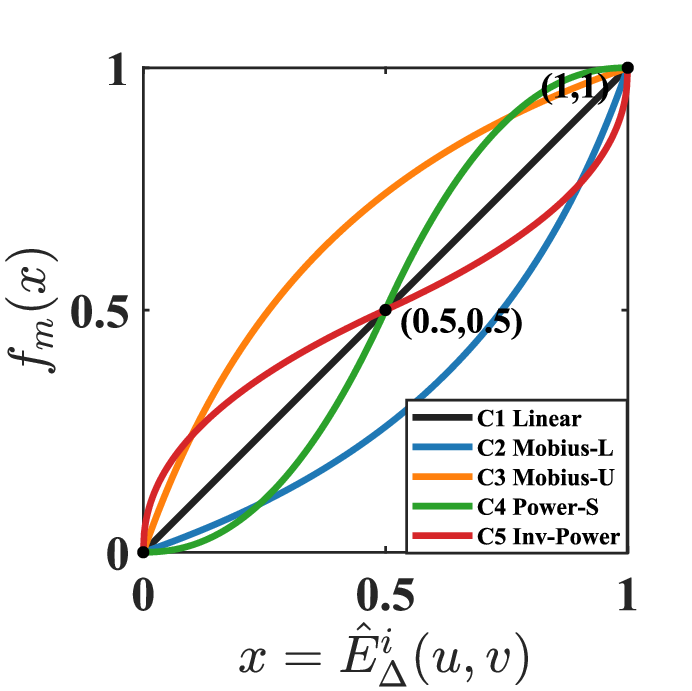
Figure 1: Nonlinear response-to-weight mapping functions C1–C5, illustrating the flexibility in targeting weak, medium, and strong Laplacian responses for reweighting.
Methodology
The LEGS framework operates as follows: Laplacian magnitude maps are precomputed from supervised views, normalized, and passed through response-to-weight mappings to produce pixel-wise loss weights. These weights amplify structurally salient areas in the pixel-level photometric term, while the original 3DGS renderer and explicit Gaussian representation remain unchanged. The photometric loss is composed as a weighted L1 norm concatenated with SSIM-driven regularization, parameterized by λ. The structural enhancement strength is governed by β, which tunes the emphasis afforded by Laplacian response.
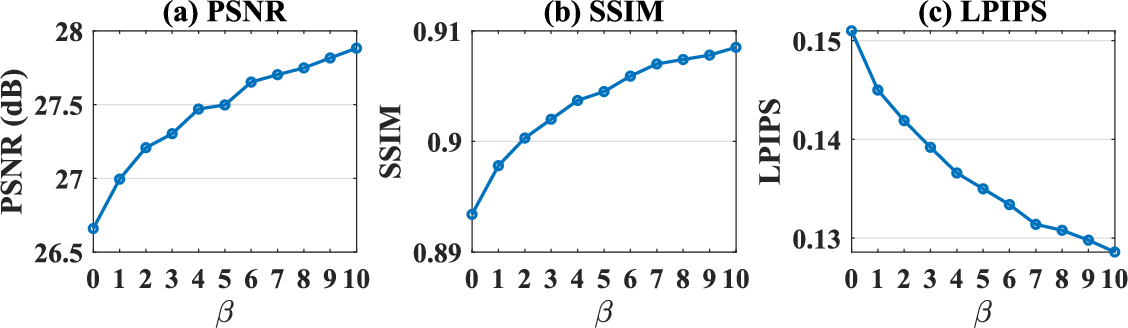
Figure 2: Effect of the weighting parameter β on T{additional_guidance}T, evidencing monotonic PSNR/SSIM improvement with increased Laplacian emphasis.
Empirical Results
Quantitative evaluation on Tanks-and-Temples and Mip-NeRF360 datasets demonstrates that LEGS achieves up to 1.68 dB PSNR gain over vanilla 3DGS, surpasses EGGS by a margin of 0.52 dB, and exceeds linear Laplacian weighting by 0.25 dB. Application to FastGS and FasterGS results in maximal improvements of 1.69 dB, validating LEGS as a general-purpose, pipeline-agnostic loss extension.
Nonlinear mappings further optimize performance. Among the mappings C1–C5, C3 yielded the best results on structure-preservation metrics, demonstrating that nonlinear response shaping outperforms linear weighting in allocating optimization priority to critical regions.
Practical and Theoretical Implications
LEGS offers a lightweight, plug-in loss formulation for enhancing structural awareness in explicit radiance field reconstructions. The independence from the underlying rendering pipeline facilitates integration with diverse Gaussian Splatting variants (e.g., FastGS, FasterGS), supporting AR/VR, immersive visualization, and real-time 3D content generation scenarios where structural fidelity is paramount.
Theoretically, the adoption of Laplacian-based guidance aligns loss-driven optimization with perceptually relevant second-order image statistics, and the pre-normalized, nonlinear weighting accommodates inter-view structural response heterogeneity. This approach could catalyze further research in adaptive structural priors, curvature-based loss modeling, and hybrid multi-modal guidance schemes (e.g., combining depth, saliency).
Future Directions
Potential extensions of the LEGS methodology include adaptive, data-driven weighting functions, representation-aware structural regularization, and integration with structured Gaussian frameworks (e.g., StruGS [StruGS], Opt3DGS [Opt3DGS]) for improved stability and scene consistency. Research could also explore Laplacian-enhanced densification strategies and real-time pipeline deployment under computational constraints.
Conclusion
LEGS establishes a robust, generalizable paradigm for structure-aware radiance field optimization by embedding nonlinear Laplacian loss guidance directly into the 3DGS framework. The empirical gains across datasets and implementation variants underscore the value of second-order, nonlinearly weighted supervision in advancing fidelity for novel view synthesis. The modularity and compatibility suggest wide applicability, with prospective impact on both algorithmic development and practical deployment in high-fidelity, real-time 3D applications (2606.07932).