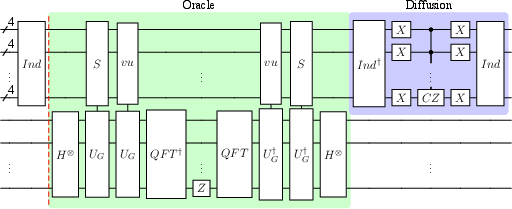
- The paper introduces a quantum divide-and-conquer framework for TSP that corrects previous enumeration errors and achieves a query complexity of O*(1.865666^n).
- It employs ordered set partition state preparation combined with polynomial-depth oracle queries to efficiently assemble and evaluate Hamiltonian cycles.
- Experimental simulations on small TSP instances demonstrate high accuracy, indicating a practical pathway toward quantum speedups in NP-hard problems.
Quantum Divide-and-Conquer for TSP: Algorithmic, Complexity, and Implementational Advances
Introduction and Context
The traveling salesman problem (TSP) is a central combinatorial optimization task with strong relevance to algorithm design, complexity theory, and quantum computing. Dynamic programming, notably the Held-Karp algorithm with complexity O(n22n), sets the classical gold standard for exact TSP solutions via exponential-time dynamic programming. Quantum algorithms, prominently those employing Grover search and quantum minimum finding, have held promise for surpassing these classical exponential regimes by leveraging coherent quantum walks, amplitude amplification, and hybrid recursive schemes.
This paper presents a critical reassessment and significant advance over prior quantum algorithms for exponential-time dynamic programming on TSP, specifically those based on the approach of Ambainis et al. ("Quantum speedups for exponential-time dynamic programming algorithms" [ambainis2019quantum]). The authors rigorously identify an error in the solution space enumeration of the previous quantum TSP approach, formally prove a corrected exponent, and construct a quantum divide-and-conquer (QDC) framework using optimal ordered set partitioning. The result is a TSP quantum algorithm with query complexity O∗(1.865666…n), a true exponential improvement over the classical Held-Karp bound of O∗(2n).
Quantum Divide-and-Conquer: Framework and Correctness
The QDC framework generalizes both Held-Karp's recursive dynamic programming and quantum search-based global minimum finding as parameter extremes on a spectrum. The hybrid algorithms interpolate between these extremes via parameterizing the number k of subsets in which the node set is partitioned. Notably:
Mathematical Correction: The authors expose a miscount in the recursive solution space in prior work [ambainis2019quantum]. Specifically, the previous approach underestimated the number of valid recursive branches when using higher-order subset schemes (e.g., O∗(1.865666…n)0). The corrected enumeration doubles certain factors, resulting in a higher exponent and, crucially, demonstrates that the claimed previous bound (O∗(1.865666…n)1) is unattainable—the actual complexity with correct accounting is O∗(1.865666…n)2, which fails to beat the O∗(1.865666…n)3 Held-Karp baseline.
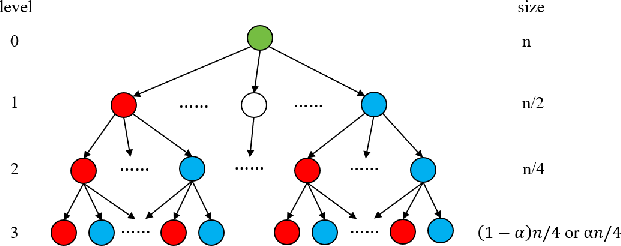
Figure 2: Recursive tree structure of the quantum DP TSP algorithm; each layer encodes increasingly refined set partitions.
Ordered Set Partition State Preparation
A core technical contribution is an efficient and scalable quantum circuit to prepare the uniform superposition (the "set partition state") over all ordered O∗(1.865666…n)4-partitions with labeled origins/ends. The method extends deterministic Dicke state preparation to the full encoding of subset labels, allowing for:
- Polynomial (O∗(1.865666…n)5 gates, O∗(1.865666…n)6 depth) resource requirements for state preparation, even without ancillas.
- Efficient retrieval of classical DP-computed shortest-path values via quantum oracles, structured to exploit the partition labels and origins/ends.
- Bypassing the need for unwieldy oracles that would otherwise require exponential classical preprocessing or complicated bijections from indices to combinatorial structures.
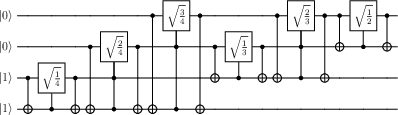
Figure 3: Quantum circuit for preparing the Dicke state O∗(1.865666…n)7, a building block for set partition encodings.
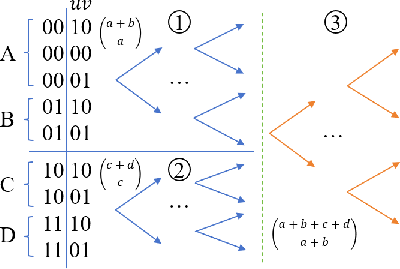
Figure 4: Binary tree produced in preparing an ordered O∗(1.865666…n)8-partition state; each path encodes a valid assignment of vertices to subsets with origin/end labeling.
The explicit encoding of combinatorial structure into the quantum state is essential to prevent the classical preprocessing required for quantum RAM (QRAM) based oracles from overwhelming the overall time complexity, a limitation of trivial O∗(1.865666…n)9-gate-based uniform superpositions.
Oracle Implementation and Query Complexity
Sparse Boolean Memory (SBM): Oracle queries utilize a classical table of shortest-path weights (precomputed via DP for subsets up to O∗(2n)0 nodes), with SBM providing the mechanism to query combinatorially-structured functions in depth O∗(2n)1. Although the oracle as a whole requires exponential qubit and gate resources due to the complexity of the SBM, the per-query circuit depth is polynomial, and the overall query complexity in the optimal regime dominated by quantum search is strictly O∗(2n)2 for O∗(2n)3, O∗(2n)4.
Query Complexity Summary: The table below summarizes key numerical results; the bold line highlights the new result that achieves the true quantum exponential gain.
| Algorithm |
Query Complexity |
Base O∗(2n)5 |
| Held-Karp (classical) |
O∗(2n)6 |
O∗(2n)7 |
| Ambainis et al. (claimed) |
O∗(2n)8 |
O∗(2n)9 |
| Ambainis et al. (corrected) |
k0 |
k1 |
| This work (k2 optimal) |
k3 |
1.865666...n |
Tightness of the Tradeoff: As k4 increases, classical precomputation cost falls, but the quantum search space grows combinatorially. Beyond k5, the advantage is lost to exponential partition proliferation; k6 is nearly as performant numerically, potentially preferable for small k7.
Experimental Demonstration
The authors validate the implementability of the QDC TSP algorithm via IBM Qiskit simulation experiments on small k8. Circuit-level simulations demonstrate high accuracy in recovering optimal TSP tours, using the described set partition state encodings, and the feasibility of marking optimal solutions via thresholded cost oracles employing QFT-based arithmetic.
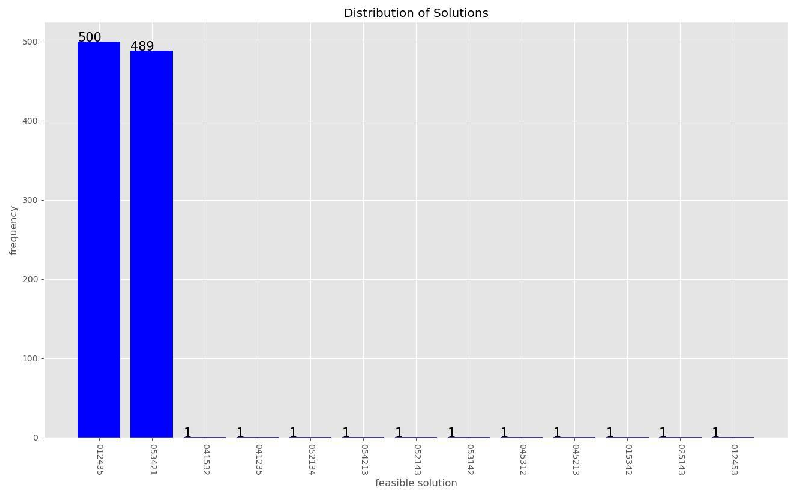
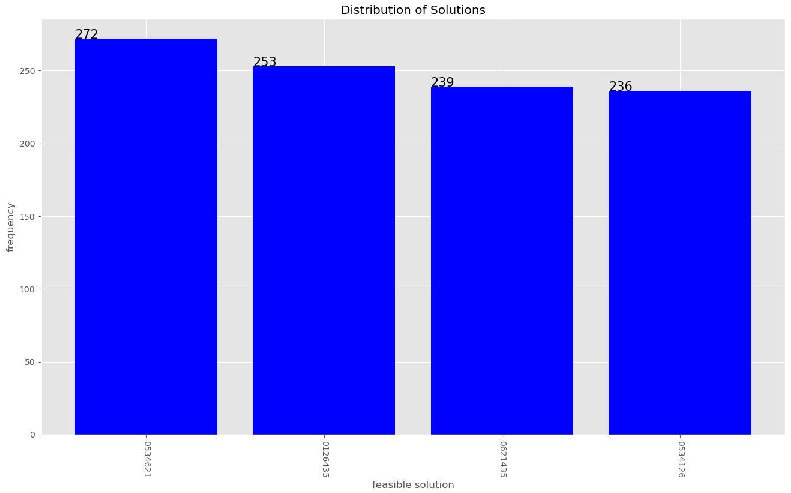
Figure 5: Simulation results for a 6-node graph using the ordered k9-partition variant of the quantum TSP solver, showing frequency of optimal tour recovery.
Practical and Theoretical Implications
Extending Quantum Speedups for Combinatorial Search: The QDC approach provides a principled template for attacking other exponential-time combinatorial problems by tightly integrating classical recursion/decomposition with structured quantum state preparation and search.
Necessity of Structured State Preparation: The explicit analysis here illustrates that quantum advantage for such problems is fundamentally nontrivial: achieving true time complexity improvement necessitates both quadratic search speedup and careful exploitation of structured state preparation; otherwise, the classical overhead can negate asymptotic quantum advantages.
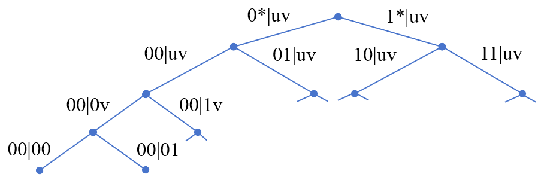
Figure 6: Address transmission schematic for a single vertex in the set partition encoding, demonstrating how subset assignment and origin/end markers are encoded and used for oracle data access.
Conclusion
This work firmly establishes a new quantum query complexity bound for TSP, identifies and formally corrects prior enumeration errors, and presents a highly implementable framework leveraging divide-and-conquer, combinatorial state encoding, and polynomial-depth oracles. It moves the field toward genuinely practical quantum exponential-time algorithms, revealing that the path to quantum advantage in combinatorial optimization is subtler than simply invoking quantum unstructured search. It highlights structured state preparation as central to quantum algorithmic design for NP-hard problems and sets a foundation for exploring similar techniques in scheduling, graph problems, and beyond.
While exponential quantum resource requirements remain a practical barrier for large k0, the principles and constructions here offer clear direction for future algorithmic and hardware developments. Possible avenues include exploring hybrid classical-quantum recursion strategies for other problems, optimizing state preparation for more general combinatorial objects, and further reducing circuit depth and ancillary overhead via advanced compilation or hardware-aware methods.