- The paper presents a NISQ-aware hybrid framework that decomposes large TSP problems into quantum-friendly subproblems using clustering and a Grover-enhanced quantum genetic algorithm.
- The paper integrates periodic amplitude amplification within the QGA to bias the sampling towards high-quality solutions, accelerating convergence without increasing circuit depth.
- The paper demonstrates robust scalability and noise resilience by achieving consistent performance improvements over classical benchmarks on diverse TSP instances.
NISQ-Aware Hybrid Quantum–Classical Optimization for Scalable Combinatorial Problems
Framework Design Principles
This paper presents a NISQ-aware hybrid quantum–classical optimization framework for scalable combinatorial optimization, specifically targeting problems like the Traveling Salesman Problem (TSP). The framework is grounded in a hierarchical decomposition of large-scale instances via clustering, partitioning the problem into qubit-compatible subproblems within the constraints of NISQ devices. Each subproblem is optimized using a Grover-enhanced Quantum Genetic Algorithm (QGA), which operates on probabilistic solution distributions. Controlled quantum amplitude amplification is periodically embedded to bias the sampling distribution towards higher quality solutions, accelerating convergence without increasing circuit depth. Local solutions are stitched into a global result through classical refinement, including boundary fusion and 2-opt optimization.
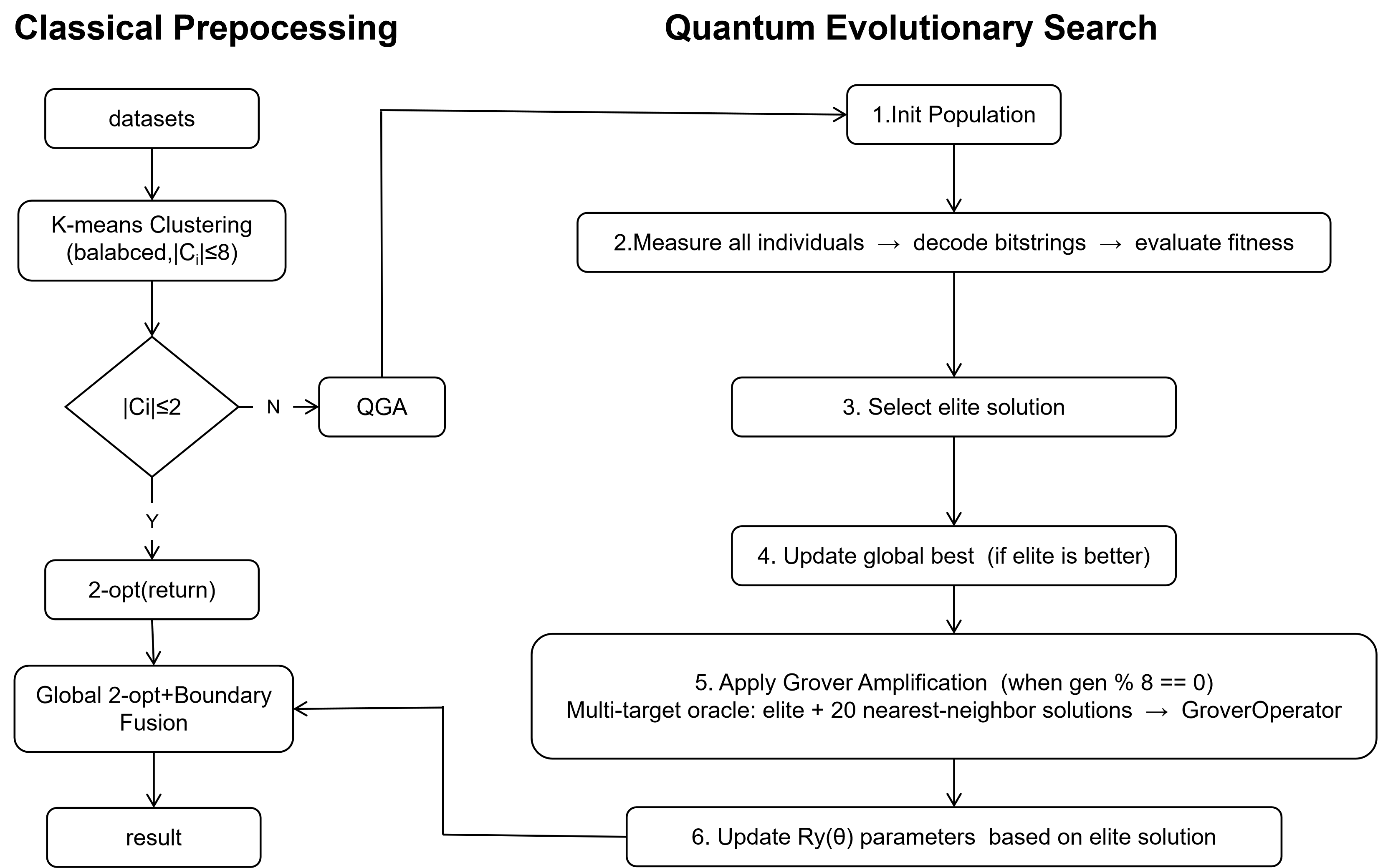
Figure 1: Hybrid Quantum-Classical Workflow detailing decomposition, quantum evolutionary search, and global refinement.
Resource-bounded scalability is achieved through structural decomposition, decoupling computational complexity from global problem size. The quantum resource requirement per subproblem remains constant, with scalability realized by increasing the number of bounded-size subproblems. This transforms intractable combinatorial complexity into tractable, parallelizable local optimization tasks.
Quantum Genetic Algorithm and Amplitude Amplification
The QGA operates by representing candidate solutions as parameterized quantum states, where amplitudes encode distributions over feasible routes. The evolutionary search proceeds through iterative state updates via rotation gates, measurement-driven sampling, and classical fitness evaluation. High-quality solutions guide update parameters, reshaping the probability distribution. Compared to classical evolutionary algorithms, this paradigm allows compact, globally-coupled distribution updates, enhancing exploration and maintaining diversity.
Periodic amplitude amplification via Grover’s algorithm amplifies the probability mass of marked high-quality solutions within the quantum state, improving convergence without incurring prohibitive circuit depth. The amplification circuit is applied locally and periodically, marking multiple elite solutions to prevent premature convergence and broaden the attraction basin.
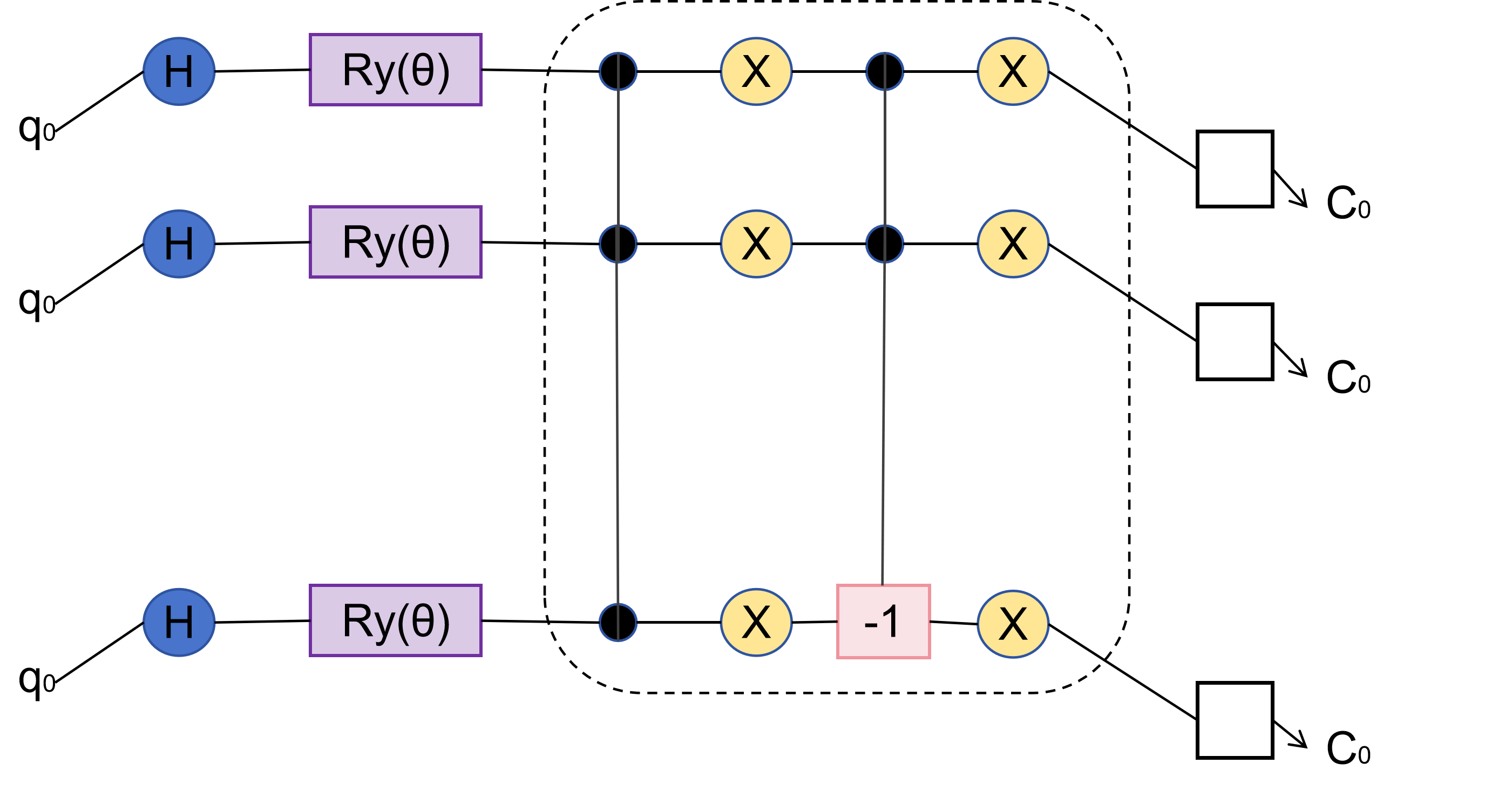
Figure 2: Localized Grover Amplitude Amplification Circuit embedding multiple marked states and periodic amplification within QGA loop.
The interplay between QGA (exploration and diversity) and amplitude amplification (convergence control) is empirically shown to be synergistic; mechanism-level ablations demonstrate consistent degradation when either is removed, especially on larger problem instances.
Comprehensive experiments are conducted on TSPLIB benchmarks and synthetic datasets (10–100 cities), comparing the framework against ACO, GA, Greedy, and QACO baselines. The hybrid framework consistently yields the best or near-best path length across all scales, with performance advantages increasing as problem size grows. For large TSP instances (e.g., St-70, Bays-29), the framework outperforms classical and quantum-inspired heuristics, with substantial improvements both in mean path length and stability. Notably, classical baselines degrade rapidly as search space expands, while the proposed method retains stable performance.
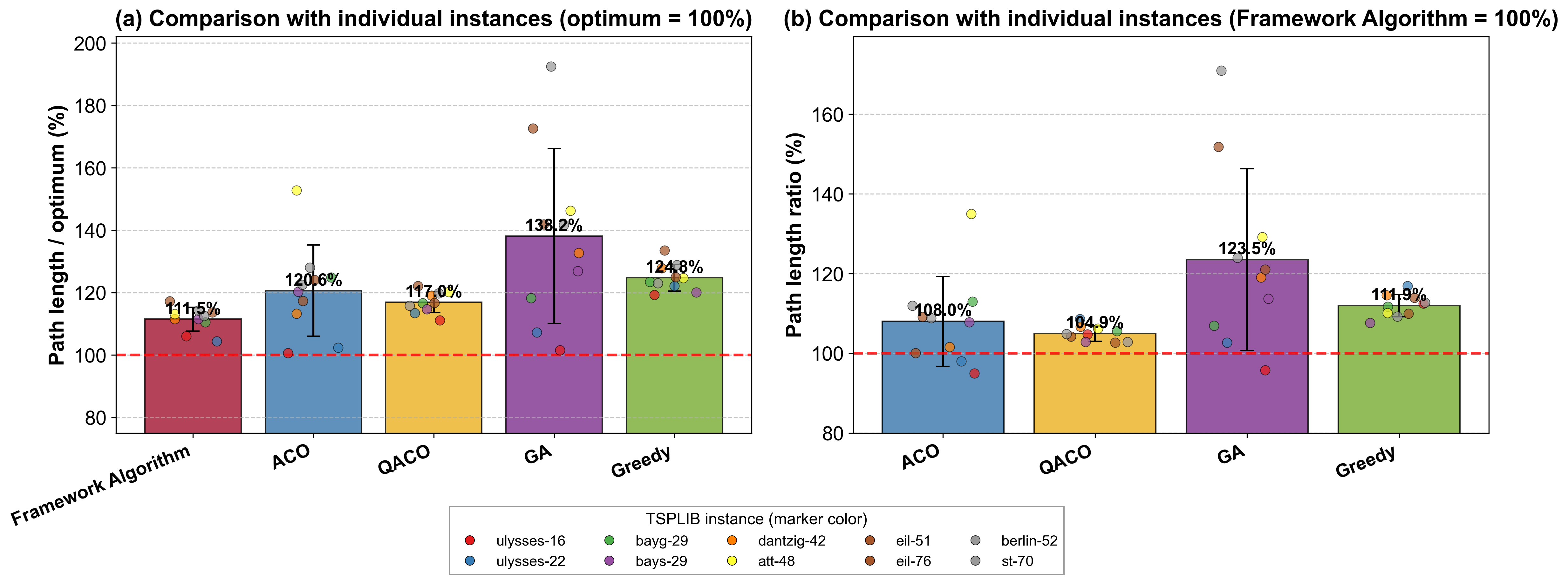
Figure 3: Comparison of route-length statistics and normalized ratios for ACO, QACO, GA, Greedy, and Hybrid Framework Algorithm.
Analysis of route geometry confirms the structural benefit: the hybrid framework produces smoother, intersection-free paths with higher global consistency, contrasting the disconnected or crossing routes obtained by classical heuristics.
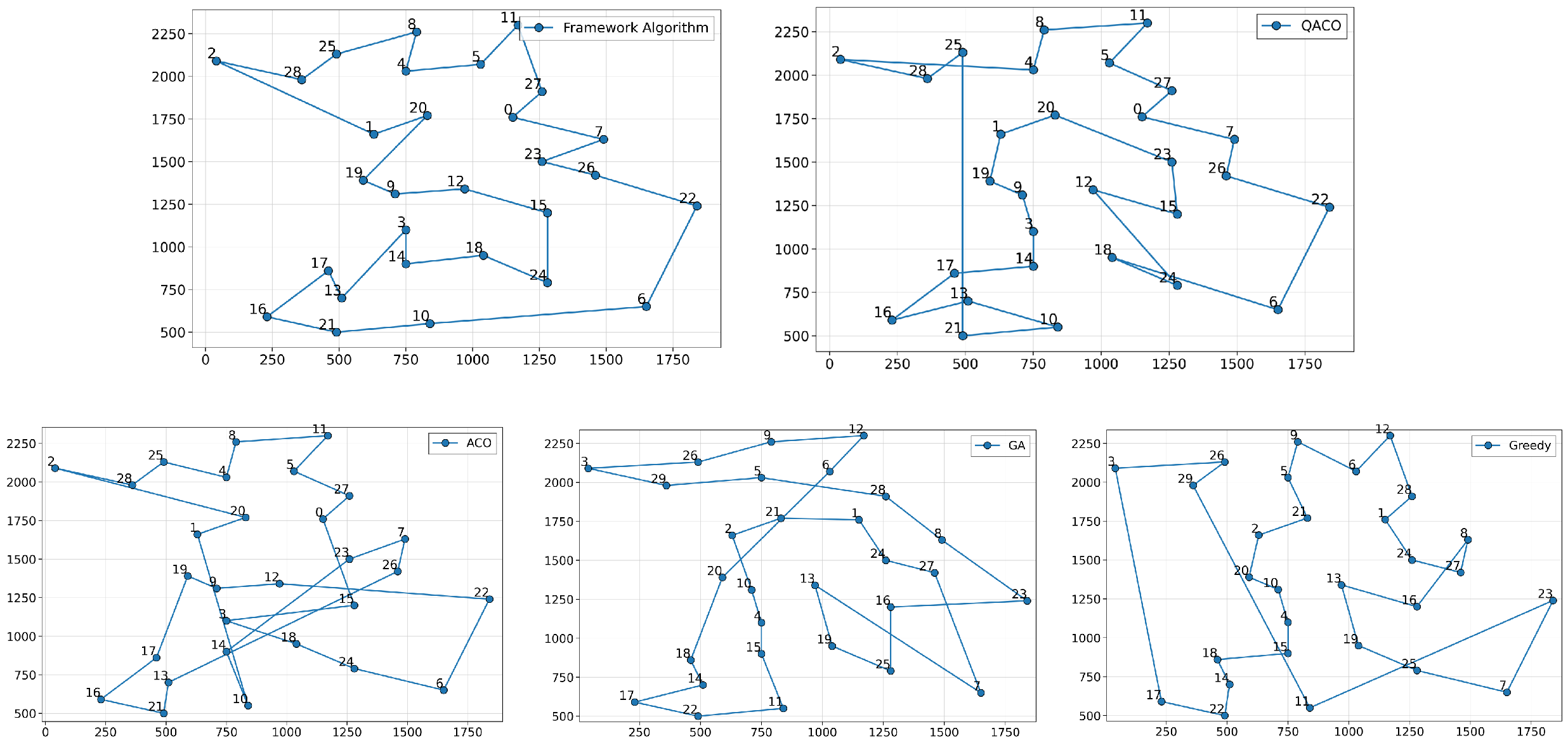
Figure 4: Route geometry comparison on Bays-29 for hybrid, QACO, ACO, GA, and Greedy algorithms.
Scalability on synthetic datasets further demonstrates that performance and variance remain robust with increasing problem size, attributed to bounded subproblem complexity and independent localized optimization.
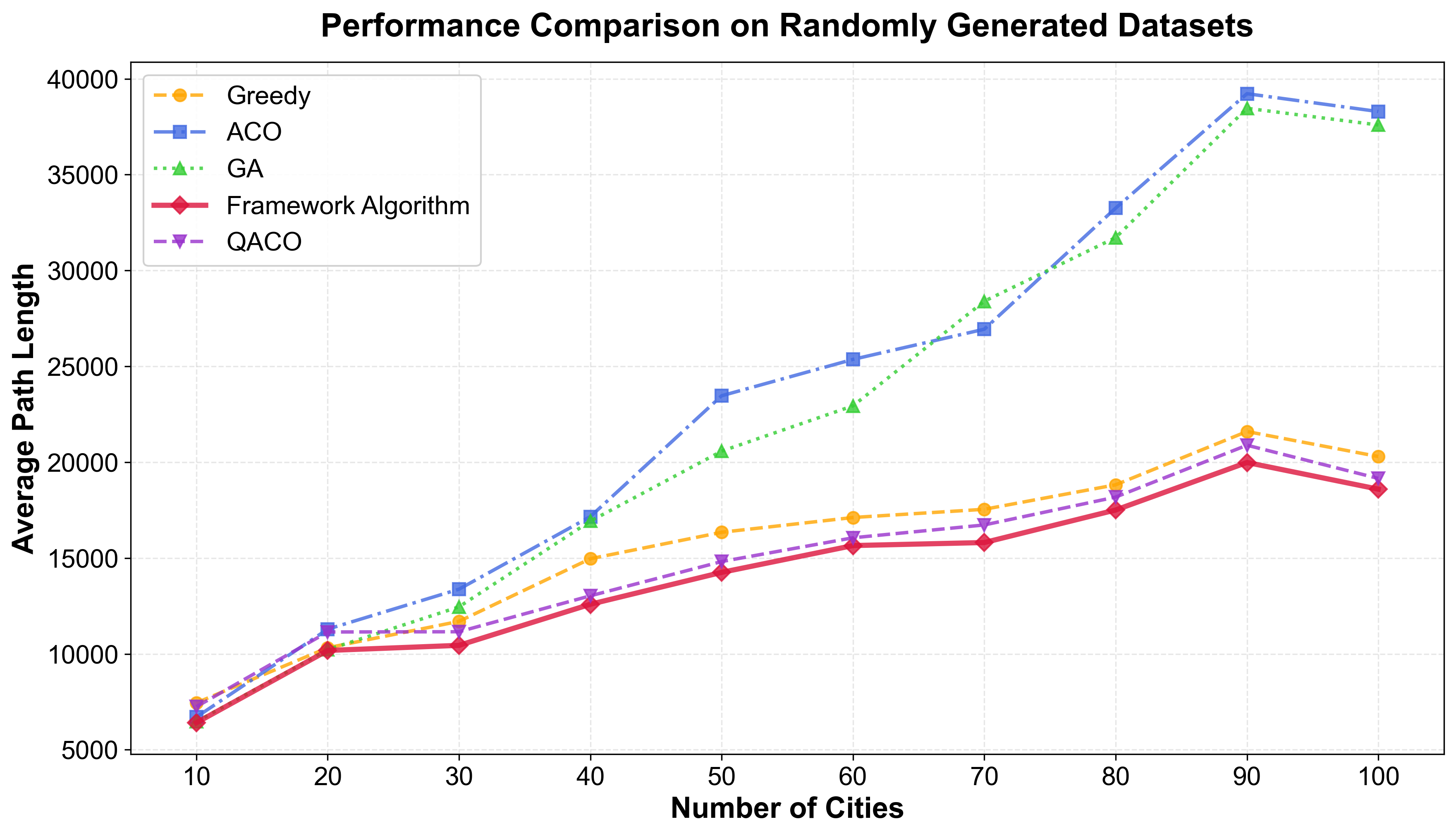
Figure 5: Algorithm comparison on random datasets (10–100 cities), with consistently lower path lengths and variability for the hybrid framework.
Noise robustness is validated by simulation of bit-flip and thermal relaxation errors (up to 10%), revealing limited degradation in solution quality. This stems from the framework’s reliance on shallow circuits, localized quantum operations, and repeated measurement-driven feedback, which structurally mitigate noise effects without explicit error correction.
Ablation Study and Mechanism Validation
Systematic ablation experiments (removal of amplitude amplification, replacement of QGA with classical 2-opt) demonstrate non-trivial performance degradation, especially as scale increases (+5–7% for 50+ cities). The impact grows with larger problem instances, confirming the necessity of both quantum evolutionary search and controlled amplification. Frequency analysis of the amplification interval reveals a unimodal relationship, with optimal performance at ΔG=8. Excessive amplification reduces diversity (premature convergence), while insufficient amplification slows convergence.
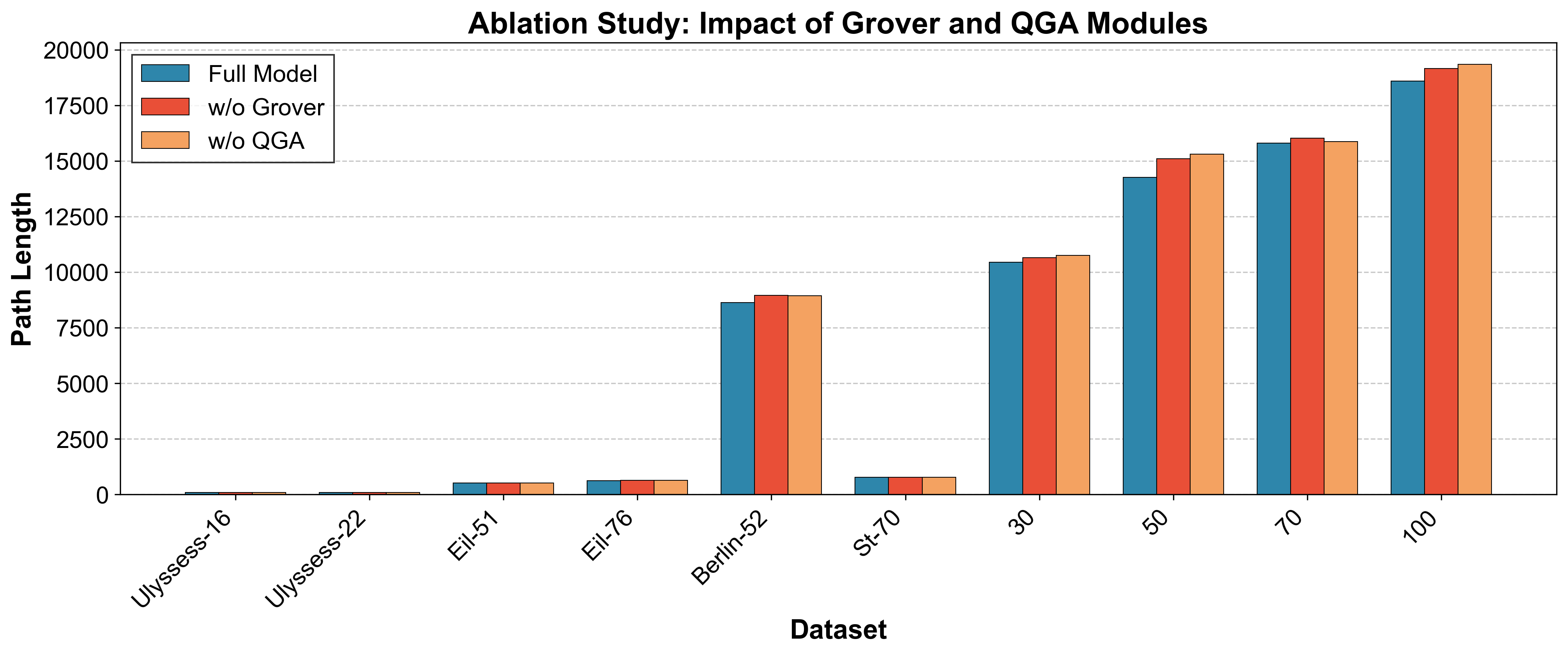
Figure 6: Ablation comparison of amplification and QGA modules on representative benchmark and synthetic datasets.
Discussion: Implications and Generalization
Structurally, the framework achieves resource-bounded scalability by aligning decomposition and optimization procedures with NISQ constraints. Scalability arises from decomposition-driven complexity control, with quantum execution localized to bounded subproblems. Quantum enhancement via periodic amplification provides convergence acceleration without depth expansion, and hybrid interaction drives performance through coordinated feedback loops.
The framework is compatible with typical NISQ device limitations: shallow circuits, limited qubit counts, and noise resilience. Limitations include reliance on simulated quantum hardware, sensitivity to decomposition quality (clustering and boundary refinement), parameter selection (subproblem size M, amplification interval ΔG), and absence of comparisons with state-of-the-art solvers (Concorde/LKH).
The design paradigm generalizes to other decomposable combinatorial problems: vehicle routing, scheduling, network optimization—where resource-compatible partitioning, localized evolutionary search, and classical aggregation are feasible.
Conclusion
A NISQ-aware hybrid quantum–classical framework for combinatorial optimization is developed, integrating structured decomposition, probabilistic quantum evolutionary search, and periodic amplitude amplification. Empirical evaluation demonstrates consistent improvements in quality, scalability, and robustness for large TSP instances. Key findings are:
- Scalability is achieved via decomposition-driven complexity control.
- Quantum enhancement is effective when applied locally and periodically.
- Performance emerges from coordinated hybrid interaction, not isolated quantum acceleration.
This framework provides an extensible, practically feasible pathway for deploying hybrid quantum–classical optimization under realistic hardware constraints, with design principles applicable to a broader class of combinatorial problems as NISQ technology matures.

