- The paper proposes exhaustively parametrised quantum circuits that guarantee access to every feasible TSP solution using group-theoretic methods.
- It outlines two circuit constructions—the bubble sort and binary insertion mixers—with performance approximations of 0.83 and 0.91 respectively.
- The results underscore that while expressivity is assured, the complexity of classical parameter optimization remains a significant challenge.
Exhaustive and Feasible Parametrisation for Quantum Optimization: Applications to the Travelling Salesperson Problem
Introduction and Context
The paper "Exhaustive and feasible parametrisation with applications to the travelling salesperson problem" (2604.24297) presents an in-depth study of quantum circuit parametrisation paradigms for combinatorial optimization under hard constraints, with the Travelling Salesperson Problem (TSP) as a central case study. The authors critique the expressivity and reachability limitations inherent in conventional Quantum Approximate Optimization Algorithm (QAOA) and Quantum Alternating Operator Ansatz (QAOA with mixers constrained to feasible states), underlining the fact that, with a fixed number of parameters, such approaches may not exactly cover all feasible solutions. Instead, existing guarantees only hold in the asymptotic regime of infinite circuit depth and parameters.
To address this gap, the authors introduce and formalize the concepts of exhaustively parametrised and feasibility-respecting quantum circuits. These circuits are mathematically guaranteed to reach all feasible solutions exactly, with a fixed and finite set of parameters, and to completely avoid infeasible states. This is achieved via a formal pipeline built on group-theoretic foundations—most notably, transitive group actions and the novel construct of generating sequences of involutions.
The technical crux of the paper is the abstract pipeline that takes as input a combinatorial optimization problem with a structured feasible set and outputs an exhaustively parametrised quantum circuit. This construction is based on two group-theoretical ingredients:
- Transitive Group Action: A group G acting transitively on the feasible set F ensures any feasible solution can be mapped to any other via elements of G.
- Generating Sequence of Involutions: An ordered tuple of involutory elements (hi)i=1d (typically group elements like transpositions) such that all elements of G can be written as products of the hi's in the fixed order, each possibly appearing zero or one times.
The circuit construction follows the following steps:
- Map the group to quantum gates via the permutation representation.
- Extend these gates to act on the full Hilbert space (with trivial action on infeasible basis states).
- Compose exponentiated involutory gates, with continuous real parameters, in the order specified by the generating sequence.
- Prepend feasible state preparation (usually a computational basis state encoding the identity permutation).
In this framework, exhaustive parametrisation is guaranteed because, given any feasible solution, there always exists a parameter vector that deterministically prepares this solution from the reference state. Feasibility-respect is maintained because the group action restricts support to the feasible subspace.
Application to the TSP: Symmetric Group-Based Circuits
The primary application is the TSP, whose feasible space corresponds to the set of all permutations (i.e., elements of the symmetric group Sn). Two encoding strategies are considered: a redundant O(n2)-bit encoding versus a more compact nlogn-bit permutation encoding.
1. Bubble Sort Sequence Mixer
Inspired by the bubble sort algorithm, the first generating sequence consists solely of adjacency transpositions (i.e., swaps of neighboring elements). The sequence length is Θ(n2), set by the inversion number of the full reversal permutation. Each adjacency transposition is mapped to a quantum swap gate acting on substrings of the Hilbert space corresponding to adjacent time slots or positions in the encoding. The corresponding quantum circuit contains F0 parametrised exponentials and is optimally short among circuits using only adjacency swaps.
2. Binary Insertion Sequence Mixer
To reduce circuit size, the second construction leverages more general involutions (not necessarily adjacency transpositions). Through a recursive construction, at each stage F1 additional involutive permutations are appended to handle insertion operations in binary, resulting in a generating sequence of length F2. While these require more complex (and less local) qubit connectivity, the scaling is asymptotically optimal given the size of F3. The more concise parameterization is reflected in improved empirical trainability.
Numerical Evaluation
The authors empirically evaluate these mixers against established QAOA variants (with Hadfield et al. [Hadfield2019] mixers) on 9-city TSP instances. All circuits are simulated in an idealized, noiseless setting with full qubit connectivity and exact expectation values. The key finding is that both exhaustively parametrised circuits outperform QAOA in terms of the final achieved approximation ratio, with the binary insertion mixer reaching approximately 0.91 and the bubble sort mixer 0.83, while QAOA variants stagnate at significantly lower ratios.
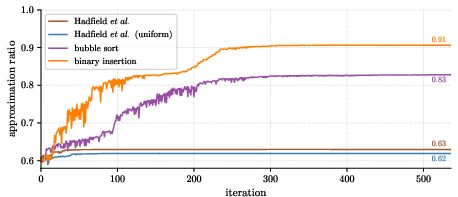
Figure 2: Approximation ratios over COBYLA iterations for different parametrised quantum circuits on a 9-city TSP instance. Exhaustively parametrised circuits substantially outperform QAOA benchmarks.
Notably, despite the theoretical expressivity guarantee, neither circuit reaches the true optimum. This disconnect highlights the classical optimisation bottleneck: reachability does not imply practical trainability due to the complexity of the induced parameter landscape.
Theoretical and Practical Implications
The main theoretical contribution is a framework that bridges combinatorial structure (group actions, generating sequences) with quantum circuit expressivity guarantees. Practically, the results indicate that exact coverage over the feasible manifold can be a design property for quantum algorithms, potentially reducing the need for penalty-engineering and infeasibility detection in quantum-classical workflows. The use of group theory also opens a pathway to portable circuit constructions where the group action structure is shared between problems.
However, the study makes clear that parameter trainability is a separate and persistent challenge: expressive circuits, while eliminating representational bottlenecks, may still induce intractable or highly entangled training landscapes. This motivates further research into more efficient parameter optimization or alternative variational landscapes.
Outlook and Future Directions
The pipeline developed is general; it can be instantiated for other hard-constrained problems provided suitable group actions and generating sequences can be identified (e.g., vehicle routing, facility location). Moreover, partial group actions covering subsets of the feasible space may be hybridized with other mechanisms, increasing applicability. The clear separation between representational power (expressivity/reachability) and parameter optimization also suggests potential for hybrid quantum-classical schemes or integration with problem-specific heuristics.
Further advances may involve:
- Analyses of the parameter landscape structure for exhaustively parametrised circuits.
- Automated discovery of efficient generating sequences tailored to the permutation structure of hard problems.
- Extension to encodings with additional side constraints (e.g., capacities, time windows).
- Investigation of the limits of classical simulability for such highly expressive circuits.
Conclusion
This paper establishes a mathematically rigorous and operationally meaningful framework for realizing exhaustively parametrised, feasibility-respecting quantum circuits via group-theoretic constructions. The demonstration on the TSP shows strong potential for improved expressivity and practical solution quality over traditional QAOA approaches, contingent on advances in classical parameter optimization. Future work will determine the broader applicability and limits of this approach in quantum combinatorial optimization.

