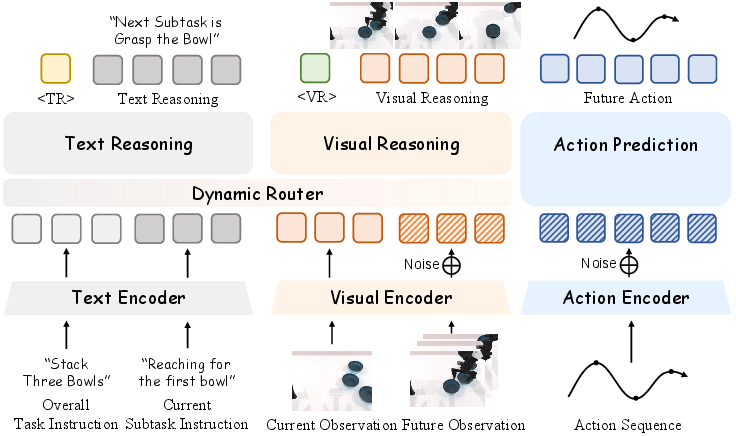
- The paper introduces AdaWAM, which uses adaptive token-level routing between textual and visual reasoning to enhance the performance of world action models.
- It demonstrates significant improvements on benchmarks like LIBERO-Long and RoboTwin 2.0, achieving higher success rates in complex, long-horizon tasks.
- Adaptive multimodal reasoning reduces computational overhead by activating precise sensory modalities at phase-specific intervals while maintaining robust manipulation foresight.
Adaptive Multimodal Reasoning in World Action Models: A Technical Dissection of AdaWAM
Introduction and Context
The presented work, "Dreaming when Necessary: Advancing World Action Models with Adaptive Multi-Modal Reasoning" (2606.07089), critically re-examines the formulation and deployment of World Action Models (WAMs) in robotic manipulation, focusing on the context-dependent requirements of multimodal reasoning. WAMs have established themselves as a compelling paradigm, bridging model-based control and sensorimotor learning by coupling video prediction with action rollout. However, traditional WAMs predominantly employ static multimodal paradigms, either video-action joint prediction—known for excessive computational overhead—or action-only prediction, which sacrifices physical foresight during fine manipulations.
AdaWAM introduces an adaptive reasoning mechanism controlling the invocation of textual and visual reasoning in a token-level, phase-specific manner, as formalized by a lightweight dynamic router. This approach is motivated by the insight that high-level task transitions necessitate textual reasoning for semantic grounding, while fine-grained manipulations benefit from explicit visual foresight.
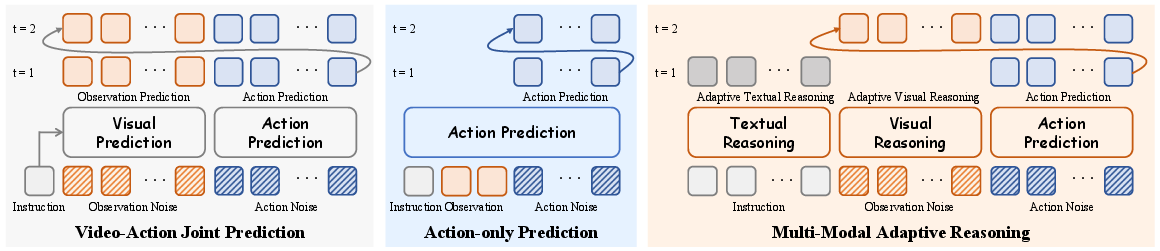
Figure 1: Comparison of traditional video-action joint, action-only, and proposed adaptive multimodal reasoning paradigms.
Adaptive Multimodal Reasoning: Annotation and Model Architecture
AdaWAM's annotation pipeline leverages trajectory-based analysis to label subtask transitions and manipulation intervals. Robot state cues—including end-effector dynamics and gripper status—delineate temporal segments for candidate subtask boundaries. These are precisely verified through VLM-based semantic classification, yielding dense phase-wise modality supervision.
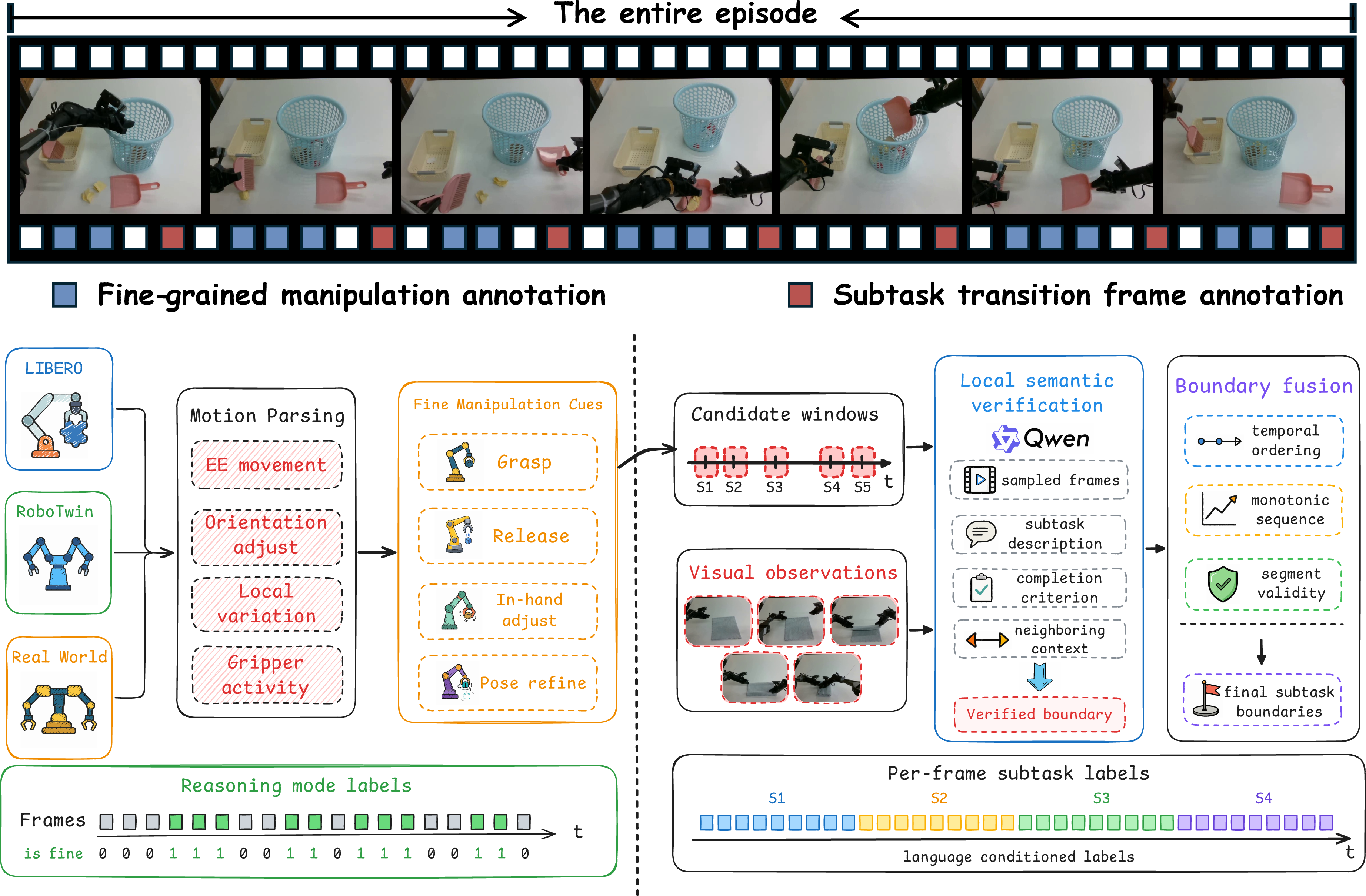
Figure 2: Schematic of the annotation pipeline for associating manipulation intervals and subtasks with relevant reasoning modes.
The AdaWAM architecture interleaves three principal components:
The training strategy is staged to jointly optimize diffusion-based generative modeling and discrete routing, later fine-tuning semantic text reasoning in isolation, ensuring semantic alignment without corrupting physical priors.
Experimental Validation
Long-horizon and Fine-grained Task Mastery
Evaluation benchmarks span LIBERO, RoboTwin 2.0, and real-world setups with complex long-horizon operations. AdaWAM achieves superior results, especially on the LIBERO-Long subset (multi-object, multi-phase tasks) and hard subsets in RoboTwin 2.0, demonstrating both elevated success rates and robust subtask-level generalization.


Figure 4: Qualitative visualizations of AdaWAM executing temporally extended, fine-grained real-world manipulation tasks.
Ablation variants—AdaWAM w/o Textual Reasoning and AdaWAM w/o Visual Reasoning—support the claim that phase-appropriate multimodal routing enables AdaWAM to realize state-of-the-art overall scores:
- Numerical highlights: AdaWAM attains a LIBERO-Long score of 99.1 versus 97.6 for the best prior baseline (X-VLA), and leads RoboTwin 2.0 with Hard SR 88.43 / Overall SR 93.11.
Efficiency and Fine-grained Policy Comparison
AdaWAM's adaptivity reduces inference time by bypassing unnecessary video generation in coarse phases, offering parity or better efficiency than action-only policies, without sacrificing the benefits of explicit visual "imagination" during precision steps. Visualization on tasks such as HangingMug illustrates that AdaWAM anticipates object-phase boundaries and fine-manipulation intervals more effectively than action-only baselines.
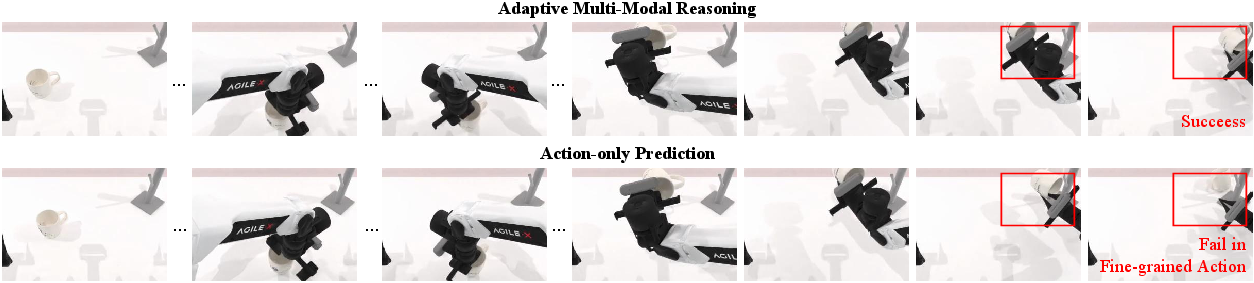
Figure 5: Visualization contrasting AdaWAM and action-only WAM in fine-grained operations, exposing the advantage of selective visual reasoning.
Inference statistics in composite tasks such as StackThreeBowls further expose the balance AdaWAM achieves between computational cost and operational success.
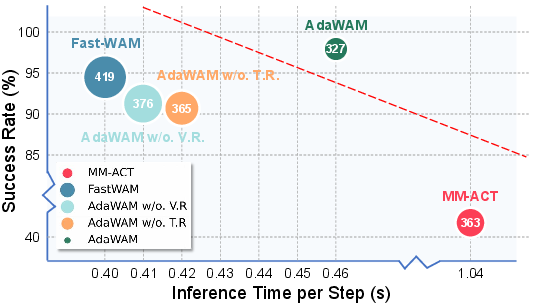
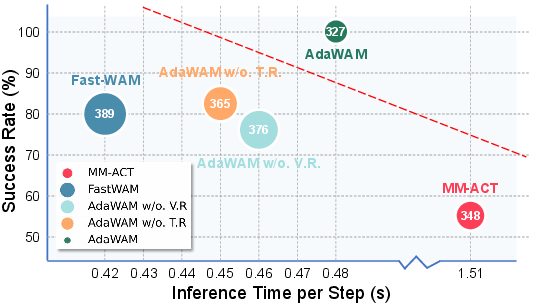
Figure 6: Task StackThreeBowls used in inference time and success rate comparisons.
Generalization through Adaptive Textual Reasoning
AdaWAM demonstrates marked improvement in generalization for unseen subtask compositions. Unlike models devoid of explicit text supervision, AdaWAM retains the ability to segment and strategize in combinatorial arrangements of known primitives—arising from its proactive utilization of dynamic linguistic reasoning at transition boundaries.
Theoretical Implications and Future Prospects
AdaWAM's framework exposes several notable theoretical and practical implications:
- Token-level reasoning control: Token-wise modality routing endows policies with finer granularity in subtask abstraction and conditional prediction, reconciling the efficiency-expressivity tradeoff in multimodal robotics.
- Semantic-phase alignment: The interleaving of compact VLM and visual prediction prevents catastrophic forgetting of physical priors, enabling a robust, compositional action-space policy.
- Out-of-domain robustness: Empirical evidence for generalization in unseen subtask recombinations substantiates the advantage of decoupled semantic and physical reasoning modalities.
Future research directions include augmenting AdaWAM with additional sensory modalities (e.g., tactile, depth), and transitioning from supervised routing supervision (derived from heuristics and VLM annotation) to end-to-end self-supervised or reinforcement learning training for routing mechanisms. This would move toward fully self-adaptive, introspective agents capable of autonomously discovering and leveraging optimal temporal reasoning boundaries.
Conclusion
AdaWAM establishes a new direction in World Action Modeling by operationalizing context-aware multimodal reasoning, achieved via dynamic, token-based routing between text, visual, and action priors. Empirical validation across simulation and real-robotic platforms supports the premise that adaptive reasoning aligns computational allocation with the demands of phase-specific manipulation subtasks, offering both efficiency and superior task success. The framework’s design and results indicate clear avenues for extending embodied AI with even richer modality integration and more autonomous reasoning arbitration, informing both the theoretical basis for embodied agency and the development of robust deployed robotic systems.