- The paper demonstrates that contextualized, sentence-level embeddings yield more reliable semantic association estimates for predicting both N400 and reading times compared to uncontextualized models.
- Methodologically, it employs Bayesian hierarchical regression to isolate semantic association effects while controlling for word predictability in naturalistic Dutch texts.
- Findings indicate that aspects like embedding choice and context window size critically influence the interpretation of neural and behavioral measures in language comprehension.
Modeling Semantic Association in Self-Paced Reading with LLM Embeddings
Introduction and Theoretical Motivation
Semantic association, distinct from word predictability, modulates both behavioral and neural indices of linguistic processing. Prior cognitive neuroscience work has identified the N400 ERP component and self-paced reading times (SPRs) as sensitive to context-driven predictability and semantic fit [kutasThirtyYearsCounting2011; frankERPResponseAmount2015; federmeierRoseAnyOther1999]. However, the degree to which LM-based embeddings can consistently and robustly quantify semantic association effects beyond predictability, particularly in naturalistic, self-paced reading paradigms with ecologically valid Dutch texts, remains unresolved. The present study directly addresses this by operationalizing and comparing a comprehensive set of embedding-based implementations of semantic association, probing their explanatory strength for the N400 and reading time data, and systematically assessing the influence of embedding type and contextual window on resulting estimates.
Methodology
The study analyzes a joint EEG and SPR corpus (TiNT [ostergaardCorpusJointEEG2025]) comprising 56 participants reading medium-length (>600 words) Dutch texts in a naturalistic setting. EEG preprocessing and N400 extraction follow established standards, targeting centroparietal electrode mean amplitudes within 300–500ms post-stimulus.
Definition and Implementation of Semantic Association
Semantic association is operationalized as the cosine similarity between a critical word's embedding and a context embedding. Two major embedding paradigms are contrasted:
- Uncontextualized word embeddings (word2vec/wikipedia2vec-nl): Context vectors constructed by averaging embeddings for all words (
WE, All), only content words (CWE, All), or via local/content word windows and exponentially weighted averages.
- Contextualized sentence embeddings (e5-large-trm-nl): Context vectors taken as sentence/document-level representations, without post-hoc averaging.
The study varies the context window granularity (all preceding words, preceding sentence, windowed contexts of 1–2 words, and exponentionally weighted averages) to probe local/global semantic integration.
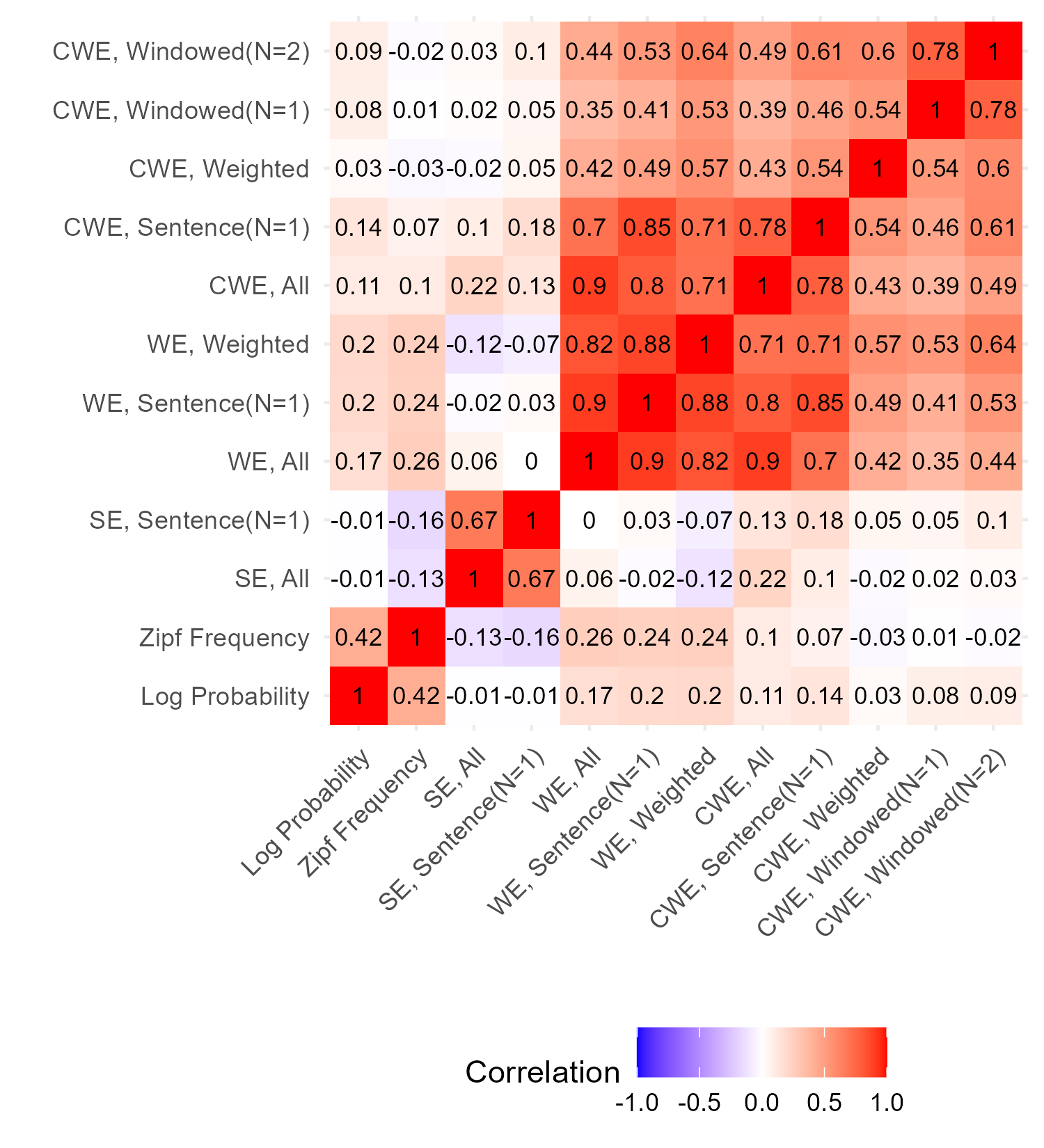
Figure 1: Pearson's correlation coefficients between implementations of semantic association, log-probability of words, and Zipf word frequency for all content words in the corpus.
Figure 1 demonstrates that semantic association estimates derived from the same embedding type are highly correlated, whereas those across embedding paradigms are only weakly related, indicating that embedding choice is non-trivial and potentially targets substantially different semantic properties in text.
Statistical Modeling
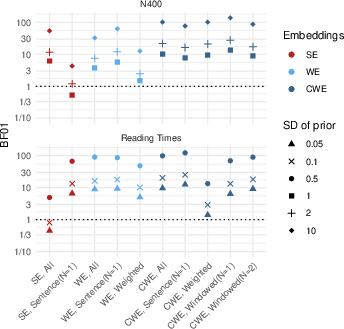
Bayesian hierarchical regression models are constructed separately for each semantic association implementation for both dependent variables (N400, SPR times), always covarying for log-probability (estimated via GPT ensemble for Dutch). Bayes factors (using the Savage–Dickey method) are reported for the semantic association coefficient, enabling a graded quantification of evidence for/against an association effect after controlling for predictability.
Results
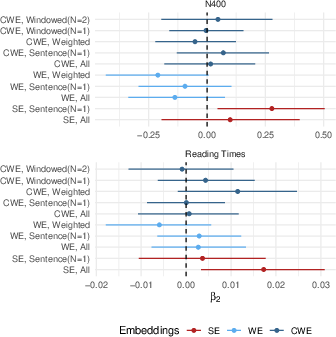
Figure 2: Regression coefficients and 95\% credible intervals for semantic association β2 across all implementations for both N400 and reading times.
Regression models yield the following primary findings:
Bayes factors indicate that across almost all implementations—especially those based on uncontextualized word embeddings—there is substantial evidence for the null hypothesis, i.e., no independent effect of semantic association on reading times or N400 once predictability is controlled. Only SE-based models provide anecdotal (i.e., non-decisive but suggestive) evidence for a non-null effect.
Crucially, these findings empirically contradict prior literature using similar word embedding-based approaches, which have frequently reported positive semantic association effects on N400 amplitude [broderickElectrophysiologicalCorrelatesSemantic2018; frankWordPredictabilitySemantic2017], demonstrating that results are heavily implementation-dependent.
Qualitative Analysis of Embedding Behavior
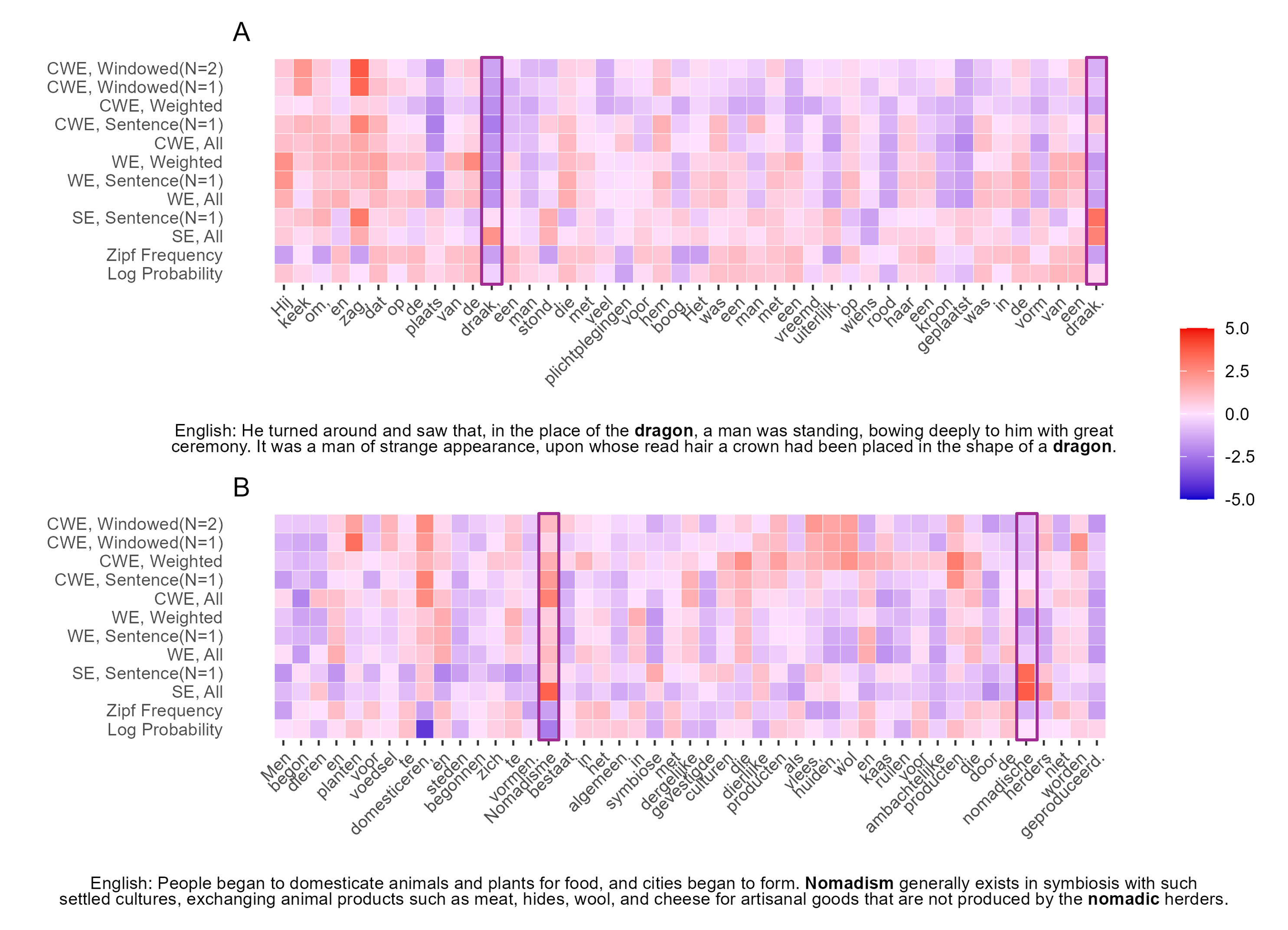
Figure 4: Semantic association (via various implementations), log-probability, and Zipf frequency for selected words in two sentence pairs. SE-based models are sensitive to thematic coherence (e.g., "draak", "Nomadisme") where WE-based models are not.
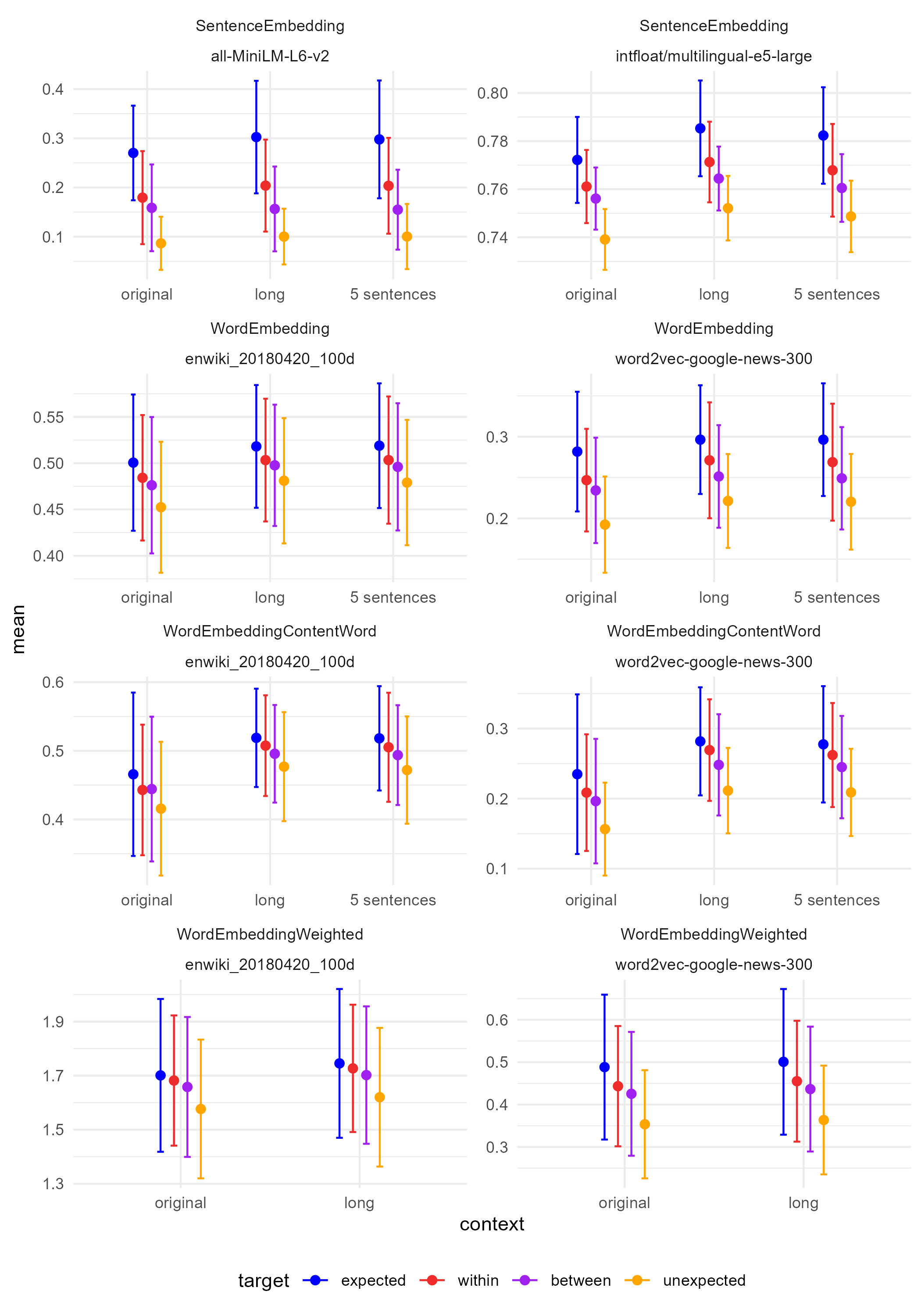
Qualitative inspection reveals SE-derived measures better track higher-level semantic or thematic relevance than WE-based measures. This is evident in cases where only SE implementations correctly reflect strong context association for repeated or topical words, a property not systematically captured by local word averages.
Discussion
The findings illustrate several key technical and theoretical points:
Implications and Future Directions
The results have both immediate and long-term consequences for the computational-cognitive modeling of language processing:
- Practical modeling guidance: For naturalistic SPR and EEG corpora, researchers should prefer contextualized, sentence- or document-level embeddings for quantifying semantic association, rather than relying on uncontextualized, static word-level representations.
- Theoretical ramifications: The findings raise the possibility that many previously reported effects attributed to "semantic association" using WE-based metrics may have been artifacts of context window size, language, text genre, or model limitations. More robust, context-sensitive embeddings can reveal associations missed by naive averaging.
- Implications for neural modeling: Given the dependency of N400 effects on embedding implementation, computational-level models of ERP signals that incorporate semantic similarity must be closely aligned with the architecture and training objectives of the underlying lexical or sentence representations.
- Resource development needs: Since only a narrow set of embedding models were fully explored, future work should systematically examine a broader landscape of contextualized and hybrid models, especially for languages beyond English where embedding quality may be variable.
Conclusion
This paper provides a rigorous, multilevel evaluation of embedding-based semantic association metrics for predicting neural and behavioral measures in self-paced reading. The findings converge on the strong claim that embedding selection and context formalization non-trivially determine the ability to detect semantic association effects beyond word predictability. Sentence embeddings, in particular, offer a more promising avenue for capturing thematic and context-driven semantic relationships in naturalistic materials. These results should inform both the design of future cognitive- and neural-level linguistic studies and the development of AI systems modeling human-like semantic processing.
Citation: "Modeling semantic association in self-paced reading with LLM embeddings" (2606.07066)