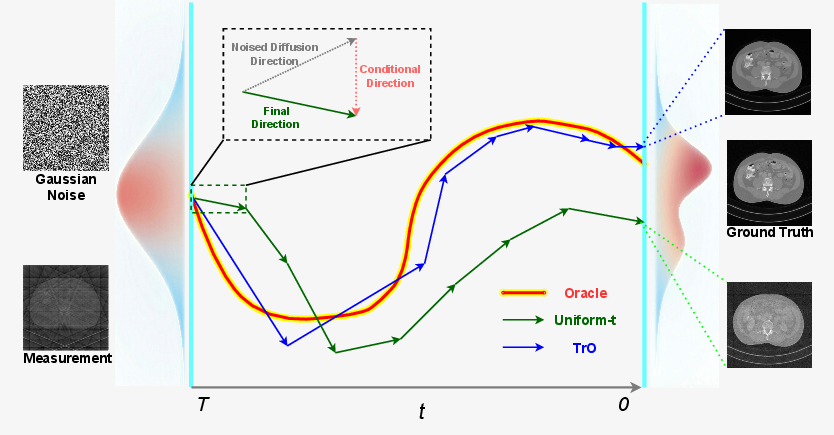
- The paper introduces TrO, which adaptively selects timesteps via discrete optimization to minimize error in 3D CT reconstruction.
- It leverages dynamic programming and noise reuse to allocate computational steps effectively under stringent evaluation budgets.
- Empirical results show TrO significantly improves PSNR and SSIM compared to uniform schedules, enabling high-quality reconstructions with fewer steps.
Tracing the Oracle: Adaptive Diffusion Timestep Scheduling for 3D CT Reconstruction
Overview
This work introduces Tracing the Oracle (TrO), a framework for non-uniform timestep scheduling in diffusion-based conditional inverse problems, with a primary focus on accelerating high-fidelity 3D computed tomography (CT) reconstruction. TrO formulates timestep selection as a discrete optimization by globally minimizing the approximation error between a sparse evaluation trajectory and a densely sampled high-fidelity "oracle" path. The methodology is motivated by the limitations of uniform and heuristic timestep schedules, particularly when computational constraints prevent the use of large neural function evaluation (NFE) budgets. TrO leverages dynamic programming, noise-reuse, and explicit discretization error modeling to allocate timesteps to stages of the reverse stochastic differential equation (SDE) process that are most susceptible to truncation error.
Methodology
The study starts from the premise that numerical inference in diffusion-based inverse problems is dominated by the discretization of the reverse SDE, and that uniform step allocation is suboptimal, especially for complex measurement-conditioned processes such as 3D CT. To address these, the authors introduce several key innovations:
Empirical Evaluation
Experimental Setup
The framework is evaluated on the AAPM dataset for two primary CT scenarios: sparse-view CT (SV-CT) and limited-angle CT (LA-CT). The DDS pipeline is used as the baseline diffusion inverse solver, and fixed (uniform, quadratic, logarithmic, cosine, EDM) and learned (TrO) schedules are compared under tight NFE budgets (8, 10, 15). State-of-the-art fast and baseline solvers (DiffMBIR, Score-Med, MCG) are included for reference, typically evaluated with four orders-of-magnitude larger sampling budgets.
Quantitative Results
TrO consistently outperforms all fixed schedules across SV-CT and LA-CT setups under severe computational constraints. The improvements in PSNR (e.g., more than +1 dB at NFE=8 vs. the best fixed schedule) and SSIM are substantial, especially for the lower NFE regime where truncation dominates over model capacity. The benefit is robust across all image planes (axial, coronal, sagittal). Compared to baseline methods, TrO-equipped DDS at 10-15 NFEs surpasses solvers utilizing 4000 NFEs.
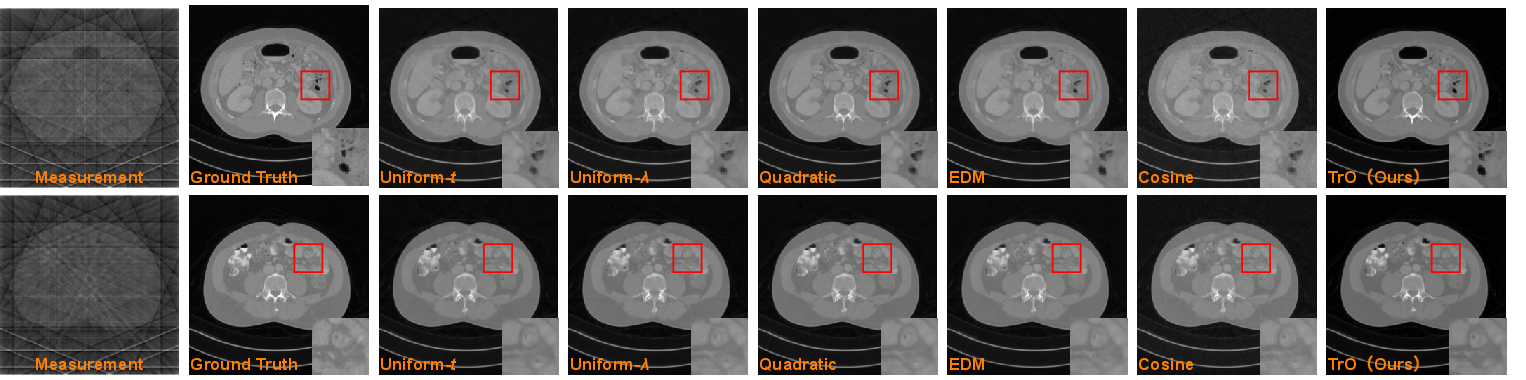
Figure 2: Qualitative comparison of 3D CT reconstructions, illustrating enhanced high-frequency detail preservation and suppression of artifacts with TrO's adaptive scheduling (see highlighted regions).
Timestep Analysis
Schedule visualization reveals that optimal allocations discovered by TrO are highly problem-dependent: for SV-CT, more steps are allocated to later reverse time stages (refining high-frequency details), whereas for LA-CT, the schedule front-loads the early stages (synthesizing missing low-frequency structures in poorly measured regions).
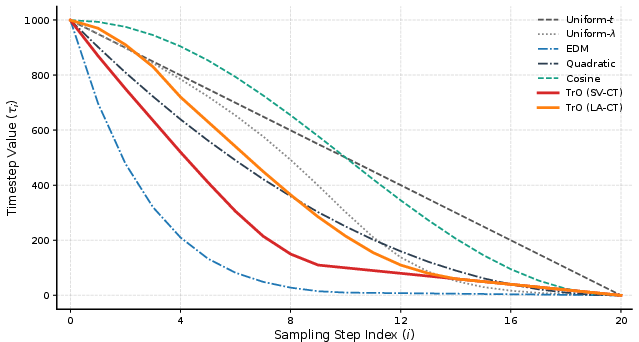
Figure 3: Visualization of timestep allocations over discrete evaluation steps for various scheduling strategies, showing that TrO dynamically adjusts according to measurement operator and budget.
Ablation and Hyperparameter Study
An ablation over the schedule regularization parameter κ shows optimal performance is achieved with moderate non-uniformity; extreme allocations can degrade fidelity, presumably by deviating from the network's training-time operational regime.
Theoretical and Practical Implications
Theoretical Insights: TrO establishes that, for measurement-conditioned SDE solvers, task- and operator-adaptive timestep allocation outperforms all uniform strategies. The global optimization and explicit separation of truncation error from stochastic variance enables practical schedule discovery in previously intractable conditional settings. The strong dependency of optimal schedules on inverse problem geometry underscores the need for domain-aware, data-driven adaptation in numerical generative inference.
Practical Impact: By closing the gap to oracle-level reconstructions at 10–15 steps, TrO makes high-quality diffusion-based reconstruction feasible under clinically relevant constraints. This enables broader deployment in resource-constrained and real-time medical imaging systems, improving accessibility without loss of fidelity. Since the schedule discovery is performed offline, the approach does not introduce any extra runtime or computational burden during inference.
Future Directions
Potential avenues for future research include:
- Extension to Other Modalities: Broadening TrO’s scheduler optimization to other inverse problems in medical and industrial imaging (e.g., MRI, PET, X-ray, seismic).
- Joint Model-Scheduler Training: Co-optimizing network parameters and schedules via meta-learning or bilevel optimization, potentially enabling even greater acceleration.
- Schedule Generalization and Transfer: Studying robustness when the measurement operator or anatomical distribution shifts; learning more data- and operator-agnostic schedule priors.
- Integration with Advanced Solvers: Combining TrO with fast ODE/SDE-based solvers or neural acceleration methods to approach real-time, high-dimensional generative inference.
Conclusion
Tracing the Oracle (TrO) provides a robust, theoretically grounded, and practically effective mechanism for optimizing timestep schedules in measurement-conditioned diffusion SDE solvers. By directly minimizing the discretization error on oracle reference trajectories and leveraging a noise-reuse mechanism, TrO allocates sparse computational budget where it is most impactful. The method produces non-uniform, task-specific schedules that significantly improve 3D CT reconstruction fidelity and efficiency under stringent computational budgets, enabling scalable deployment of diffusion-based generative models for complex inverse problems in medical imaging.