- The paper presents a self-bootstrapped global-local decomposition that shifts tokenization complexity away from generative models.
- It employs entropy-regularized optimal transport to align 2D visual features with 1D tokens, reducing training overhead by up to 54% in time and 40% in computation.
- Empirical results validate state-of-the-art performance using only 64 tokens with improved gFID, rFID, PSNR, and SSIM metrics on ImageNet-1K.
Balancing Image Compression and Generation with Bootstrapped Tokenization: A Technical Review
Introduction
The SelfBootTok framework addresses a core challenge in advanced image modeling: constructing token representations that are simultaneously compact, efficient for downstream generative models, and scalable with growing data or model capacity. The proposed paradigm decomposes image tokens into distinct global and local sets, using a self-bootstrapped learning mechanism to recover local details directly from global tokens. This eliminates redundancy across tokens, enhances representational efficiency, and fundamentally shifts part of the generation load from generative models to the tokenizer itself.
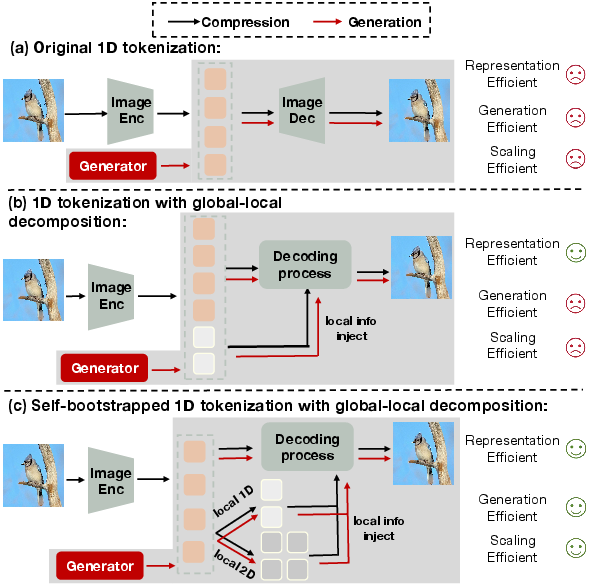
Figure 1: The self-bootstrapped learning paradigm contrasting classical 1D image tokenizers and methods with local detail injection, highlighting the global-local token decomposition and bootstrapping approach.
Limitations of Classical Tokenization Paradigms
Conventional image tokenizers predominantly operate in two modes:
- 2D Grid Discrete Tokenization—preserves spatial structure but at high computational cost and limited compression.
- 1D Sequential Tokenization—achieves high compression (e.g., Titok [32 tokens]), but existing designs entangle global semantics with local details, leading to redundant information across tokens and complex generator training dynamics.
Recent innovations (e.g., GigaTok, HieraTok, SoftVQ) have improved compression and flexibility, but typically do not explicitly decompose or differentiate between global context and fine local detail, nor do they efficiently scale the learning of local details.
SelfBootTok: Global-Local Decomposition with Self-Supervised Bootstrapping
Architectural Overview
SelfBootTok introduces a hierarchical decomposition strategy:
- Global Tokens: Encoded via a ViT backbone, capturing high-level semantics.
- Local Tokens: Predicted from global tokens using self-supervised bootstrapping, and modeled at both 1D and 2D granularities. Local detail is learned and injected via alignment to different pretrained visual encoders (e.g., DINOv2 for global, I-JEPA or SigLIP for local branches).
Both token groups are softly quantized and subsequently fused for decoding.
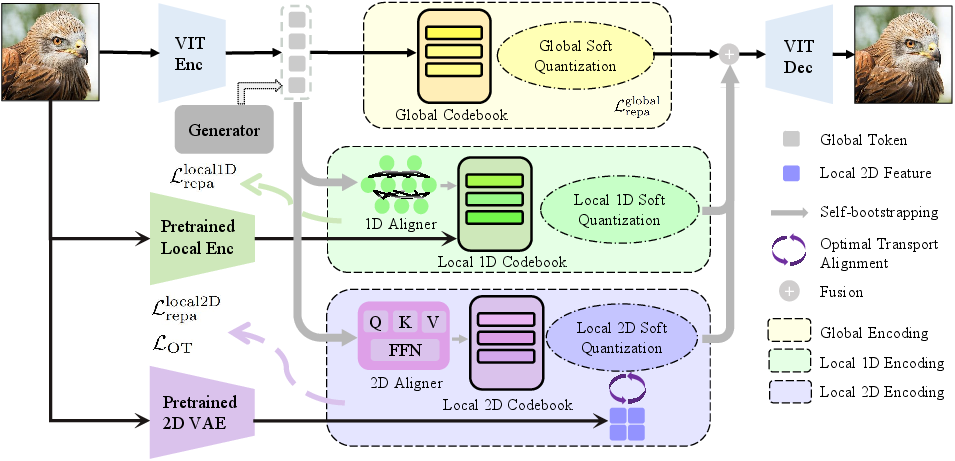
Figure 3: The SelfBootTok pipeline, where images are encoded into global tokens, local tokens are predicted and aligned, then all fused and decoded, evidencing the method’s scalability and efficiency.
Self-Supervised Bootstrapping
Local tokens are directly regressed from global tokens through non-parametric (1D, via MLP) and transformer-based (2D) heads. Training is bootstrapped: local detail decoders learn to predict the ground-truth local token sequences using only global information, without requiring labeled data or paired modalities.
This architecture factors the tokenization process, reducing learning complexity in downstream generators, which now only generate global tokens. Local structure is reconstructed reliably by the tokenizer.
Training, Optimization, and Scalability
Optimal Transport for 2D→1D Alignment
The mapping between local 2D visual features and their compressed 1D token representations is formulated as an entropy-regularized optimal transport problem, efficiently solved via the Sinkhorn algorithm. This enforces a compact, cost-optimized alignment between spatially-distributed details and sequential latent tokens.
Parallel and Efficient Training
After learning the global tokens, their parameters and codebooks are frozen. Expansion of the local aligners (from 10M to 600M parameters) can be performed in parallel with generator training, as generation relies only on the global tokens. This strategy reduces training time and computation—by approximately 54% and 40% respectively—since retraining of the generator for each new tokenization scale is not required.
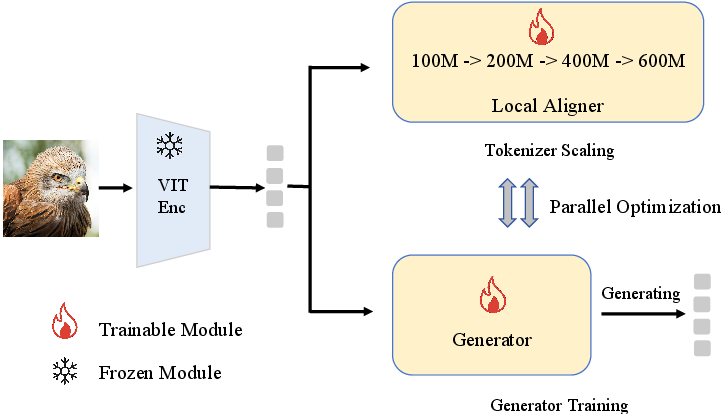
Figure 2: Parallel training pipeline illustration, showing separation and simultaneous scaling of tokenizer and generator branches for efficient optimization.
Empirical Results
Quantitative Evaluations
SelfBootTok achieves a new state-of-the-art gFID score of 1.56 on ImageNet-1K 256×256 with only 64 tokens, outperforming previous 1D tokenizers at the same token budget and matching or exceeding much larger 2D and autoregressive tokenizers (e.g., VA-VAE at 1.35 with 256 tokens; MAR-H at 1.55 with 256 tokens). Reconstruction metrics also improve progressively with scaling of the local aligner, with rFID dropping to 0.66, and further improvements observed for PSNR and SSIM.
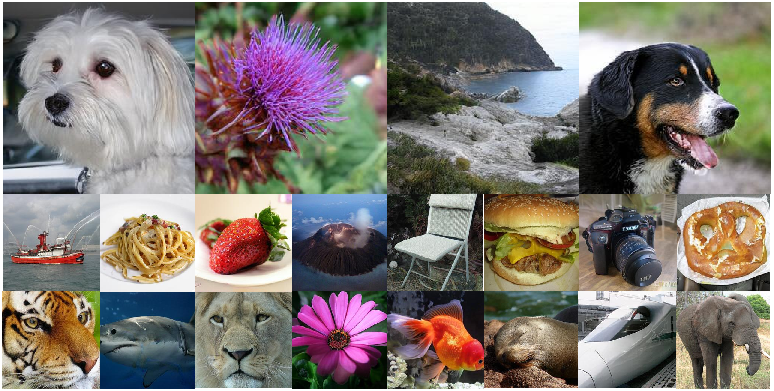
Figure 4: ImageNet-1K generative samples at 256×256 resolution from models with only 64 tokens, demonstrating visually diverse and detailed image synthesis across broad categories.
Ablation Studies
SelfBootTok’s performance consistently improves as both local branches (1D and 2D) are included, indicating nontrivial boosts in reconstructive fidelity (rFID, PSNR, SSIM). Among 1D alignment strategies, I-JEPA outperforms DINOv2 and SigLIP, confirming the impact of encoder selection on tokenizer behavior. Fusion strategy analysis reveals that while concatenation can enhance reconstruction, it may increase both decoder cost and computational demand, adversely affecting generative quality.
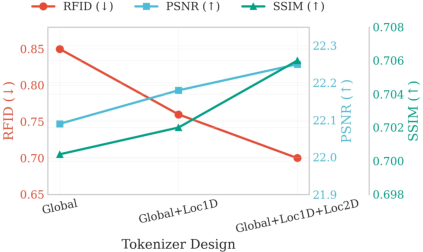
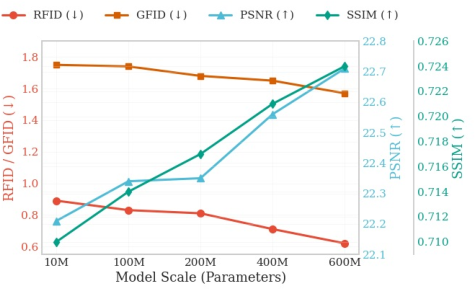
Figure 5: Ablation of the global-local self-bootstrapping design showing systematic improvement in rFID, PSNR, and SSIM as both 1D and 2D local details are incorporated.
Scaling Effects
Scaling the local 2D aligner (from 10M up to 600M parameters) directly improves both reconstructive and generative quality, with one-time generator training sufficing for all scales, due to the generator’s dependence solely on global tokens.
Practical and Theoretical Implications
SelfBootTok’s strict global-local decomposition, together with its self-bootstrapped recovery of local detail, fundamentally shifts complexity from downstream generation to the compression pipeline. This:
- Reduces model size, inference cost, and training burden for generative models.
- Enhances scalability: local detail branches can be scaled independently and in parallel without generative retraining.
- Suggests new directions for learned representations in multimodal and large-scale visual generative models, by merging scalability with efficient utilization of model capacity.
From a theoretical standpoint, the explicit factorization and use of OT-based alignment offer a clear path for studying generalization, redundancy minimization, and the disentanglement of visual information across hierarchical token groups.
Conclusion
SelfBootTok provides an efficient and scalable solution to balancing image compression and generation via bootstrapped tokenization. By decomposing tokens into global and local components and instituting a bootstrapped design for local detail recovery, the method sets new benchmarks for compactness and generation quality within the 1D tokenizer paradigm. The framework advances the scalability, efficiency, and modularity of contemporary image tokenization and fosters possibilities for future unification of visual, multimodal, and generative learning schemas.