Can AI Refute Economic Theory? Evidence from Beyond the Knowledge Cutoff
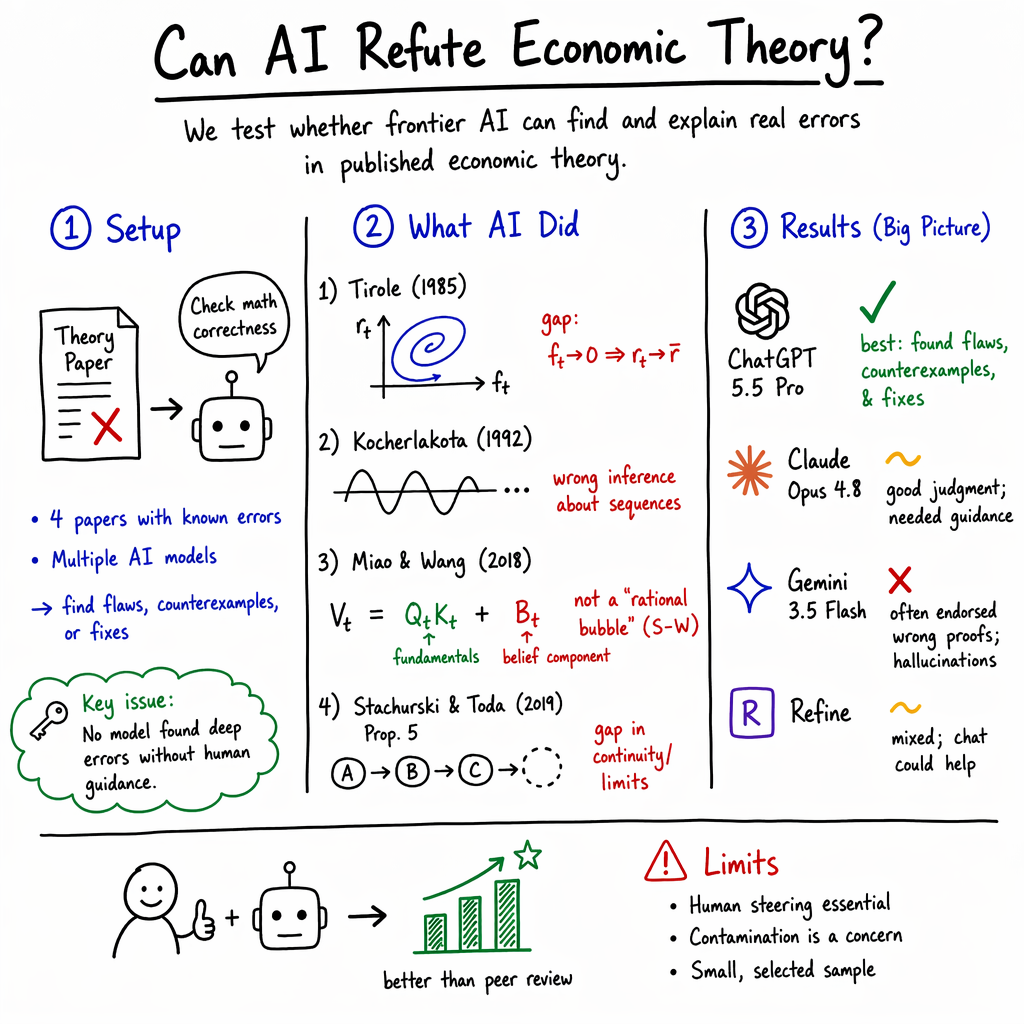
Abstract: Can AI refute economic theory? I document experiments in which I asked several AI models (Gemini, Refine, Claude, and ChatGPT) to check the correctness of four published papers in economic theory, each containing an error that I helped identify or correct. ChatGPT Pro performed best, occasionally constructing counterexamples and corrected proofs, while other models fared worse. However, no model located a true error without substantial human guidance, and data contamination complicates interpretation. I argue that a competent human paired with a frontier model can outperform current peer review, but AI cannot yet refute economic theory on its own.
Paper Prompts
Sign up for free to create and run prompts on this paper using GPT-5.
Top Community Prompts
Explain it Like I'm 14
Overview of the Paper
This paper asks a simple question: Can today’s AI find real mistakes in math-heavy economics papers? The author tested several AI models on famous economics papers that actually contain errors (the author already knew where the mistakes were). The big takeaway: AI can be very helpful at checking math once a human points it in the right direction, but it still can’t reliably find deep errors on its own.
Key Questions
- Can AI check whether a complicated proof in an economics paper is correct?
- Can AI discover a real error without being guided by a human?
- Which AI models do better at math reasoning and economics explanations?
- How much do issues like “knowledge cutoff” and “data contamination” affect what looks like AI reasoning?
What the Author Did (Methods, in simple terms)
The author ran a set of hands-on experiments:
- He chose four published economics theory papers that each had a known mistake. He knew these well, because he helped find or fix the errors before.
- He uploaded the papers to several AI tools (Gemini, Refine, Claude, and ChatGPT) and asked: “Is this key proof correct?”
- When the AI said “yes” but he knew there was a problem, he gave hints and follow-up questions to push the AI toward the tricky part.
- He asked the AIs to build a “counterexample” or a “fixed proof” when possible. A counterexample is like finding one special case that breaks a claimed rule—if even one case fails, the original claim isn’t always true.
- To reduce the chance that the AI was just “remembering” a known correction from the internet (data contamination), he ran a careful test on one paper: he turned off ChatGPT’s memory and web search and used a paper whose correction had only just been published. This helps show the AI was reasoning, not just retrieving.
Helpful translations:
- Knowledge cutoff: the latest date an AI was trained on. It usually doesn’t “know” new events after that date.
- Data contamination: when the test material is already in the AI’s training data. That makes the AI look smart because it’s seen the answer before, not because it truly reasoned it out.
- Peer review: the process where other experts read a paper before it’s published to check for quality and correctness.
Main Findings and Why They Matter
- ChatGPT Pro performed the best overall. It sometimes built correct counterexamples and cleaner proofs after some guidance.
- Claude was decent at explaining ideas in economics and judgment, but weaker at formal math reasoning.
- Gemini often accepted incorrect proofs at first and gave explanations that sounded good but weren’t solid.
- Most importantly: none of the AIs found a major error without strong human guidance. Left alone, they usually said the proof was correct.
- In the most careful test (on a 1985 paper with a newly posted correction), ChatGPT Pro seems to have created a fresh counterexample, not just pulled one from memory—suggesting real reasoning is possible.
- Why this matters: A skilled human working with a strong AI can already check arguments faster and sometimes better than typical peer review, where referees often don’t have time to dig deeply into long proofs. But AI is not ready to replace human judgment.
Short notes on each paper tested
- Tirole (1985): The proof had a flaw. No AI found it alone; with guidance, ChatGPT Pro produced a valid counterexample and fixes.
- Kocherlakota (1992): ChatGPT Pro quickly spotted the issue and gave a neat corrected proof; others needed more help.
- Miao and Wang (2018): The paper called something a “rational bubble,” but under the standard definition it isn’t one. Claude and ChatGPT Pro explained this clearly; Gemini got confused at first.
- Stachurski and Toda (2019): There were gaps in a proof. ChatGPT Pro identified key gaps quickly; others took more nudging.
Implications and Impact
- For researchers and students: AI is a powerful helper for checking algebra, exploring edge cases, and building counterexamples—once you suspect where the problem might be. It’s like having a fast, detail-oriented study partner who still needs your direction.
- For peer review: A human+AI team can likely beat the current system at catching technical mistakes. Journals and reviewers may want to responsibly allow AI-assisted checking (with clear rules about privacy and public preprints).
- Limits to keep in mind:
- The tests were on a small set of papers chosen by the author (who already knew the answers).
- Models change fast; results may differ later.
- Data contamination can make AI look smarter than it is if it’s seen the paper or its correction before.
Bottom line
AI can’t yet refute economic theory by itself. But in the hands of a thoughtful human who knows where to look, frontier AI can already help catch errors and improve proofs—and may do so better than the usual peer-review process.
Knowledge Gaps
Knowledge gaps, limitations, and open questions
Below is a consolidated list of unresolved issues that future research could address to strengthen, generalize, and operationalize the paper’s claims.
- External validity: Evaluate AI performance on a large, representative, and time-stamped sample of economic theory papers (including correct ones) to estimate false positive/negative rates and generalize beyond four handpicked cases with known errors.
- Contamination control: Implement rigorous decontamination audits (frozen offline models with known cutoffs, corpus provenance checks, paraphrase-based rewordings, and canary insertions) and quantify residual contamination risk for each run.
- Human steering quantification: Measure how much human input is required to surface genuine errors (time, number and specificity of hints), across zero-shot, limited-hint, and fully guided regimes.
- Prompting protocols: Standardize and ablate prompt features (chain-of-thought, tool use, multi-turn scaffolding, self-critique/debate) to isolate which prompting elements drive error detection versus spurious agreement.
- Formal tool integration: Systematically compare free-text workflows to pipelines that invoke code interpreters, SMT solvers, and proof assistants (Lean/Isabelle/Coq/HOL Light) for checking steps and verifying counterexamples in economics proofs.
- Benchmark and taxonomy: Construct and release a contamination-controlled, time-stamped benchmark of economic proofs with labeled error types (missing assumptions, boundary cases, non sequiturs, stability vs global arguments, measure-theoretic gaps) and gold-standard fixes/counterexamples.
- Reproducibility and model drift: Quantify run-to-run variance and version-to-version drift in judgments and constructions (report seeds, temperatures, model hashes), and assess stability under slightly rephrased or reordered documents.
- Autonomy claims: Conduct blinded studies where experimenters do not know the ground truth to test whether any model can locate deep errors without targeted steering.
- Counterexample verification: Develop automated economic “checkers” that validate all assumptions and equilibrium conditions for model-generated counterexamples, and report systematic failure modes (e.g., violating stability or feasibility constraints).
- Comparative reviewer trials: Run controlled experiments comparing human referees, AI-only, and human+AI teams on the same manuscripts, measuring accuracy, time, and cost, to substantiate the claim that human+frontier AI beats current peer review.
- Cost, access, and equity: Assess performance and cost-effectiveness across paid vs free tiers and open-weight local models; quantify whether access constraints create inequities in quality assurance.
- Confidentiality-preserving workflows: Test local/offline deployments, secure enclaves, and redaction protocols that satisfy journal privacy policies, and measure performance trade-offs relative to cloud models.
- Domain adaptation: Evaluate whether fine-tuning or instruction-tuning on math-econ corpora and formalized economics proofs improves rigor and reduces hallucinations without overfitting.
- Calibration and abstention: Measure confidence calibration and develop mechanisms (uncertainty estimates, abstain/deferral policies) to reduce plausible-but-wrong endorsements of flawed arguments.
- Scope across subfields: Extend evaluation beyond macro/OLG to game theory, mechanism design, general equilibrium, and econometric theory to map where AI succeeds/fails and why (e.g., dimensionality, fixed-point vs dynamical arguments).
- Policy design and metrics: Propose concrete editorial/refereeing guidelines (disclosure, allowable tools, reproducibility checklists) and define quantitative metrics for “refutation quality” that distinguish gap identification, valid counterexample construction, and correct proof repair.
Practical Applications
Immediate Applications
The paper demonstrates that a competent human paired with a frontier LLM can reliably identify gaps, construct counterexamples, and suggest corrected proofs in economic theory—faster and more thoroughly than typical peer review. The following applications can be deployed now:
- AI-augmented referee reports and editorial triage
- Sectors: academia, publishing
- Tools/workflows: ChatGPT Pro for line-by-line logic checks; Claude for economic interpretation; standardized prompts; memory/web disabled to reduce contamination; shareable audit trails
- Assumptions/dependencies: access to frontier LLMs; reviewer expertise; clear journal policies on confidentiality and AI use
- Pre-submission “proof audit” for authors
- Sectors: academia
- Tools/workflows: authors run main results through ChatGPT Pro to stress-test proofs, request counterexamples, and generate corrected proofs; attach an AI-audit checklist to submissions
- Assumptions/dependencies: author time and competence; model access; human verification of AI outputs
- Seminar/discussant assistant for targeted critique
- Sectors: academia, education
- Tools/workflows: upload preprints to produce likely weak points, alternative assumptions, and counterexample families; generate focused questions for presenters
- Assumptions/dependencies: availability of preprints; informed human oversight
- Consistency and definition audits (e.g., “bubble” vs fundamental value)
- Sectors: academia, finance
- Tools/workflows: LLM checks that definitions match citations; flags inconsistent use of terms (as in the bubble definition case); verifies whether TVC or other conditions are actually proved
- Assumptions/dependencies: clear canonical definitions in the literature; access to cited papers or a curated definition library
- Model validation and red-teaming in industry R&D
- Sectors: finance (risk/pricing models), energy (optimization/planning), software (algorithm design)
- Tools/workflows: LLM-guided counterexample search and edge-case sweeps for internal models; verification that key steps (monotonicity, stability) are correctly used
- Assumptions/dependencies: expert-in-the-loop; secure environments for confidential models/data
- Compliance documentation and regulatory submission checks
- Sectors: finance, energy, telecom/utilities
- Tools/workflows: LLMs review regulatory models and documentation to validate logic, identify unjustified steps, and ensure assumptions match conclusions
- Assumptions/dependencies: regulator acceptance of AI-assisted methods; confidentiality controls
- Curriculum enrichment for graduate methods and mathematical economics
- Sectors: education
- Tools/workflows: assignments where students critique proofs with LLMs, contrast local vs global stability, and construct numerical counterexamples
- Assumptions/dependencies: instructor guidance; institutional policies on AI use in coursework
- Journal policy updates to enable responsible AI use
- Sectors: academia, publishing
- Tools/workflows: require/encourage public preprint posting (e.g., arXiv) to sidestep confidentiality, allow AI-assisted review with disclosure, and store AI logs as part of the referee file
- Assumptions/dependencies: buy-in from editors and societies; clear disclosure and privacy standards
- Cost-aware tool selection and division of labor
- Sectors: academia, SMEs
- Tools/workflows: use ChatGPT Pro for formal reasoning; use Claude for interpretive and literature-framing tasks; avoid redundant paid tools when existing subscriptions suffice
- Assumptions/dependencies: awareness of each model’s strengths; budget constraints
- Contamination-aware evaluation protocols
- Sectors: academia, industry
- Tools/workflows: disable web/memory, date-stamp runs, compare to knowledge cutoffs, and maintain reproducible transcripts to reduce data contamination risks
- Assumptions/dependencies: discipline in setup; organizational standards for AI evaluation
- Reading companion for complex documents (advanced users)
- Sectors: daily life (academics, policy analysts)
- Tools/workflows: LLM-generated structured summaries, assumption maps, and “what would falsify this?” checklists for technical reports or contracts
- Assumptions/dependencies: user literacy in basic logic; careful human verification to prevent hallucination-driven errors
Long-Term Applications
The paper also points to research and infrastructure opportunities that require advances in models, tooling, policy, or standards before broad deployment:
- Autonomous theory refutation without human steering
- Sectors: academia
- Tools/workflows: next-generation LLMs that propose and test candidate flaws and counterexamples end-to-end
- Assumptions/dependencies: improved mathematical reasoning and search; reduced hallucinations; better training on formal corpora
- Tight integration with formal proof assistants
- Sectors: academia, software/verification
- Tools/workflows: LLMs produce machine-checkable proofs (Isabelle/Coq/Lean) for economic theorems; creation of an economics-proof library
- Assumptions/dependencies: formalization of core econ definitions/models; developer tooling; community standards
- Referee-as-a-service platforms for journals and funders
- Sectors: publishing tech, research funding
- Tools/workflows: secure portals that run standardized AI audits (logic checks, counterexample search, definition consistency) and provide dashboards to editors
- Assumptions/dependencies: legal/ethical frameworks; scalable infrastructure; integration with submission systems
- Regulatory model audit pipelines
- Sectors: finance, energy, health economics
- Tools/workflows: institutionalized AI-assisted checks for models submitted to regulators (e.g., stress testing, tariff design), with certified audit artifacts
- Assumptions/dependencies: regulator endorsement; on-prem or air-gapped LLMs; auditability and chain-of-custody
- Field-specific benchmarks and corpora for contamination-safe evaluation
- Sectors: academia, AI research
- Tools/workflows: curated datasets of econ proofs (including known flawed proofs) with precise release dates to measure true reasoning gains
- Assumptions/dependencies: community contribution; clear licensing; shared evaluation protocols
- AI proof-audit certificates for publications
- Sectors: academia, publishing
- Tools/workflows: standardized “AI-audited” badges with reproducible logs attached to papers; badges distinguish human-only, AI-assisted, and formally verified proofs
- Assumptions/dependencies: uptake by journals and societies; incentives for authors
- Multi-agent AI debate for red-teaming theory
- Sectors: academia, safety-critical industries
- Tools/workflows: competing LLM agents (prover vs refuter) to pressure-test proofs and surface edge cases before publication/deployment
- Assumptions/dependencies: coordination frameworks; evaluation metrics for debate quality
- Secure, confidential LLM deployments for peer review and regulation
- Sectors: academia, government, finance
- Tools/workflows: on-prem/private-cloud LLMs with strict data retention and no-training guarantees to handle unpublished or proprietary materials
- Assumptions/dependencies: procurement and IT capabilities; verifiable privacy assurances
- Domain-specialized “EconMath” models
- Sectors: academia, policy analysis
- Tools/workflows: LLMs trained/fine-tuned on economic theory, dynamic programming, equilibrium concepts, and standard definitions (e.g., bubbles, TVC)
- Assumptions/dependencies: high-quality domain datasets; risk management for overfitting/contamination
- Cross-domain transfer to safety-critical mathematical claims
- Sectors: robotics (control proofs), energy (grid stability), aerospace (safety margins)
- Tools/workflows: adapt the human-in-the-loop + AI counterexample workflow to verify stability, feasibility, and invariants in engineering proofs
- Assumptions/dependencies: domain expertise; integration with simulation/verification stacks
- Automatic executable tests from symbolic counterexamples
- Sectors: software/ML, quantitative finance
- Tools/workflows: pipelines that turn AI-suggested counterexamples into numerical simulations/unit tests for algorithms and models
- Assumptions/dependencies: reliable program synthesis; robust numerical tooling
- Pedagogical reform to integrate AI reasoning and ethics
- Sectors: education
- Tools/workflows: courses on AI-assisted proof checking, contamination risks, and reproducibility culture in economics and related fields
- Assumptions/dependencies: curriculum redesign; faculty training; institutional policy alignment
Each application rests on the paper’s core insight: today’s best results come from a human expert steering a strong LLM, with explicit controls for contamination and careful human verification.
Glossary
- asymptotic behavior: The behavior of a sequence or function as the index or argument goes to infinity. Example: "including cases (i)--(iii) for the asymptotic behavior of the interest rate."
- benchmark data contamination: Evaluation data overlapping with training data, inflating measured performance. Example: "benchmark data contamination"
- bubbleless equilibrium: An equilibrium in which asset prices equal their fundamental values with no bubble component. Example: "the possibility of a bubbleless equilibrium with "
- bubbly steady state: A steady state supported by a positive bubble component in prices. Example: "a
bubbly'' and abubbleless'' steady state" - Cobb-Douglas production function: A common production function with constant elasticities, typically of the form F(K,L)=AKαL1−α. Example: "it successfully generated a counterexample based on the Cobb-Douglas production function"
- constant relative risk aversion (CRRA): A utility specification where the coefficient of relative risk aversion is constant. Example: "a utility function exhibiting constant relative risk aversion (CRRA)"
- corrigendum: A published correction to a previously published article. Example: "When I uploaded the corrigendum, Claude flagged that the original proof had a further issue"
- counterexample: A specific example that shows a general statement or proposition is false. Example: "presenting a counterexample (see their Proposition 1)."
- Diamond model: The standard overlapping-generations (OLG) framework introduced by Peter Diamond. Example: "the one-dimensional Diamond model"
- Diamond's stability assumption: A local stability condition about intersecting curves in the Diamond OLG setup. Example: "Diamond's stability assumption"
- endowment economies: Models where agents receive exogenous income streams (endowments) rather than producing output. Example: "infinite-horizon models of endowment economies with borrowing constraints"
- formal proof assistants: Software systems that help construct and verify mathematical proofs in a formal language. Example: "LLMs coupled with formal proof assistants can resolve previously open problems"
- formal verification: The use of mathematical/formal methods to rigorously verify correctness of proofs or systems. Example: "computer-assisted formal verification"
- frontier model: A state-of-the-art AI model at the cutting edge of capabilities. Example: "a competent human paired with a frontier model can outperform current peer review"
- global convergence: Convergence to a steady state from any initial condition in the state space. Example: "guarantee global convergence"
- Inada condition: A condition on production/utility functions, e.g., marginal product going to infinity as input goes to zero. Example: "Inada condition "
- JEL codes: The Journal of Economic Literature classification system used to categorize economics research. Example: "JEL codes: A11, B41, O33"
- knowledge cutoff: The latest date up to which an AI model has been trained on data. Example: "knowledge cutoff"
- LLMs: Large neural network–based models trained to process and generate natural language. Example: "LLMs"
- local stability condition: A stability property ensuring convergence when starting sufficiently close to a steady state. Example: "a local stability condition"
- monotonicity property: A property where a mapping preserves order, often aiding convergence arguments. Example: "the monotonicity property in the Diamond model"
- no-Ponzi TVC: A transversality/no-Ponzi condition ruling out debt schemes that grow without bound. Example: "no-Ponzi TVC"
- OLG model: The overlapping-generations model where cohorts live for multiple periods and overlap in time. Example: "If the OLG model does not have dividends"
- Planar Unit Distance Problem: A discrete geometry question about points in the plane at unit distance apart. Example: "Planar Unit Distance Problem"
- present discounted value: The current value of a stream of future payments discounted back to the present. Example: "present discounted value of dividends"
- rational bubbles: Price components above fundamentals sustained by self-fulfilling expectations and consistent with rationality. Example: "can generate rational bubbles."
- rents: In this context, dividend-like payouts referred to as “rents” by Tirole. Example: "what Tirole calls rents"
- Santos-Woodford present-value definition: A standard asset-pricing definition of rational bubbles via the present-value relation. Example: "the standard Santos-Woodford present-value definition"
- steady state: A fixed point of a dynamical system where variables remain constant over time. Example: "near the steady state"
- subsequence: A sequence derived by selecting a subset of terms from another sequence in order. Example: "the existence of a subsequence "
- temporary equilibrium mapping: The period-by-period mapping that determines equilibrium given current states. Example: "the temporary equilibrium mapping"
- transversality condition (TVC): A boundary condition ensuring non-explosive optimal paths, often ruling out bubbles or Ponzi schemes. Example: "two different notions of ``transversality condition'' (TVC)"
- Type I error: Incorrectly rejecting a true hypothesis (false positive). Example: "A Type~I error (the incorrect rejection of a correct contribution)"
- Type II error: Failing to reject a false hypothesis (false negative). Example: "A Type~II error (the incorrect acceptance of an incorrect contribution)"
Collections
Sign up for free to add this paper to one or more collections.

