- The paper introduces SocialCoach, an RL-based framework for personalized and scalable social skill training.
- It employs a multi-agent LLM pipeline to construct a structured theory-to-practice knowledge corpus validated by expert ratings.
- Empirical results show significant improvements in learner engagement and proficiency compared to non-adaptive instructional methods.
SocialCoach: Reinforcement Learning-Driven Personalized Social Skill Tutoring at Scale
Introduction
"SocialCoach: Personalized Social Skill Learning with RL-based Agentic Tutoring and Practice" (2606.04155) presents a fully agentic, LLM-driven tutoring framework for scalable, individualized social skill development. This system addresses bottlenecks in existing soft skill education—namely, the reliance on expert coaches, lack of personalization, insufficient theory-practice integration, and scalability limitations—by combining automatic, schema-guided knowledge extraction, reinforcement learning-based adaptive scenario scheduling, and attribution-based pedagogical feedback. The result is the deployment of SocialCoach as the core engine in a commercial-grade product (EQoach), with empirical results demonstrating strong pedagogical and user engagement outcomes.
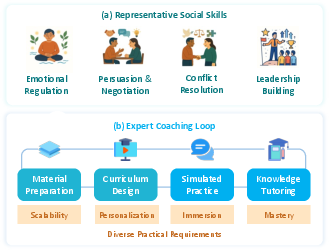
Figure 1: The social skills training landscape with critical competencies and the traditional expert coaching loop.
Theory-to-Practice Knowledge Corpus Construction
The foundation of SocialCoach is an automated, multi-agent, LLM-powered pipeline that constructs a highly-structured, theory-to-practice knowledge corpus from authoritative sources (including selected books, papers, and media). The schema captures three pedagogical layers: (1) strategic theories (“why”), (2) illustrative cases (“how”), and (3) practical scenarios (“doing”). The knowledge base is structurally tagged across multiple dimensions—core competencies (based on CASEL: Self-Awareness, Self-Management, Social Awareness, Relationship Skills, Responsible Decision-Making), fine-grained social skills, and scenario contexts (family, workplace, etc.). The pipeline’s agentic workflow comprises extraction, schema validation, multi-dimensional tagging, and refinement, ensuring pedagogically-grounded and traceable content.
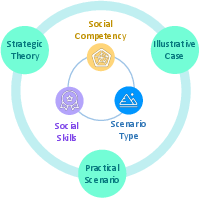
Figure 3: The proposed theory-to-practice social knowledge framework with multi-faceted categorization perspectives.
Corpus analysis reveals robust diversity and balance: over 40,000 entries, high tag entropy, strong expert Likert ratings (tag agreement and pedagogical value frequently >4.5/5 for scenarios), and logical skill-competency co-occurrence structures. Such structured granularity is critical for supporting nuanced retrieval and adaptation in downstream agentic modules.
Adaptive RL-Based Scenario Prescription
An RL-based prescription agent lies at the heart of personalization. SocialCoach reframes practice scheduling as a reinforcement learning problem with a Markov decision formulation, where the agent conditions on a learner’s dynamic profile (demographics, behavioral trace, evolving proficiency vector) to prescribe scenario queries and retrieval filters over the corpus. The system leverages synthetic user simulation—profile diversity bootstrapped from large, public datasets (SocioVerse, PersonaHub) and matched/deduplicated via embedding plus MMR/Hungarian assignment—for efficient high-fidelity training. To optimize the agent for both pedagogical gains and engagement, proxy rewards are generated by modern LLM judges (GPT-5, rubric-grounded, one-shot). The policy is fine-tuned with agentic RL (“multi-turn” protocol with experience replay), emphasizing both retrieval-ability across the schema and alignment with realistic proficiency progression.
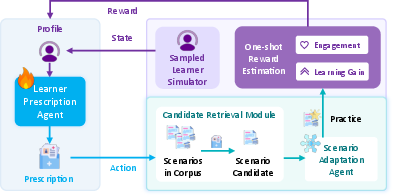
Figure 2: Scenario reference retriever optimization with RL from learner simulation feedback.
Empirical results show that SocialCoach’s RL-trained prescription agent outperforms strong retrieval and non-adapted generation baselines on both simulated learning gain and engagement (e.g., gains of 0.2–0.7 Likert points over GPT-5, Qwen3-based non-tuned agents in multi-turn instructional planning, Table 5), validating the necessity for RL adaptation in simulation-rich, schema-aware practice personalization.
Pedagogically-Grounded Coaching Loop
SocialCoach operationalizes the “coaching loop” by integrating immersive scenario-based practice (with role-playing agents, context-sensitive behavioral norms), fine-grained attributional proficiency assessment (diagnosing both skill gaps and root causal deficits using acquisition/performance taxonomy), and knowledge-grounded, Socratic reflective tutoring (retrieval-augmented, theory/case-based, with explicit reflection triggers). Each post-session update refines the user’s multidimensional proficiency estimate and targets future prescriptions. Automated and human-judged experiments indicate that the attributional diagnostic layer notably enhances actionable feedback, traceability, and perceived personalized learning value compared to ablated and traditional RAG/prompting baselines.
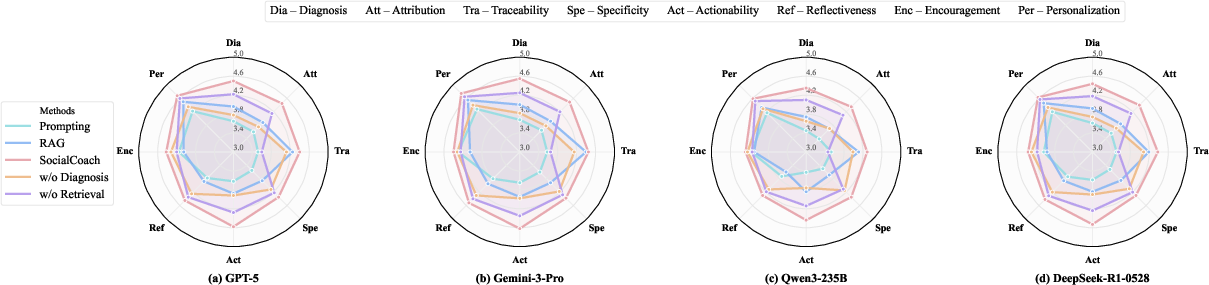
Figure 4: Evaluation results on tutoring guidance, with SocialCoach showing higher multi-metric judge scores over baselines.
Empirical Analysis and User Study
The framework is implemented over a robust MLLM stack (Qwen3, GPT-5, scaling libraries, Chroma+embedding DB backend, 16 GPU cluster for RL finetuning). Quantitative evaluation encompasses (a) corpus coverage and diversity, (b) prescription/personalization efficacy (using thousands of simulated learner paths, judged by LLMs and humans), and (c) guidance/pedagogical value (eight detailed metrics including diagnostic specificiity, actionability, and encouragement).
On end-to-end deployment in EQoach, a 50-participant human user study (students/young professionals) assesses perceived alignment, engagement, realism, and skill transfer: all core components receive high marks (e.g., reflective guidance: 4.88/5, agent realism: 4.40/5, engagement retention: 4.48/5). Qualitative feedback cites advanced Socratic diagnosis and realistic scenario immersion as unique strengths. Simulator reward correlation with human judgments (Pearson r = 0.37–0.42, p < 0.01) supports the validity of RL-based simulation for optimizing agentic pedagogy.
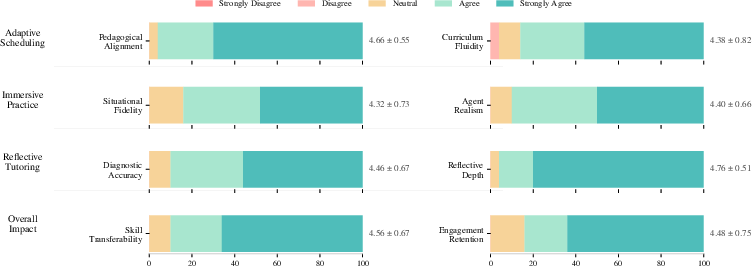
Figure 5: Questionnaire results from 50 participants, illustrating high user satisfaction with adaptive scheduling and reflective guidance.
Distributional and Contextual Scalability
In-depth exploratory analyses further validate the framework’s coverage and transferability:
- Scenario context diversity is broad: scenarios cover family, workplace, education, public/social, romantic, and more. Family and workplace dominate by count, but all domains are well-represented.
- Skill granularity: distribution and co-occurrence analyses (heatmaps, frequency plots) highlight balanced representation of foundational skills (communication, empathy, conflict resolution) and confirm logical cross-tagging (e.g., Social Awareness–Relationship Skills).
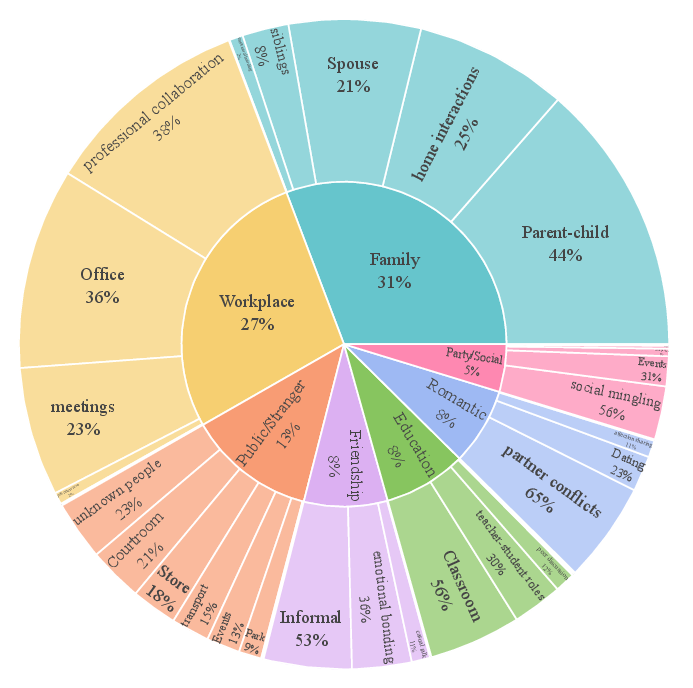
Figure 8: Distribution of scenario contextual types showing rich coverage across key life domains.
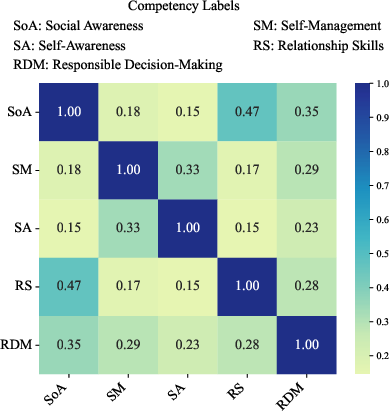
Figure 7: Co-occurrence heatmap of social competencies, with clusters reflecting expected pedagogical relationships.
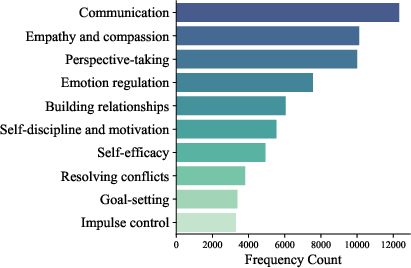
Figure 9: Top 10 social skills by frequency, such as Communication and Empathy.
Scaling to broader populations and additional contexts is thus supported by both the corpus schema and the adaptability of agentic scenario design.
Implications and Future Directions
The SocialCoach framework exemplifies a scalable template for RL-enhanced, LLM-powered soft skill tutoring. Its design advances agentic ITS research along multiple vectors:
- Pedagogical soundness via automation: systematic schema extraction and tagging overcome the scarcity and unstructured nature of human soft skill expertise.
- Simulation-based RL for cold start: realistic user emulation and proxy reward design are critical for adaptive training in domains unsuited for large, human-annotated logs.
- Framework generalizability: modular agent roles (extraction, prescription, adaptation, attribution, reflective feedback) can be composably extended to other open-ended domains (e.g., emotional intelligence, counseling, creativity).
- Human-AI alignment: User studies show that proper attributional and Socratic scafolding is trusted and actionable for learners, a result not robustly achieved by prior mono-task LLM or rule-based tutors.
Further research may explore richer, continual-updating user modeling, curriculum learning over longer timescales, deeper cross-domain transfer, and large-scale outcome-based human evaluation in authentic settings. The blend of RL with LLMs for open-ended, schema-aware skill acquisition represents a methodological shift likely to impact the architecting of future pedagogical agents, both in education and human-robot interaction.
Conclusion
SocialCoach demonstrates that agentic LLM architectures, when grounded in large-scale, theory-to-practice knowledge frameworks and optimized with simulation-based RL, can deliver highly personalized, immersive, and pedagogically valid soft skill learning at scale. Its practical deployment, engineering robustness, and empirical validation with both LLM and human evaluators mark a significant advance toward generalizable, scalable, and effective agentic tutoring in complex, open-ended behavioral domains.
(2606.04155)

