- The paper presents a comparative analysis of VQE, QAOA, and feedback-based algorithms to probe quantum phase transitions in strongly correlated many-body systems.
- It identifies major challenges including barren plateaus, noise-induced fidelity loss, and exponential sampling complexity in NISQ devices.
- The study highlights that integrating physics-informed ansätze with hybrid classical-quantum protocols is key to overcoming simulation limitations.
Quantum Optimization Algorithms for Strongly Correlated Many-Body Systems
Introduction
The simulation of strongly correlated quantum many-body systems poses formidable challenges due to the exponential growth of the Hilbert space and severe sign problems that frustrate classical algorithms. The limitations of exact diagonalization, QMC, and tensor network methods motivate the exploration of quantum simulators as natural tools for these systems, in line with Feynman’s vision. The focus of this work is a comparative and critical analysis of quantum optimization algorithms in the context of the NISQ regime, with an emphasis on their application to probing quantum phase transitions and exotic collective phenomena in condensed matter physics (2606.03147).
The analysis spans both standard variational paradigms—specifically the Variational Quantum Eigensolver (VQE) and Quantum Approximate Optimization Algorithm (QAOA)—and emergent feedback-based approaches (e.g., FALQON), elucidating their respective algorithmic architectures, operational bottlenecks, and suitability for the investigation of phenomena such as Deconfined Quantum Criticality (DQC), many-body localization (MBL), topological transitions, spin liquids, and non-Fermi liquid behavior.
Algorithmic Paradigms in the NISQ Regime
Three major algorithmic frameworks are delineated for quantum optimization under NISQ constraints: VQE, QAOA, and FQAs.
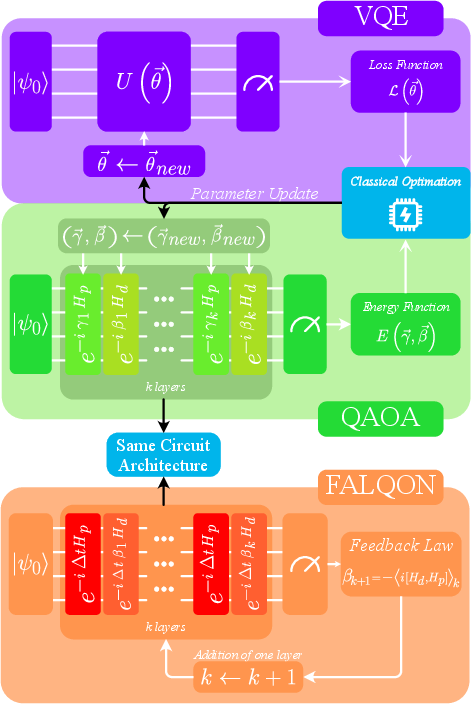
Figure 1: Schematic comparison of VQE, QAOA, and FALQON in the NISQ setting, highlighting differences in the quantum-classical feedback and circuit growth mechanism.
VQE operates via iterative minimization of the energy expectation value over a parameterized quantum state, requiring repeated quantum measurements fed into a classical optimizer. Its flexibility and resilience to certain coherent gate errors are contrasted by a dramatic sensitivity to sampling noise and the severe barren plateau phenomenon, which can render optimization infeasible for system sizes of practical interest [McClean2018_Barren].
QAOA, initially proposed for classical combinatorial optimization, alternates layers of operator evolutions generated by a cost Hamiltonian and a mixing Hamiltonian. It has explicit connections to digitized adiabatic evolution, with provable convergence in the infinite-depth limit [Farhi2014]. Its main practical bottleneck is the hardware-implemented connectivity; generic QAOA requires topologies matching the problem graph, and SWAP insertion to achieve this aggravates circuit depth and error rates [Wurtz2020].
Feedback-based Quantum Algorithms, notably FALQON, abandon black-box classical optimization in favor of deterministic iterative updates based on physical observables, notably commutator measurements i[Hd,Hp]. This structurally avoids gradient vanishing and barren plateaus native to variational circuits. However, FQAs are highly susceptible to accumulative errors in feedback, and face latency and decoherence constraints as the circuit depth grows dynamically.
Applications to Quantum Phase Transitions and Exotic Matter
A rigorous analysis of quantum optimization algorithms is only meaningful in the context of their ability to elucidate non-trivial physics. This work surveys five emblematic problems where NISQ-era algorithms have both theoretical promise and acute limitations.
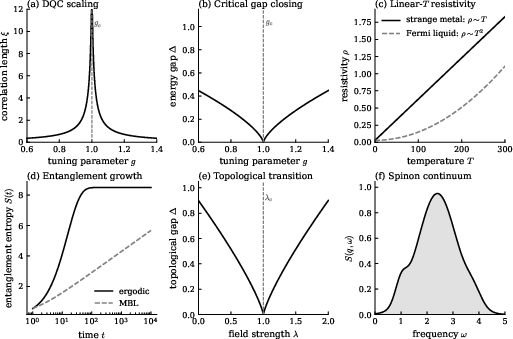
Figure 2: Key signatures of correlated quantum matter, including criticalities, scaling of energy gaps, dynamics of entanglement, transport anomalies, MBL transitions, and spectral features of fractionalization.
Deconfined Quantum Criticality
DQC transitions, such as the direct N\'eel–VBS transition in 2D Heisenberg models, evade the LGW paradigm and involve emergent fractionalization with long-range entanglement and vanishing spectral gaps. Classical numerics are undermined by severe finite-size artifacts and sign problems. Near the critical point, variational optimization is stymied by the entanglement-induced barren plateau, blocking the scaling needed for critical exponent extraction. FALQON, especially with imaginary-time enhancements (ITE-FALQON), is positioned as a candidate for deterministic ground state preparation even in highly entangled, symmetry-protected regimes.
The absence of quasiparticles and Planckian dissipation in strange metals have deep connections to quantum chaos (SYK model). QAOA-based time-evolution algorithms can probe dynamics such as OTOC decay, linking quantum simulation directly to finite-temperature quantum chaos bounds. However, classical simulation is functionally intractable due to entanglement growth, reinforcing the need for shallow quantum circuits.
Many-Body Localization
The MBL transition cannot be efficiently captured by DMRG or exact methods due to the necessity of accessing highly excited eigenstates and non-thermalizing dynamics. The expressibility-fidelity trade-off is distilled in this context: ergodic regimes require exponential circuit depth, while localized phases are efficiently simulatable with low-depth circuits. The logarithmic entanglement entropy growth post-quench is a stringent test for quantum hardware, with variational deflation and adaptive circuit architectures providing practical access to otherwise unreachable observables.
Topological Transitions
Robust topologically ordered phases, such as those in the Toric Code with transverse fields, are invisible to local order parameters and subject to non-trivial global entanglement structure. FALQON uniquely respects symmetries and gauge constraints by construction, ensuring physicality across transitions. Extracting topological entanglement entropy from VQE-prepared states remains a central challenge, with hybrid classical shadow tomography providing scalable access to entanglement measures relevant for phase identification.
Quantum Spin Liquids
QSLs, especially on frustrated geometries such as the Kagome lattice, involve ground state degeneracies and gapless or gapped spinon continua. Quantum simulators enable the simulation of dynamical correlation functions, e.g., the dynamic structure factor S(q,ω), giving direct access to the spectroscopic fingerprints of fractionalization. The contextual integration of QAOA and variational techniques with experimental protocols (shadow tomography) is essential for practical phase characterization.
Critical Challenges: Optimization, Landscape, and Noise
Despite the range of applications, quantum optimization for many-body physics in the NISQ era is fundamentally challenged by several interconnected phenomena:
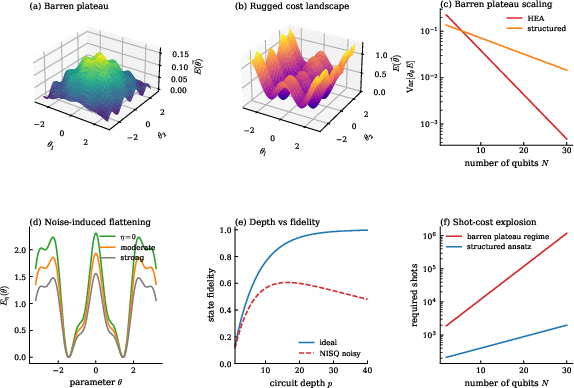
Figure 3: Cost landscape pathologies, noise impact, and sampling complexity for variational circuits in the NISQ context.
- Barren Plateaus: Expressive hardware-efficient ansätze generate cost landscapes where the gradient vanishes exponentially with system size, inhibiting all known gradient-based optimization methods.
- Rugged Cost Landscapes: Physical Hamiltonians create landscapes with numerous spurious local minima, trapping classical optimizers and precluding global convergence.
- Noise-Induced Plateaus and Fidelity Loss: As hardware noise increases, cost surfaces flatten, the global minimum is displaced, and the effective attainable fidelity with respect to the target state sharply decreases. There is a hard trade-off between physical expressibility and operational feasibility.
- Sampling Explosion: Measurement overhead grows exponentially both with precision requirements and system size, and is exacerbated under barren plateau scenarios.
Feedback-based algorithms mitigate expressibility vs. trainability paradoxes via local, deterministic updates, enhancing the likelihood of algorithmic success. Nevertheless, their convergence and stability are highly contingent on an improved experimental noise floor and reduced feedback latency.
Implications and Future Directions
The investigation confirms that NISQ devices, when controlled by naive variational routines, face intrinsic algorithmic and hardware-induced limitations for large-scale many-body physics. The adoption of feedback-based algorithms, physics-informed ansätze, and co-designed hardware could substantially increase system sizes and correlation lengths accessible by near-term quantum computing.
On the theoretical side, deterministic and adaptive circuits provide a more robust foundation for navigating ground states near criticality, preparing excited states in MBL and non-Fermi liquid systems, and preserving symmetries in gauge-constrained models. On the experimental side, persistent advances in error mitigation, improved qubit coherence, and reduced readout errors are necessary to move beyond proof-of-principle toward quantum advantage in condensed matter studies.
The steep ascent toward practical utility will likely unfold along the following axes:
- Integration of hybrid classical-quantum protocols (classical shadows, randomized measurements) for scalable extraction of many-body observables.
- Further development and formal analysis of feedback-based quantum optimization—particularly with imaginary-time and adaptive time-scaling—for symmetry-rich and entangled systems.
- Algorithm/hardware co-design strategies to natively embed problem symmetries and reduce the operational circuit depth.
- Progress in quantum error correction and mitigation tailored for many-body correlators and phase transition observables.
Conclusion
Quantum optimization algorithms in the NISQ regime offer targeted, though not unqualified, progress toward simulating strongly correlated quantum matter. The interplay of algorithmic design (VQE, QAOA, FQAs), hardware constraints, and physical insight underpins current capability and calls for integrated development strategies. Breakthroughs will depend on leveraging deterministic dynamics informed by feedback, encoding symmetries natively, and innovating both at the hardware layer and the algorithm-controller interface. Such developments are essential to unlock the characterization of quantum-critical and topologically non-trivial phenomena inaccessible to classical computation.

