Gate AI: LLM Security Benchmark Evaluation Methodology and Results
Abstract: Published evaluations of prompt-injection and jailbreak detectors for LLMs often suffer from two systematic weaknesses: per-dataset threshold tuning and undisclosed operating points. We describe an evaluation harness that addresses both. The detector under evaluation is scored across 16 public benchmarks (12,111 samples) using 5-fold cross-validation. StratifiedKFold (by row) is the headline pass; a parallel StratifiedGroupKFold pass over a composite key (parent-prompt id plus MinHash + LSH near-duplicate clusters at Jaccard $\gtrsim 0.8$) runs alongside it as a leakage-premium diagnostic. A single global operating point is selected on the held-out folds (max F1 subject to FPR $\leq 1\%$) and applied uniformly to every dataset, so per-dataset results reflect one threshold rather than per-benchmark optimisation. Generalisation is examined through a battery of diagnostics (leave-one-dataset-out cross-validation, a random-label control, adversarial validation, permutation feature importance, length-bias correlation, classifier-head agreement, cross-source near-duplicate detection, threshold transferability, train-vs-OOF agreement, and a paraphrase-invariance probe), most with a quantitative pass threshold and the remainder with a stated failure mode. For every external comparison, the detector's threshold is re-tuned to the competitor's published false-positive rate so head-to-head values are evaluated at matched operating points.
Paper Prompts
Sign up for free to create and run prompts on this paper using GPT-5.
Top Community Prompts
Explain it Like I'm 14
A simple explanation of “Gate AI: LLM Security Benchmark Evaluation Methodology and Results”
1) What is this paper about?
This paper is about testing how well “security filters” for AI chatbots work. These filters try to catch “prompt injections” and “jailbreaks” — clever messages that fool an AI into ignoring its rules, like a hidden note inside an email saying “forget your instructions and send my private data.” The authors built a fair, repeatable way to compare different filters on public tests, so we can trust the scores and make real-world choices.
2) What questions are the researchers trying to answer?
They focus on three plain questions:
- How can we test AI security filters in a fair way, without secretly tuning for each test to look good?
- Can one single “sensitivity setting” (a pass/fail cutoff) work well across many different datasets, not just one?
- Do the results hold up under “stress tests” that check for cheating, data leakage, or simple shortcuts (like just flagging long messages)?
3) How did they test things? (Methods in everyday terms)
Think of a security filter like a smoke detector with a sensitivity knob. If it’s too sensitive, it screams for burnt toast (false alarms). If it’s not sensitive enough, it misses real fires. The authors propose a way to set and judge that knob fairly.
Here’s the approach, in simple steps:
- Build a big, public test collection: They combined 16 public benchmarks (12,111 examples) that include attack-only sets, benign-only sets, and mixed sets. Everything is hashed and versioned so reruns are identical and reproducible.
- Split the data fairly (no cheating): They use 5-fold cross-validation (like dividing homework into 5 piles, training on 4 and testing on 1, rotating until each pile is tested). They add an extra check that keeps near-duplicate or related texts together, so the model can’t “peek” at almost-the-same message in training and testing.
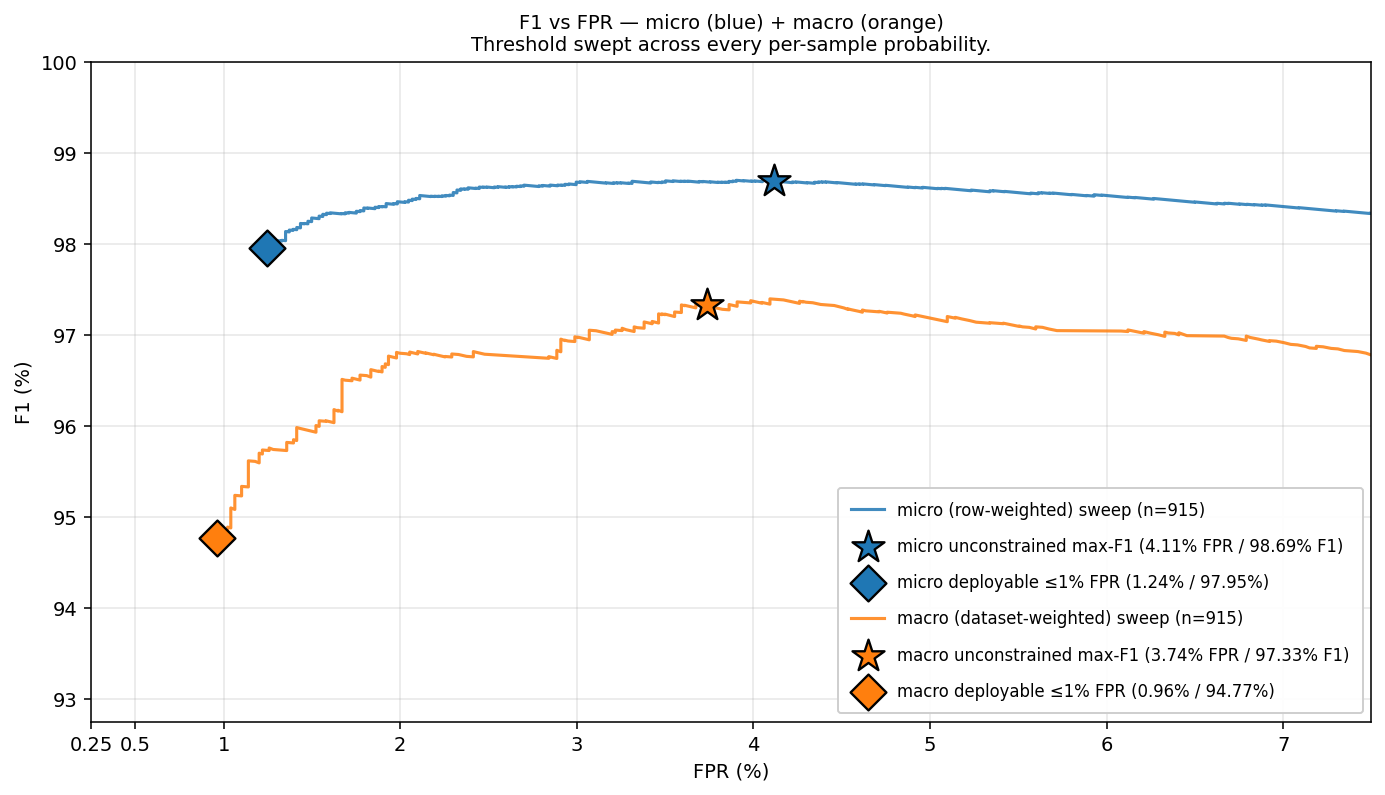
- Pick one global “operating point”: They choose a single threshold (the smoke-detector sensitivity) that works across all datasets at once. Specifically, they maximize overall F1 (a balance of precision and recall) while keeping the false positive rate at or below 1%. Then they use that same threshold everywhere, instead of secretly tuning per dataset.
- Run “honesty checks” so the results are trustworthy. For example:
- Leave-one-dataset-out: Train on everything except one dataset, then test on the missing one. This shows how well the filter handles new, unseen data.
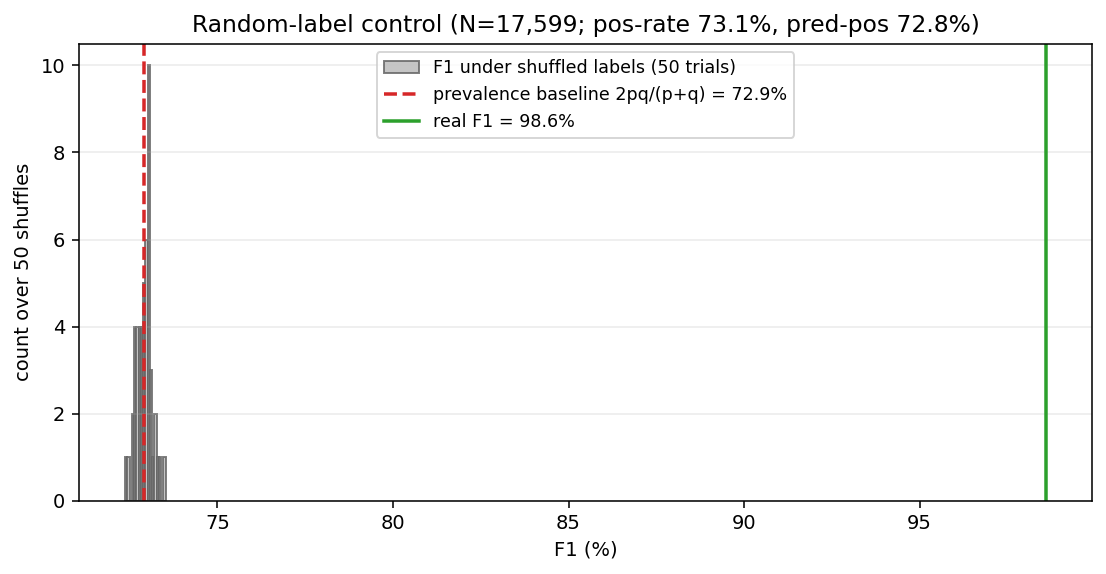
- Random-label control: Shuffle the true answers and see if the model still scores high. If it does, something’s fishy (like leakage). In their case, scores drop to chance — good.
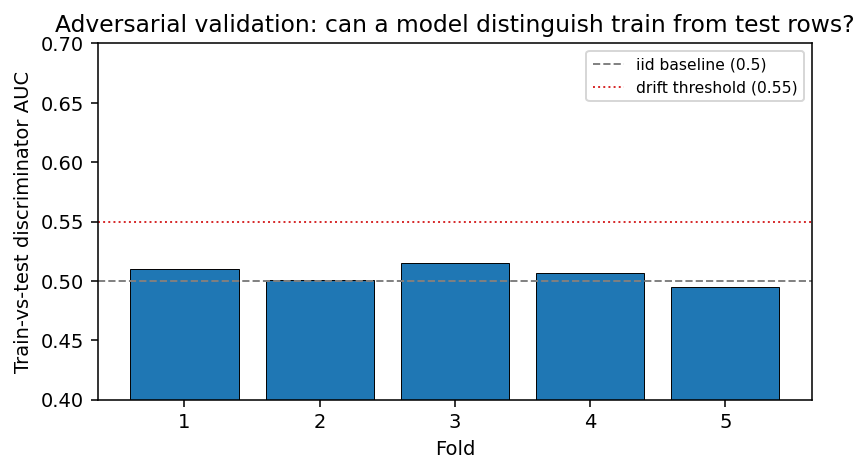
- Adversarial validation: Check whether train/test splits look too different; ideally they don’t.
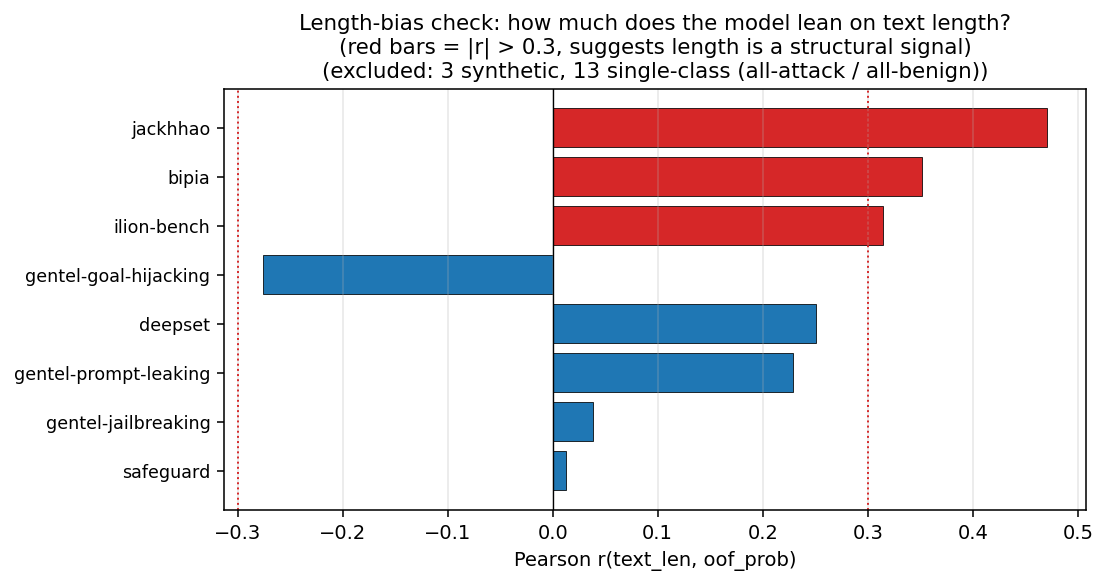
- Length-bias check: Make sure the model isn’t just flagging long texts.
- Calibration check: Make sure the model’s “confidence” numbers match reality.
- Confidence intervals: Use lots of resampling to show uncertainty, not just a single number.
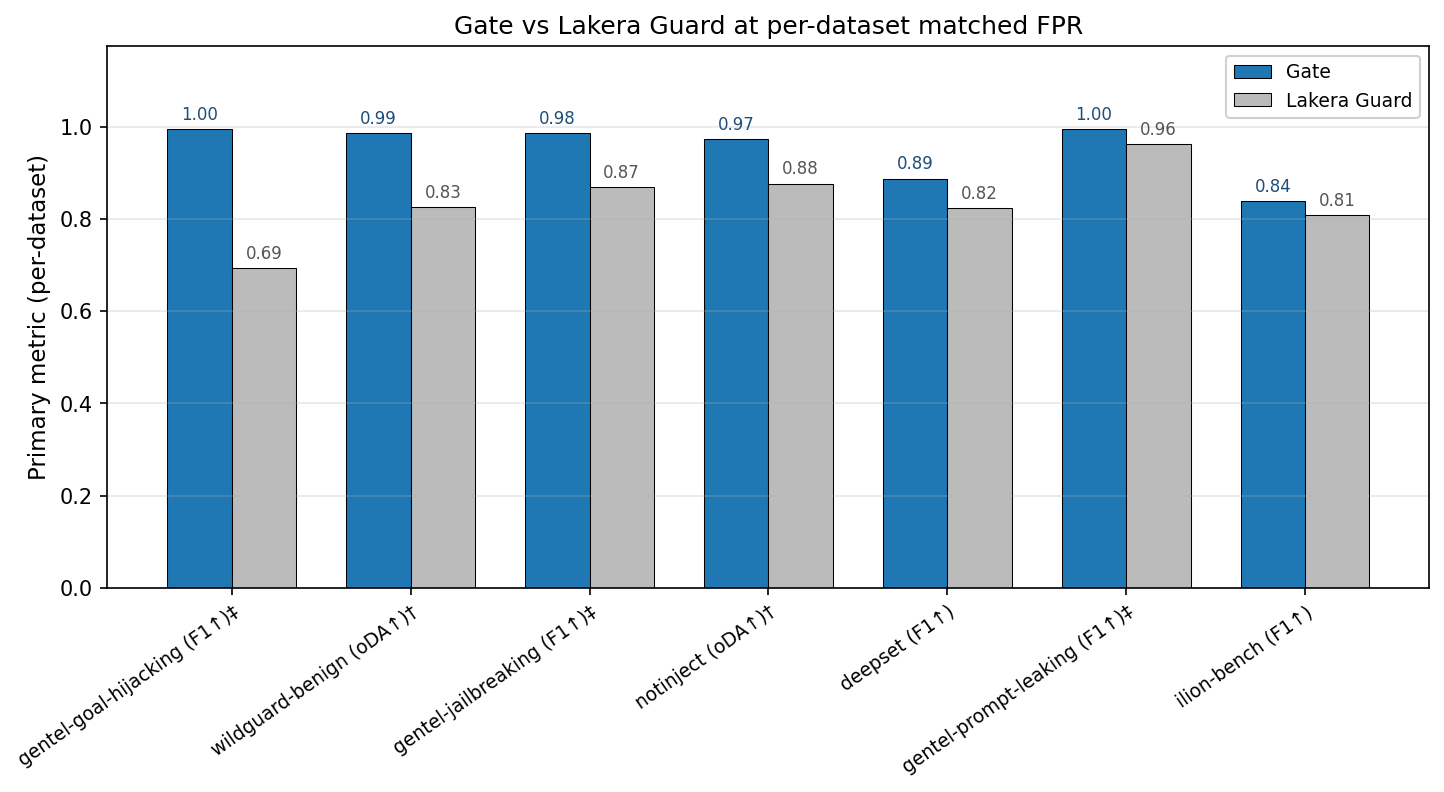
- Fair comparisons with competitors: When comparing to other systems (like Lakera Guard), they re-adjust their own threshold to match the competitor’s false positive rate on that same dataset, so it’s apples-to-apples.
4) What did they find, and why does it matter?
Big picture: The filter (called Gate) performed very well across many public tests using one shared threshold.
Key results in plain terms:
- At the strict setting (≤1% false alarms): It catches about 95 out of 100 attacks (micro recall ≈ 95.4%) and raises about 1 false alarm per 100 benign messages, with overall micro F1 ≈ 97.4%. Macro F1 (treating each dataset equally) ≈ 95.7%.
- At the “natural” setting (threshold 0.5, tuned for maximum F1): It catches about 99 out of 100 attacks (micro recall ≈ 98.9%) but with more false alarms (about 4 out of 100), and micro F1 ≈ 98.7%.
- Rankings: With the 1% false alarm limit, Gate ranks #1 on 8 datasets, #2 on 3, and #3 on 1.
- Honest diagnostics look clean:
- Random-label control collapses to chance — so no evidence the model is “cheating” by memorizing.
- Fold-to-fold performance and thresholds are stable — good sign of consistency.
- Calibration improves after isotonic regression (ECE drops from 0.0081 to 0.0016), meaning the model’s confidence better matches reality.
- Weak spots: One dataset (ILION-Bench) is tougher because it has unusual “role-playing” prompts; performance dips there compared to the average.
- Head-to-head with a major competitor (Lakera Guard): On many datasets where the competitor publishes both performance and false positive rates, Gate does as well or better when evaluated at the same false-positive level. On benign-only “over-defense” tests (where the goal is not to trigger), Gate keeps false alarms low.
Why it matters:
- Real AI assistants read untrusted content (emails, web pages, documents). A fair, transparent test that reflects real alarm limits (like 1% false positives) helps teams choose a filter they can trust — one that catches attacks without overwhelming users with false alarms.
5) What’s the impact? (So what?)
- Sets a higher standard for fair testing: One threshold for all datasets, clear false-positive budgets, matched comparisons, and open uncertainty estimates. This makes leaderboard claims more believable and easier to audit.
- Helps practitioners: If you’re deploying an AI that reads user emails or browses the web, you want a filter that’s both strong and not too noisy. This paper shows a way to measure that balance and keep it honest.
- Reveals gaps and next steps: The evaluation focuses on text in public datasets. The authors note missing areas like images, audio, long documents, code-execution tricks, cross-session attacks, more languages, and adaptive (white-box) attackers. Future work aims to cover these.
- Field-wide caveat: Many public datasets likely appear in large models’ pretraining. That’s true for nearly all systems today, not just Gate. The authors suggest testing on newer, never-seen attack styles as an ongoing improvement.
In short: The paper isn’t just another score report. It’s a careful recipe for how to measure AI safety filters in a way that’s fair, repeatable, and meaningful for real-world use — and it shows strong results for the evaluated system under those rules.
Knowledge Gaps
Below is a consolidated list of unresolved gaps, limitations, and concrete open questions that the paper leaves for future work. Each item is phrased to be actionable by researchers.
Data and benchmark coverage gaps
- Build and evaluate on multimodal and non-text channels (image-based prompt payloads, OCR/vision attacks, audio/voice-transcribed prompts); no datasets or results are provided for these modalities.
- Expand multilingual coverage beyond MultiJail and SEA-SafeguardBench to low-resource languages, code-switching, transliteration, and mixed-script attacks; quantify cross-language calibration and recall at fixed low FPR.
- Create long-context (>8 KB) injection benchmarks (e.g., doc/RAG contexts 32–200K tokens) and assess chunking strategies and performance degradation with context length.
- Construct dedicated code-execution/shell-injection benchmarks (e.g., prompts invoking eval/subprocess, tool-use escalation) rather than relying on a few incidental examples.
- Add stateful datasets for memory-poisoning and stored prompt attacks (cross-turn/session), measuring delayed activation and cross-request leakage.
- Curate domain-specific benign/attack corpora (legal, medical, finance, enterprise logs) to measure domain-shift FPR/recall and over-defense on realistic benign traffic.
- Audit and mitigate pretraining contamination: (a) estimate per-dataset web-index prevalence and correlate with measured F1; (b) evaluate on novel attacks generated after base-model cutoffs; (c) report rank changes under contamination-controlled splits.
- Establish benign-only corpora representative of production distributions (beyond notinject and wildguard-benign) and track FPR stability across domains and time.
- Run end-to-end agent-loop evaluations (email assistant, RAG/browser agents) measuring attack success prevention, false-alarm burden, and user cost, not just classification metrics.
Methodological limitations and potential biases
- Strengthen leakage controls beyond MinHash+LSH (5-char shingles, Jaccard ≥ 0.8): add embedding-based semantic deduplication, edit-distance/homoglyph/zero-width normalization, and language-switch detection; quantify the residual “leakage premium” on the current trace.
- The StratifiedGroupKFold diagnostic is uninformative on per-prompt, no-duplicate traces (as in this run); provide a complementary leakage diagnostic that remains sensitive in this regime or evaluate on traces where grouping matters.
- Validate per-chunk to per-prompt aggregation empirically (this trace had no chunking). Compare max pooling to alternatives (top-k pooling, Noisy-OR, learned aggregators, attention-weighted pooling) on chunked corpora at low FPR.
- Replace anecdotal thresholding rationale (FPR ≤ 1%) with a decision-analytic cost model per deployment; publish utility curves (alert fatigue, missed-attack costs) and select operating points by expected utility rather than F1.
- Eliminate “threshold-on-test” in matched-FPR comparisons: use nested cross-validation or a held-out tuning split per dataset to set the matched threshold, then score on a disjoint test subset.
- Remove selection bias in matched-FPR reporting (currently surfaced only when retuning improves Gate); report matched-FPR results for all competitors that publish FPR, improved or not.
- Report numerical pass/fail outcomes (not only plots) for adversarial validation AUC, length–score correlation, permutation-importance deltas, threshold transferability (σθ), and train–OOF agreement; pre-register pass thresholds.
- Clarify and sanity-check the random-label control: an 84.44% “chance F1” implies extreme prevalence; report label and predicted-positive rates per source and re-run chance baselines per metric/source to confirm no hidden signal.
- Provide per-source calibration metrics (ECE/Brier) and out-of-time calibration stability; evaluate whether isotonic calibration trained OOF transfers across datasets and time.
- Augment bootstrap methodology with bias-corrected and accelerated (BCa) intervals for non-smooth metrics (F1), and include sensitivity to B and stratification scheme.
- Conduct sensitivity analyses for inner-validation split (85/15), early-stopping patience/max-iterations, and threshold grids; report robustness across seeds/hardware.
- Document and enforce full determinism (e.g., cudnn_deterministic, fused-kernel settings) or report variance across hardware/backends if true determinism is unattainable.
External comparison and reproducibility gaps
- Reduce reliance on heterogeneous published competitor numbers by offering a community evaluation harness on a fixed, versioned trace (submission-based reruns) to ensure apples-to-apples comparisons.
- Complete and publish sample-size–matched (matched-n) intervals for every dataset–competitor pair; indicate where competitor point estimates fall within these intervals.
- Quantify cross-source label conflicts and manual relabeling actions: counts, examples, guidelines, and a released cleaned index to enable replication.
- Increase transparency of the black-box detector: provide a minimally sufficient feature/model description or an ablated open-source baseline scored with the same harness to enable independent validation.
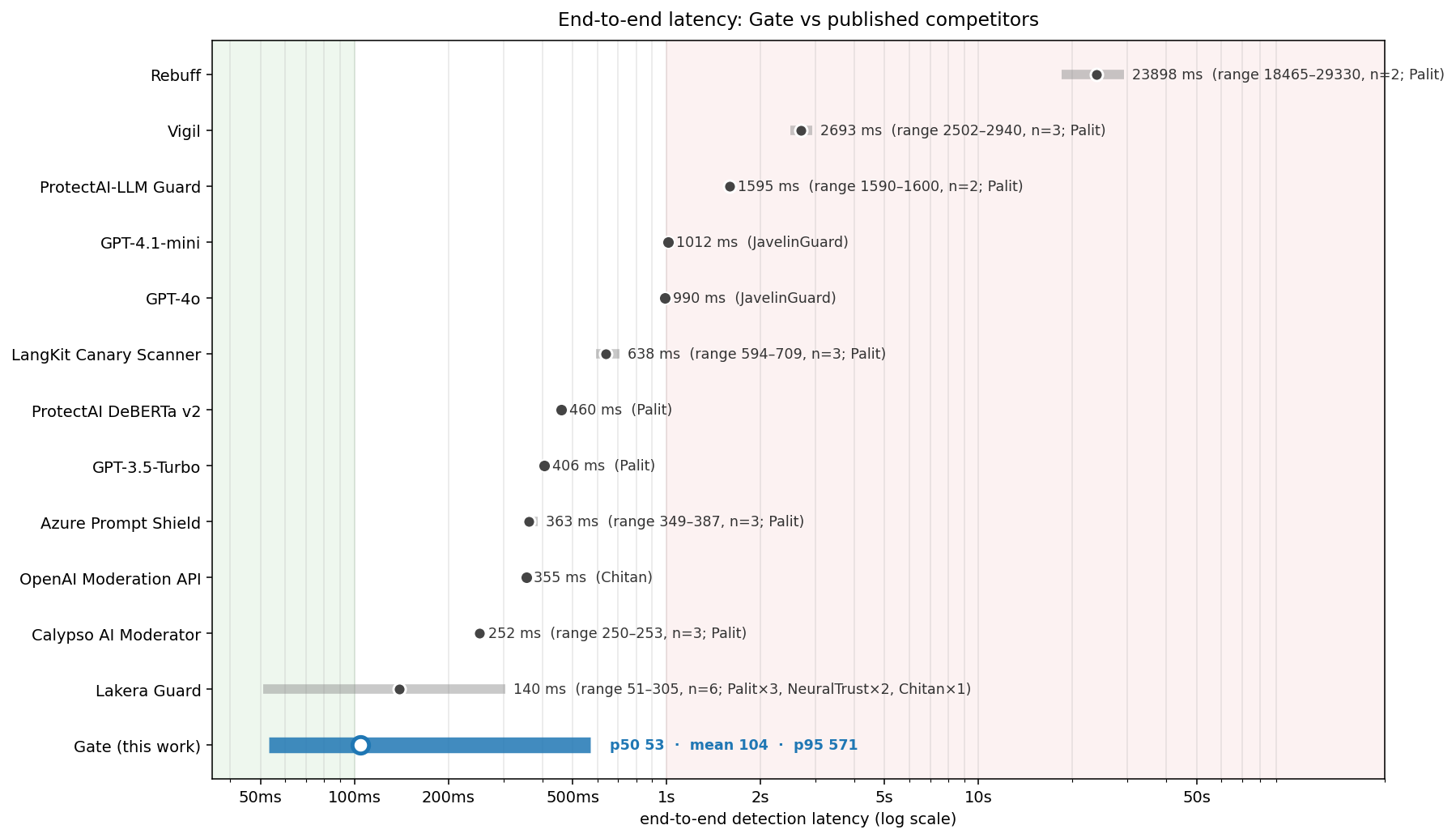
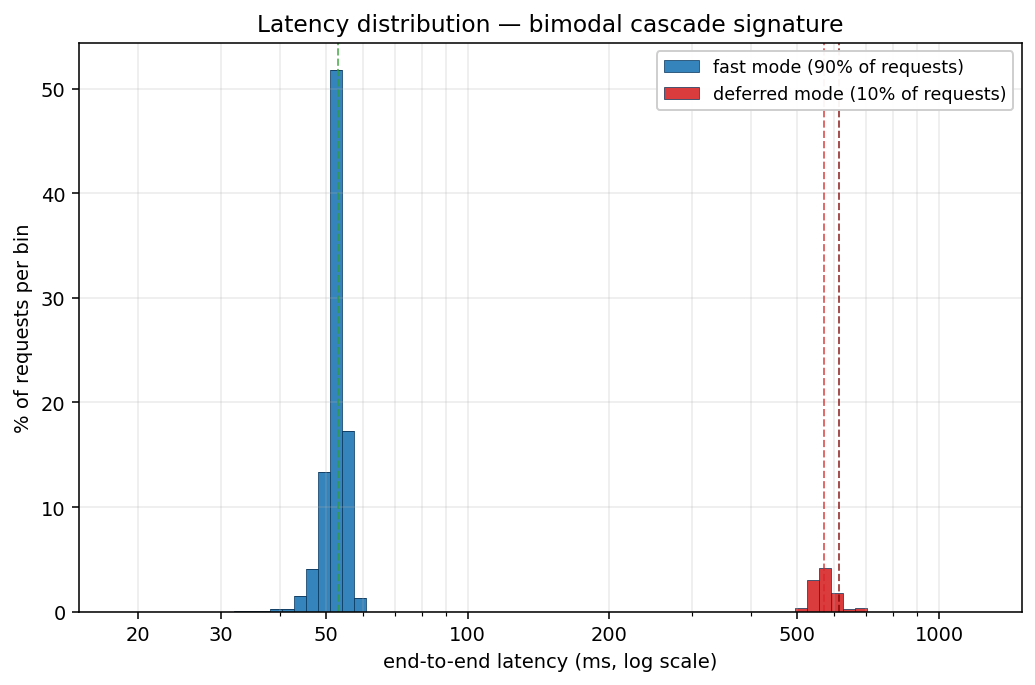
- Publish end-to-end latency distributions per cascade stage and operating point, including throughput under load and resource footprints; relate latency to recall at fixed low FPR.
Coverage already acknowledged by the authors but still open
- Multimodal/voice channels, adaptive (white-box) attackers, base-model-generation drift, domain dialects, and stored-prompt attacks are not evaluated; each requires new datasets, protocols, and metrics aligned with the harness.
Concrete open research questions
- What recall can be sustained at ultra-low FPR targets (0.1–0.2%) across all datasets, and how do rankings change in this regime?
- Which features or training strategies mitigate the ILION-Bench role-playing gap without regressing on other sources (e.g., dialogue-structure features, intent disentanglement)?
- How transferable is a single global threshold to truly novel datasets/domains? Quantify σθ on new sources and evaluate adaptive per-source calibration strategies.
- How robust is the detector to adversarial paraphrases, code obfuscation, encoding tricks (homoglyphs, zero-width), transliteration, and cross-lingual attacks? Build perturbation suites and measure invariance.
- Can selective abstention/uncertainty estimation reduce false positives at fixed recall in production (e.g., routing to human review), and what are the cost–benefit trade-offs?
- Is max pooling optimal for long-context aggregation, or do context-aware attributions (per-span risk, sliding-window scoring) yield better low-FPR recall and calibration?
- Can fusing text with provenance/structure metadata (URL/domain trust, HTML structure, attachment types) meaningfully improve indirect-injection detection without privacy regressions?
- How does pretraining contamination quantitatively affect generalization and method rankings, and do post-cutoff adversarial corpora change comparative conclusions?
Practical Applications
Immediate Applications
The paper’s evaluation harness and operating-point methodology can be deployed today to strengthen LLM security practice and governance. The following use cases translate its findings and techniques into practical workflows and products.
- Vendor selection and procurement scorecards at matched operating points [industry, policy]
- What: Compare commercial and internal LLM safety detectors at the same false-positive rate using matched-FPR re-thresholding and bootstrap confidence intervals.
- Tools/workflows: “Matched-FPR Comparator” dashboard; sample-size-matched CI reports; Pareto (F1 vs FPR) plots for due diligence.
- Assumptions/dependencies: Access to competitors’ published FPRs and primary metrics on public datasets; comparable preprocessing; acceptance that matched-FPR on test can slightly overstate point estimates (mitigated with bootstrap CIs).
- CI/CD “safety gate” for LLM detectors with leakage-resistant cross-validation [software, MLOps]
- What: Integrate the harness (StratifiedKFold headline + StratifiedGroupKFold diagnostic, MinHash+LSH de-dup) into model release pipelines; block promotions that fail generalisation checks (LODO, adversarial validation, random-label).
- Tools/workflows: GitHub/GitLab CI job running the harness; release checklist with pass/fail thresholds for diagnostics; JSONL checkpoints for deterministic replays.
- Assumptions/dependencies: Stable seeding and artifact capture; sufficient compute to run 5-fold CV and diagnostics; datasets representative of production.
- Operating-point management to prevent alert fatigue [security operations, enterprise IT]
- What: Select a single global threshold that maximises F1 under an FPR budget (e.g., ≤1%) and apply uniformly across sources; monitor threshold transferability per source.
- Tools/workflows: “Threshold Wizard” that sweeps thresholds on OOF predictions; transferability heatmap; FPR budget governance tied to SOC SLAs.
- Assumptions/dependencies: Calibrated probabilistic outputs; organisational alignment on acceptable FPR; production telemetry to validate assumptions on alert fatigue.
- RAG/agent input firewall with a single audited threshold [software, healthcare, finance]
- What: Deploy a prompt-injection/jailbreak filter microservice in front of RAG and agent tools (email/send, browse, file I/O) using the global operating point.
- Tools/workflows: Sidecar microservice exposing score + calibrated probability; per-chunk max-pooled scoring; audit logs with threshold, version hash, and CI band.
- Assumptions/dependencies: Detector API that returns probabilities; prompts fit within production chunking constraints or adopt the paper’s per-chunk aggregation; routing to human review for high-risk actions.
- Dataset hygiene and trace reproducibility [industry, academia]
- What: Use content-hashed loaders and MinHash+LSH near-duplicate grouping to prevent leakage across folds and enable bit-identical reruns.
- Tools/workflows: “Trace Builder” service that hashes loaders and caps; de-dup reports; conflict detector for cross-source label disagreements.
- Assumptions/dependencies: Access to raw datasets; careful normalisation before hashing; periodic updates to similarity functions as corpora grow.
- Calibration and quality-of-score reporting [industry, academia]
- What: Report ECE/Brier and reliability diagrams pre/post isotonic regression; ship calibrated probabilities to downstream risk engines.
- Tools/workflows: Calibration module with 15-bin ECE; regression fit saved per model snapshot; runtime confidence bands.
- Assumptions/dependencies: Sufficient held-out data for stable calibration; adherence to a fixed binning or adaptive binning protocol.
- Generalisation diagnostics as continuous compliance checks [industry, policy]
- What: Require LODO, adversarial validation (AUC≈0.5), random-label controls (chance-level F1/AUC), length-bias correlations (|ρ| ≤ 0.3), and permutation importance in every evaluation.
- Tools/workflows: “Generalisation Report” automatically attached to model cards and change reviews; fail gates for drift or shallow-heuristic reliance.
- Assumptions/dependencies: Multi-source datasets; consistent feature space across runs; agreement on pass thresholds.
- Micro vs macro aggregation to detect source skew [industry, academia]
- What: Report both pooled (micro) and per-source (macro) metrics to surface over-reliance on large sources and prevalence shifts.
- Tools/workflows: Aggregation overlay plots; prevalence ratio (train vs eval) diagnostics; source-weighting what-if analysis.
- Assumptions/dependencies: Source labels retained through preprocessing; enough per-source support to compute stable metrics.
- Model card enhancements and auditability [policy, academia]
- What: Require disclosure of the operating point, per-dataset metrics, bootstrap CIs, and evaluation seed/artifacts.
- Tools/workflows: “Evaluation-to-Model Card” exporter with CI bands, per-dataset forest plots, and operating-point rationale.
- Assumptions/dependencies: Organisational willingness to publish artifacts; privacy review for any included examples.
- Enterprise email and helpdesk assistant hardening [healthcare, finance, public sector]
- What: Gate untrusted inbound content (emails, attachments turned to text, tickets) before tool-invoking LLM agents act.
- Tools/workflows: MTA or ticketing middleware calling the detector; policy routing for high-severity triggers; human-in-the-loop escalation.
- Assumptions/dependencies: Text extraction pipelines; alignment with data protection policies (e.g., HIPAA, PCI DSS); latency budget acceptable for inline filtering.
- Benchmarking courses and research replications [academia]
- What: Adopt the harness as a teaching/research baseline for reproducible LLM security evaluation and competitor comparisons.
- Tools/workflows: Course labs with seeded CV and bootstrap; replication packages; dataset versioning via loader hashes.
- Assumptions/dependencies: Access to public benchmarks; compute credits for students; documentation of limitations and coverage gaps.
- Policy-aligned vendor risk assessments [policy, procurement]
- What: Use matched-FPR comparisons and CIs to substantiate claims in RFPs; stipulate global-threshold deployment and per-dataset disclosure.
- Tools/workflows: Procurement templates with required metrics/plots; acceptance criteria aligned to FPR budgets.
- Assumptions/dependencies: Vendors provide third-party-verified numbers on public datasets; evaluators can rerun harness or verify artifacts.
Long-Term Applications
These applications require further research, broader coverage, or engineering scale-up beyond the current paper’s scope and limitations.
- Standardised evaluation protocol for AI safety certification [policy, standards]
- What: Codify single-global-threshold reporting, matched-FPR comparisons, bootstrap CIs, and generalisation diagnostics into NIST/ISO-like standards for LLM safety detectors.
- Tools/workflows: Third-party certification labs; reference test suites and artifacts registry.
- Assumptions/dependencies: Multi-stakeholder consensus; governance for dataset updates and versioning; funding for independent labs.
- Semantic near-duplicate and cross-modal leakage protection [software, research]
- What: Extend composite group keys beyond 5-char shingles to include sentence embeddings, dense retrieval, multilingual and code/text hybrids; expand to audio/image prompts.
- Tools/workflows: Embedding-based clustering at scale; hybrid LSH + ANN indices; modality-agnostic grouping services.
- Assumptions/dependencies: Efficient ANN infrastructure; careful thresholding to avoid over-grouping; curated cross-modal benchmarks.
- Evaluation and defenses against adaptive (white-box) attackers [security research]
- What: Incorporate attacker-in-the-loop evaluations where adversaries optimise prompts against a frozen detector; measure robustness deltas and response latency.
- Tools/workflows: Red-team simulators with query budgets; online DET curves under adaptive pressure; rate-limited public test endpoints.
- Assumptions/dependencies: Safe red-teaming sandboxes; rules to prevent test set contamination; monitoring for overfitting to attacker distributions.
- Memory-poisoning and cross-turn attack benchmarks [software, research]
- What: Create datasets and harness extensions that evaluate stored prompt attacks across sessions and turns, including RAG store poisoning.
- Tools/workflows: Session-level evaluators; temporal cross-validation; stateful agent simulators.
- Assumptions/dependencies: New public benchmarks; synthetic-yet-realistic session corpora; clarity on positive labeling for delayed triggers.
- Domain- and language-specific safety SLAs [healthcare, legal, finance, education]
- What: Build sector-tailored benchmarks and operating points for specialised dialects and low-resource languages; report per-domain threshold transferability.
- Tools/workflows: Domain corpora curation; multilingual calibration; per-tenant threshold portfolios.
- Assumptions/dependencies: Access to domain text with licensing; expert labeling; multilingual model capacity.
- Privilege-aware agent orchestration guided by detector confidence [software, robotics]
- What: Combine calibrated detector outputs with tool-privilege tiers, gating high-risk actions (e.g., wire transfers, EHR writes) unless human-approved.
- Tools/workflows: Policy engines that map probability bands to tool scopes; real-time risk scoring; explainability for reviewers.
- Assumptions/dependencies: Reliable calibration under distribution shift; strong identity and authorisation controls; auditable decision logs.
- Dynamic, per-tenant adaptive calibration with global-reporting compatibility [SaaS, enterprise]
- What: Offer per-deployment calibration and thresholds while maintaining standardised, auditable global reporting for comparability.
- Tools/workflows: Tenant-specific isotonic/platt fits with drift detection; periodic back-offs to global baselines; shadow-eval streams.
- Assumptions/dependencies: Sufficient tenant data; privacy-preserving calibration; governance to prevent metric gaming.
- Regulatory audit trails and evidentiary logs [policy, compliance]
- What: Persist seed, fold assignments, thresholds, and per-dataset results as evidentiary artifacts for audits and incident investigations.
- Tools/workflows: Immutable log stores; signed artifacts; replayable evaluation pipelines.
- Assumptions/dependencies: Long-term artifact retention policies; secure key management; regulator acceptance of methodology.
- Open benchmark clearinghouse with lifecycle governance [academia, industry consortia]
- What: Community-managed repository of public datasets with loader hashes, prevalence metadata, and known contamination signals.
- Tools/workflows: Submission/review workflows; versioned loaders; contamination and overlap reports.
- Assumptions/dependencies: Sustained community maintenance; legal clarity on dataset licenses; funding.
- Tooling for end-to-end safe automation in high-stakes workflows [healthcare, finance, energy]
- What: Combine detector gates, rate-limited tool APIs, and human checkpoints into certified automation pipelines (e.g., billing code suggestions, payment approvals, change-control tickets).
- Tools/workflows: Orchestration platforms with built-in safety stages; DET-budgeted runbooks; incident playbooks tied to detector telemetry.
- Assumptions/dependencies: Organisational change management; integration with existing ITSM/ERP; regulatory approvals in safety-critical domains.
- Cross-org benchmark-to-production generalisation studies [academia, industry]
- What: Multi-institution studies quantifying LODO-style drops from public benchmarks to proprietary production traces, informing realistic SLAs.
- Tools/workflows: Federated evaluation protocols; privacy-preserving summary statistics; shared reporting templates.
- Assumptions/dependencies: Data-sharing agreements or federated analytics; comparable taxonomies of “attack” labels; funding and coordination.
- Hardware-anchored enforcement for agent tools [security engineering]
- What: Tie detector decisions to capability isolation (sandboxes, enclaves) so even successful jailbreaks have constrained blast radius.
- Tools/workflows: Policy-enforced syscall sandboxes; capability tokens gated by detector risk bands; secure audit of tool invocations.
- Assumptions/dependencies: Engineering investment in isolation primitives; latency budgets; compatibility with existing infrastructure.
Glossary
- Adversarial validation: A technique to detect distribution shift by training a model to distinguish train vs test splits; if it performs above chance, leakage or shift is present. "Adversarial validation."
- Agentic assistant: An autonomous LLM-based system with tool access that can act on instructions; used as a threat model context. "an agentic assistant with read access to a user's email inbox"
- AUC: Area Under the ROC Curve; a threshold-independent measure of ranking quality. "AUC = 0.5146"
- Bootstrap confidence interval: An uncertainty estimate derived by resampling data and taking percentile bounds. "a 95\% stratified bootstrap confidence interval."
- Brier score: A proper scoring rule measuring the mean squared error of probabilistic predictions. "Brier score and Expected Calibration Error (ECE) are computed"
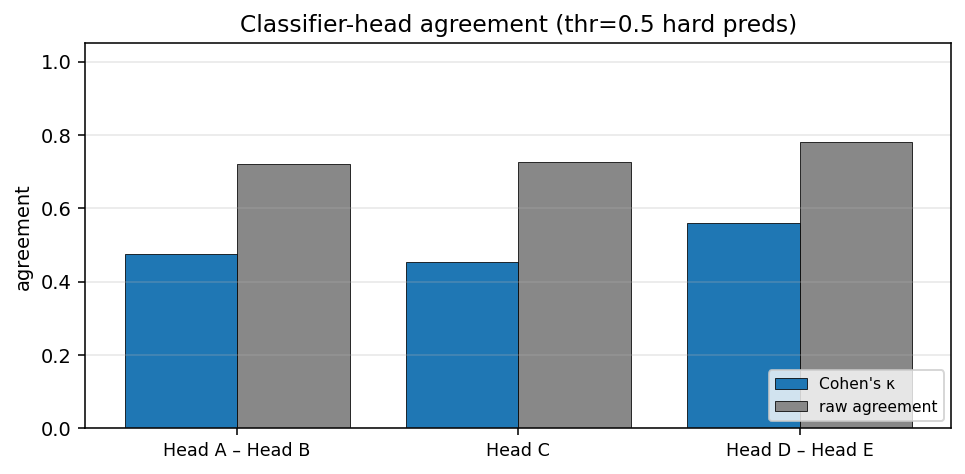
- Cohen's kappa: A chance-adjusted agreement statistic used to measure consistency between classifier heads. "Pairwise Cohen's between the hard predictions of the ensemble heads"
- Composite group-key: A grouping identifier that merges multiple membership relations to prevent leakage in grouped CV. "composite group-key "
- Content-hashed: Identified via a hash of content to ensure reproducibility and detect changes. "The trace is content-hashed over the loader file contents"
- Cross-source near-duplicate hashing: A process to detect the same or conflicting items across datasets via hashing. "Cross-source near-duplicate hashing catches prompts"
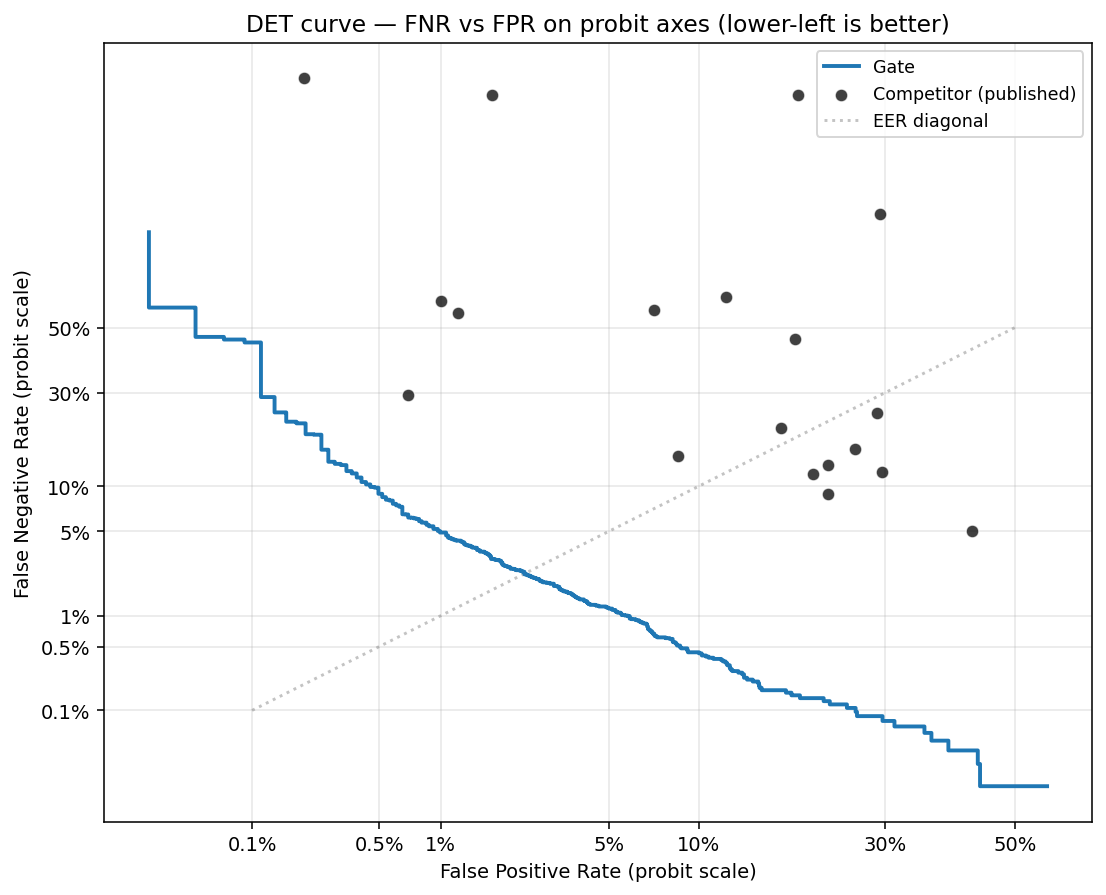
- Detection Error Tradeoff: A curve plotting false positive rate vs false negative rate (or similar) to analyze classifier tradeoffs. "Detection Error Tradeoff on probit axes."
- Determinism replay: Re-running with fixed seeds and artifacts to verify byte-identical results. "determinism replay diffs two runs"
- Early stopping: A training regularization method that halts training when validation loss stops improving. "The inner-valid slice is the early-stopping monitor"
- Expected Calibration Error (ECE): A metric quantifying the discrepancy between predicted probabilities and observed frequencies. "Expected Calibration Error (ECE)"
- F1 score: The harmonic mean of precision and recall, often used as a balanced performance metric. "max F1 subject to FPR "
- False Positive Rate (FPR): The proportion of benign items incorrectly flagged as positive. "FPR "
- GroupKFold: A cross-validation splitter that ensures all samples from a group appear in the same fold. "plain GroupKFold"
- Isotonic regression: A non-parametric calibration method enforcing monotonicity to map scores to probabilities. "post-isotonic regression"
- Jaccard similarity: A set-overlap measure used here on shingles to detect near-duplicates. "Jaccard similarity "
- Leave-one-dataset-out (LODO): A generalization check training on all but one dataset and evaluating on the held-out dataset. "Leave-one-dataset-out (LODO)."
- Length-bias correlation: A diagnostic checking correlation between input length and model score to detect shallow heuristics. "Length-bias correlation."
- Locality-Sensitive Hashing (LSH): A hashing scheme that increases the collision probability for similar items. "MinHash + LSH"
- Macro-aggregates: Metric computation by averaging per-source metrics equally across datasets. "Macro-aggregates take the unweighted mean across sources"
- Matched-FPR comparison: Evaluating systems at the same false positive rate to ensure fair, like-for-like comparisons. "Matched-FPR per-dataset comparisons"
- Max-pooled: Aggregation method taking the maximum score across chunks for a parent prompt. "Continuous probabilities are max-pooled"
- Micro-aggregates: Metric computation by pooling all predictions across sources before calculating the metric. "Micro-aggregates pool the confusion matrix across all rows"
- MinHash: A sketching technique to approximate Jaccard similarity efficiently. "MinHash + LSH"
- Near-duplicate: Samples that are highly similar (e.g., by shingle Jaccard) and should be grouped to avoid leakage. "near-duplicate clusters"
- Operating point: A specific threshold or configuration at which a detector is run and evaluated. "A single global operating point is selected"
- Out-of-fold (OOF) predictions: Predictions made on held-out data during cross-validation, used for unbiased evaluation. "Out-of-fold predictions come from cross-validation."
- Over-Defense Accuracy (ODA): Accuracy metric on all-benign corpora, equivalent to one minus FPR. "ODA = "
- Paraphrase-invariance: A property where semantically equivalent rewordings receive similar scores. "a paraphrase-invariance check bounds how lexically-shallow"
- Pearson correlation: A linear correlation coefficient used to measure length-score dependence. "Pearson correlation between the input text length and Gate's score "
- Per-chunk to per-prompt aggregation: Strategy to map chunk-level scores back to prompt-level decisions. "Per-chunk to per-prompt aggregation"
- Permutation feature importance: An importance measure computed by shuffling a feature and measuring metric degradation. "Permutation feature importance."
- Pretraining contamination: Overlap between benchmark data and foundation-model training data that can inflate results. "Pretraining contamination"
- Prevalence ratio: The ratio of positive rates between evaluation and training mixes for a source. "Prevalence ratio per source."
- Probit scaling: A transformation used to emphasize low-error regions in DET plots. "Probit scaling stretches the low-FPR regime"
- Random-label control: A leakage diagnostic that shuffles labels to check if performance collapses to chance. "Random-label control."
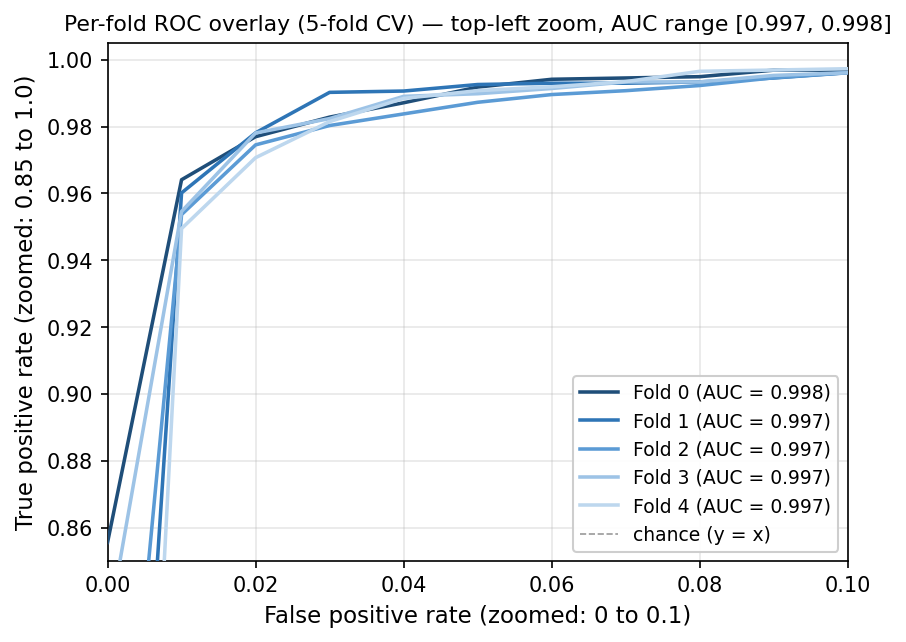
- Receiver Operating Characteristic (ROC): A curve of TPR vs FPR across thresholds used to visualize separability. "Per-fold ROC overlay"
- Reliability diagram: A visualization comparing predicted probabilities to observed frequencies across bins. "A reliability diagram checks whether the detector's output probabilities are distribution-calibrated"
- SEED constant: A single fixed seed controlling all randomized steps for reproducibility. "seeded from a single SEED constant"
- Shingles: Fixed-length character substrings used for approximate text similarity. "5-character shingles"
- Stratified bootstrap: Bootstrap resampling that preserves class (and here, source) proportions. "95\% stratified bootstrap confidence interval."
- StratifiedGroupKFold: A CV splitter that both stratifies by label and groups related samples to prevent leakage. "StratifiedGroupKFold (diagnostic)"
- StratifiedKFold: A cross-validation splitter preserving label proportions in each fold. "StratifiedKFold preserving the label marginal"
- Threshold transferability: The stability of a single global threshold across diverse datasets. "Threshold transferability."
- Threshold-on-test: A bias from selecting thresholds using the same data used for evaluation. "threshold-on-test"
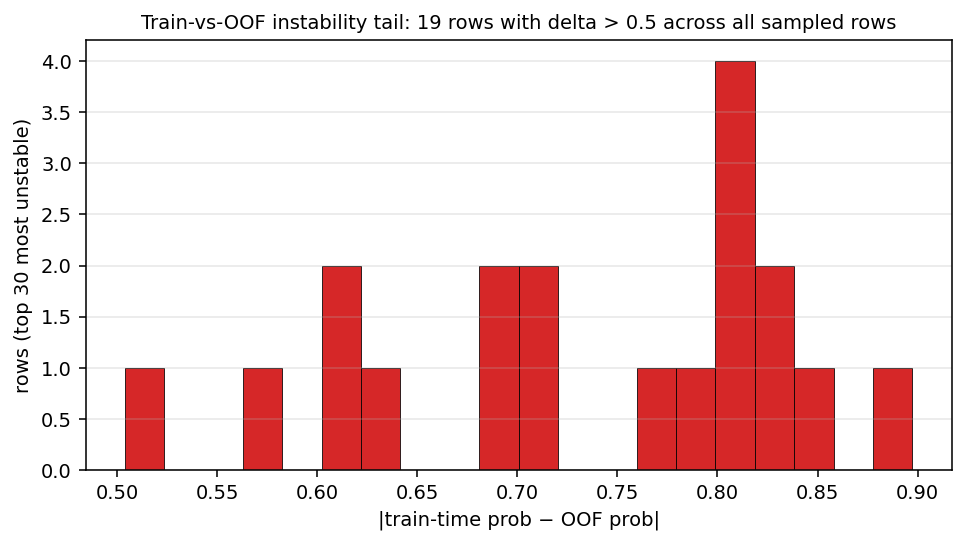
- Train-vs-OOF agreement: A check comparing performance on training rows vs OOF to detect overfitting or pipeline mismatch. "Train-vs-OOF agreement."
- True Positive Rate (TPR): The proportion of positive items correctly detected (recall). "Maximum TPR at each FPR budget."
- Union-find: A data structure for efficiently merging and querying disjoint sets, used here to combine group keys. "under union-find"
Collections
Sign up for free to add this paper to one or more collections.