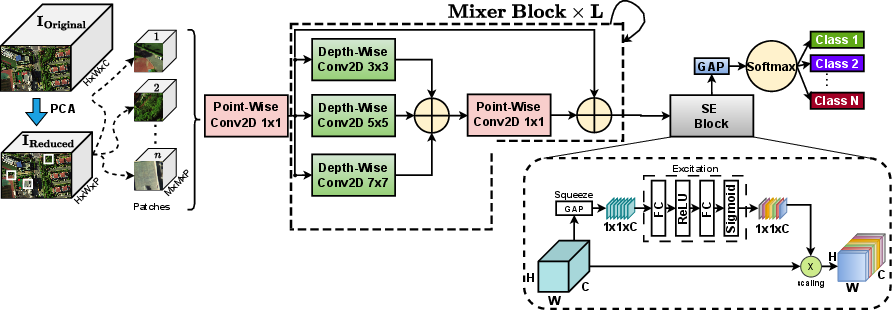
- The paper introduces MixerSENet, which integrates spatial-spectral mixing with SE attention for efficient hyperspectral image classification.
- Its methodology employs PCA-based dimensionality reduction, patch-based processing, and depthwise separable convolutions to reduce computational overhead.
- Empirical results on Houston13 and Qingyun datasets demonstrate superior accuracy and robustness, especially with minimal training data.
MixerSENet: Lightweight and Efficient Hyperspectral Image Classification
Introduction
The explosive growth in hyperspectral imaging (HSI) has created significant opportunities in remote sensing, land use mapping, and environmental monitoring. However, HSI's high spectral dimensionality imposes challenges on feature extraction, computational efficiency, and classification, especially in data-scarce settings. Conventional deep learning techniques—ranging from 2D- and 3D-CNNs to hybrid architectures and, most recently, transformer-based vision networks—have been deployed for HSI classification, but each presents trade-offs between accuracy, resource demands, and robustness. The "MixerSENet: A Lightweight Framework for Efficient Hyperspectral Image Classification" (2606.01700) proposes a model designed to address these simultaneous challenges by integrating spatial-spectral mixing with efficient attention, presenting a compelling route for practical HSI deployment.
Architectural Overview
MixerSENet is a patch-based, fully convolutional network leveraging both depthwise separable convolutions and a squeeze-and-excitation (SE) block to disentangle and adaptively enhance spatial and spectral features. The architecture takes HSI patches, applies PCA-based dimensionality reduction, and organizes the reduced tensors into patches that are processed consistently in terms of size and resolution throughout the pipeline. The workflow comprises:
This architecture design enables MixerSENet to maximize accuracy with minimal parameter and operational overhead, enhancing its suitability for deployment in resource-constrained or embedded systems.
Depthwise Separable Convolutions
A significant contributor to MixerSENet’s efficiency is the adoption of depthwise separable convolutions, wherein spatial convolutions are performed on each channel independently, eschewing the standard cross-channel kernel mixing of classic convolutions. This approach results in drastic reductions in parameter count and MACs, allowing for extensive model stacking without excessive computational burden. It especially benefits HSI, where channel redundancy is high and spatial structures may vary per spectral band.
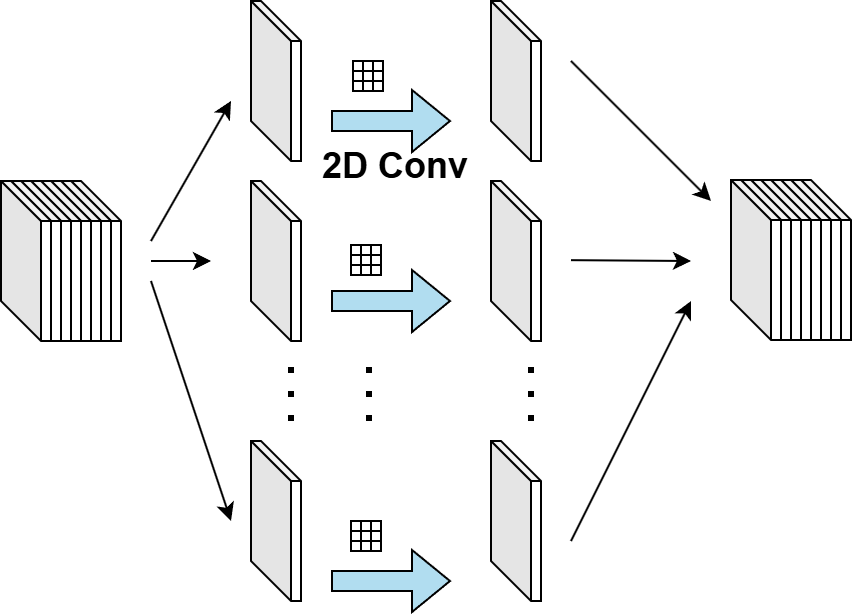
Figure 2: Depthwise Separable Convolution: Input channels are separated, and each is convolved with a spatial filter. The split channels are then concatenated.
Squeeze-and-Excitation Feature Calibration
The SE block adaptively modulates each channel’s significance, enabling the network to focus on discriminative spectral characteristics and suppress less useful, highly correlated, or noisy bands—a crucial capability given the high spectral redundancy in HSI. The combination of global context aggregation and learned channel scaling aligns seamlessly with the demands of robust HSI feature extraction.
Empirical Evaluation and Ablation Studies
MixerSENet is evaluated on two canonical HSI benchmarks: Houston13 and QUH-Qingyun. Experiments adopt competition-standard train/val/test splits and rigorous controls (batch size, optimizer, repeated trials with mean/std reporting). Results indicate:
- Houston13: OA = 82.47% ± 0.25, outperforming 3D-CNN (80.13%), HybridKAN (75.27%), HSIFormer (77.38%), SimPoolFormer (77.82%), MorphMamba (76.04%), and even its own ablated MixerNet variant (81.23%). Notably, the SE block delivers meaningful lift over the Mixer-only baseline.
- Qingyun: OA = 96.70% ± 0.21, AA = 95.46%, Kappa = 95.64, marking improvements over baseline convolutional, transformer, and hybrid models across all metrics.
The model also demonstrates robustness when trained on extremely limited data, achieving competitive OA (94.10%) at only 1% training coverage—surpassing all baselines at every tested ratio.
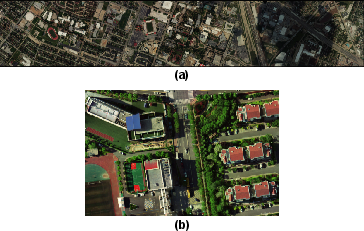
Figure 3: RGB Composites: (a) Houston13; (b) QUH-Qingyun.
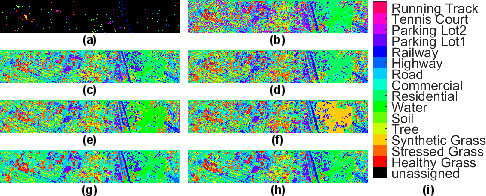
Figure 4: Classification maps of Houston13 Dataset revealing Model, SE block, and baseline comparisons.
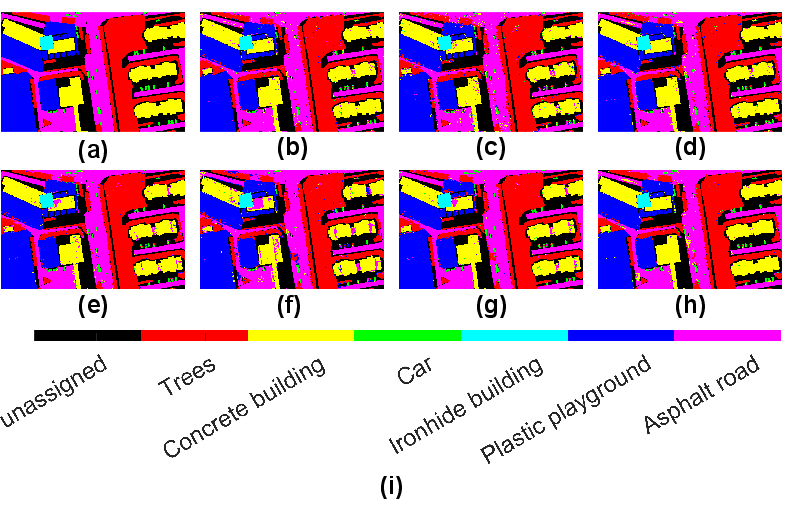
Figure 5: Classification maps of Qingyun Dataset for different methods, with MixerSENet yielding visually superior contiguity and class separation.
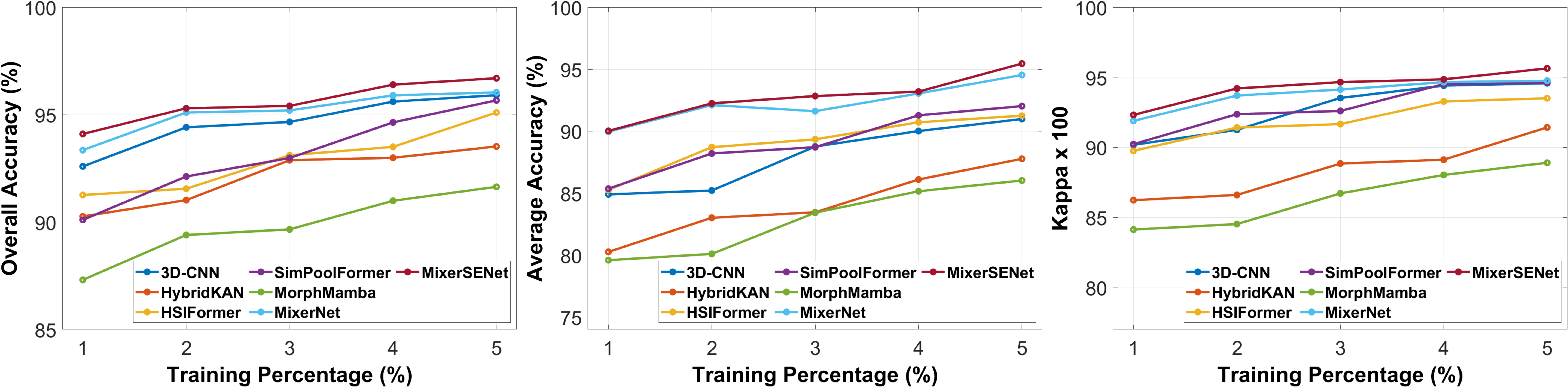
Figure 6: Classification accuracy of Qingyun dataset at different percentages of training data (left) OA (center) AA and (right) Kappa index.
In terms of computational metrics, MixerSENet achieves:
- Parameter count: 53,146
- FLOPs: 7.894 × 10⁶
- MACs: 3.890 × 10⁶
- Inference time: 2:32 minutes (RTX 2080, 8GB VRAM)
These figures are markedly lower than contemporary transformer-based models (e.g., HSIFormer, SimPoolFormer), which have parameter footprints and inference durations an order-of-magnitude higher, despite lower or comparable accuracy. MixerSENet remains on par in time and efficiency with its non-attention MixerNet baseline while producing superior classification.
Implications and Future Prospects
MixerSENet’s combination of depthwise separable convolutions and SE attention demonstrates that lightweight, non-transformer architectures can deliver competitive, often superior, performance for HSI classification under real-world constraints. This challenges the prevailing trend toward ever-larger transformer-based models by establishing that carefully crafted convolutional architectures—augmented with attention and efficient mixing—may be preferable for HSI, especially where inference resources and training labels are scarce.
Key implications include:
- Resource-aware HSI deployment: MixerSENet’s high accuracy and efficiency suit embedded, edge, and on-board satellite processing scenarios, facilitating low-latency, high-throughput analytics.
- Label-efficient learning: Robustness under training scarcity indicates intrinsic regularization and generalization capacity, further bridging the gap between deep learning and the limited-annotation realities of most remote sensing tasks.
- Architectural extensibility: While the SE block partially mitigates channel redundancy, further exploration into lightweight spectral mixing and contextually adaptive attention may yield additional gains; hybridization with transformer-derived mechanisms in a parameter-efficient way is a plausible next step.
Conclusion
MixerSENet redefines efficiency-accuracy trade-offs in HSI classification, demonstrating that explicit spatial-spectral separation, depthwise convolutions, and targeted channel attention suffice for state-of-the-art results across benchmarks. The model’s suitability for deployment and empirical robustness position it as a reference point for future lightweight and scalable architectures in remote sensing. Subsequent research directions may involve investigating alternative spectral mixing, further reducing overfitting at deeper model scales, and extending the paradigm to broader classes of multichannel spatial data.