- The paper presents a novel benchmark that systematically evaluates agentic procedural 3D modeling using both automated metrics and human preference assessments.
- It details an agentic data curation pipeline combining API migration, geometric validation, iterative multi-view feedback, and human-in-the-loop quality checks.
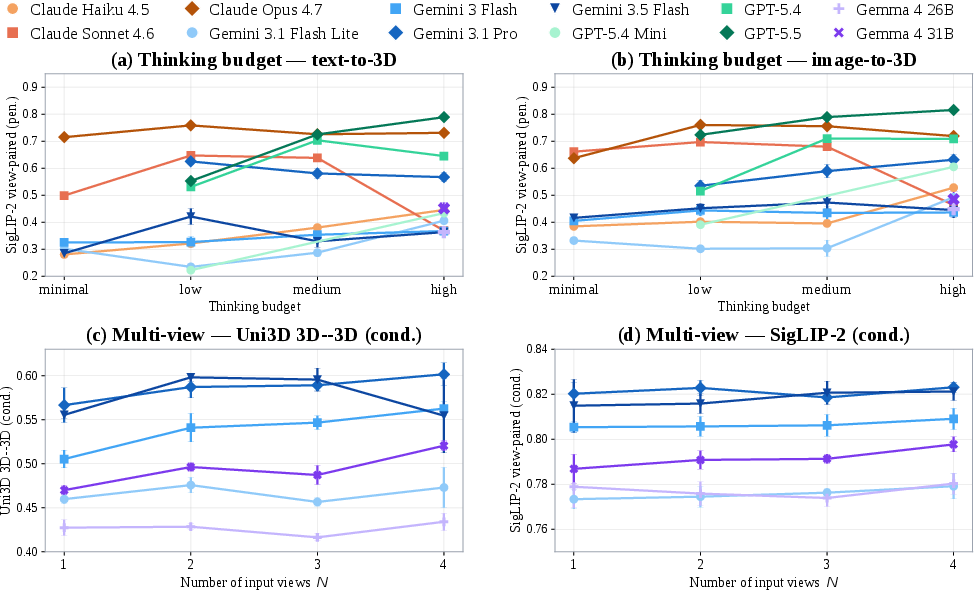
- Empirical results reveal that multi-turn error-feedback and model scaling significantly boost executability, with automated metrics showing strong correlation with human judgments.
3DCodeBench: A Comprehensive Benchmark for Agentic Procedural 3D Modeling
Introduction and Motivation
Procedural 3D modeling through code forms a cornerstone for asset creation in domains such as gaming, simulation, and digital design, due to its deterministic, editable, and scalable nature. However, authoring procedural assets requires deep knowledge of 3D APIs, parametric reasoning, and geometric logic. Existing efforts to automate this process via vision-LLMs (VLMs) and LLMs have outpaced standardized benchmarks for evaluating 3D code generation, leading to fragmented metrics and ad hoc test cases. "3DCodeBench: Benchmarking Agentic Procedural 3D Modeling Via Code" (2606.01057) directly addresses the deficit in systematic and robust evaluation for VLM-driven 3D procedural modeling, offering a comprehensive benchmark for agent-based code generation and assessment.
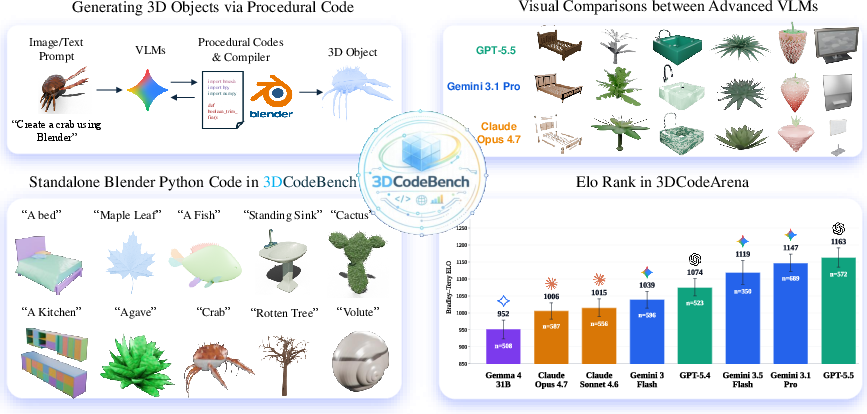
Figure 1: Overview of 3DCodeBench highlighting its benchmarking setup, semantic coverage, qualitative evaluation, and the 3DCodeArena human preference platform.
Data Curation Pipeline and Dataset Composition
The paper details a highly structured, agentic pipeline for curating the 3DCodeBench dataset, leveraging VLM agents to convert complex procedural factories sourced from Infinigen into standalone, API-accurate Blender 5.0 Python scripts. The pipeline incorporates API migration, geometric validation, and code simplification, augmented by iterative refinement using multi-view render comparison via a VLM-based visual critic. All (prompt, code, mesh) triplets are further validated by human annotators to guarantee semantic and geometric fidelity.
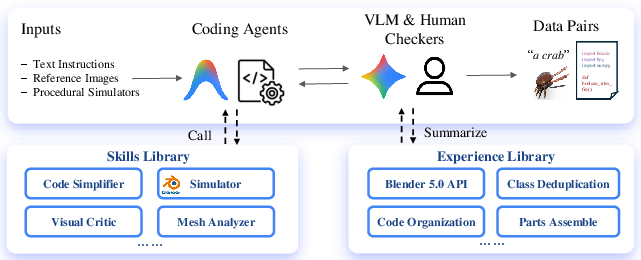
Figure 2: The data-curation pipeline, combining agentic transformation, geometric validation, iterative multi-view feedback, and human-in-the-loop quality inspection.
The resulting dataset captures substantial semantic and geometric diversity, spanning 212 categories—from organic entities to manufactured objects and architectural elements—with script lengths (mean 531 lines) reflecting code complexity not typically present in prior code-based 3D datasets.
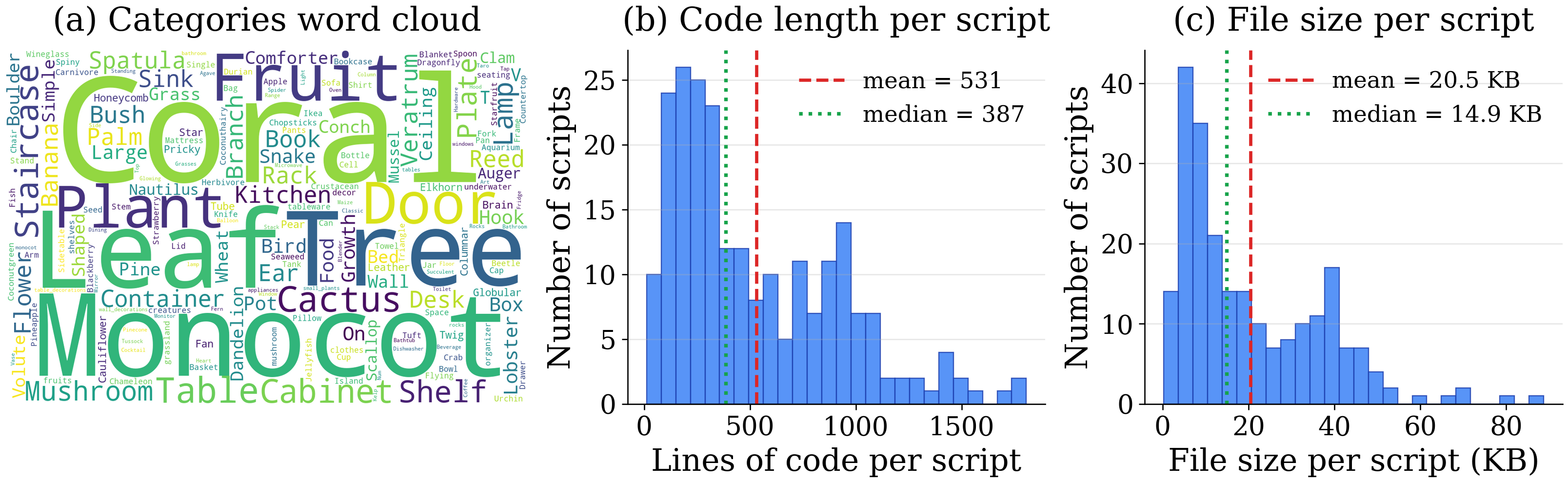
Figure 3: Distributional and categorical statistics of 3DCodeBench, depicting code complexity and file size heterogeneity across curated scripts.
The procedural asset collection exceeds 26,000 (prompt, code, object) triplets, each annotated with multiple caption styles and paired multi-view imagery to support multi-modal evaluation protocols.
Evaluation Protocol: Automated Metrics and Human Preferences
3DCodeBench evaluates models not only for the executable validity of output scripts but also for mesh-grounded geometric similarity using a suite of automated metrics. These include, but are not limited to: executability, SigLIP-2 and DINOv3 perceptual embeddings for multi-view image similarity, Chamfer Distance for point cloud shape correspondence, and Uni3D for both 3D-3D and cross-modal (prompt-to-3D) metric alignment. Importantly, evaluation is stratified into conditional and penalized reporting paradigms to differentiate geometric quality from mere code execution reliability.
To anchor benchmark claims in human perception, 3DCodeArena conducts large-scale pairwise human preference comparisons, assigning Bradley–Terry Elo scores to each model.
Empirical Results and Analysis
Metric–Human Preference Alignment
A core empirical contribution is the demonstration that SigLIP-2 multi-view similarity and DINOv3 metrics exhibit strong linear and rank correlation with human Elo on 3DCodeArena (Pearson r up to 0.964; Spearman ρ up to 0.972), validating the use of automated metrics for large-scale evaluation.
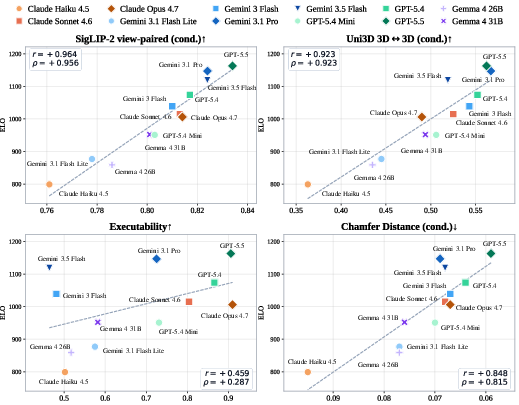
Figure 4: Correlation between automated metrics (SigLIP-2, Executability, Uni3D, Chamfer Distance) and human Elo rankings across 12 evaluated VLMs.
Qualitative and Failure-Mode Analysis
Qualitative renders reveal that while current VLMs can roughly capture object silhouettes and part structure, they consistently struggle with connectedness, alignment, and physical plausibility—disconnects, floating parts, and geometric artifacts persist.
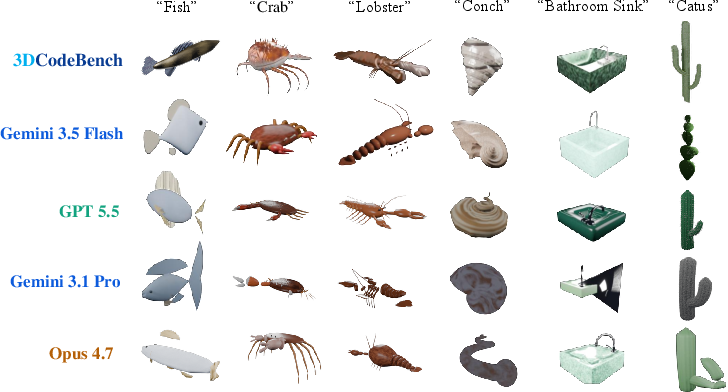
Figure 6: Qualitative outputs from Gemini 3.1 Pro, Claude Opus 4.7, and GPT-5.5, indicating proficiency in silhouette abstraction but challenges in achieving physically plausible, integrated geometry.
To address the limitations of automated evaluation, 3DCodeBench includes 3DCodeArena, a blind-pairwise voting interface supporting both text-to-3D and image-to-3D modalities. Anonymized, orbitable 3D renders are presented for direct geometric assessment, and aggregate Elo is calculated over thousands of human votes, enabling robust cross-model and cross-prompt comparisons.
Implications and Future Directions
This benchmark exposes gaps in both dataset coverage and model capacity: existing VLMs require curated, high-quality procedural code datasets for meaningful improvements and demonstrate that geometric reasoning and physical plausibility require further architectural and training advancements. The results underscore the importance of multi-turn refinement loops and high-fidelity feedback (e.g., error tracebacks, visual self-critique) for actionable progress. Furthermore, reliable automated metrics aligned with human judgment will be essential as the field transitions to larger-scale and cross-platform settings (e.g., Houdini, Unreal Engine).
Future developments may involve extending 3DCodeBench to scene-level composition, cross-platform API generalization, and more structured evaluation of multi-modal generative agents for complex 3D assets. The agentic methodology in data curation and evaluation protocol can be adapted for both foundational code LMs and embodied policy models in robotics and simulation.
Conclusion
3DCodeBench represents a significant step toward rigorous evaluation of procedural 3D model generation via agentic code synthesis. It provides (1) an extensible dataset capturing semantic and geometric diversity, (2) a robust, multi-faceted evaluation protocol combining executable, metric, and human-preference axes, and (3) empirical insights into the failure modes and improvement levers for current VLMs in 3D procedural modeling. The framework sets a foundation for the next generation of agentic 3D modelers capable of deterministic, high-fidelity, and physically plausible code-driven asset creation.