- The paper demonstrates that selectively encoding only critical classical features into quantum states reduces resource overhead while preserving quantum advantage.
- It details the AQSE framework combining projected quantum observables with classical processing to control sample complexity and mitigate noise effects.
- Experimental benchmarks show that the hybrid model outperforms classical baselines with fewer samples by targeting residual predictive errors.
Learning with Active Quantum Subspaces: Scalable Hybrid Advantage without Full Quantum Data-Encoding
Introduction and Motivation
Recent advances in quantum machine learning (QML) have underscored the potential for quantum models to offer statistical or computational advantages relative to classical approaches. However, a principal bottleneck in many QML schemes is the resource and noise overhead involved in fully embedding large-scale classical data into quantum states. This work provides a rigorous structural analysis of scalable hybrid quantum-classical learning in which only a carefully chosen subset of classical variables is quantum-encoded. The framework centers on active quantum subspace encoding (AQSE), where an “active” subset of input features is lifted to a quantum encoding while the remainder is processed classically. By judicious selection of the quantum-encoded sector and a projected quantum readout, the hybrid model controls the sample complexity and the expressivity-growth endemic to naive global quantum kernels, and can persistently outperform its classical subspace competitor without the full quantum encoding overhead.
The following schematic contrasts conventional full-data quantum encoding versus active subspace partitioning as proposed in this work:
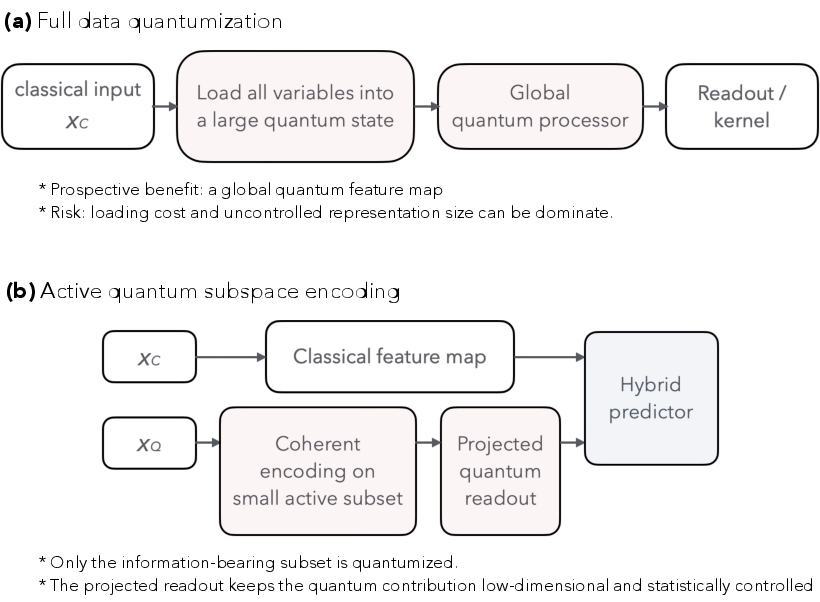
Figure 1: Two paradigms for hybrid quantum learning. Full quantum encoding embeds all classical input data in a quantum state, while AQSE encodes only a selected quantum-relevant subspace, allowing controlled, low-dimensional projected quantum readout.
Framework: Active Quantum Subspaces and Projected Readout
The AQSE model introduces a formal distinction between (i) the full device register size (total qubits), (ii) the subset of features actively and coherently encoded as quantum, and (iii) the family of observables measured at readout. The selected variables for quantum encoding are denoted xQ, while the remainder xC are processed classically. The model postulates a quantum feature map ΦQ(x) built from expectation values of a finite set of projected observables, inducing a positive semidefinite kernel with rank explicitly bounded by the projection dimension M.
The AQSE projected kernel can be expressed as
KH(x,x′)=KC(x,x′)+λa=1∑MTr[Oaρx]Tr[Oaρx′]
where KC is any classical kernel and ρx is the (selectively encoded) data state.
Strong theoretical guarantees are derived. For any sample size N, the sample regularized dimension and the maximal statistical capacity scale only with the sum of the classical sample rank and the number of projected quantum observables M, rather than the full Hilbert space dimension. This crucially mitigates the dimension blow-up of fidelity-type or global kernels and aligns the statistical complexity of the model with accessible quantum measurements.
Criteria for Hybrid Improvement Over Classical Baselines
Partial quantum encoding is beneficial only when the quantum-projected subspace contributes predictive directions outside the classical feature span that are correlated with the classical model’s residual error. The authors formalize this with a rigorous residual-information criterion: strict improvement over the purely classical predictor (in squared loss) is achieved if and only if there exists a projected quantum feature orthogonal to the classical feature space and correlated with the residual. The gain is quantitatively lower-bounded by the squared inner product between the classical residual and the orthogonal quantum-projected direction, normalized by the quantum-feature norm.
This criterion operationalizes what “quantum advantage” means for hybrid models: not a generic use of extended quantum Hilbert space or indiscriminate application of quantum resources, but a targeted, statistically meaningful contribution that augments the classical model’s explanatory power.
Learning in the Presence of Noisy Quantum Oracles
In practical NISQ regimes, quantum measurement and encoding noise are unavoidable. The authors model the hybrid learner as accessing labels through a noisy binary oracle with reliability parameter β(x), and prove PAC sample complexity bounds scaling as xC0, where xC1 is the worst-case oracle reliability across the data space. Provided the quantum-projected sector is low-dimensional and the oracle reliability decays at most inverse-polynomially with input size, the hybrid model remains PAC-learnable with polynomial sample complexity.
This result tightly links the noise-scaled advantage of quantum models to experimentally relevant parameters, rather than abstract representation-theoretic distinctions. The predicted xC2 sample scaling is empirically validated in synthetic and large-qubit numerical benchmarks.
Analysis of Scalability and Noise Robustness
A key innovation is the formalization of scalable AQSE schemes under realistic circuit and noise constraints. The core architecture involves a set of “active” qubits undergoing phase encoding, Clifford processing, and projected Pauli readout, subject to local dephasing or general local Pauli-diagonal noise. The authors derive exact analytic expressions for the learned observable’s noise-induced attenuation as a function of the observable’s backward light cone and the circuit’s local noise rates. Provided the active subset size and the cumulative noise in this subspace grow only logarithmically or polynomially with system size, the oracle reliability remains at least inverse-polynomially bounded, preserving learnability.
A canonical example is studied: a 64-qubit circuit with only 6 “active” phase encoded qubits, with the remainder treated classically. The projected quantum feature is a high-order interaction of active phases and selected context bits. This single scalar feature is proven to lie completely outside any classical interaction-only feature basis of degree 7 or less, compressing exponentially many classical interactions.
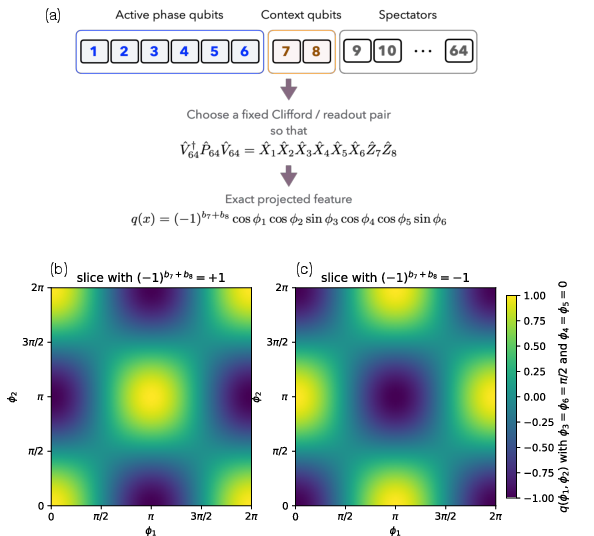
Figure 2: Architecture of the 64-qubit toy model. Six active phase qubits are actively quantum-encoded, contextual bits are encoded as computational basis states, and a Clifford block acts globally.
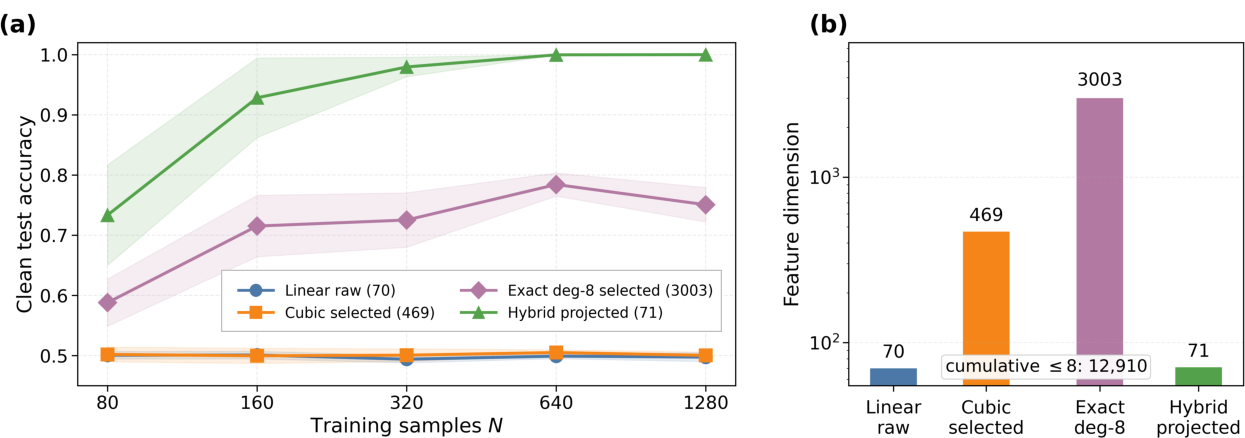
Figure 3: Benchmark numerics for the 64-qubit toy family. The hybrid projected model (explicit quantum feature) attains perfect accuracy with substantially fewer samples compared to classical baselines, demonstrating statistical efficiency.
Operational Protocols: Residual Screening and Sample Complexity
The projected quantum feature admits a practical, data-driven residual screening protocol: by orthogonalizing candidate quantum features against the classical space and scoring their correlation with the classical residual (empirical or population), one can directly identify the subspaces promising maximal predictive improvement.
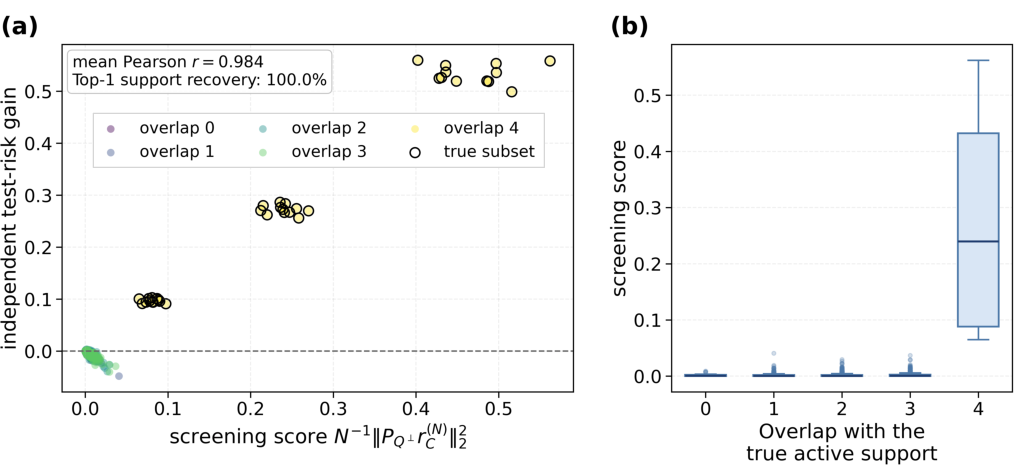
Figure 4: Empirical correspondence between the finite-sample residual screening score for candidate quantum features and actual test risk reduction: features matching the true active support dominate.
The sample complexity and noise resilience analysis are validated in finite-size simulations. When the oracle reliability xC3 is artificially controlled by adjusting the quantum phase range and noise attenuation, the number of samples required to reach a fixed target accuracy grows linearly with xC4, matching the theoretical prediction.
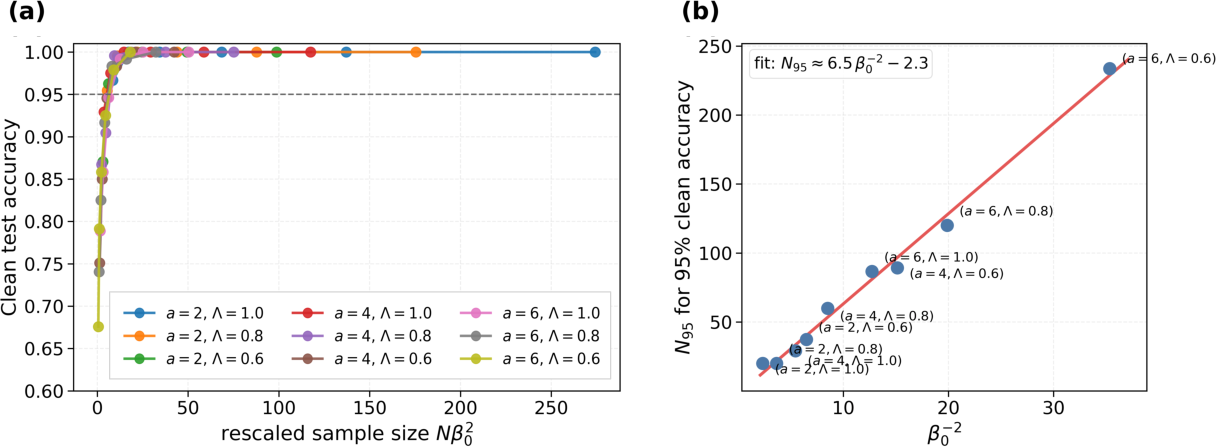
Figure 5: Clean test accuracy for varying active-subspace size and noise attenuation, plotted against xC5; learning curves collapse, consistent with the predicted sample complexity scaling.
Projected versus Global Kernels
The superiority of low-dimensional projected kernels is further evidenced in direct comparison to traditional global fidelity-based quantum kernels. Projected AQSE kernels concentrate sample regularized dimension on a handful of meaningful modes, effectively circumventing exponentially large Hilbert space blowup and ensuring statistical efficiency. In contrast, the global kernel’s sample regularized dimension scales with the sample size and suffers from statistical dilution.
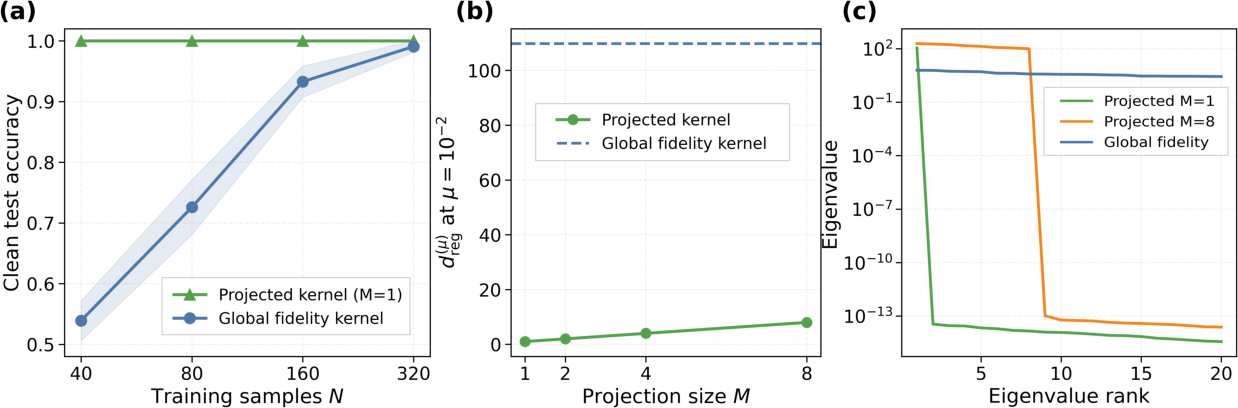
Figure 6: Projected AQSE kernels versus global fidelity kernel. Projected kernels reach perfect accuracy with much lower sample complexity and regularized dimension.
Noisy, Finite-Shot Measurements
Finally, the model’s resilience to realistic, finite-shot quantum measurement is quantified. Moderate shot counts recover nearly all the statistical benefit of the analytic quantum feature, even in the presence of dephasing and readout noise.
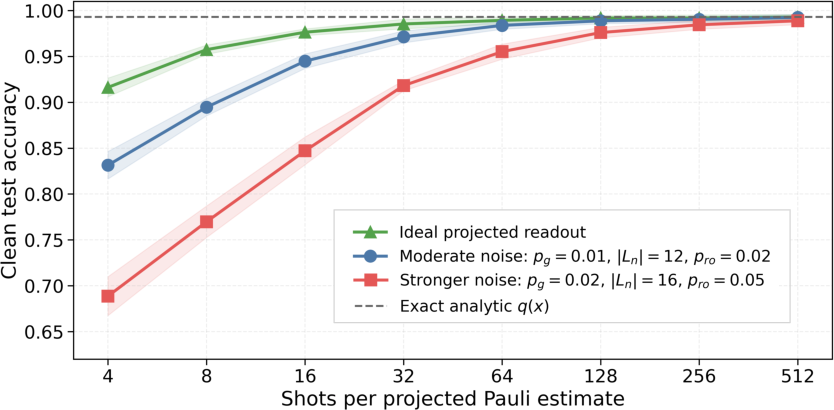
Figure 7: Finite-shot projected readout under realistic noise achieves high clean-test accuracy; the statistical benefit is retained even with finite measurement resources.
Theoretical and Practical Implications
The evidence presented establishes that full quantum encoding is not a necessary condition for hybrid quantum learning advantage. Instead, AQSE methods that (1) actively select quantum-encoded variables outside the expressivity of classical featurizations, (2) control the quantum readout dimension, and (3) maintain oracle reliability against device noise, yield a tractable, statistically efficient, and scalable avenue for QRAM-free, NISQ-compatible quantum learning. This approach is directly extensible to adaptive active subset selection informed by residual analysis, robust kernel engineering strategies, and variable encoding architectures tailored to the inductive bias of the learning task.
Conclusion
The AQSE framework demonstrates that selective quantum encoding, coupled with projected observables and explicit statistical control, enables scalable quantum advantage in hybrid learning even when the majority of the data remains classically processed. The statistical, circuit, and noise-theoretical analysis provided here forms a rigorous foundation for continued exploration of practical, resilient quantum enhancement in both near- and long-term quantum machine learning.
Reference: "Learning with Active Quantum Subspaces: Scalable Hybrid Advantage without Full Quantum Data-Encoding" (2606.00932)
Figure 1: Two paradigms for data encoding in quantum learning: Full quantum encoding (left) versus selective active quantum subspace encoding (right).
Figure 2: Architecture schematic for the 64-qubit toy family highlighting partition of the active quantum and context bits.
Figure 3: Empirical test accuracy of hybrid projected versus classical models on the synthetic 64-qubit task.
Figure 4: Comparison of screening scores and observed test-risk reduction for candidate quantum features, validating practical utility of residual-based selection.
Figure 5: Oracle reliability scaling: Required sample size for fixed accuracy increases as xC6, matching theory.
Figure 6: Comparison of projected AQSE and global quantum kernels on a small-qubit benchmark; projected kernels retain low sample regularized dimension.
Figure 7: Clean test accuracy under finite-shot projected readout for the 64-qubit family, including device noise.