- The paper demonstrates quantum learning advantage by showing fully quantum protocols outperform measure-first strategies at 30–40 qubits even amid moderate noise.
- It employs a combined analytical and simulation framework to assess how dephasing, depolarizing, and amplitude damping affect learning performance.
- Results indicate that scalable quantum advantage is experimentally accessible with current devices, setting concrete benchmarks for near-term quantum hardware.
Evidence of Quantum Machine Learning Advantage with Tens of Noisy Qubits
Overview and Context
The study "Evidence of Quantum Machine Learning Advantage with Tens of Noisy Qubits" (2605.21346) addresses the persistence and accessibility of quantum machine learning (QML) advantage under realistic hardware and data noise. The work specifically targets learning scenarios where both the data and the processing are inherently quantum: the learner receives quantum states as input and must infer underlying relational properties. Central to this study is the comparison of fully quantum (FQ) protocols—where data is processed coherently on quantum devices—against measure-first (MF) strategies that perform a fixed, untrained measurement on quantum states and use only classical post-processing for inference.
Key questions addressed are:
- At what realistic system sizes (qubit numbers) do QML advantages persist?
- How do various noise mechanisms (dephasing, depolarizing, amplitude damping) affect the quantum-classical performance gap?
- What are the hardware requirements for observing this gap on near-term quantum processors?
The authors provide a comprehensive numerical and analytical framework that integrates physical hardware constraints, task-specific learning protocols, and rigorous sample complexity analysis. The results support the conclusion that clear, empirically resolvable quantum learning advantages exist already at the 30–40 qubit scale, even in the presence of significant physical noise. This regime is already accessible to today’s or near-future quantum devices.
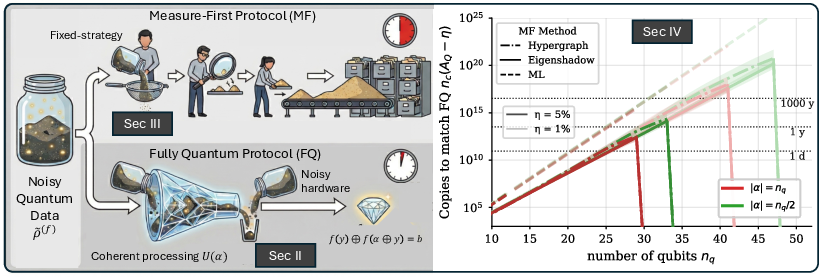
Figure 1: Framework for evaluating quantum advantage in learning from noisy quantum data. The schematic distinguishes between coherent fully quantum (FQ) processing and measure-first (MF) schemes, and shows the experimental scaling gap in copy complexity with realistic noise channels.
Learning Task and Protocol Architecture
The central task is structured relational prediction: given access to quantum states parameterized by hidden Boolean functions f, the learner must predict the outcome of a relational measurement involving classical and quantum information. Specifically, for an nq-qubit random phase state ∣ψf⟩ encoding f in its phases, and a target measurement parameter α (a bitstring), the task is to produce a bitpair (y,b) such that b=f(y)⊕f(y⊕α), where y is a queried string and ⊕ denotes bitwise XOR.
Fully Quantum (FQ) Protocol:
This protocol leverages a trained, task-specific unitary U(α) to extract nq0 via quantum interference, requiring a circuit comprising nq1 CNOTs and a Hadamard gate. Upon measurement, the correct output is obtained in a single shot with perfect accuracy in the noise-free regime.
Measure-First (MF) Protocols:
These protocols perform fixed local or random measurements on single copies of the state, followed by classical inference (e.g., shadow tomography, statistical estimators, hypergraph reconstruction). Crucially, they cannot adapt their measurements post hoc and must deliver the final prediction based solely on classically accessible measurement outcomes.
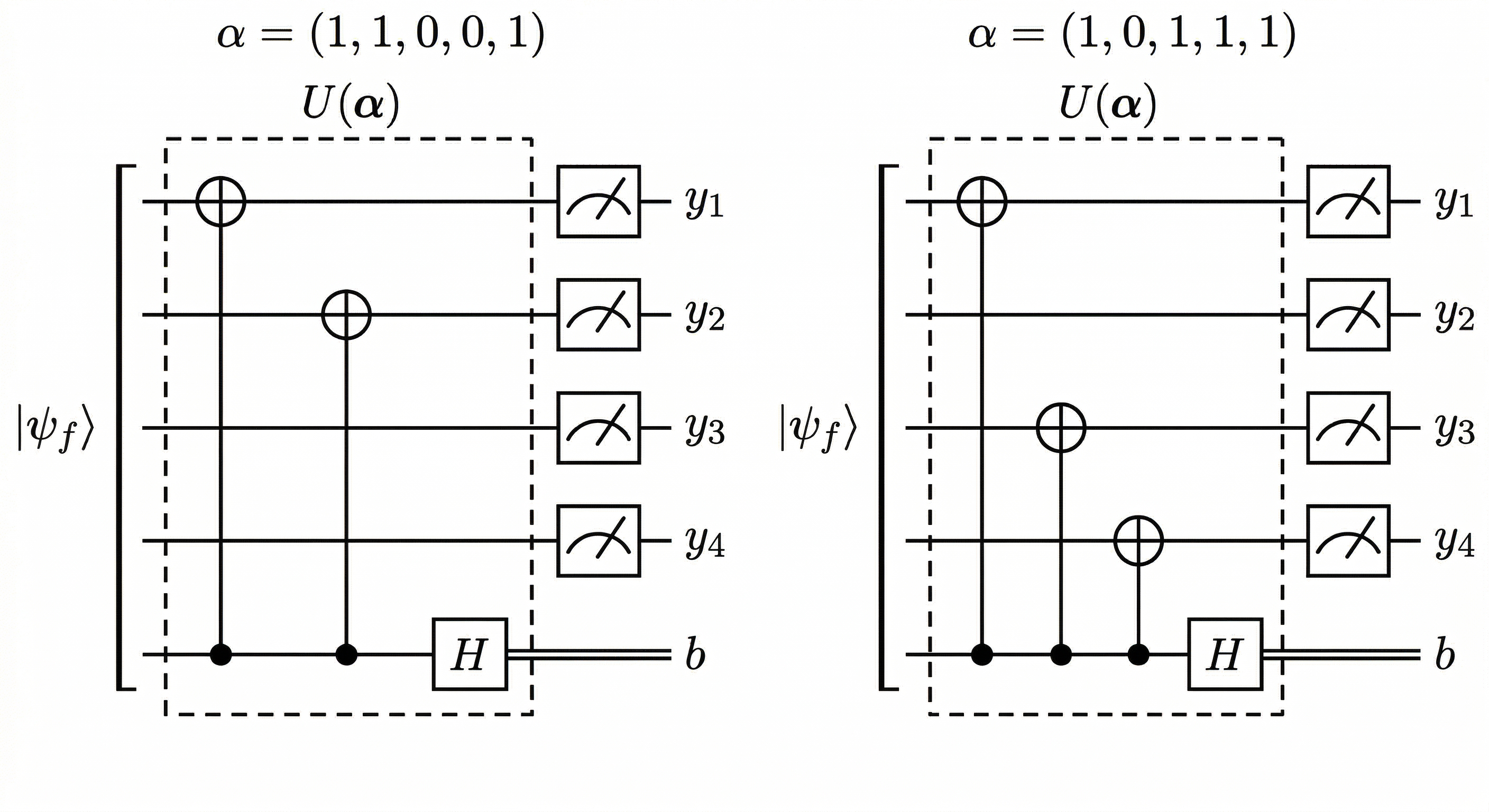
Figure 2: Measurement circuit for two different concepts nq2, illustrating the circuit depth scaling and qubit activation.
The core theoretical distinction lies in the sample complexity: FQ protocols exploit quantum parallelism and coherence to infer global properties in a single shot, while MF protocols typically suffer exponential sample complexity with respect to qubit number.
Realistic Noise Modeling and Hardware Constraints
The analysis incorporates realistic noise mechanisms:
- State Preparation Noise: Dephasing, amplitude damping (relaxation), and depolarizing channels, parameterized by per-qubit noise strength nq3.
- Gate and Circuit Noise: Gate fidelities, decoherence from idle periods, and connectivity-induced routing overhead, characterized for three device archetypes (A: all-to-all, B: square lattice/high-fidelity, C: square lattice/lower-fidelity).
- Readout Noise: Modeled as independent bit flips with probability nq4, compounded over the measured register.
Analytical decompositions and high-fidelity simulations establish that the overall visibility (i.e., quantum advantage signal) factorizes into the product of preparation, circuit, and readout visibility losses.
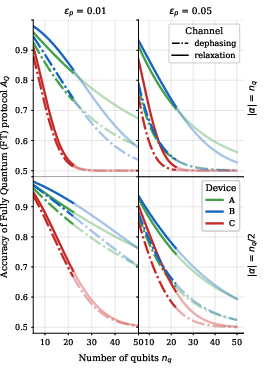
Figure 3: Accuracy of the fully quantum protocol under realistic hardware constraints and diverse noise channels, exposing the sharp accuracy decay with system size and circuit depth.
A rigorous evaluation of multiple MF protocols establishes the exponential separation. Considered MF baselines include:
- Shadow-based Estimators: Both direct inference on off-diagonal elements and more robust spectral/eigenshadow estimators.
- Task-specialized Protocols: Hypergraph-based reconstruction leveraging the algebraic structure of the quantum phase ensemble.
- Physically Informed Machine Learning: Supervised models trained on summary statistics derived from shadow measurement data.
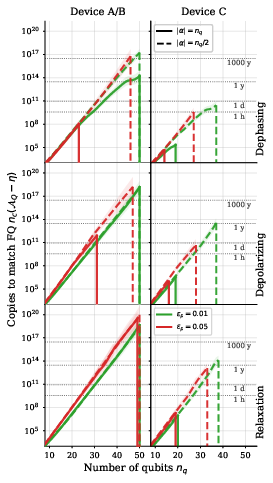
Strong claims are made on the scaling of required state copies (nq5) for these MF strategies to reach FQ accuracy. For system sizes nq6 and moderate noise, nq7 grows so large that experimental run times (even at modern fast cycle times) range from days to years—a separation that is robust to improvements in classical post-processing.
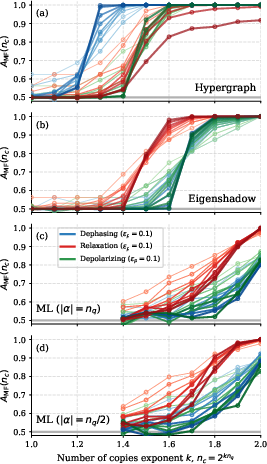
Figure 4: Sample complexity of various MF protocols, with exponential scaling apparent as a function of noise and system size, confirming the theoretical bottleneck.
Demonstration of Quantum Advantage and Key Findings
Comparative results show that even under moderately strong noise (nq8 as high as 0.1), fully quantum protocols vastly outperform all considered MF baselines at experimentally relevant scales (nq9–∣ψf⟩0). Of particular note:
Technical Contributions
The work validates and extends the QML advantage paradigm by providing:
- A scalable simulation framework that accounts for quantum data noise, circuit depth, hardware connectivity, and full device-level error models, with validated extrapolation up to ∣ψf⟩9 for benchmarking and scaling trends.
- Analytical sample complexity predictions for both FQ and optimized MF protocols, deriving precise scaling exponents for different noise regimes and operator weights.
- A surrogate model for classical shadow tomography, enabling tractable evaluation of MF protocols at large f0.
- Physically motivated MF baselines, including a hypergraph method and shell-averaged ML classifiers, optimized to exploit algebraic structure and physical symmetries in the data.
- A robust methodology for statistical extrapolation and experimental feasibility estimation, with conservative uncertainty quantification and validation.
Implications and Future Directions
Practical and Theoretical Impact
The main practical implication is that QML advantage in learning from quantum data is not merely asymptotic, but accessible at realistic scales on noisy devices, provided that the learning protocols are sufficiently tailored and noise-aware. The results set concrete targets for hardware architects striving to demonstrate quantum advantage: f1 qubits with moderate noise and adequate connectivity suffice for an unambiguous separation.
Theoretically, the findings reinforce the centrality of the noise model and system size in quantitative quantum advantage. The observed dependence on noise channel and circuit architecture may guide future QML task design and hardware optimization.
Extensions and Future Work
- Broader class of tasks: The relational learning task formalized here is structurally related to physical property prediction (e.g., symmetry learning, many-body correlator estimation). Extending the methods to more physically natural or application-relevant tasks is an important research direction.
- Multi-copy/adaptive classical protocols: While single-copy MF protocols were shown to be outperformed, future analysis of multi-copy MF protocols (e.g., using entangled measurements or collective error-mitigation techniques) is warranted.
- Adaptive/Variational Quantum Learners: Investigation of variational or adaptive FQ protocols with real hardware feedback could further enhance robustness and reduce hardware requirements.
- Integration with analog-digital devices: Leveraging hybrid platforms for near-term demonstrations and exploring analog state preparation schemes promises experimental acceleration.
Conclusion
This work constitutes a comprehensive, quantitative, and hardware-aware demonstration that quantum learning advantage over any measure-first classical protocol is observable at system sizes and noise levels accessible in current and near-term quantum hardware platforms, given coherent access to quantum data and competent error mitigation. The results establish new experimental benchmarks, reinforce the necessity of device- and noise-model-specific analysis, and open pathways for near-term empirical demonstrations of practical quantum machine learning advantage.