- The paper demonstrates that restricted, training-only quantum feature extraction yields exponential learning advantages under plausible cryptographic assumptions.
- It introduces the LUQPI framework by contrasting offline quantum feature extraction with online methods using rigorous theoretical separations.
- Empirical results on Rydberg atom chains show that LUQPI with SVM+ improves classification accuracy in low-data regimes and near phase boundaries.
Framework and Taxonomy of Quantum-Enhanced Learning
The paper "Machine learning with minimal use of quantum computers: Provable advantages in Learning Under Quantum Privileged Information (LUQPI)" (2601.22006) formally advances the study of hybrid quantum–classical machine learning, focusing on quantifying scenarios in which quantum resources play an extremely restricted role, yet yield provable learning benefits. The analysis adapts the classical Learning Under Privileged Information (LUPI) framework to quantum contexts, introducing LUQPI, where quantum computation is solely leveraged for feature extraction at training, with fully classical deployment.
A key theoretical distinction is drawn between “online” and “offline” quantum feature extraction (Figure 1):
- In online regimes, quantum computation is used during deployment for new inputs and extracted features.
- In offline regimes (LUQPI), quantum resources are used only in the training phase; during inference, only classical operations on raw data and pre-extracted quantum features are allowed.
This paradigm is compared to prior work including quantum kernel methods, cryptographically-motivated separations, QELMs, and quantum topological data analysis, resulting in a taxonomy that clarifies the scope, limitations, and assumptions required for provable quantum learning advantages.
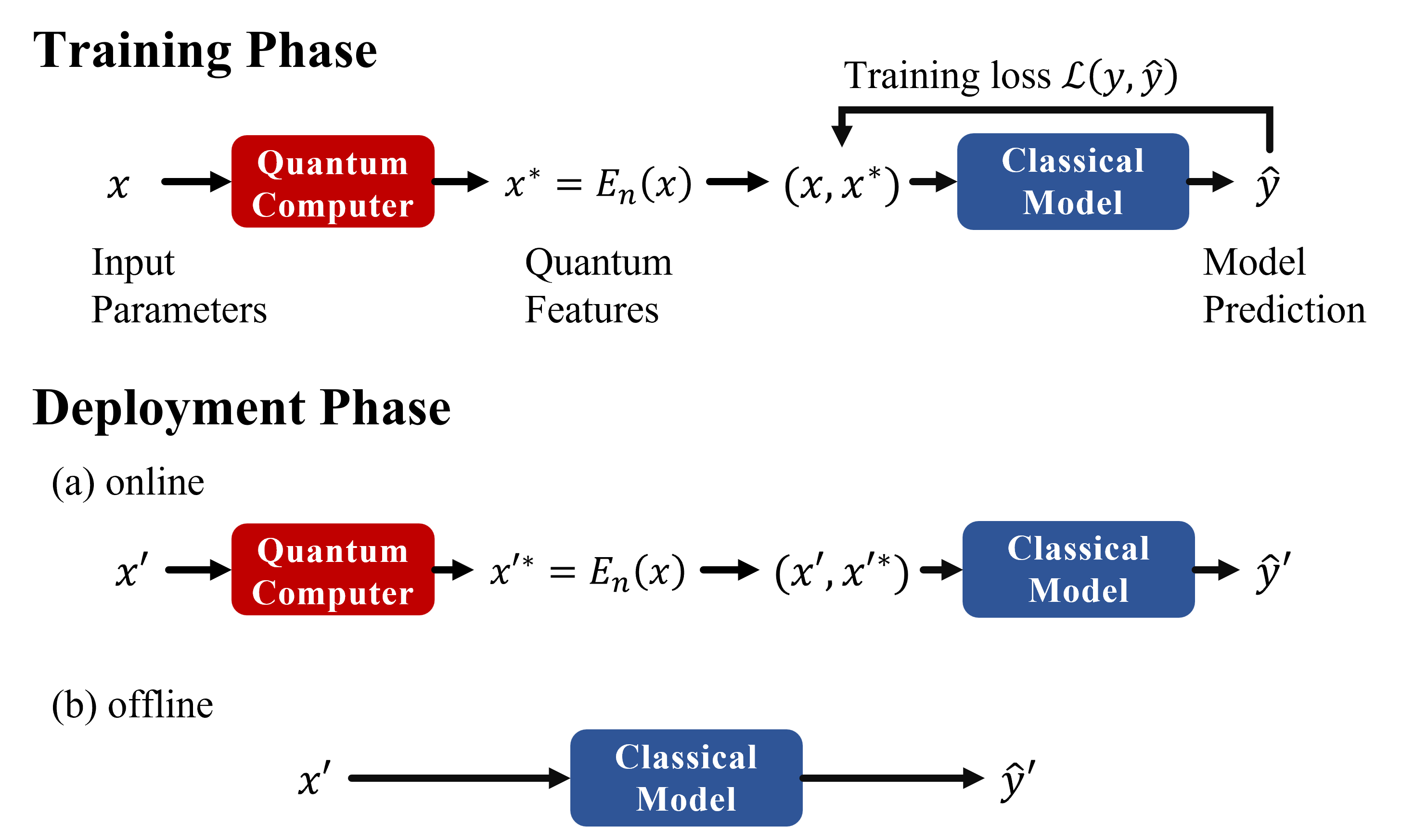
Figure 1: Online vs. offline quantum feature extraction: quantum resources are used at training only (offline), or additionally at inference (online); offline allows classical deployment on raw plus quantum-derived features.
Theoretical Constructions: Cryptographic Concept Classes and Separation Results
The authors construct explicit PAC learning problems where LUQPI yields exponential quantum-classical separation under reasonable computational assumptions. The formal mechanism is cryptographic: specifically, the construction is based on the hardness of Decisional Diffie-Hellman and its “circular power” variant in generic groups. Here, the concept classes are parameterized such that evaluation is classically infeasible unless group structure or key information is available, but quantum feature extraction (discrete logs, etc.) easily recovers the necessary encoding. These constructions are rigorously shown to be secure and yield advantage against non-uniform (P/poly) classical learners for natural uniform distributions, unlike earlier approaches relying on contrived distributions or distribution/concept coupling.
A substantial technical contribution is the demonstration that even minimal, training-only quantum feature extraction (with features added to the data independently of labels or dataset structure) can enable efficient classical learning of otherwise intractable concept classes—provided the features are computationally hard to generate except by quantum means. The framework is extended to include concept-friendly embeddings to ensure that the mappings from bitstrings to group elements maintain uniformity and hardness properties.
The practical realization of LUQPI calls for classical learning architectures that can exploit augmented datasets containing quantum-extracted features only at training. The authors discuss SVM+, which models slack variables as functions of privileged information provided in training and not at inference, as a particularly fitting approach. This mechanism enables finer control of classification decision boundaries, and under certain conditions yields improved generalization bounds (by reducing VC dimension of the effective hypothesis space).
Empirical Results: Quantum Phase Identification in Rydberg Atom Chains
The paper provides a comprehensive empirical evaluation of LUQPI in a physically realistic many-body quantum system: phase identification in 1D Rydberg atom chains. Here, quantum-derived order parameters (expectation values of observables on ground states) serve as privileged information. SVM+ is employed as the LUQPI learning algorithm, compared against classical SVM (no privileged features) and Transformer-based generative models that learn to reproduce quantum observables (attempting classical emulation of quantum features).
Key experimental observations:
- LUQPI via SVM+ achieves consistent gains over SVM in low-data regimes and under boundary-concentrated sampling, consistent with the theoretical convergence improvements predicted for privileged information usage.
- LUQPI models outperform generative architectures when training data is sparse and concentrated near phase transitions, where quantum privileged information serves as a surrogate for difficult-to-learn correlations.
- The advantage of privileged information is most pronounced for classification tasks with ambiguous labels or underrepresented classes, especially when feature extraction cannot be efficiently emulated classically.
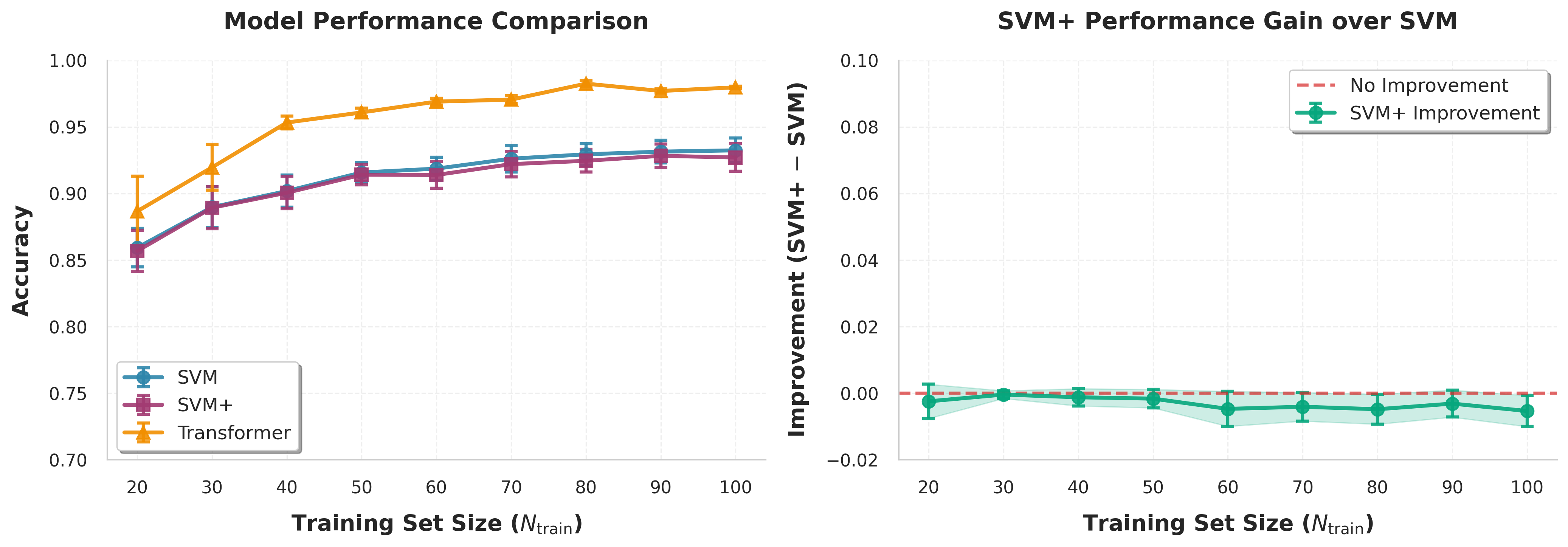
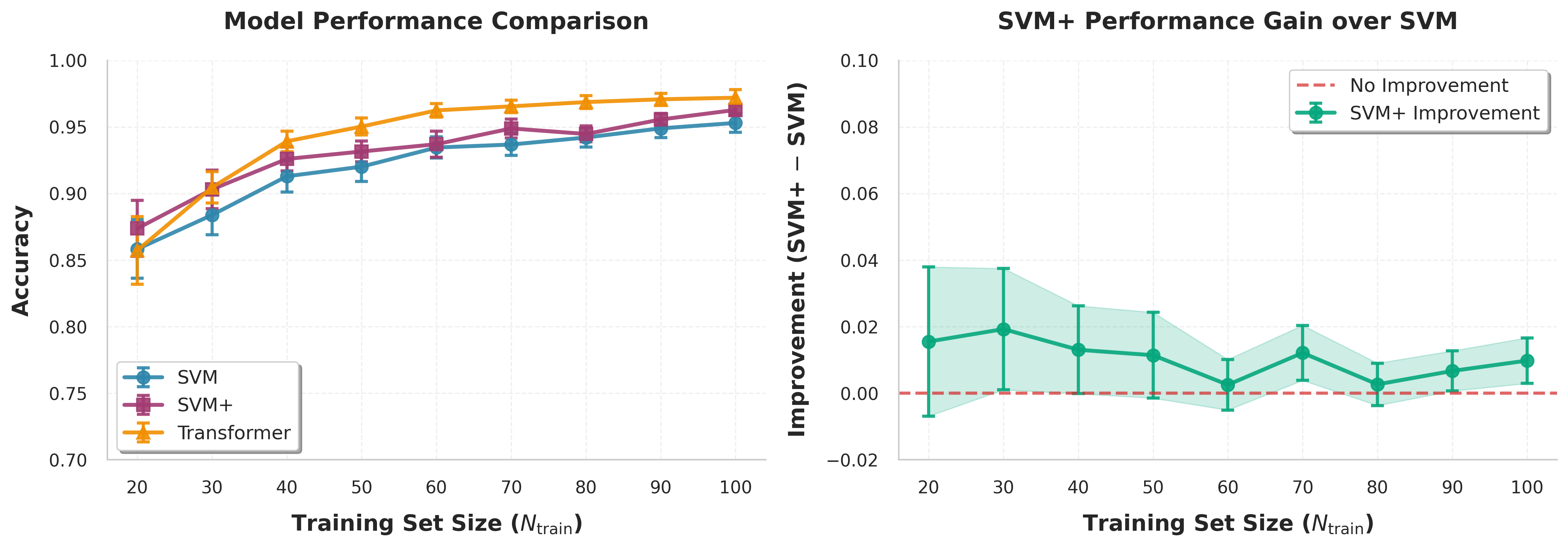
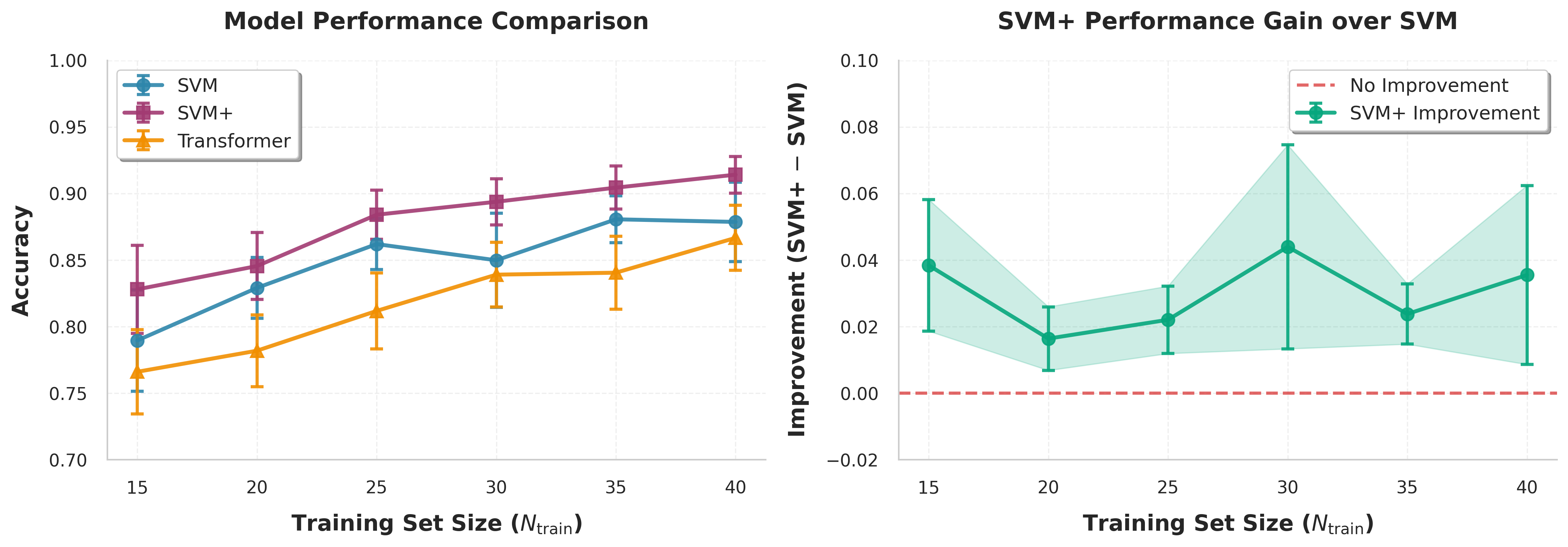
Figure 2: Uniform sampling exhibits consistent, modest improvements with LUQPI-based SVM+ over classical baselines, particularly in low-sample regimes.
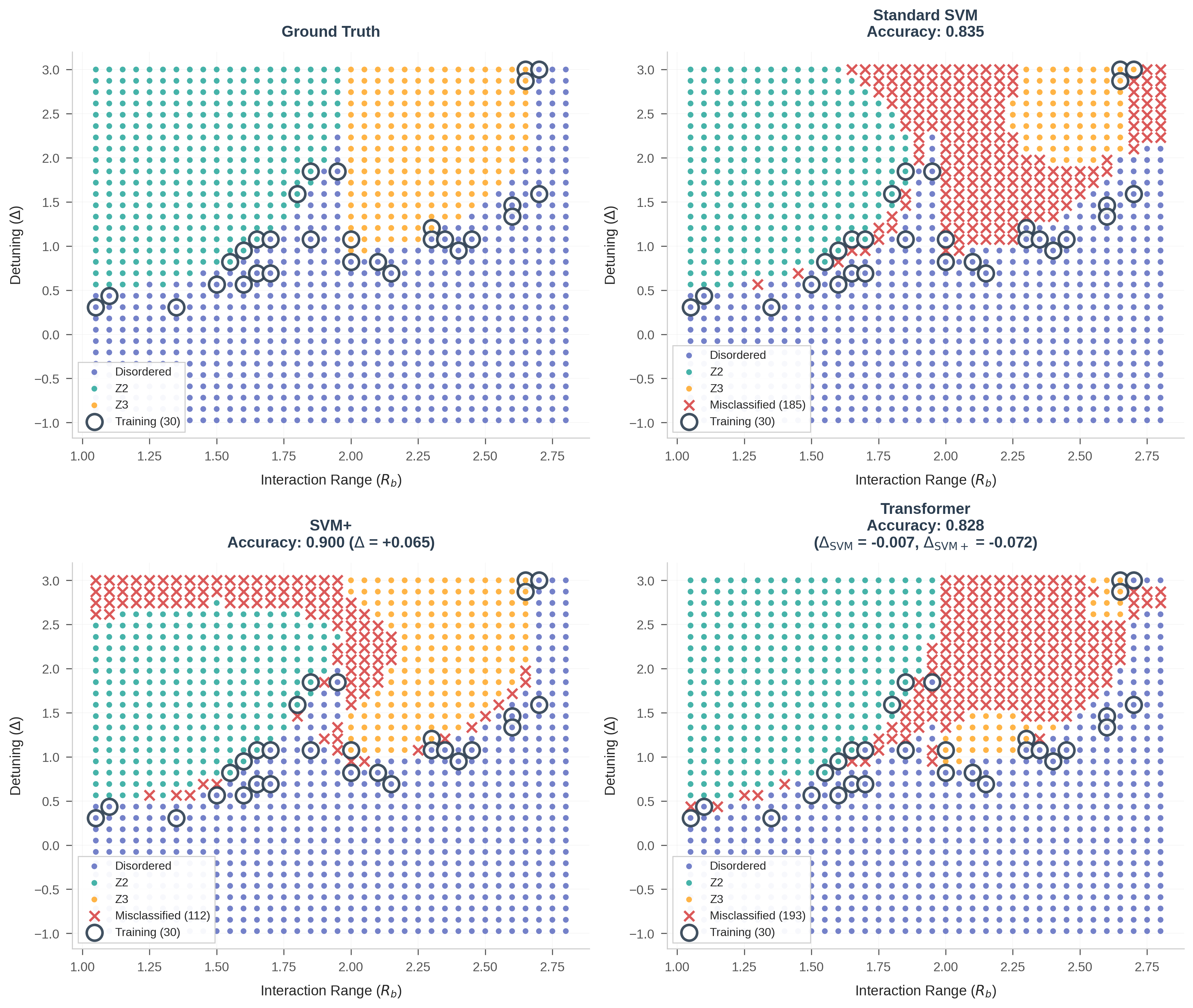
Figure 3: Misclassification analysis under hard boundary sampling; SVM+ (LUQPI) corrects errors near phase boundaries better than SVM or Transformer models, emphasizing the utility of quantum privileged information for ambiguous instances.
Implications, Limitations, and Future Directions
Theoretically, the work demonstrates that exponential quantum-classical separation is possible in highly constrained hybrid regimes, and establishes that restricted quantum feature extraction suffices for strong learning advantages under plausible hardness conjectures. Empirically, the study shows that quantum privileged information can improve classical learning accuracy, especially for low-sample, boundary-concentrated distributions relevant to expensive quantum simulations.
Practical implications include the potential for scalable, resource-efficient quantum-enhanced machine learning workflows where quantum computation is restricted to a data preprocessing stage, enabling tractable deployment in classical environments. The LUQPI framework is especially attractive for applications involving costly quantum hardware or simulation, allowing maximal leverage of quantum advantage with minimal quantum utilization.
Limitations stem from the tractability of privileged feature generation for novel quantum systems, robustness to noise in quantum measurements, and the challenge of identifying optimal forms of privileged information in practice. The study focuses on a system where quantum feature extraction is classically tractable for experimental control, but the full benefits would require application to classically intractable models. Furthermore, only SVM+ is studied extensively as an offline-privileged architecture; broader algorithmic development remains open.
Future work should target:
- Extension to higher-dimensional, classically intractable systems using experimentally accessible quantum simulators
- Exploration of alternative forms of quantum privileged information (e.g., quantum shadows, dynamical correlators)
- Robustness analysis under noise and imperfect quantum feature extraction
- Development of classical algorithms designed for offline quantum-augmented learning beyond SVM+
Conclusion
This work establishes a rigorous foundation for provable quantum learning advantage in hybrid regimes with minimal quantum involvement, constructing formal LUQPI settings with exponential separations and validating practical utility in quantum phase detection tasks. The results highlight LUQPI as a compelling direction for resource-efficient quantum machine learning, with substantial theoretical implications for the boundaries of quantum advantage and practical prospects for quantum-assisted scientific inference.