- The paper demonstrates that incorporating pseudo-angular momentum conservation yields giant enhancements in lattice thermal conductivity, with up to a 6.38-fold improvement.
- The method uses symmetry-resolved three-phonon scattering analysis in chiral 3_1 helical tellurium chains to restrict Umklapp processes and extend phonon lifetimes.
- The work implies broader material applications, including a 24% increase in α-quartz conductivity and promising avenues for directional phonon transport and rectification.
Giant Enhancement of Thermal Conductivity via Pseudo-Angular Momentum Conservation in Chiral Phonon Systems
Introduction and Theoretical Foundation
The study addresses the impact of pseudo-angular momentum (PAM) conservation on intrinsic phonon-mediated heat transport in chiral crystals, specifically those with rotational and screw symmetry. Chiral phonons possess definitive handedness and are characterized by an eigenphase quantum number derived from a crystalline symmetry operation. The core innovation is the explicit incorporation of PAM conservation as an anharmonic selection rule in three-phonon Boltzmann transport calculations. This symmetry-resolved constraint is demonstrated using the one-dimensional 31 helical tellurium (Te) chain as an exact proof platform, where all phonon modes are labeled by screw PAM due to full Brillouin zone screw invariance.
In conventional transport frameworks, only energy and crystal-momentum conservation are imposed on phonon-phonon scattering processes. However, in a screw-symmetric lattice, nonzero cubic anharmonic vertices require eigenphase balance among the participating phonons, leading to the modular PAM residue rule:
ls1+ls2−ls3+m≡0(mod3)
for absorption (1+2→3), and a corresponding rule for emission. This residue rule restricts the allowed scattering channels and reorganizes relaxation pathways, fundamentally altering the thermal transport landscape.
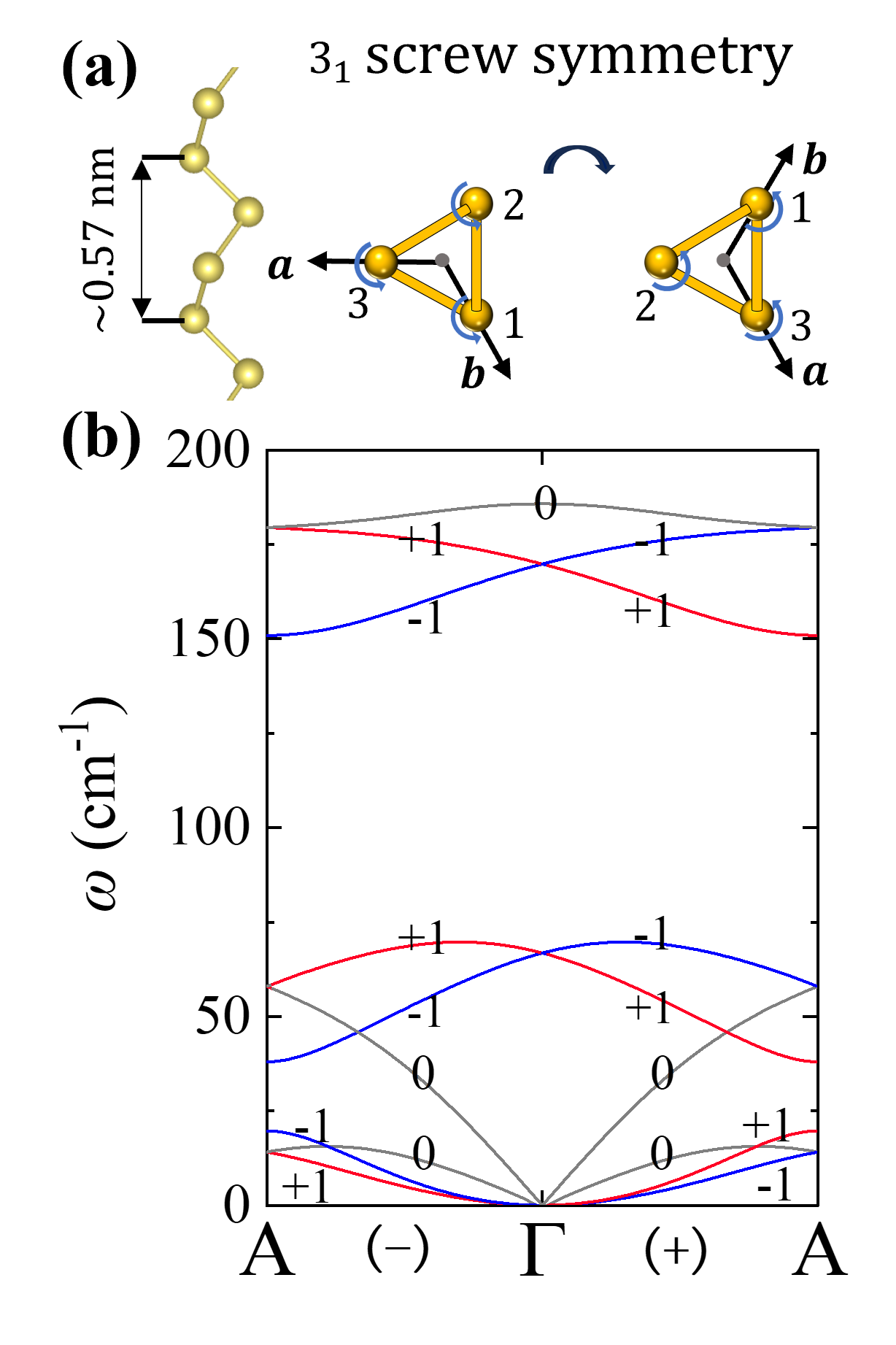
Figure 1: Right-handed 31 helical Te chain structure and phonon dispersion, demonstrating clean separation of PAM quantum sectors and dynamical stability.
PAM Selection Rule: Phase-Space and Scattering Suppression
The imposition of the PAM selection rule manifests as a substantial reduction in three-phonon phase-space. Approximately two thirds of kinematically allowed triplets are eliminated as symmetry-forbidden, irrespective of satisfying energy and momentum conservation. This exclusion is validated with uniform distribution over residue classes (Δl≡ΔPAM mod $3$), highlighting that only the Δl=0 class participates in nonzero cubic vertices.
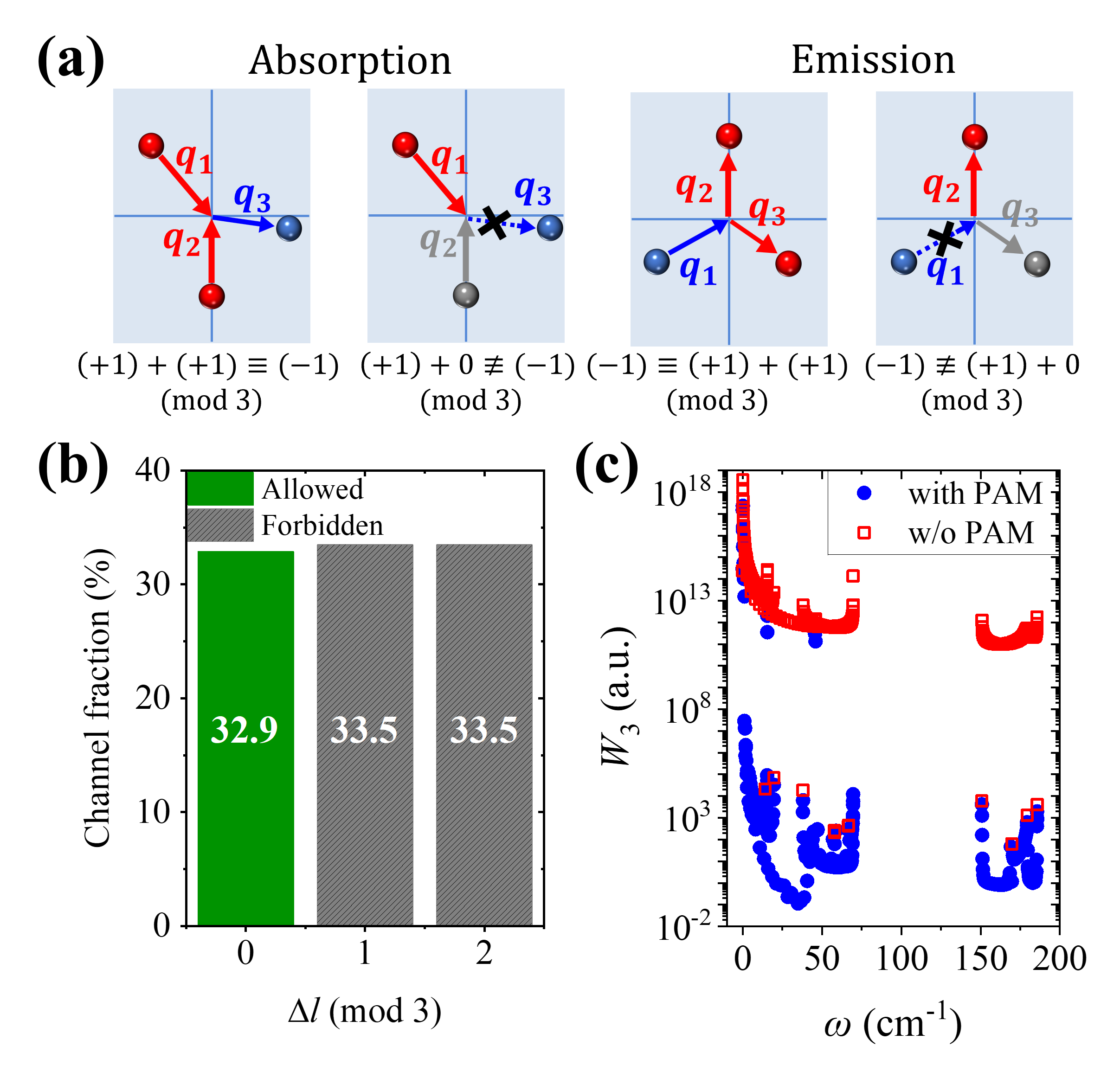
Figure 2: Illustration of allowed/forbidden three-phonon processes via PAM residue, uniform exclusion in kinematic phase-space, and suppression in temperature-weighted channel count.
The weighted phase-space analysis, even after accounting for thermal occupations and energy broadening, reveals that the PAM rule remains significant. The reduction is most pronounced in the optical frequency regime, where PAM labels are distinct, but extends across the spectrum, suggesting chiral optical modes act as symmetry-selective scattering partners for low-frequency acoustic carriers.
Modification of Anharmonic Relaxation Mechanisms
The symmetry-driven exclusion of scattering channels directly impacts phonon lifetimes and intrinsic relaxation dynamics. Frequency-resolved anharmonic scattering rates, decomposed into normal and Umklapp contributions, exhibit significant mode-dependent suppression in the PAM-conserving framework relative to the diagnostic PAM-relaxed baseline. The reduction is not merely a uniform rescaling but follows selective pruning of resistive Umklapp pathways which are central to momentum relaxation and thermal resistance.
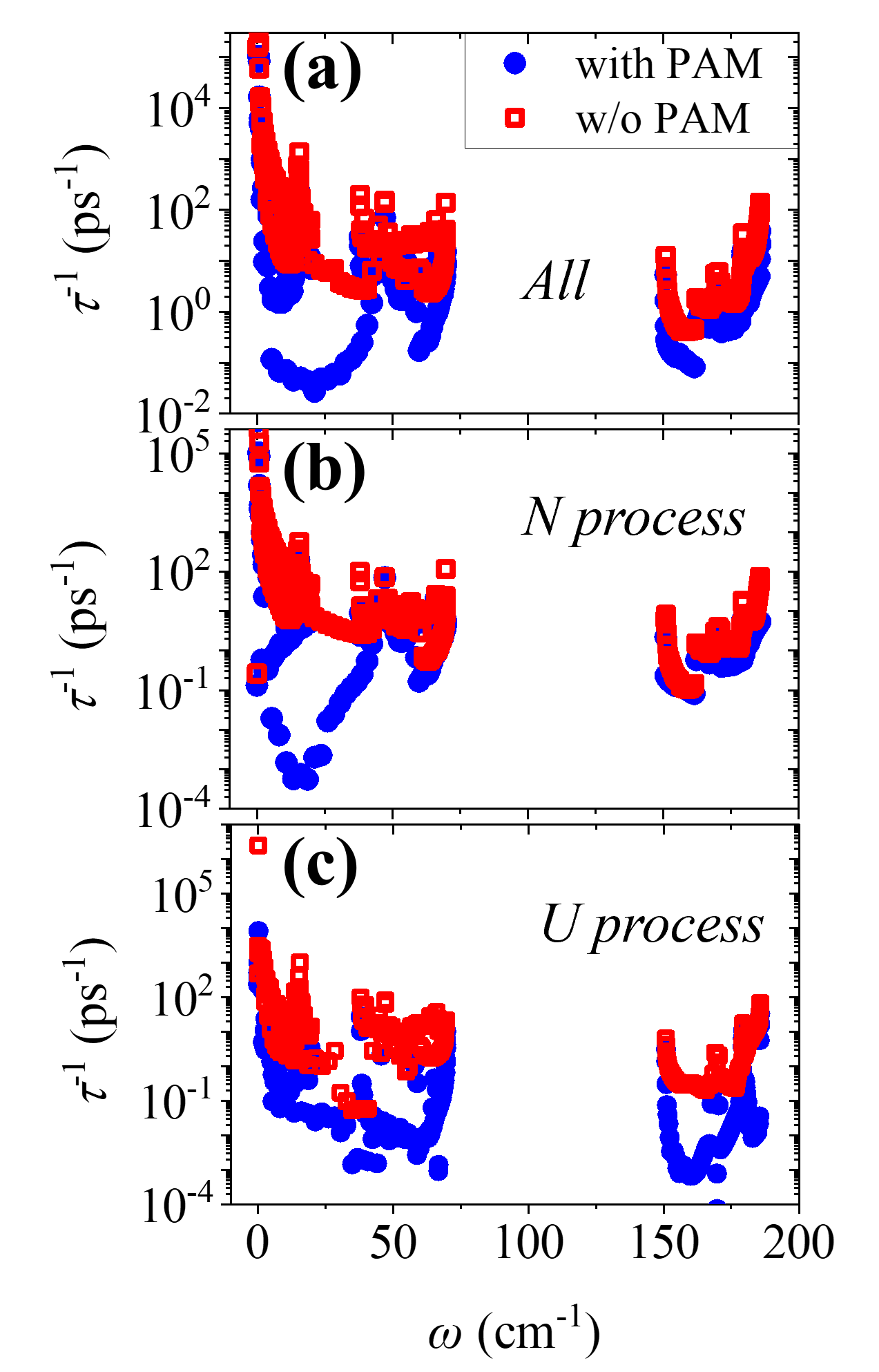
Figure 3: Comparison of frequency-resolved scattering rates for all, normal, and Umklapp processes, showing strong suppression in PAM-conserving calculation.
This channel pruning reshapes the connectivity of acoustic and optical branches in the relaxation network and enhances the lifetimes and mean free paths of low-frequency heat-carrying phonons. Consequently, heat carriers are not direct participants in visibly chiral modes, but their lifetimes are protected by symmetry-incompatible partners being forbidden, establishing the network nature of transport enhancement.
Giant Thermal Conductivity Enhancement and Mode Analysis
Explicit inclusion of the PAM selection rule in first-principles Boltzmann transport calculations yields a dramatic enhancement in lattice thermal conductivity. The order-one improvement persists across the entire temperature range studied. Quantitatively, the lattice conductivity in the 31 helical Te chain is boosted by factors of $6.38$, $5.30$, and ls1+ls2−ls3+m≡0(mod3)0 at ls1+ls2−ls3+m≡0(mod3)1, ls1+ls2−ls3+m≡0(mod3)2, and ls1+ls2−ls3+m≡0(mod3)3 K, respectively. This enhancement is predominantly realized among low-frequency acoustic modes, as demonstrated by cumulative conductivity and mean free path spectra.
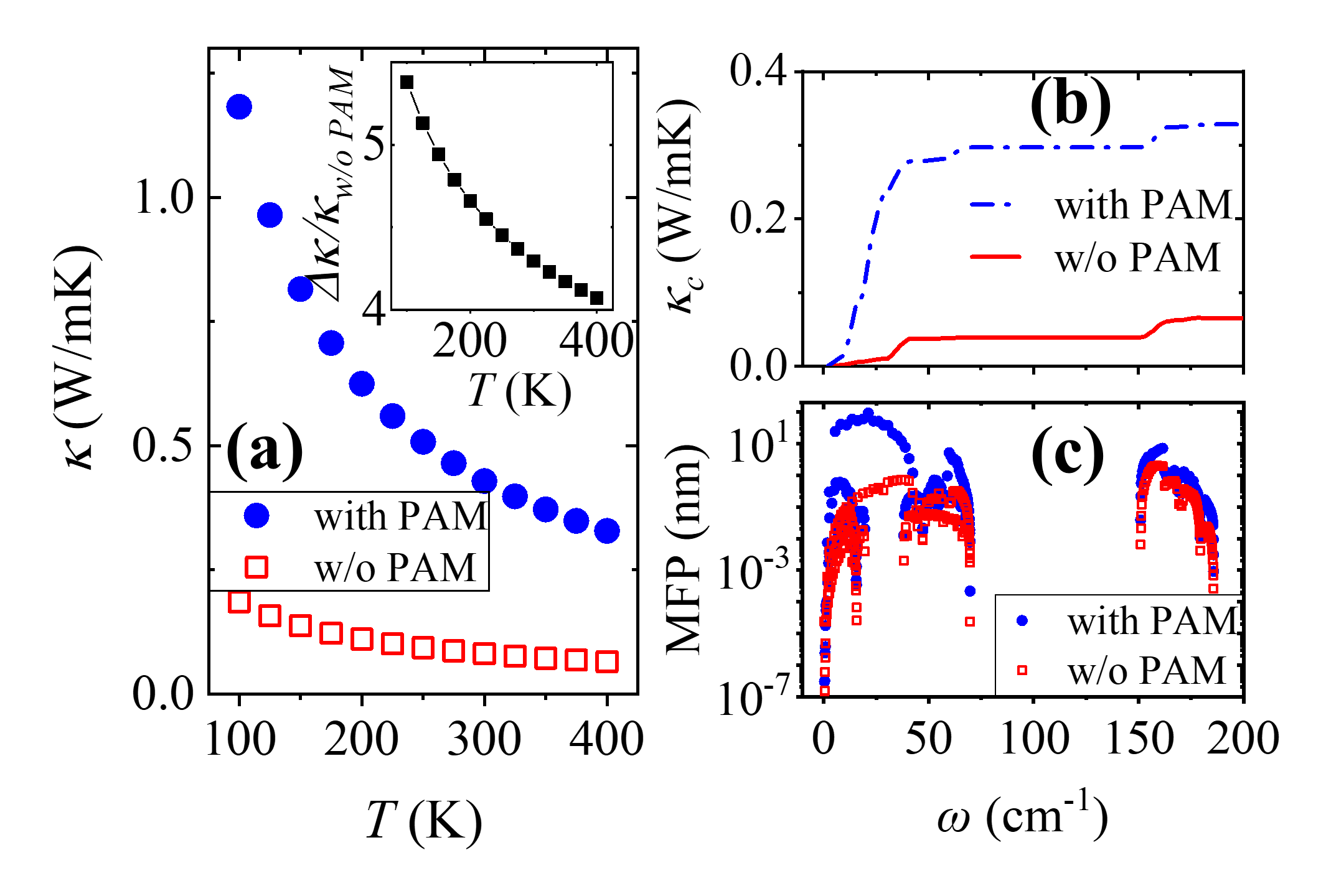
Figure 4: Macroscopic thermal conductivity enhancement, cumulative frequency-resolved conductivity, and mean free path extension for low-frequency carriers.
While optical chiral modes dominate the symmetry landscape, heat current is principally carried by long-wavelength acoustic phonons. The latter’s lifetimes and propagation ranges are extended due to PAM-constrained suppression of relaxive Umklapp scattering, clarifying the separation between branches with maximal chirality and those with dominant thermal capacity.
Extension to Bulk Chiral Crystals and Material-Scale Relevance
The symmetry principle underpinning PAM conservation is material agnostic and extends to bulk chiral crystals exhibiting rotational or screw symmetry. Application of PAM-explicit scattering in ls1+ls2−ls3+m≡0(mod3)4-quartz, a canonical chiral crystal, indicates a ls1+ls2−ls3+m≡0(mod3)5 increase in calculated lattice thermal conductivity, closely matching the discrepancy between experimental measurements and prior first-principles calculations that neglected this symmetry constraint. This demonstrates material-scale significance beyond the one-dimensional proof platform.
Chirality-Selected Directional Propagation and Rectification
PAM conservation also enables chirality-selected directional propagation due to velocity-locking between phonon group velocity and PAM label within optical windows. Excitation of chiral phonons can preferentially generate right- or left-moving wave packets with extended propagation and reduced attenuation in PAM-conserving systems. Thermal rectification estimates based on these mechanisms show superior preservation of directional transport relative to PAM-relaxed baselines, establishing a symmetry-guided pathway for phononic diode functionality.
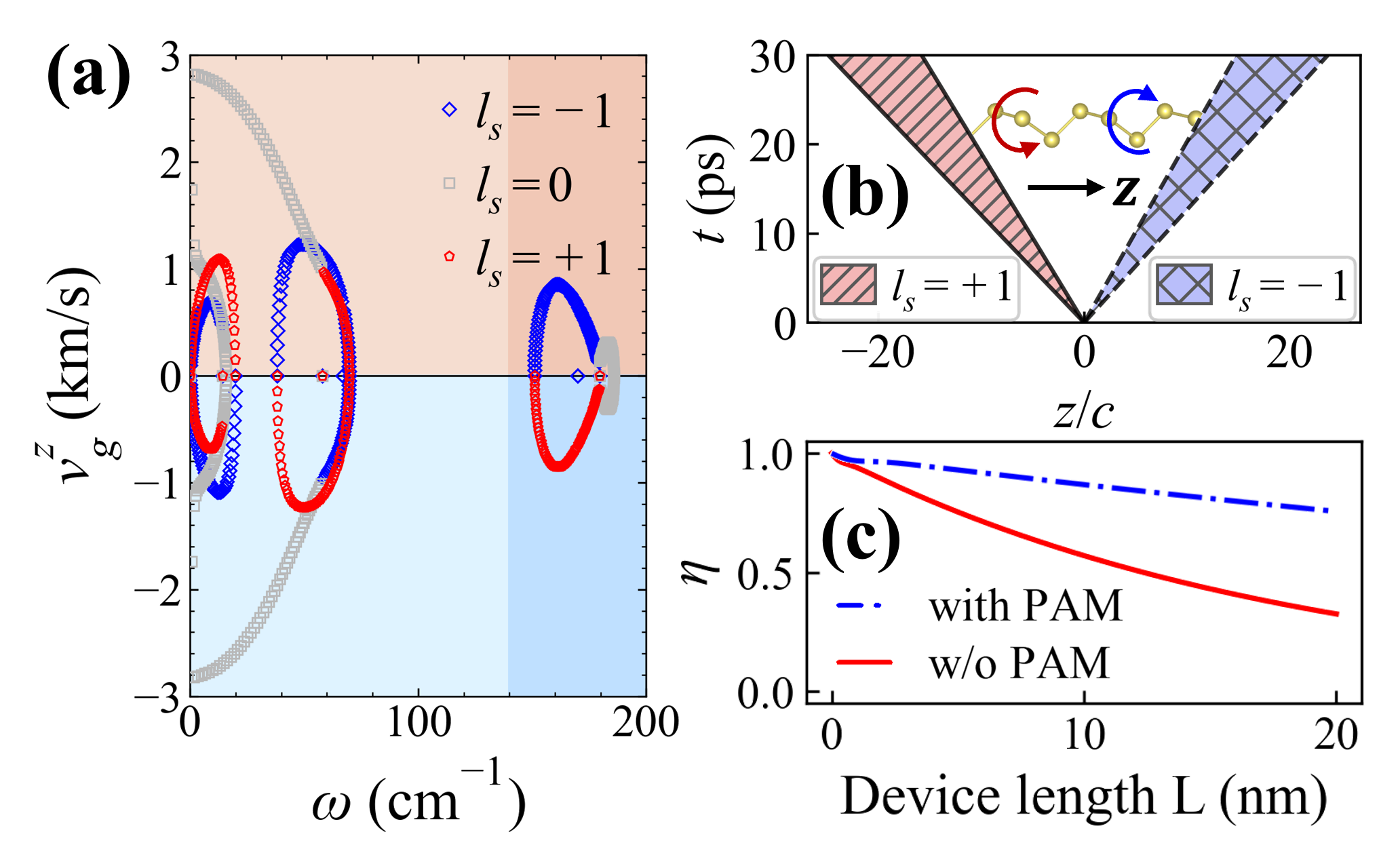
Figure 5: PAM-velocity locking in optical windows, ideal handed propagation fans, and rectification estimates illustrating enhanced directional transport.
Conclusion
The explicit conservation of pseudo-angular momentum in chiral phonon systems is established as a fundamental selection rule governing phonon-phonon scattering and incoherent heat transport. In ls1+ls2−ls3+m≡0(mod3)6 helical Te chains, PAM-resolved phase-space pruning suppresses resistive Umklapp processes and yields a giant enhancement in lattice thermal conductivity. The effect is realized through protection and extension of low-frequency acoustic heat carriers, orchestrated by the symmetry-sensitive nature of chiral optical modes. The symmetry principle has direct material-scale relevance, as evidenced in bulk ls1+ls2−ls3+m≡0(mod3)7-quartz. Moreover, PAM conservation informs the design of directional phonon transport and rectification devices in chiral nanostructures. Theoretical and practical implications include a refined understanding of heat flow in symmetry-rich materials and the development of phononic systems with engineered thermal response profiles.