- The paper shows that elasticity-induced renormalization modifies graphene’s ZA phonon dispersion from quadratic to sub-quadratic, restoring well-defined phonon quasiparticles.
- It demonstrates that the inclusion of SCSA renormalization nearly doubles thermal conductivity at 300 K by suppressing four-phonon scattering rates.
- It reveals that enhanced phonon hydrodynamics and reduced Umklapp processes necessitate revisions to traditional 2D thermal transport models.
Elasticity-Driven Renormalization of Heat Flow in Graphene
Background and Motivation
Thermal transport in graphene exhibits notable deviations from three-dimensional (3D) paradigms, rooted in the unique interplay between its dimensionality, symmetry, and lattice dynamics. The intricate nature of phonon-phonon interactions, especially in suspended monolayer graphene, has led to evolving theoretical models to reconcile discrepancies between experimental and computational results for thermal conductivity (κ). Earlier predictions relying solely on three-phonon processes systematically overestimated κ, while newer four-phonon-inclusive theories tended to underpredict experimental values. Additionally, the nature of phonon dispersion for the out-of-plane flexural (ZA) modes remains a central topic, given the constraints imposed by the Hohenberg-Mermin-Wagner theorem on two-dimensional (2D) crystals.
This work addresses whether the well-established renormalization of the elastic bending rigidity (D) — needed to ensure the thermodynamic stability of the flat phase in 2D — also fundamentally alters the microscopic phonon scattering mechanisms and, thus, the overall thermal transport in graphene. The findings here delineate a critical connection between macroscopic elasticity and heat transport, necessitating a revision of canonical 2D thermal transport models.
Main Results
SCSA Renormalization and the Restoration of Phonon Quasiparticles
The study employs a self-consistent screening approximation (SCSA) to renormalize the ZA phonon dispersion, which replaces the standard quadratic behavior with a sub-quadratic (ν∼q1.6) form at long wavelengths. This approach is physically motivated by the coupling of in-plane and out-of-plane elastic fluctuations, leading to a size- and temperature-dependent bending rigidity D(L,T0). SCSA renormalization is validated against experimental measurements of D and is incorporated into a first-principles thermal transport framework using the SCAP methodology.
The impact of this renormalization is profound. Prior to SCSA correction, the phonon quasiparticle description for low-frequency ZA modes is invalidated, with phonon lifetimes (1/Γ) comparable to or less than their oscillation periods (1/ω), especially at and above room temperature. SCSA renormalization restores well-defined phonon quasiparticles across the Brillouin zone, maintaining the fundamental assumption required for the use of Peierls-Boltzmann transport equations at all investigated temperatures (Figure 1).
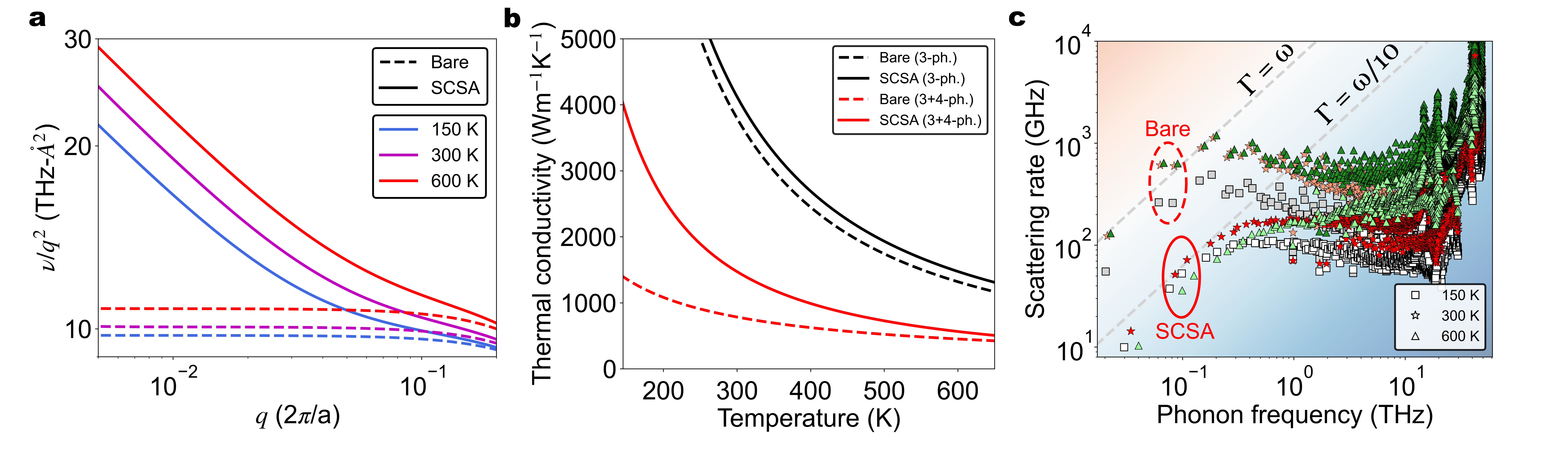
Figure 1: SCSA renormalization of ZA phonons modifies their dispersion, enhances κ, and restores the phonon quasiparticle regime by strongly reducing scattering rates.
Enhancement of Thermal Conductivity
A central quantitative result is that inclusion of SCSA-renormalized ZA phonons nearly doubles the calculated κ (from κ0850 Wmκ1Kκ2 to κ31600 Wmκ4Kκ5 at 300 K) relative to calculations with bare ZA dispersions, bringing the theory into closer agreement with a range of experimental observations. This enhancement is specific to scenarios where four-phonon scattering is included; results using only three-phonon scattering are less sensitive to the phonon renormalization schema.
Notably, strong four-phonon scattering among the bare ZA modes accounts for both the lower κ6 and the breakdown of quasiparticle transport, whereas SCSA modification sharply suppresses the effective four-phonon scattering rates for these modes, explaining the concurrent rise in κ7 and restoration of quasi-particle character.
Microscopic Mechanisms: Four-Phonon Scattering and Hydrodynamics
The suppression of four-phonon scattering rates emerges not because of a reduced phase space but is attributed directly to the drastic reduction in matrix elements for the scattering events, and to decreased Bose occupation factors for the higher-frequency (SCSA-renormalized) ZA modes. This finding clarifies that the key controlling factor is not kinematic, but is tied intrinsically to the restructured phonon interaction Hamiltonian (Figure 2).
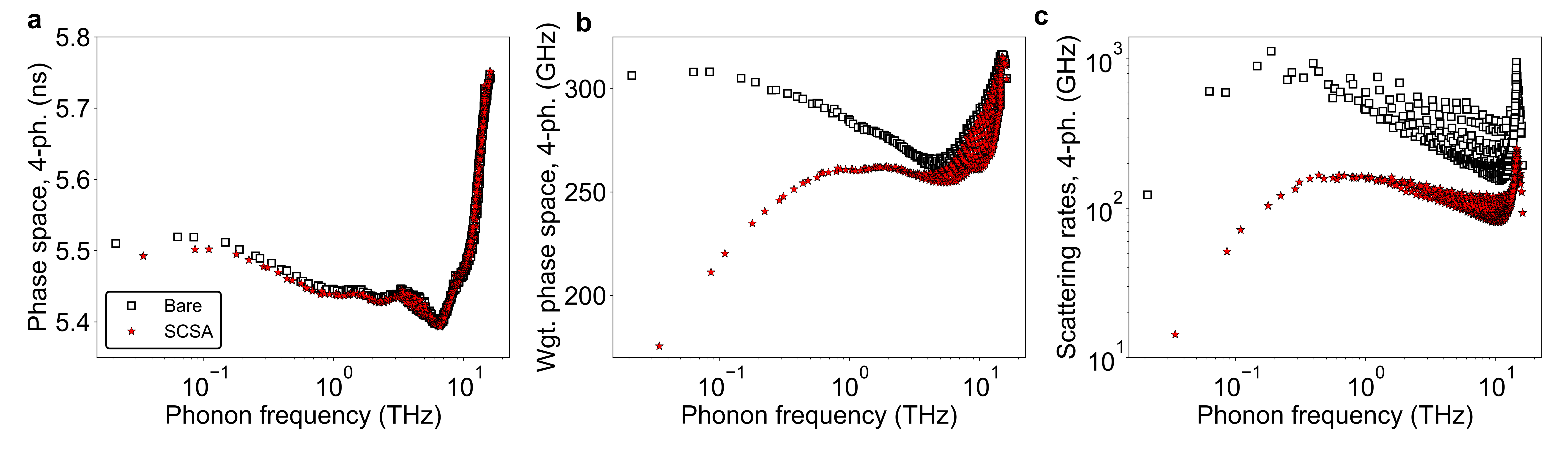
Figure 2: SCSA affects the four-phonon scattering not via phase space reduction, but through suppression of matrix element-weighted phase space and scattering rates for ZA phonons.
Furthermore, the SCSA renormalization is shown to amplify phonon hydrodynamics, as evidenced by larger contributions to κ8 from long-lived drifting eigenmodes and reduced eigenvalues associated with momentum destruction via Umklapp (U) processes, compared to Normal (N) processes. Although N-scattering remains dominant, thermal transport becomes far more "hydrodynamic" in character, with diminished U rates (Figure 3).
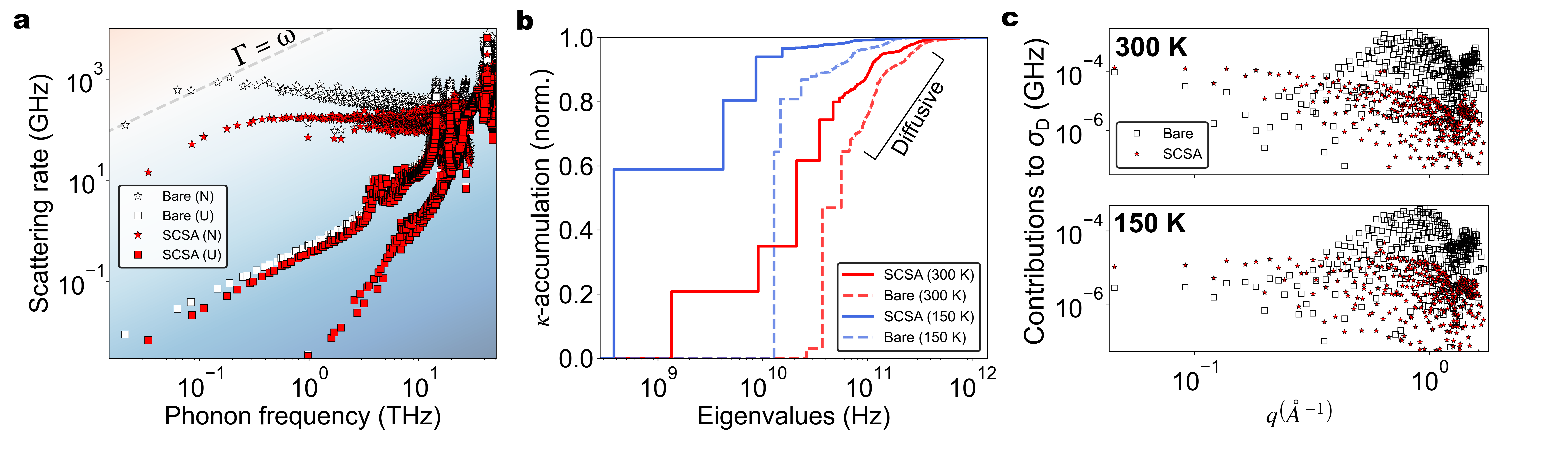
Figure 3: SCSA renormalization leads to enhanced phonon hydrodynamics, reflected in altered scattering rates and larger hydrodynamic mode contributions to κ9.
Implications and Broader Context
The findings dictate a reevaluation of thermal transport models in all 2D crystals characterized by significant flexural lattice dynamics, as the standard theoretical framework — which does not account for elasticity-induced phonon renormalization — systematically underestimates D0 and mischaracterizes foundational transport regimes. The explicit connection between elasticity and phonon lifetime suggests that any property contingent on phonon coherence (including, but not limited to, thermal and electronic relaxation times, nonequilibrium optical phonon phenomena, and spin decoherence mechanisms) must explicitly incorporate such renormalizations for accuracy.
Practically, the general first-principles methodology developed here affords a robust computational platform for predicting and engineering thermal transport in an arbitrary 2D or lower-dimensional system. The results are particularly relevant for device applications where management of heat or phonon-mediated decoherence is critical, as well as for the foundational exploration of non-Fourier transport signatures in strongly hydrodynamic or ballistic regimes.
Conclusion
This work rigorously establishes that the renormalization of the bending rigidity in graphene — a necessity for the thermodynamic stability of the 2D crystal — simultaneously and fundamentally reshapes the microscopic scattering landscape, restoring the phonon quasiparticle regime, sharply enhancing thermal conductivity, and amplifying phonon hydrodynamic signatures. The macroscopic-microscopic linkage revealed here mandates a revision of classical thermal transport theory in 2D systems and provides actionable routes for the engineering of heat flow and phonon-related phenomena in next-generation nanoelectronic and quantum devices.