- The paper introduces symmetry-adapted structure factors and bulk measures (G0 and Gu) to quantify phonon chirality across various crystal systems.
- It validates the framework through DFPT and finite-displacement methods on both chiral and noncentrosymmetric achiral materials.
- Temperature and symmetry are shown to drive linear increases in bulk dynamical chirality, informing avenues for phononic device applications.
Quantification of Chirality in Phononic Excitations
Introduction
The paper "Quantifying chirality of phonons" (2604.10231) systematically develops a framework for quantifying dynamical chirality in phonons across diverse material classes, including chiral and noncentrosymmetric crystals. Phonon chirality, unlike electronic chirality encoded in the handedness of wavefunctions, requires new theoretical constructs as lattice vibrations are vectorial collective excitations susceptible to crystal symmetries. This work establishes symmetry-adapted structure factors for different point groups, introduces bulk chirality measures G0 and Gu, and validates the robustness of these descriptors via complementary first-principles computational methodologies.
Computational Methodology and Symmetry Analysis
Ab initio calculations were carried out predominantly using density functional perturbation theory (DFPT), with crucial benchmarks using finite-displacement (phonopy + VASP) approaches to ensure methodological consistency. The investigation utilized eight materials that spanned chiral (e.g., Se, Te, α-HgS) and noncentrosymmetric but achiral (e.g., GaP, ZnTe) cases. Exchange-correlation was treated within the PBE-GGA or LDA frameworks as appropriate.
Central to the approach is the symmetry-resolved decomposition of the phonon angular momentum Lj(k) through projection operators associated with irreducible representations of relevant point groups (e.g., D3, Oh, Td). The derived structure factors F1(k) encapsulate the lowest-order symmetry-adapted behavior. Explicit expressions for F1(k) are given in terms of trigonometric functions of the crystal momentum, and their derivation via group theoretical projection techniques is fully detailed. The role of unit cell vectors and phase factors under symmetry operations is analyzed for each irreducible representation, directly connecting lattice structure to momentum-space chirality.
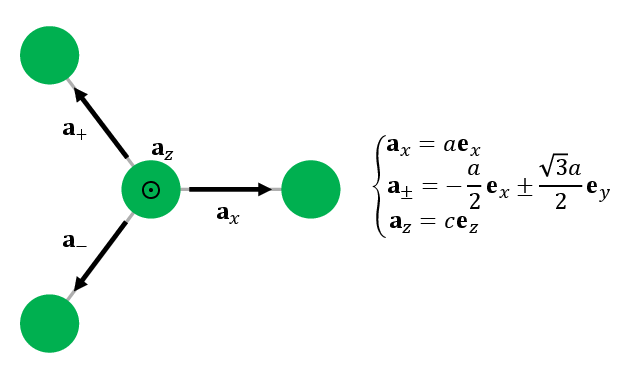
Figure 1: Schematic of the simple unit cell and its vectors in the D3 materials.
Momentum-Resolved and Bulk Dynamical Chirality
The momentum-resolved dynamical chirality, Gu0, is computed along high-symmetry paths for multiple chiral and achiral materials. In chiral crystals, nonzero momentum-resolved dynamical chirality switches sign between left- and right-handed enantiomers, with stark signatures evident throughout the Brillouin zone. For noncentrosymmetric achiral materials, local chirality exists but cancels upon Brillouin-zone integration.
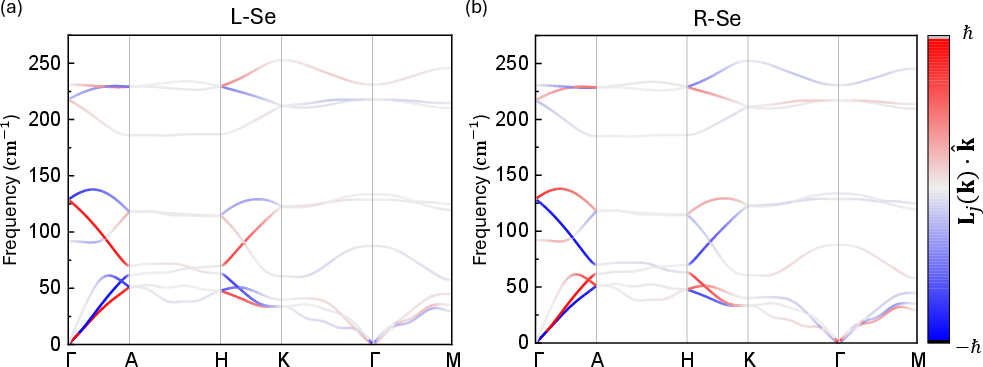
Figure 2: Momentum-resolved dynamical chirality in (a) L-Se and (b) R-Se along the paths between high symmetry points.
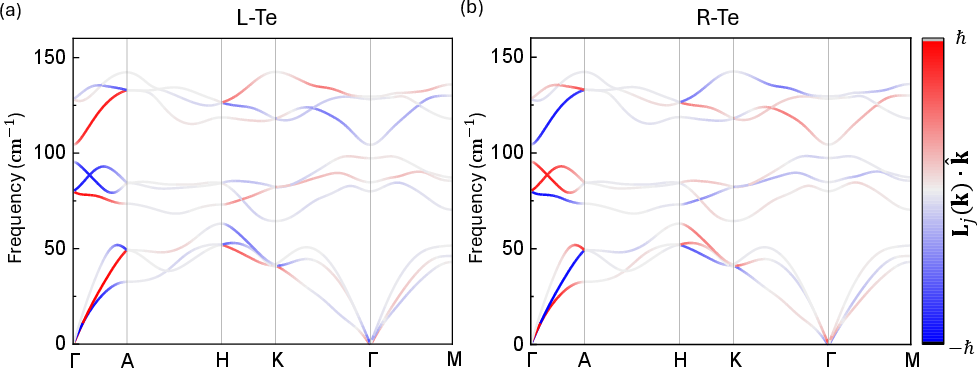
Figure 3: Momentum-resolved dynamical chirality in (a) L-Te and (b) R-Te along the paths between high symmetry points.
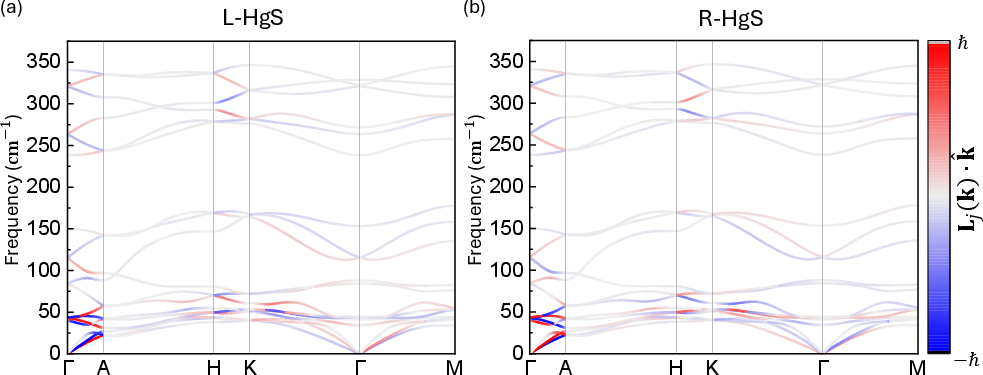
Figure 4: Momentum-resolved dynamical chirality in (a) L-HgS and (b) R-HgS along the paths between high symmetry points.
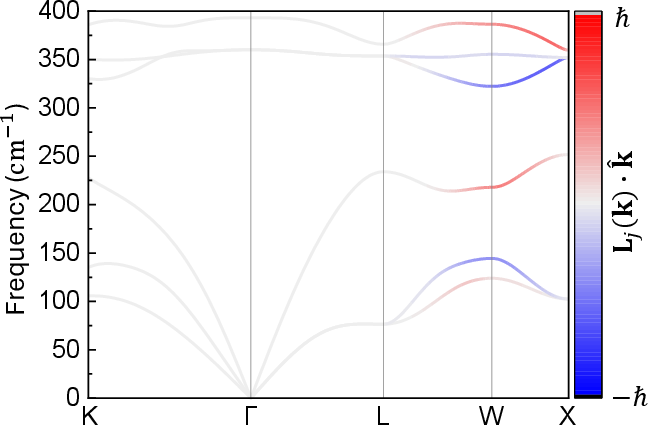
Figure 5: Momentum-resolved dynamical chirality in GaP along the paths between high symmetry points.
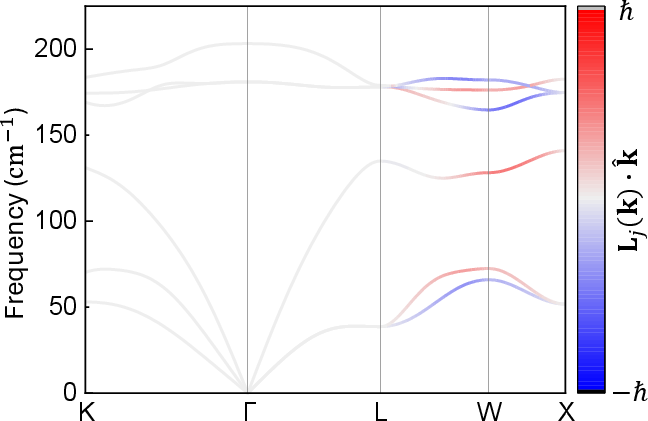
Figure 6: Momentum-resolved dynamical chirality in ZnTe along the paths between high symmetry points.
Bulk measures Gu1 and Gu2 are then introduced as Brillouin-zone-summed, mode- and structure factor-weighted angular momentum quantities. These quantities capture global phonon chirality and are rigorously zero in centrosymmetric systems and finite with opposite sign for chiral enantiomers. Quantitative agreement is confirmed between DFPT and finite-displacement calculations up to factors arising from convergence, pseudopotential, and structural details, reinforcing the universality of the chirality measures.
Temperature Dependence of Bulk Chirality
The temperature dependence of Gu3 and Gu4 is analytically and numerically found to be approximately linear in the high-temperature regime, consistent with equipartition and Bose-Einstein occupation. Explicit expressions relate the thermal scaling to the phonon frequencies and symmetry-adapted matrix elements.
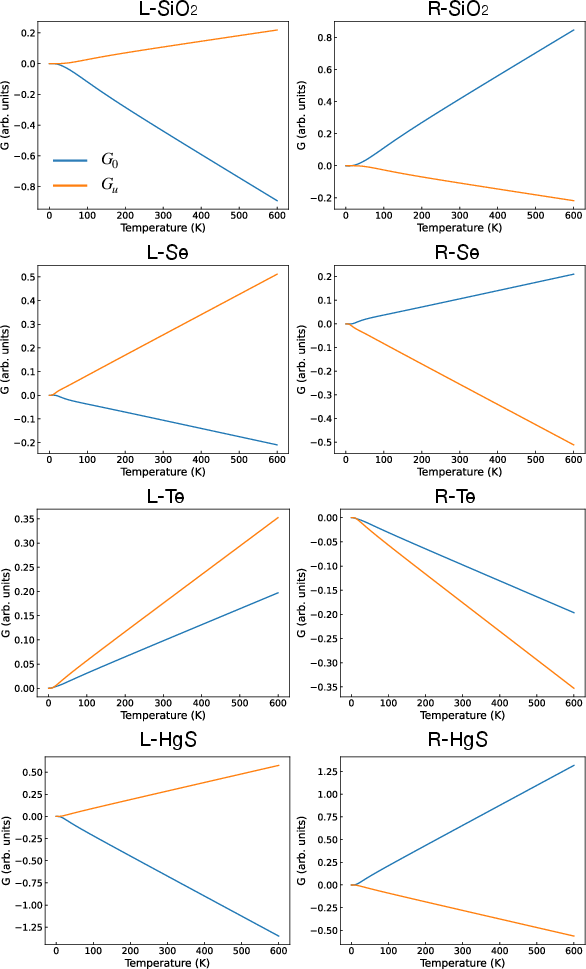
Figure 7: Temperature dependence of bulk dynamical chirality as characterized by Gu5 and Gu6.
Both Gu7 and Gu8 show a proportional increase with temperature across all material classes surveyed, confirming that thermal activation is a central driver for accessible phonon chirality.
Validation and Computational Consistency
The authors conducted parallel calculations using both DFPT and finite-displacement methods (phonopy+VASP), demonstrating robustness of the proposed chirality measures. Quantitative differences in computed values of Gu9 and α0 are ascribed to methodological nuances (pseudopotentials, convergence, supercell, α1-mesh sampling), but essential symmetry-driven results are reproduced. Notably:
- Momentum-resolved chirality switches sign between enantiomers.
- Centrosymmetric materials yield zero momentum-resolved and bulk chirality.
- Noncentrosymmetric achiral systems exhibit finite momentum-resolved but vanishing Brillouin-zone integrated chirality.
Theoretical and Practical Implications
This framework for quantifying phonon chirality enables precise, symmetry-based classification of vibrational angular momentum phenomena across crystals, disentangling local versus global chirality effects. The results offer pathways to control and harness vibrational chirality in materials design, phononic devices, and potentially for chiral phonon-driven phenomena such as phonon Hall effects and nonlinear optical responses.
From a theoretical perspective, the projection-based approach generalizes the treatment of phononic pseudovectors under crystal symmetry, facilitating future developments in topological phononics and symmetry-protected vibrational phenomena. The temperature dependence results further inform experimental conditions for maximizing chiral phononic effects.
Conclusion
The paper delivers an internally consistent, symmetry-grounded quantification scheme for dynamical phonon chirality, illustrated across multiple materials classes and computational paradigms. The formalism lays the groundwork for systematic exploration of chiral phononics, including design rules relating lattice symmetry to dynamical chirality signatures. Future advances may leverage these insights for engineering chiral phonon transport, selective phonon manipulation, and coupling with chiral electronic or optical environments in quantum materials.

