- The paper introduces an atomistic theory showing that non-equilibrium polarization mixing yields a transverse phonon angular momentum current under thermal gradients.
- The paper employs a stochastic Langevin harmonic lattice model to derive closed-form expressions for displacement–velocity correlations that enable edge accumulation of phonon angular momentum.
- The paper validates its findings using minimal 2D models and first-principles analysis, demonstrating robust PAMHE across diverse materials like graphene, MgO, and BaTiO₃.
Atomistic Theory of the Phonon Angular Momentum Hall Effect
Introduction and Context
The manuscript presents an atomistic, real-space theory for the phonon angular momentum Hall effect (PAMHE), a phenomenon whereby a longitudinal temperature gradient in a crystalline solid drives a transverse flow of phonon angular momentum (PAM), resulting in edge accumulation. This effect is formalized and analyzed analogously to the spin and orbital Hall effects, which underpin modern spintronics and orbitronics. Unlike the conventional phonon Hall effect, which relies on broken time-reversal symmetry (e.g., magnetization, external fields), the PAMHE described here emerges generically even in centrosymmetric, time-reversal invariant crystals through the non-equilibrium, polarization-mixed vibrational dynamics induced by thermal bias.
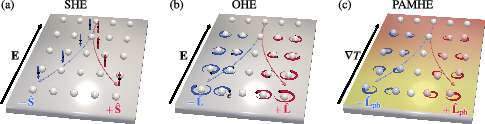
Figure 1: Schematic depiction of the spin Hall, orbital Hall, and phonon angular momentum Hall effects, illustrating the genesis of transverse angular momentum accumulation from longitudinal driving forces.
Theoretical Framework: Langevin Harmonic Lattice and Nonequilibrium Correlation Structure
An explicit microscopic theory is constructed using a stochastic Langevin harmonic lattice model, enabling analytic treatment of atomic displacement and velocity correlations in steady-state nonuniform temperature profiles. Each lattice site is coupled to its own local heat bath, and the equations of motion incorporate both damping and random (thermal) Langevin forces. Diagonalization of the dynamical matrix specifies normal mode structure; non-uniform thermal driving is encoded via off-diagonal mode-mode noise correlations.
The authors derive closed-form expressions for steady-state modal and real-space covariances. The critical insight is that in equilibrium (uniform local temperatures), displacement–velocity cross-correlators vanish, precluding net PAM. Under thermal gradients, these correlations are nonzero due to mode mixing, generating finite local PAM density:
Li(s)=−msTr[Ei⟨usu˙s⊤⟩]
where Ei is the antisymmetric generator of rotations.
Crucially, nonzero PAM current relies on the force-constant matrix admixing orthogonal polarizations (`polarization-mixing'). The bond-resolved PAM current between sites s and t is derived as:
js→t(Li)=Tr[EiΦ(st)(⟨usus⊤⟩−⟨utus⊤⟩)]
where Φ(st) is the force constant tensor for bond (s,t). Nonzero off-diagonal force-constant components (present in any lattice with oblique bonds, multi-atomic unit cells, or anisotropic interactions) suffice for finite PAMHE.
Minimal Model Realizations: Square and Honeycomb Lattices
To establish the universality and elucidate microscopic mechanisms, the PAMHE is computed in minimal centrosymmetric 2D models: the square lattice with both axial and diagonal springs, and the honeycomb lattice with only nearest-neighbor couplings.
Induced by a longitudinal thermal bias, a robust transverse PAM current appears, flowing toward the transverse sample edges and accumulating there. In the square lattice, diagonal bonds (absent in the simplest model of the lattice) are strictly necessary for any finite effect, as only these induce x-y polarization mixing. In the honeycomb lattice, three bond directions and the two-site basis are sufficient for strong polarization mixing with only nearest neighbors.
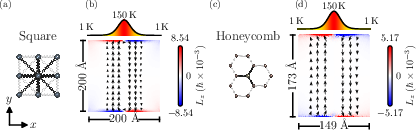
Figure 2: Visualization of the phonon angular momentum Hall effect in minimal square and honeycomb lattices, with the colormap denoting local Lz and arrows indicating PAM current direction. The edge accumulation and transverse current are manifest under longitudinal bias.
Effect of External Magnetic Fields
The authors incorporate Zeeman-type gyroscopic coupling to capture the influence of external magnetic fields. They show that the magnetic field rotates both the kinetic-energy current (enabling the conventional phonon Hall effect) and the PAM current. At zero field, the kinetic energy current is purely longitudinal while the PAM current is exclusively transverse; with increasing field, the currents acquire both longitudinal and transverse components. The relative insensitivity of a mixed "Hall-angle-like" ratio (comparing transverse PAM current to longitudinal energy current) to field magnitude highlights the inherent distinction between the PAMHE and conventional phonon Hall effects.
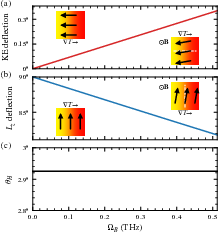
Figure 3: Field dependence of deflection angles for kinetic-energy and PAM currents, and the mixed Hall angle. The PAMHE is maximally transverse at zero field, while energy current deflection increases with magnetic field.
Realistic First-Principles Demonstration: Graphene, MgO, BaTiOEi0, Si
The theory is quantitatively applied to strictly 3D, non-chiral, and widely differing materials, with force-constant matrices extracted from first-principles DFT. For all cases considered—graphene, MgO, silicon, and BaTiOEi1—application of a thermal gradient yields a clear and robust PAM accumulation at transverse edges in finite samples.
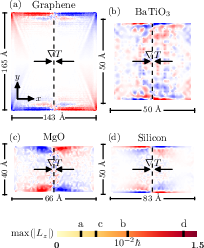
Figure 4: Atomically-resolved maps of PAM density (Ei2) in graphene, BaTiOEi3, MgO, and silicon showing universally nonzero, oppositely-signed accumulations at sample edges under uniform thermal bias.
Quantitative and Parametric Analysis
The magnitude and spatial character of PAMHE are controlled by interatomic force constants, damping rate, temperature profile, and sample geometry. The edge-accumulated PAM density in these finite models ranges from Ei4 to Ei5 per atom. In idealized minimal models, the effect is largest for strong polarization mixing and intermediate damping: too little damping suppresses mode mixing, while overdamping collapses displacement–velocity correlations.
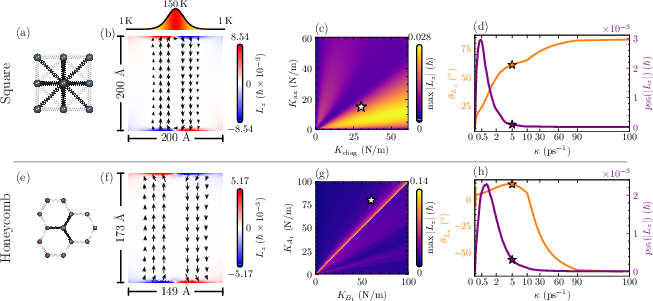
Figure 5: (a–d) Square lattice geometry, response maps, and parametric dependence of edge accumulation and transverse angle; (e–h) analogous analysis for the honeycomb lattice.
Implications and Prospects
This work resolves the outstanding question of the universal existence of PAMHE in nonchiral, time-reversal invariant crystals: the only requirement is nonzero polarization-mixing in the harmonic force network, a condition satisfied by all but the most trivial (idealized) lattices. The framework affords a new bulk route for angular momentum transfer between electron and phonon sectors, decoupled from any need for lattice chirality, external fields, or time-reversal breaking.
On the practical front, the authors discuss several detection strategies: magneto-optic probes of phonon-induced edge magnetization, conversion to magnonic or spin currents at interfaces, direct mechanical torque measurements (e.g., via cantilever deflection), and time-resolved x-ray or electron scattering techniques for atomic-scale angular motion.
Theoretically, the PAMHE provides a thermally driven, topologically consistent angular momentum current in solids, parallel to the central role of spin and orbital Hall effects for magnetization and torque transfer in spintronics.
Conclusion
The paper provides a rigorous, comprehensive, and broadly applicable atomistic theory for the phonon angular momentum Hall effect. Its central claim—that the PAMHE is a universal, bulk, symmetry-agnostic feature of nonequilibrium phononic transport—rests on both robust analytic derivations and first-principles modeling of diverse crystals. The presented framework lays the foundation for detailed material-by-material predictions of PAMHE magnitude and for experimental searches exploiting pure phonon angular momentum currents in spintronic and orbitronic device architectures.
References
- "Atomistic theory of the phonon angular momentum Hall effect" (2604.01899).

