- The paper shows that the Assistant persona demonstrates dominant self-recognition with strongly correlated authorship claim rates, vector distances, and entropy differentials.
- It employs a 23×22 cross-persona authorship matrix and metrics like persona-vector distance and entropy gap to evaluate the model's discrimination across varied personas.
- The findings indicate that only the Assistant serves as an effective structural baseline for self/other discrimination, reflecting its canonical role in the model's internal geometry.
The Assistant as a Privileged Persona: Cross-Persona Self-Recognition in LLMs
Introduction
This paper investigates the self-recognition mechanisms in post-trained LLMs, with a focus on Llama-3.1-70B-Instruct, by evaluating how the model identifies its own outputs across various prompted personas. The central thesis is the structural and informational primacy of the "Assistant" persona—a default conceptual self instilled via instruction-tuning—both in introspective authorship judgment and as the reference axis for cross-persona recognition. The analysis reveals robust coupling between authorship claims, activation-space distance, and entropy differentials on the Assistant row, and an asymmetric, Assistant-centered organizational pattern for non-Assistant personas.
Experimental Protocol and the Cross-Persona Authorship Matrix
The study operationalizes self-recognition via the authorship claim rate, Ev(g;e), defined as the probability that the model (in persona e) claims authorship of text generated under persona g. The authors assemble a 23×22 evaluator-generator matrix across a spectrum of personas including Assistant, librarian, pirate, dragon, Shakespeare, and others, using concise one-sentence article summaries as the stimulus.
Two quantitative measures provide the geometric and statistical backbone for the analysis:
- Persona-vector distance: The Euclidean distance in residual-stream activation space at layer 5 between persona p and the Assistant, ∥hˉp−hˉAsst∥.
- Entropy gap: The difference in mean per-token entropy between the Assistant's and the generator's own prediction of a summary: (EntAsst−Entp).
The authors first benchmark Assistant self-recognition against both on-policy and off-policy generations, demonstrating high discrimination between self, other LLM outputs, and human or memorized text. This establishes the baseline sensitivity of the model.
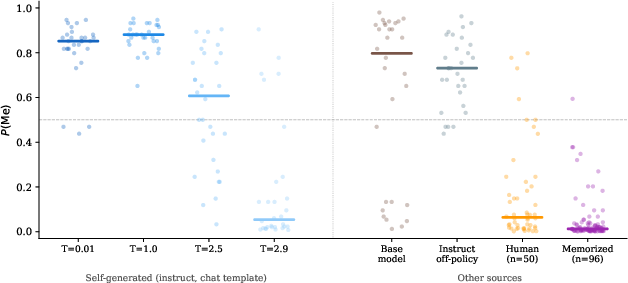
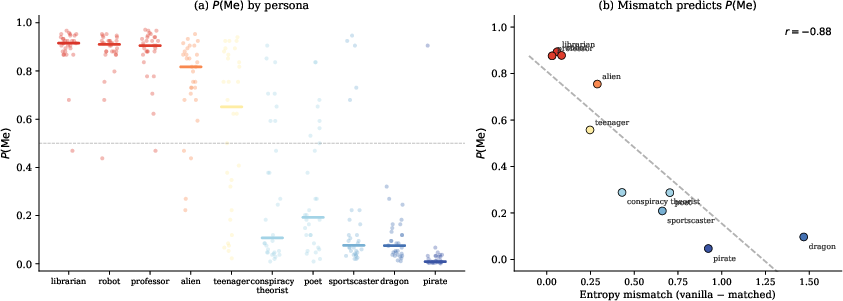
Figure 1: Assistant authorship claim rates (Me) across diverse generator conditions and personas, demonstrating strong discrimination—especially by persona-vector distance and entropy gap.
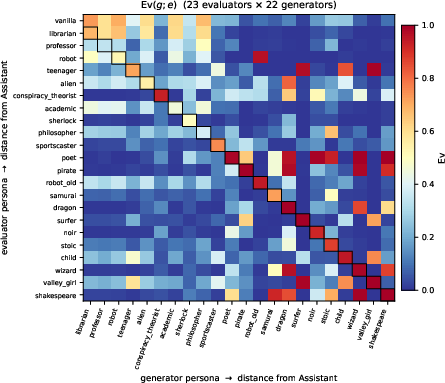
Figure 2: The Ev(g;e) cross-persona authorship matrix, sorted by activation-space distance from the Assistant, revealing strong block-diagonal structure and distinct asymmetric clusters.
Assistant-Row Coupling: Claim Rate, Activation Space, and Entropy Gap
The first principal claim is that, for the Assistant evaluator row, the authorship claim rate, persona-vector distance, and entropy gap are tightly, monotonically correlated. The Assistant's claim probability drops as personas become more idiosyncratic (e.g., dragon, pirate), and this drop aligns quantitatively with both increased geometric distance from the Assistant vector and increased entropy gap.
Strong correlations are reported:
- Ev(p;Asst) vs. persona-vector distance: e0
- e1 vs. entropy gap: e2
- Activation-space vs. information-space distance: e3
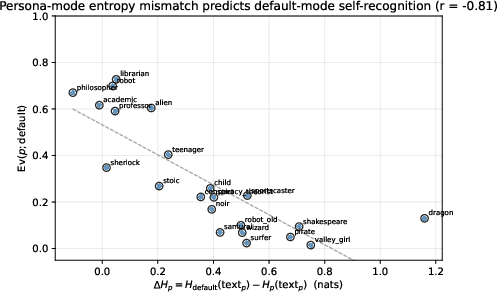
Figure 3: Entropy gap vs. Assistant authorship claim rate (e4); a pronounced negative correlation shows the tight link across personas.
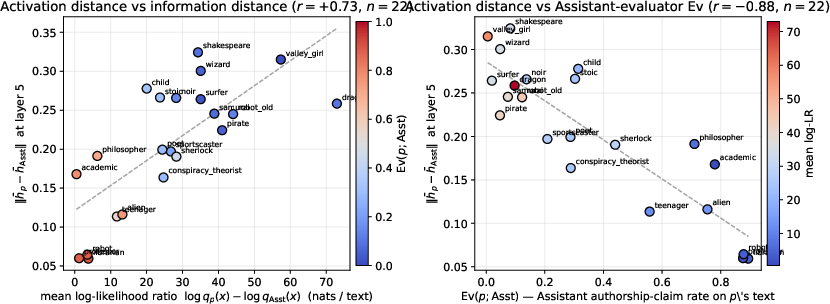
Figure 4: (Left) Log-likelihood ratio between persona and Assistant, and (Right) e5 versus activation-space distance to the Assistant; both metrics robustly reflect persona distinctiveness.
This trifold coupling supports the thesis that Assistant self-recognition operates via a univariate underlying signal: statistical alignment with the Assistant's generative distribution, directly mirrored in the early residual stream.
Breakdown of Symmetry Off the Assistant Axis
Extending the analysis beyond the Assistant row, the authors demonstrate that this tight coupling does not generalize. When a non-Assistant persona acts as evaluator, symmetric entropy-gap predictors (e6) fail for distinctive personas (pirate, dragon, Shakespeare). The best predictor instead compares the evaluator’s surprise to the Assistant's surprise on the candidate text: e7.
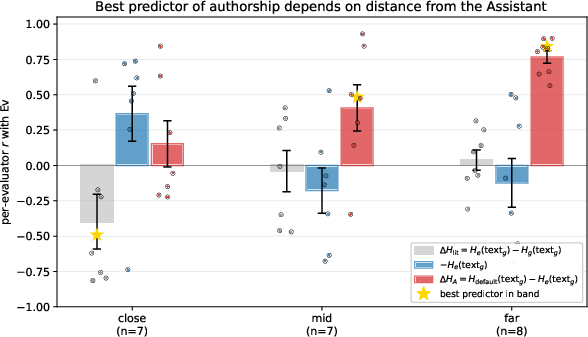
Figure 5: Per-evaluator correlation (e8) of three predictors with e9, grouped by activation-space distance from the Assistant. Only asymmetric predictors referencing the Assistant retain predictive power at large distances.
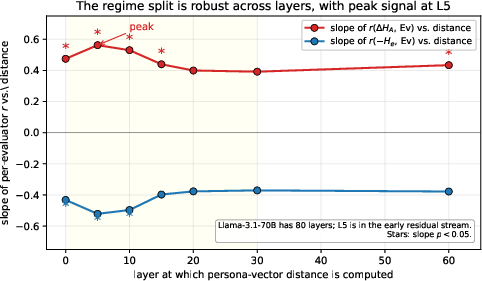
Figure 6: Slope of per-evaluator correlation against activation-space distance for different network layers. The sign and significance of slopes confirm robustness across early model layers.
This pattern indicates that the Assistant is structurally privileged as the reference for self/other discrimination, and no symmetric extension captures the empirical pattern for distinctive personas. The phenomenon is robust to layer choice, observed throughout the lower quarter of the model's depth.
Assistant as a Structural Reference Distribution
A critical ablation replaces the Assistant with each other persona as the reference in the asymmetric predictor. Only the Assistant consistently serves as a privileged, effective null distribution for authorship claims by distinctive evaluators.
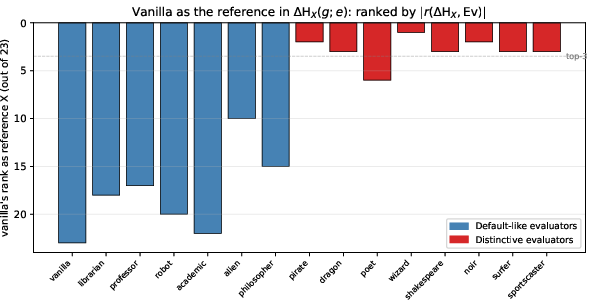
Figure 7: Assistant's rank as the reference in g0 for each evaluator. Only the Assistant is consistently top-ranked for distinctive evaluators, highlighting its unique structural status.
Assistant-like evaluators do not use the Assistant or even the base (pre-instruction) model as a reference, ruling out alternative sources for this null distribution and reinforcing the structural singularity of the Assistant axis.
Mechanistic and Theoretical Implications
The findings suggest the model implicitly carries out a Bayesian likelihood-ratio test, but with critical constraints on hypothesis accessibility: the system-prompted persona is directly accessible, and the Assistant is accessible for all personas by construction (since personas are deltas off the Assistant). This geometric asymmetry explains why only Assistant-centered, not symmetric, predictors perform well in off-diagonal conditions.
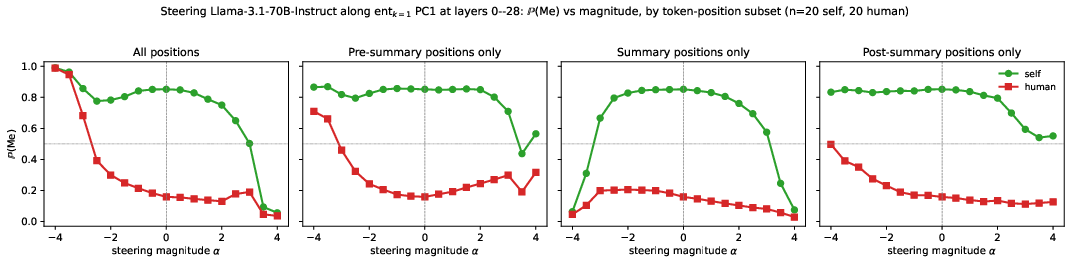
Figure 8: Steering Llama-3.1-70B-Instruct along the leading entropy direction in early layers shows strong modulation of authorship claim probability, especially when steering tokens preceding the summary evaluation.
Additional experiments in the appendices show that steering activations along the leading entropy principal component robustly modulates authorship claims, with strongest effects for context tokens preceding the evaluated summary, and that surprise on role-generated text under mismatched prompts decays as evidence accumulates for the correct persona.
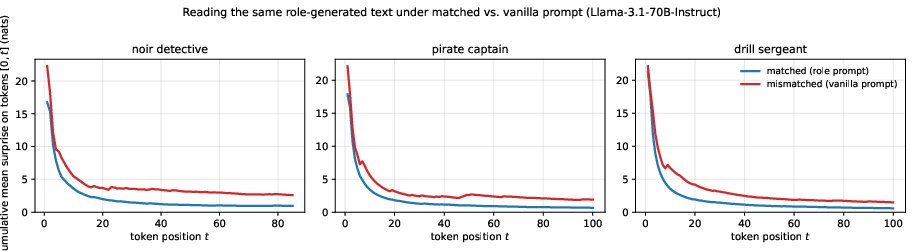
Figure 9: Cumulative mean per-token surprise for role-generated text under matched vs. mismatched prompts: rapid decay of surprise indicates the model’s dynamics for posterior updating over persona hypotheses.
This architectural constraint—where only the Assistant is universally computable as an alternative—imposes an asymmetric organization on the model's sense of agency and self-recognition. The Assistant persona, a product of instruction tuning, becomes the canonical "self" and the sole accessible baseline in the model’s internal geometry.
Conclusion
This study elucidates the unique, structurally privileged role of the Assistant persona in post-trained LLMs. The Assistant's generative prior not only anchors self-recognition mechanisms, but also serves as the canonical reference axis for discriminating authorship across diverse prompted personas. This reveals a latent geometric and informational hierarchy within the model, shaped by instruction tuning to center the Assistant as both the self and the only universally accessible alternative. These findings have significant implications for future research in mechanistic interpretability, prompt engineering, and the characterization of emergent agency in LLMs. The explicit identification of such asymmetries is likely to inform future understanding of reference frames for identity and agency in foundation models, especially as they are extended to multi-agent and human-interactive settings.

