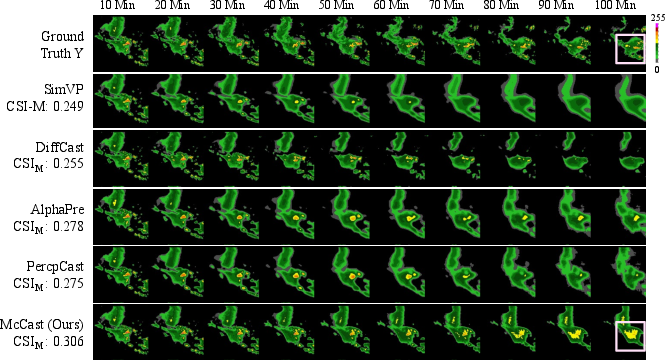
- The paper introduces a two-stage Drift-Corrective Memory Bank that actively corrects latent drift in autoregressive nowcasting models.
- It employs a learnable gating mechanism to integrate temporally structured corrections, significantly improving CSI and perceptual accuracy.
- McCast outperforms prior models on SEVIR and MeteoNet benchmarks, demonstrating robustness over extended prediction horizons.
Memory-Guided Latent Drift Correction for Long-Horizon Precipitation Nowcasting
Introduction and Problem Statement
Precipitation nowcasting demands temporally coherent, accurate forecasts of atmospheric evolution, with particular emphasis on challenging long-range (100+ min) horizons. Deep learning-based approaches predominantly adopt iterative, autoregressive protocols: each subsequent frame is generated conditioned on previous predictions. This design is fundamentally susceptible to error accumulation—"drift"—which exacerbates with prediction horizon, resulting in forecasts that progressively diverge from plausible meteorological behavior.
Recent memory-augmented generative models inject external memory as additional conditioning to improve contextual recall; however, such mechanisms overwhelmingly treat historical states as unordered, passive context, lacking any targeted correction or explicit temporal dependency modeling. These approaches are suboptimal against the elementary problem of compounding, temporally structured drift.
The paper "McCast: Memory-Guided Latent Drift Correction for Long-Horizon Precipitation Nowcasting" (2605.13197) addresses these limitations with a methodologically distinct approach. McCast reforms memory from passive context to an active, temporally organized correction operator and introduces a two-stage Drift-Corrective Memory Bank (DCBank) for explicit drift estimation and rectification. This targets the core limitation of existing autoregressive precipitation nowcasting and achieves state-of-the-art performance on SEVIR and MeteoNet.
From Passive Conditioning to Active Correction
Conventional models perform stepwise generation, optionally conditioning on static memory or features from past states. McCast fundamentally rethinks this interaction by casting memory as a generator of explicit residual corrections applied to latent states, actively counteracting autoregressive drift. Instead of fusing latent features via cross-attention or concatenation, McCast retrieves temporally structured memory, estimates correction vectors, and applies them through a learnable gating mechanism.
The full process follows a backbone encoder-decoder paradigm, with the memory intervention operating at the latent state interface between encoder and decoder.
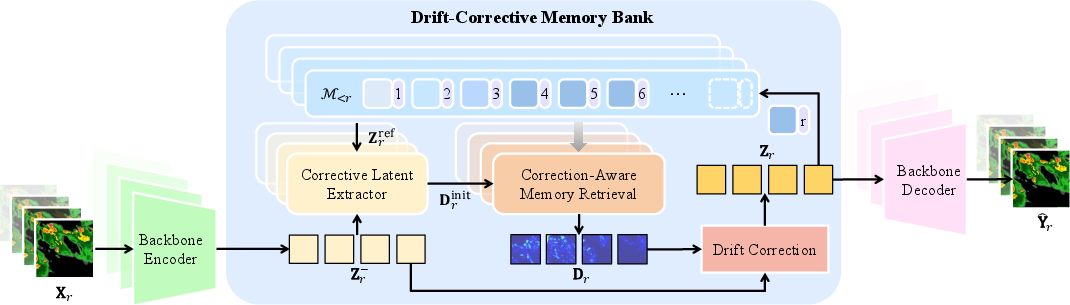
Figure 1: High-level design: input sequence is encoded and refined via the Drift-Corrective Memory Bank before being decoded to a forecast.
Drift-Corrective Memory Bank (DCBank)
The DCBank is the epistemic core of McCast:
- Stage 1: Corrective Latent Extractor computes an initial drift correction by modeling the discrepancy between the current prior latent and a reference historical latent (latest memory entry), leveraging both direct residual signals and context-projected discrepancies with dynamic gating.
- Stage 2: Correction-Aware Memory Retrieval enhances the initial correction by selectively aggregating temporally organized historic memory, guided by two relevance criteria: content similarity and drift-consistency. The former ensures retrieved states reflect similar meteorological conditions, the latter enforces alignment with the current drift pattern via differencing and projection.
Critically, McCast maintains the temporal sequence order of memory entries and employs learnable positional encodings to reinforce temporality. The final drift correction is integrated via gating—modulating correction magnitude spatially and across feature dimensions to prevent overfitting and unwarranted correction.
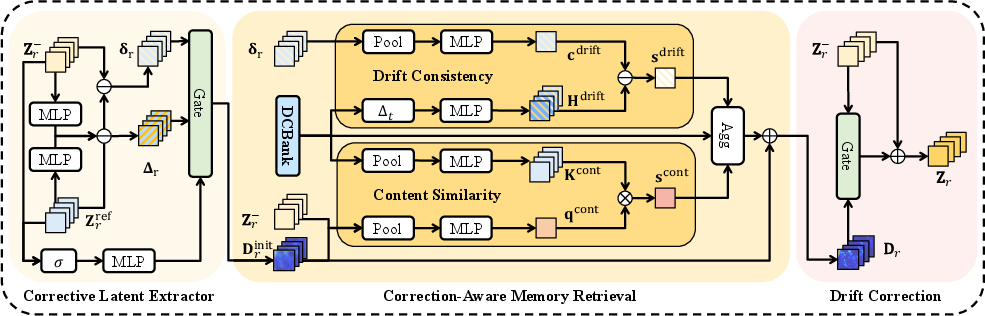
Figure 2: DCBank architecture: drift correction is estimated and recursively refined through temporally and contextually aware memory retrieval.
Quantitative Results
Extensive benchmarks display the efficacy of McCast, particularly in maintaining credible long-horizon structure and intense precipitation coherence.
(Table reference omitted; see below for plotted results.)
In the SEVIR and MeteoNet benchmarks, McCast yields:
- +5.6%–5.9% CSIM: Surpassing all prior baselines on mean critical success index.
- Up to +21.1% high-intensity CSI at severe rainfall thresholds.
- Superior HSS (Heidke Skill Score) and lower LPIPS, indicating strength in perceptual and categorical accuracy.
- Competitive SSIM: Although AlphaPre, with its strong structural smoothing, marginally surpasses McCast in SEVIR, the difference is offset by McCast’s superior skill in event detection and intense event preservation.
Performance is robust across varying lead time (short–long horizon) and intensity thresholds, with advantages amplifying at extended horizons and extreme events. This reflects DCBank’s ability to mitigate compounding drift far beyond the achievable range of passive memory conditioning or per-step architectures.
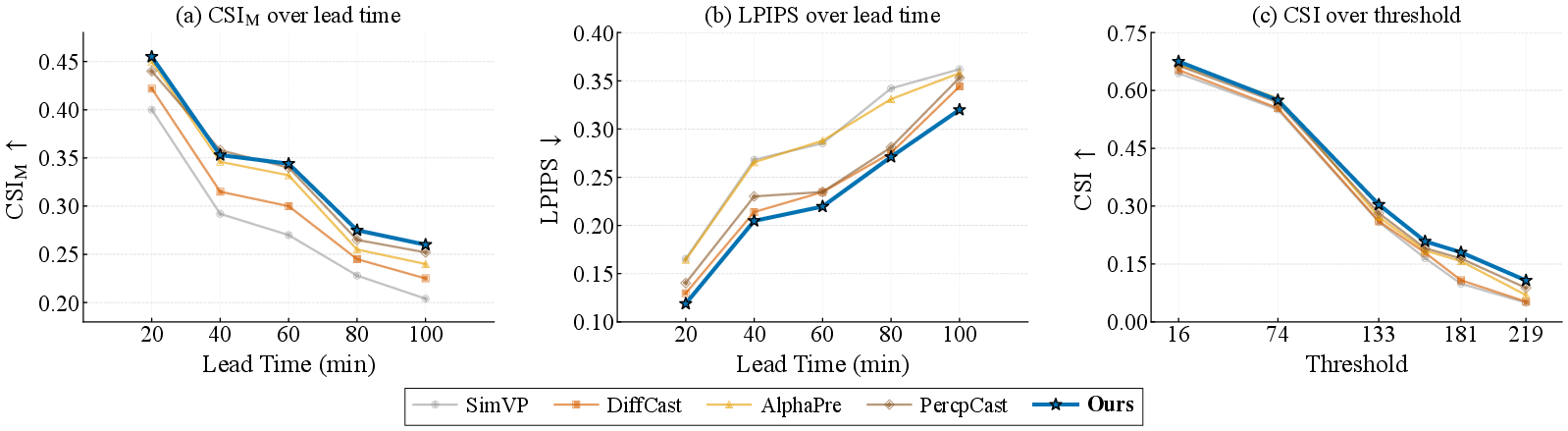
Figure 3: McCast performance as a function of forecast horizon and threshold. Gains become more significant at longer lead times and higher rainfall intensities.
Qualitative Results and Analysis
Visual analysis further confirms the theoretical and quantitative benefits:
Ablation studies isolate the effect of each module in DCBank. Removal of the Correction-Aware Memory Retrieval or the explicit active correction (using memory as a conditioning signal only) demonstrably reduces fine-scale and temporal coherence, especially evident at longer lead times.
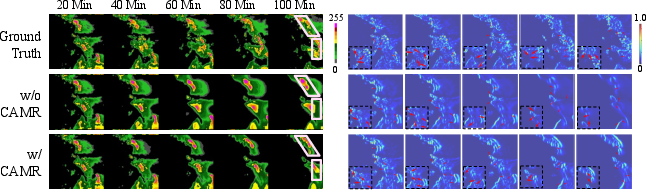
Figure 5: Left: Prediction with and without Correction-Aware Memory Retrieval—CAMR yields better preservation of local structure. Right: Memory visualizations confirm better temporal consistency.
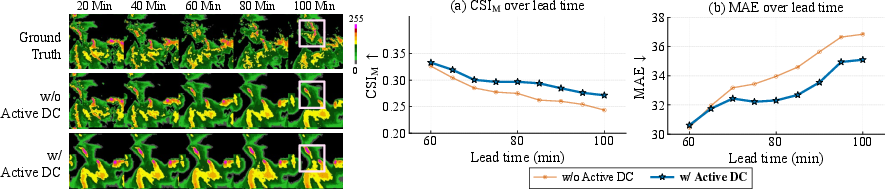
Figure 6: Active drift correction enables robust tracking of high-intensity cores and improved CSI/MAE metrics, highlighting the necessity of explicit residual correction.
Theoretical and Practical Implications
By establishing memory as an active correction mechanism (rather than as unordered context), McCast defines a sufficient geometric criterion for drift reduction: residuals are guaranteed to reduce error provided they align with the direction of accumulated drift (negative gradient). This yields a principled, interpretable approach to error accumulation in autoregressive generation—an insight directly generalizable to other temporal or sequential generative tasks.
On the practical side, McCast’s backbone-agnostic construction, demonstrated by integrating DCBank with both foundation-model (Aurora) and conventional (SimVP) architectures, underlines its extensibility. Computational cost is kept modest (LoRA finetuned, 10M parameters, <4 TFLOPs per 100-min forecast), supporting operational deployment viability.
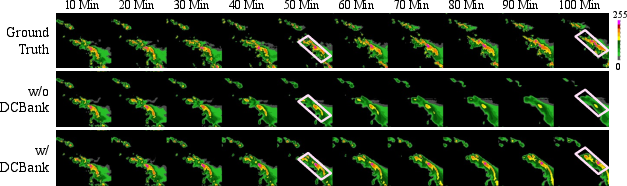
Figure 7: DCBank enables better preservation of intense local structures in high-impact forecast scenarios.
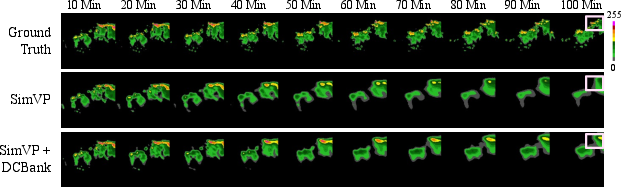
Figure 8: Integration of DCBank into SimVP backbone corroborates its backbone-agnostic benefits.
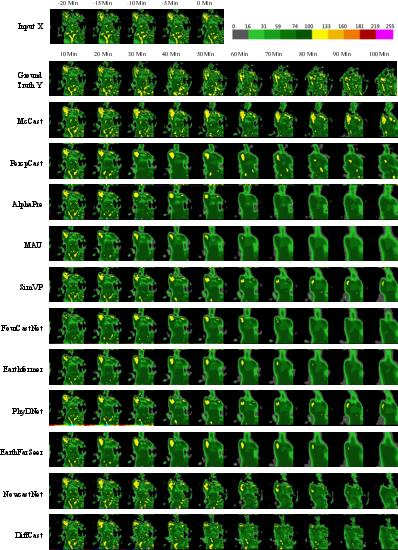
Figure 9: SEVIR prediction examples demonstrate McCast’s fine-scale and large-scale coherence across event types and precipitation regimes.
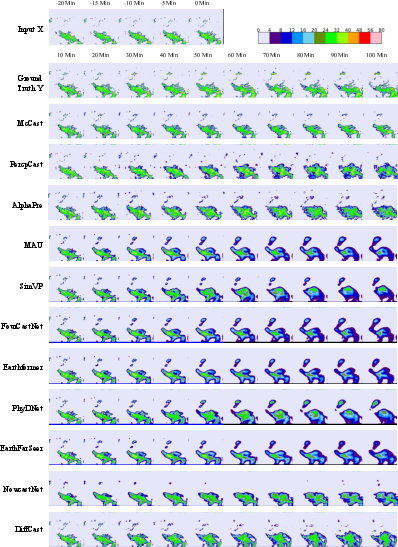
Figure 10: MeteoNet examples highlight generalization to varying regional weather systems and data domains.
Conclusion
McCast provides a theoretically justified, computationally efficient, and empirically robust solution to the fundamental challenge of drift in long-horizon precipitation nowcasting. By reframing memory from passive context to an active, temporally consistent correction operator, the method both advances the state of the art and establishes a new paradigm for drift mitigation in autoregressive spatiotemporal models. The design principles and memory retrieval mechanisms are directly extensible to a broad class of generative modeling and forecasting applications where error accumulation and temporal coherence are central challenges.
(2605.13197)