- The paper introduces a comprehensive pipeline to estimate hardware resources for magic-state distillation on silicon spin qubits, incorporating device-specific noise and pulse-level optimizations.
- It benchmarks various QEC codes—including bias-tailored XZZX—and compares architectures, demonstrating a 42% reduction in overhead with dense, optimized designs.
- The study provides actionable guidelines for improving shuttling fidelities and bias-preserving operations to enable scalable, fault-tolerant quantum computing.
Hardware-Tailored Resource Estimation for Magic-State Distillation on Silicon Spin Qubits
Introduction and Motivation
Magic-state distillation (MSD) is a fundamental process for achieving universal fault-tolerant quantum computation, bridging the gap between the set of Clifford operations protected by quantum error correction (QEC) codes and the requirement for high-fidelity non-Clifford gates. Silicon spin qubits, owing to their scalability, compatibility with semiconductor manufacturing, and favorable coherence properties, have emerged as a promising physical platform. However, resource estimation for MSD protocols on silicon remains challenging due to device-specific noise (notably $1/f$ noise), connectivity constraints, shuttling errors, and realistic hardware constraints. This work introduces a comprehensive, hardware-tailored resource estimation framework for logical magic-state production on silicon spin-qubit platforms, benchmarking several QEC codes, distillation protocols, and architectural design choices.
Pipeline Overview and Main Results
The study employs a holistic pipeline that compiles a target quantum application through multiple abstraction layers down to hardware-level resource metrics. The pipeline:
- Starts with the logical circuit representation of quantum algorithms (such as quantum dynamics, Shor's factoring, and quantum chemistry),
- Specifies QEC code (surface, XZZX, or color codes), MSD protocol (5→1 or 15→1), and logical operation style (lattice surgery or transversal gates),
- Selects among silicon-specific architectures: sparse SpinBus, patched semi-dense, and dense nearest-neighbor arrays,
- Models hardware-level implementation with pulse-optimized controls (via GRAPE), and integrates realistic $1/f$ and Markovian noise models,
- Produces resource metrics (space-time volume, required physical qubits, runtime) and derived constraints on hardware performance parameters.
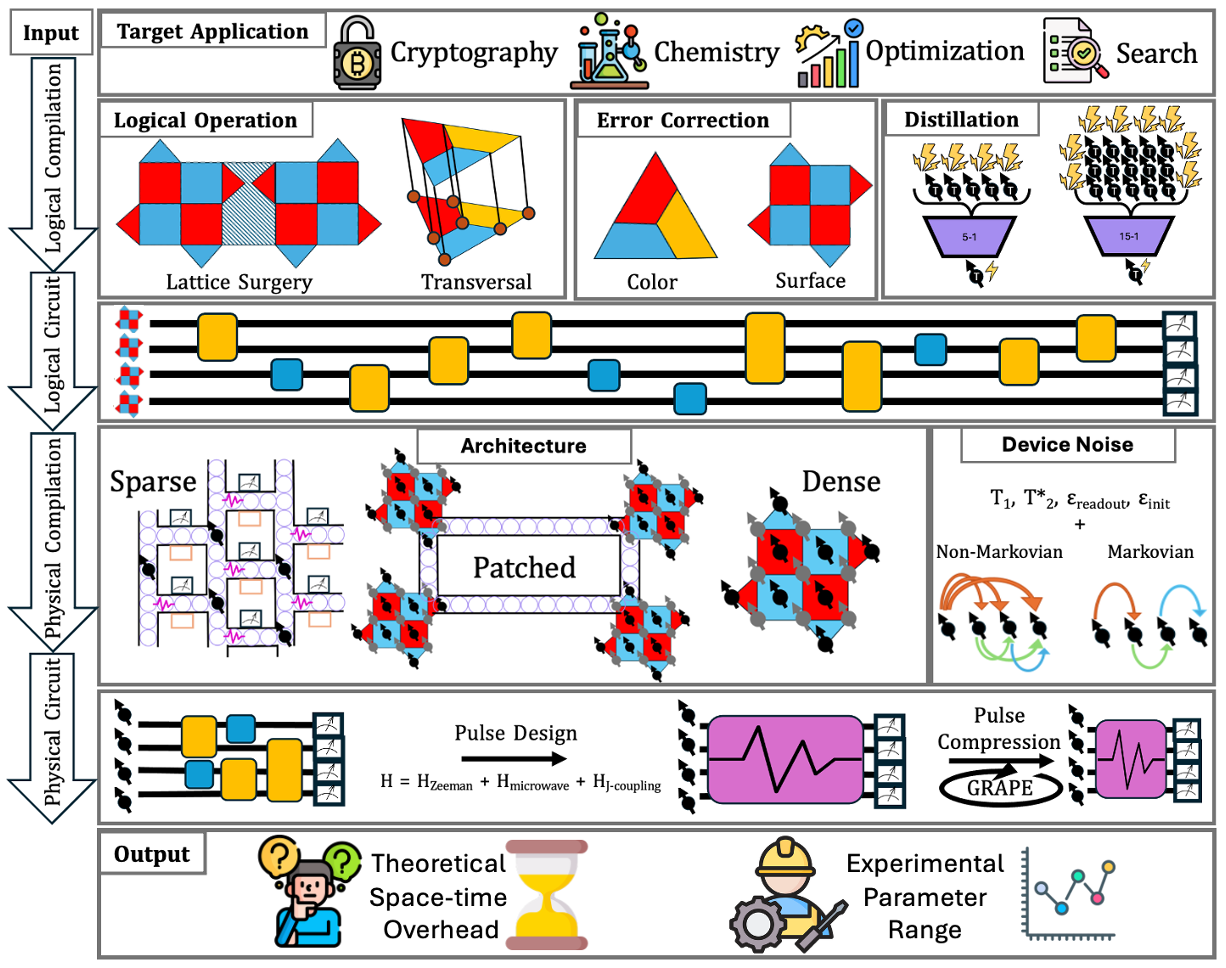
Figure 1: Resource-estimation pipeline from algorithm compilation, QEC/MSD selection, hardware-aware circuit mapping, noise modeling, pulse-level optimization, to concrete resource and hardware requirement outputs.
Across several quantum algorithm benchmarks, the analysis reveals that dense nearest-neighbor architectures yield significantly lower resource overheads than shuttle-mediated, sparse SpinBus architectures, while the intermediate patched architecture offers beneficial tradeoffs when dense layouts are infeasible. MSD remains the principal driver of resource overhead in all studied regimes. Furthermore, exploiting pulse-level optimization for syndrome extraction and logical operations leads to a 42% reduction in MSD overhead compared to standard gate-based implementations. Critically, the use of silicon-tailored, biased QEC codes such as XZZX provides a factor ~$3-5$ reduction in the physical footprint over the conventional surface code, even in the absence of fully bias-preserving physical controls.
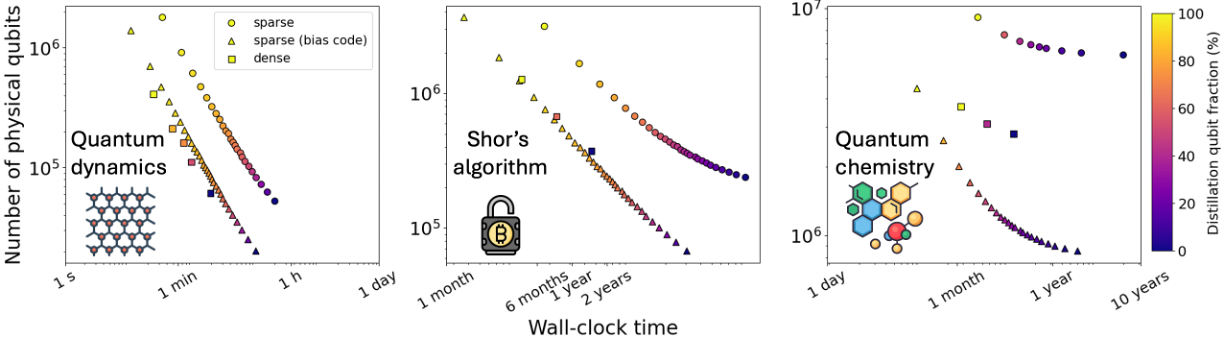
Figure 2: Physical-qubit and wall-clock resource requirements for three quantum algorithms under various architecture and QEC code configurations, highlighting the impact of bias-tailored codes and architectural connectivity.
Architectural Models and Connectivity Tradeoffs
Sparse SpinBus Architecture
The SpinBus scheme addresses the wiring bottleneck in silicon processors by sparsely placing quantum dots and leveraging coherent electron shuttling for long-range connectivity. The layout enforces local computation zones and shuttling lanes, with overhead driven by both shuttle error and temporal latencies.
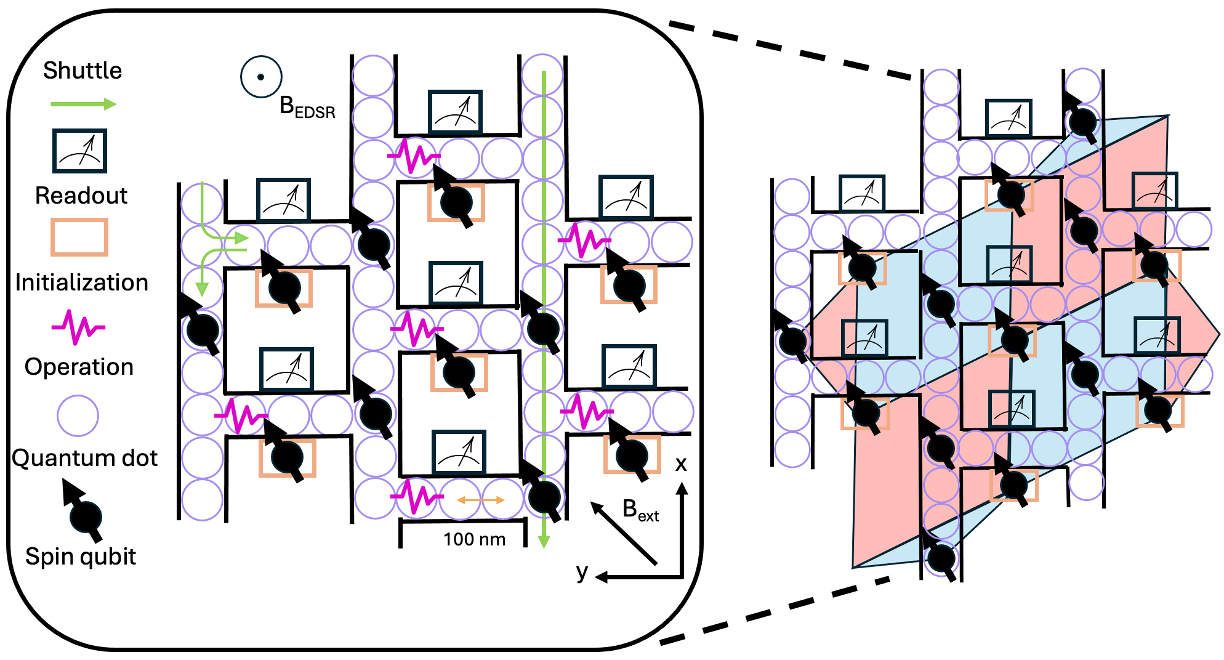
Figure 3: Sparse SpinBus: separated manipulation/readout zones and shuttle lanes connecting long-range sparse qubits; lattice mapping of a rotated surface code.
Patched and Dense Architectures
Patched architectures partition the processor into locally dense patches of physical qubits connected by shuttling channels, reducing shuttling overhead while ameliorating wiring demands—demonstrating a sharp decrease in space-time overhead as the fraction of dense connectivity increases.
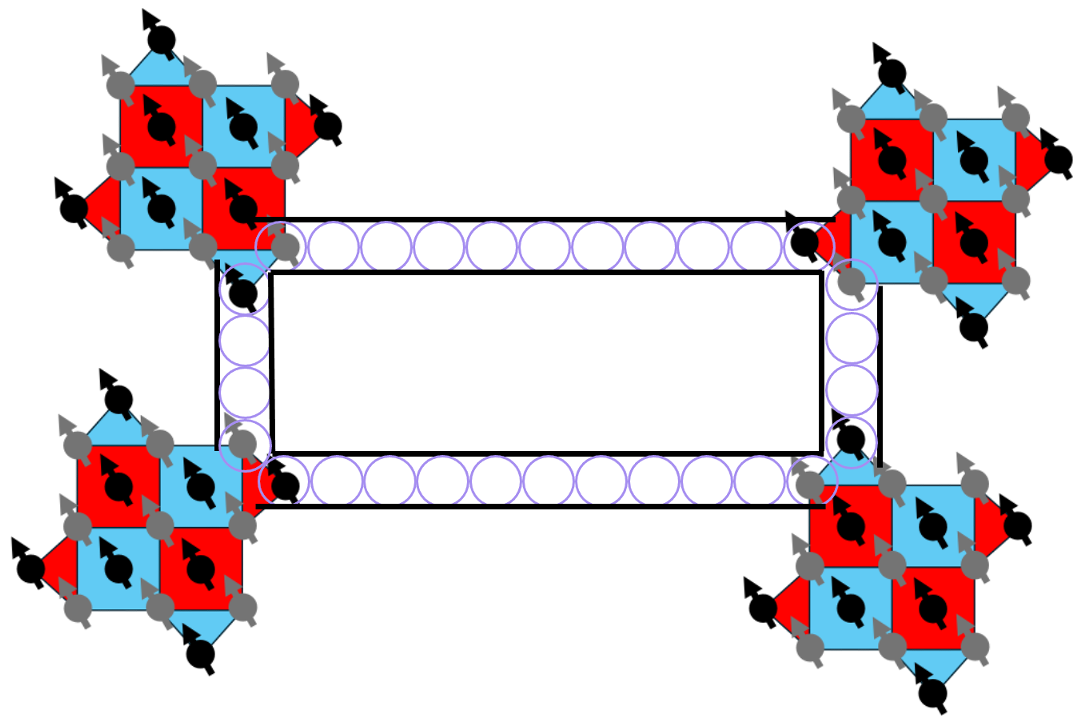
Figure 4: Patched architecture: each patch encodes one or more logical qubits densely and connects to other patches via shuttle channels.
Dense nearest-neighbor arrays eliminate shuttling, optimizing local gate and syndrome operations but are currently limited by wiring complexity and device integration constraints.
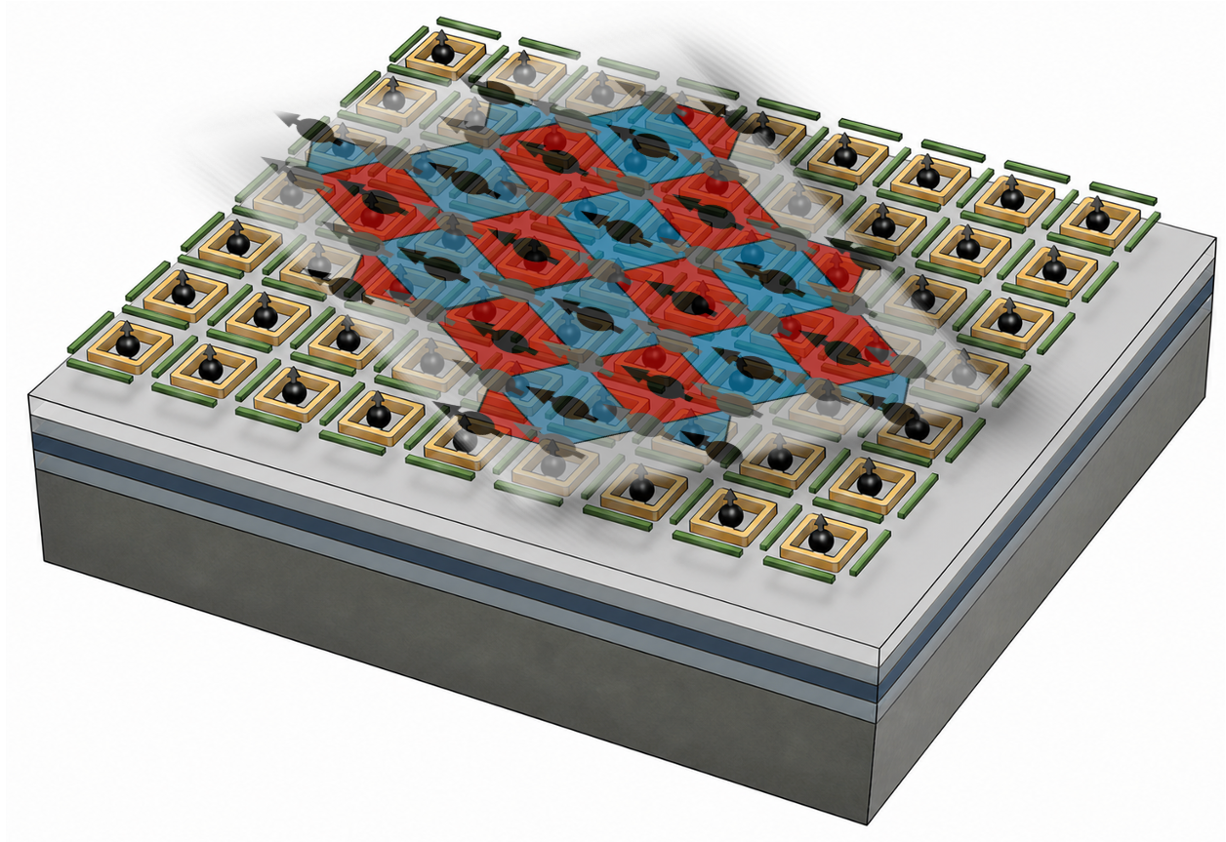
Figure 5: Dense architecture: all qubits defined via gate electrodes in a uniform 2D array—ideal for minimal overhead but wiring-limited.
Overhead Comparison
Transitioning from sparse to patched to dense topologies monotonically reduces the space-time overhead for MSD as shown in:
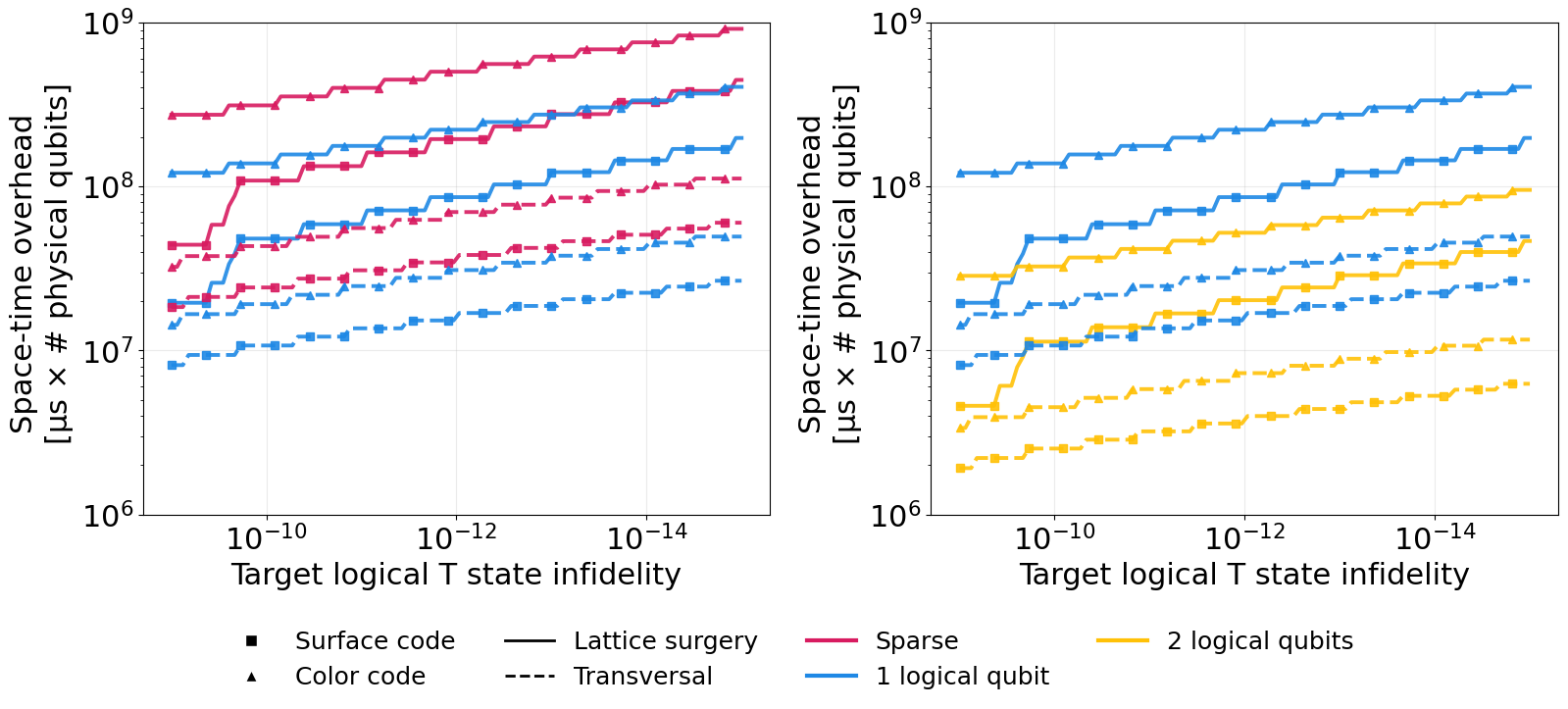
Figure 6: Relative space-time overhead reduction for MSD factories when moving from sparse to patched/dense layouts.
Error Correction Codes and Biased Noise
Surface, color, and specifically, XZZX (bias-tailored) surface codes are evaluated. The XZZX code, leveraging the pronounced dephasing (Z) bias in silicon spin qubits (η∼102−103), provides exponential suppression of logical error with code distance, contingent on bias preservation at the circuit level. Simulations show up to a fivefold reduction in resources for high-fidelity magic-state output utilizing XZZX over standard surface codes.
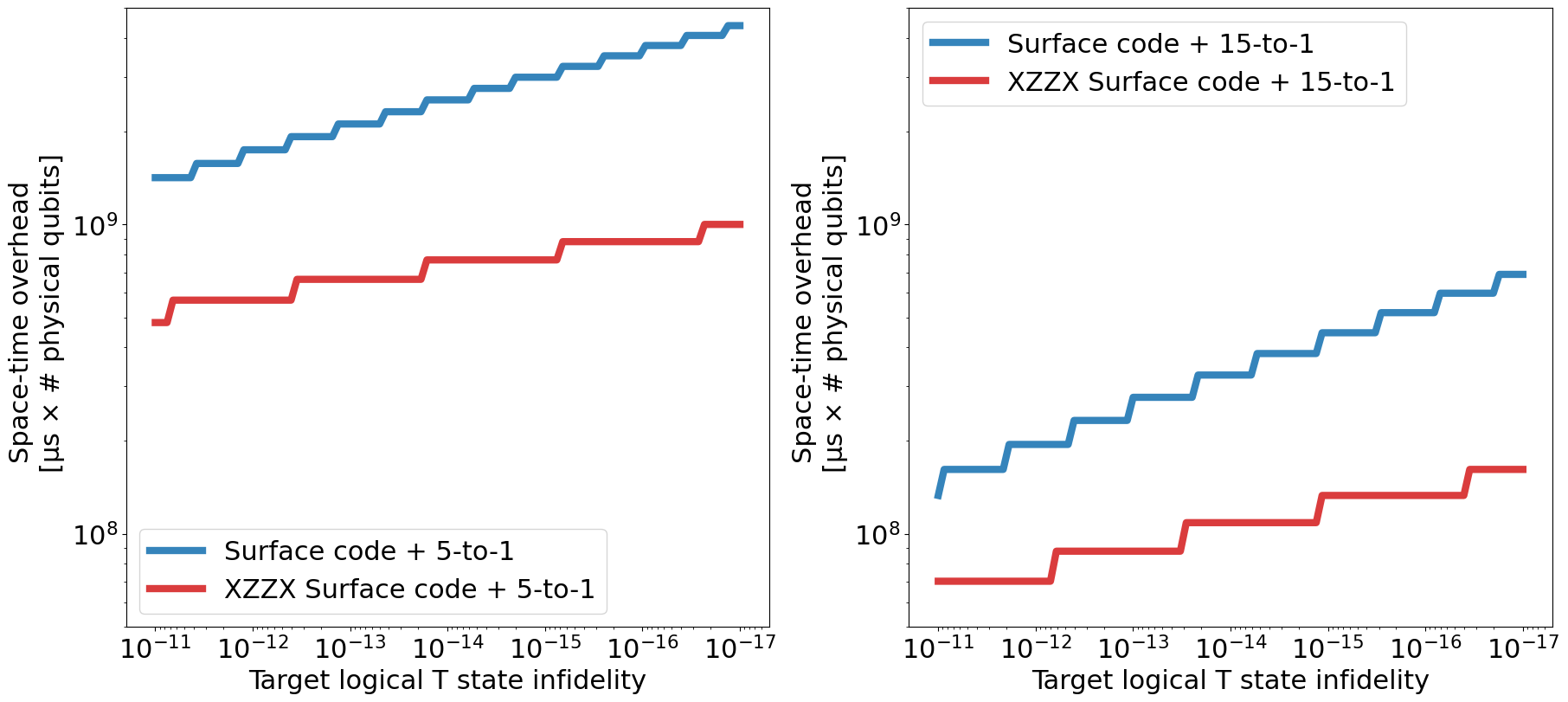
Figure 7: Space-time cost for achieving target magic-state infidelity: XZZX (blue) vs. standard surface code (red); resource reduction with bias-tailored codes across 5→1 and 15→1 protocols.
Unlike standard analyses assuming depolarizing noise, this work constructs:
- Markovian models parameterized by device T1 and T2∗ times,
- Non-Markovian noise models using the filter-function formalism to capture dominant silicon 5→10 spectra,
- Defect models for shuttling-based layouts,
- Explicit shuttling-induced error contributors.
The impact of physical error models is validated through logical memory experiments, with pulse-level optimization pushing the logical-to-physical performance crossover to less stringent hardware requirements.
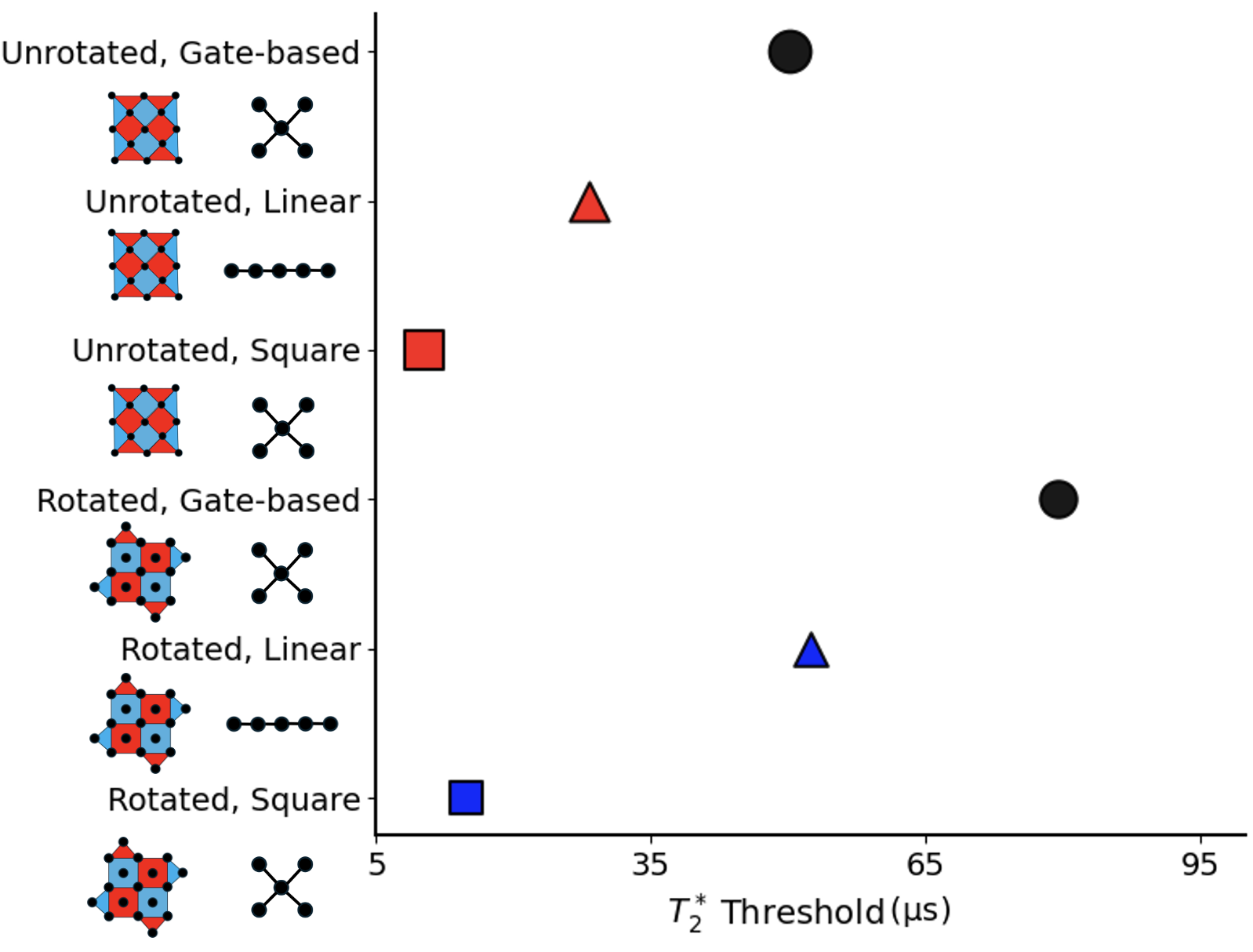
Figure 8: Coherence-time (5→11) thresholds for effective QEC under various connectivity and code geometry choices—with and without pulse compression.
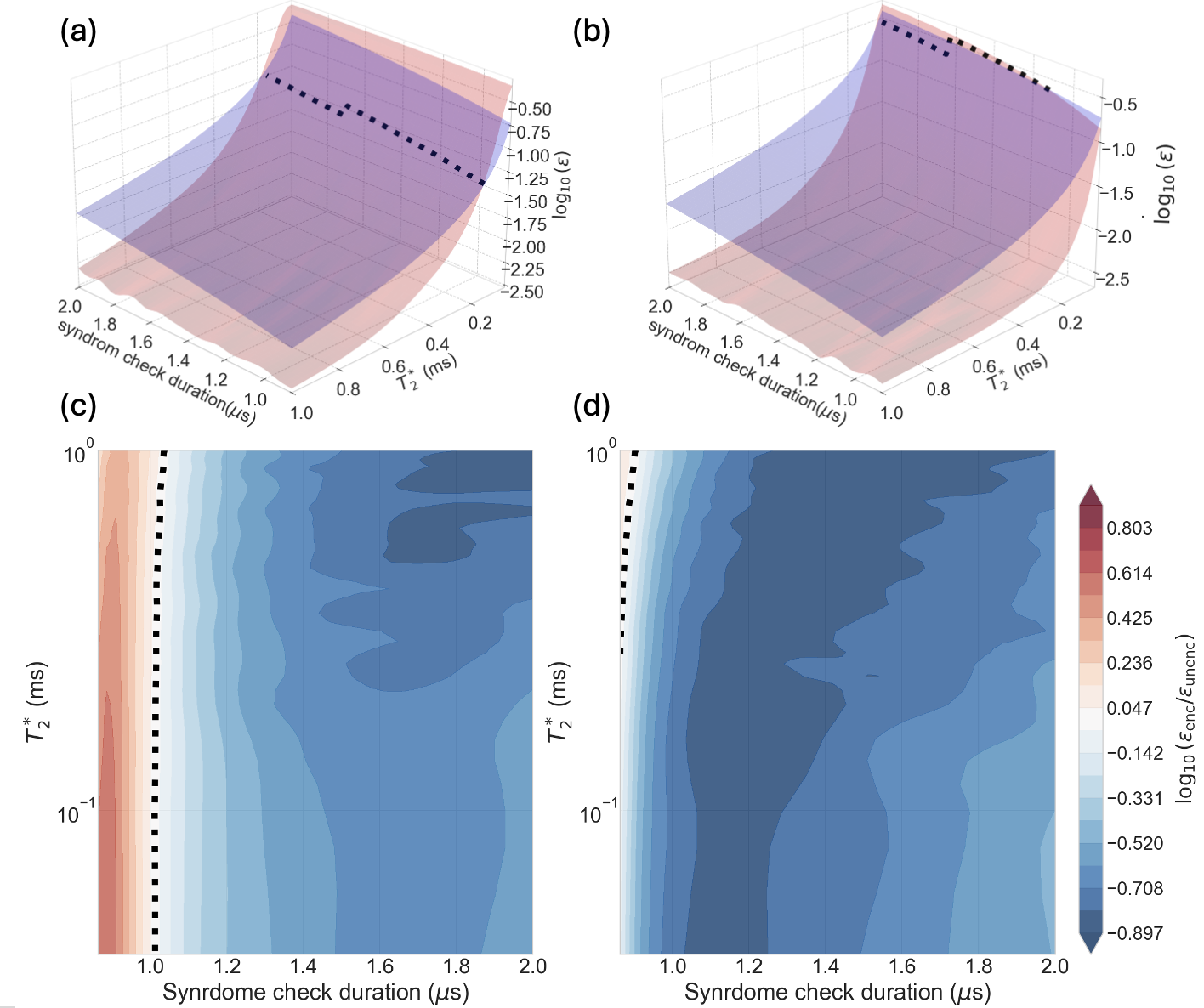
Figure 9: Logical vs. physical memory infidelity as a function of syndrome duration and 5→12; dotted line denotes region where logical encoding outperforms unprotected physical qubits.
Magic-State Distillation Protocol Benchmarking
Both 5→13 and 5→14 MSD protocols are analyzed in detail, with explicit modeling of logical operation, inject, idle, and syndrome failure rates. The 5→15 protocol, especially with surface code and transversal operation in the dense architecture, demonstrates the lowest space-time overhead for achieving 5→16 magic-state infidelity.
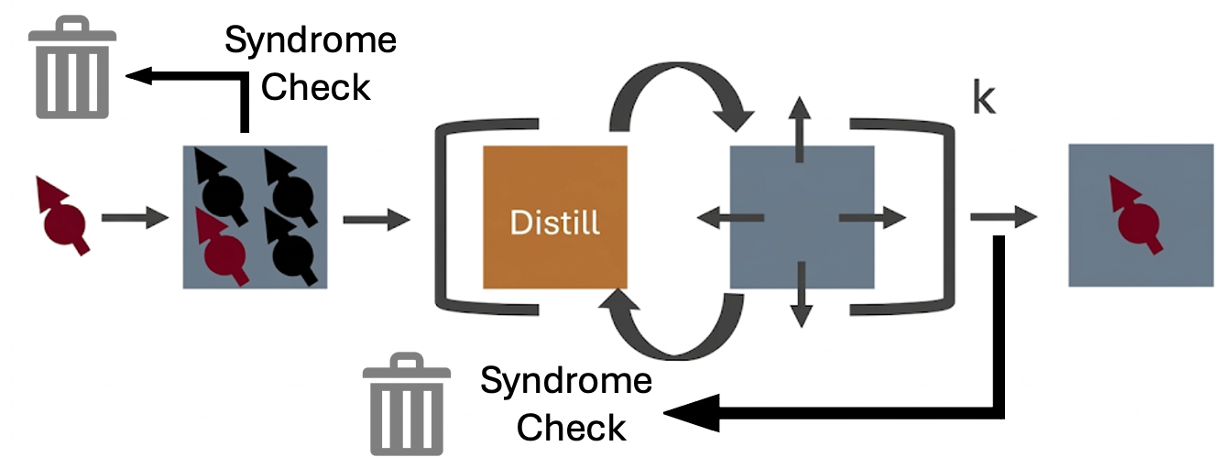
Figure 10: Grow-and-distill MSD protocol schematic with gradual distance ramp-up and iterative acceptance/failure handling.
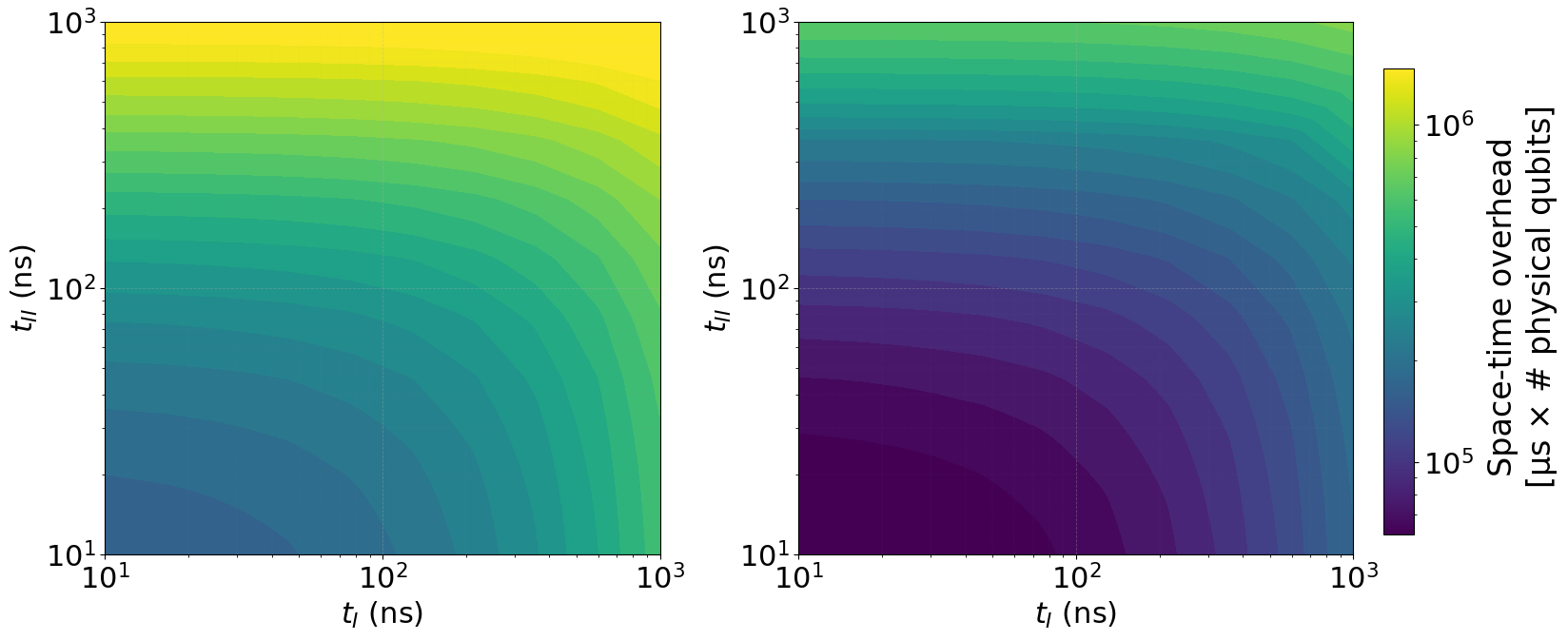
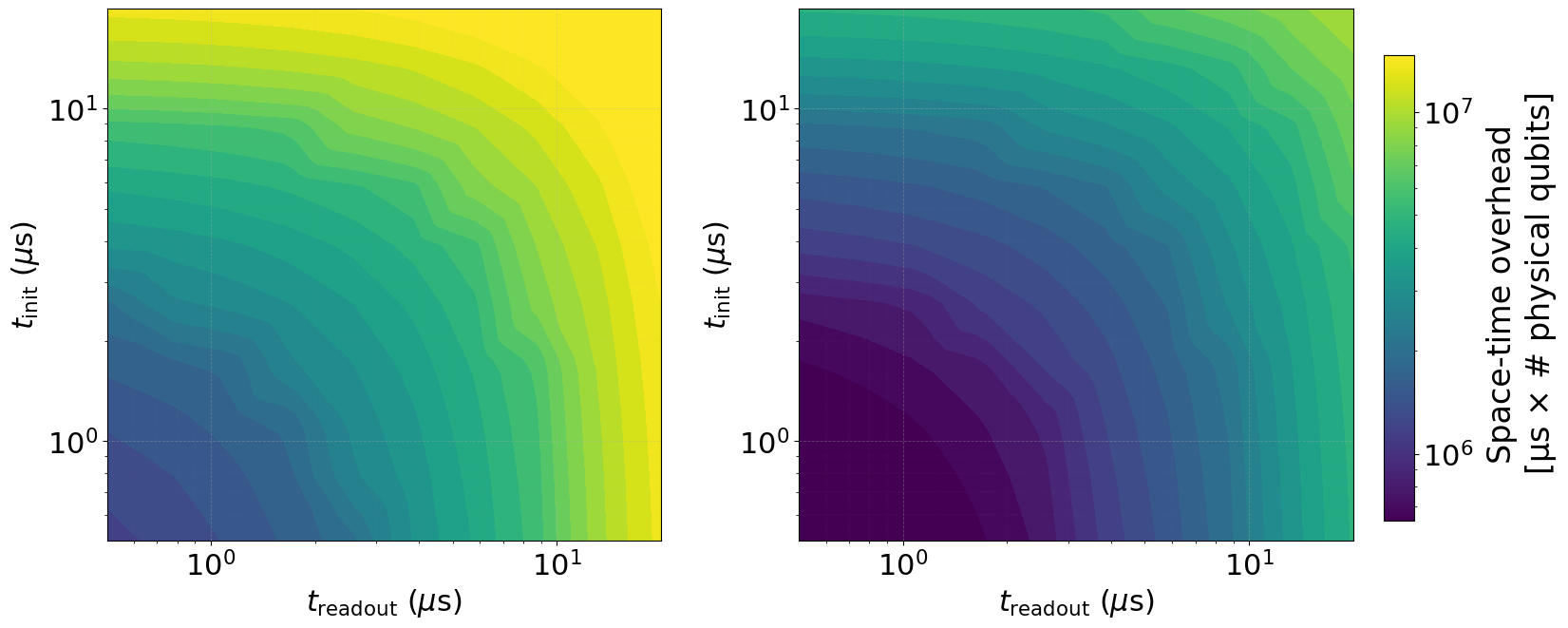
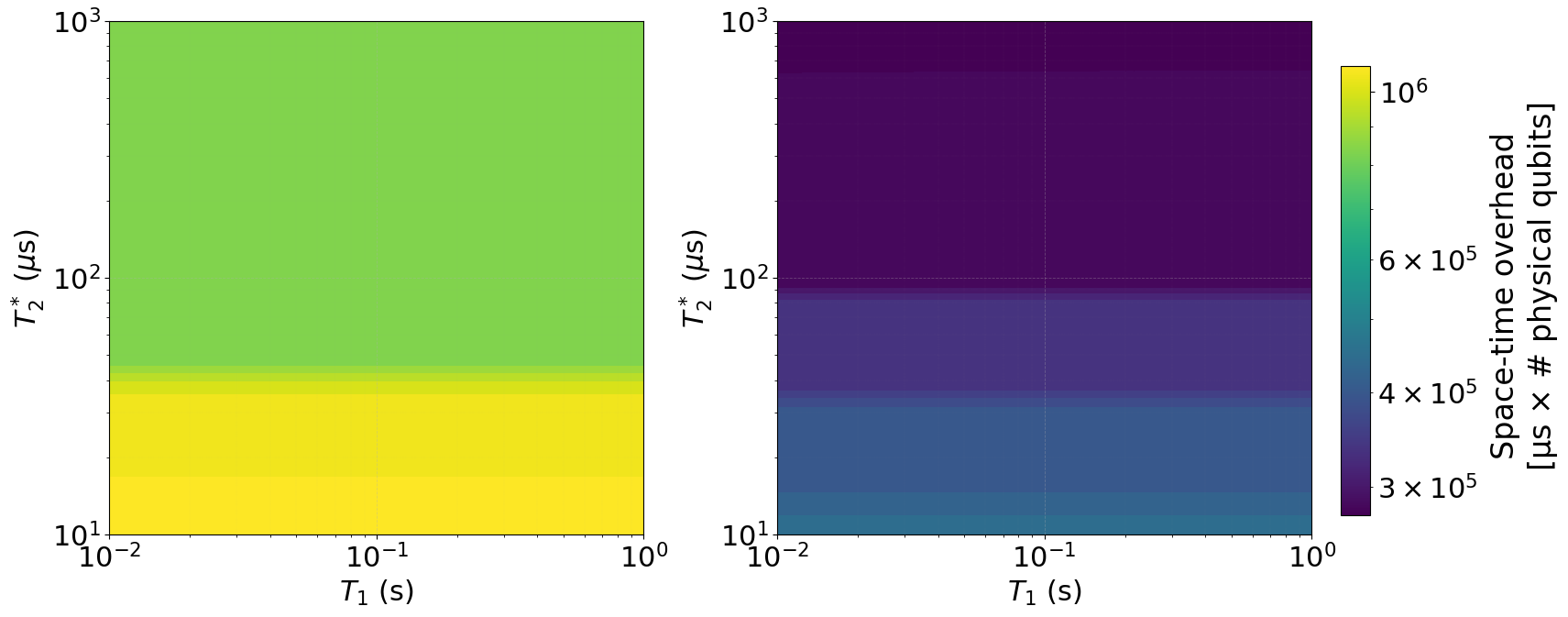
Figure 11: Space-time overhead for producing a high-fidelity logical magic state as a function of physical performance metrics.
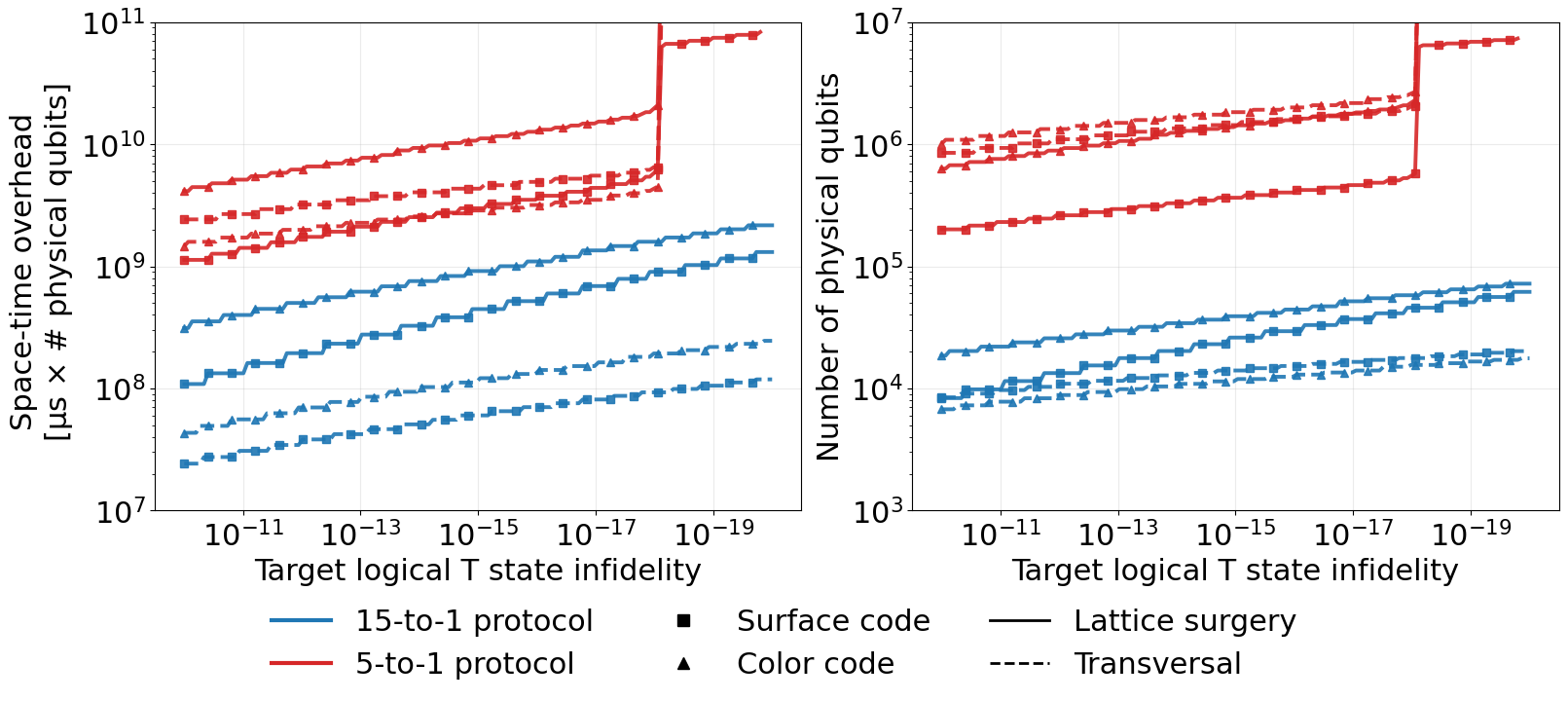
Figure 12: Scaling of space-time overhead and qubit count with target magic-state infidelity across all protocol and architecture combinations.
Pulse-based operation achieves a 42% overhead reduction over standard gate-based scheduling in dense architectures. Resource bottlenecks in sparse and patched architectures are dominated by shuttling errors, highlighting the need for improved shuttle fidelities for scalable QEC.
Algorithm-Level Resource Estimates
Concrete resource projections are provided for quantum dynamics, quantum chemistry, and RSA-2048 Shor factoring. Analysis demonstrates the dominant impact of MSD factories, with potential space-time savings accessed through hardware-tailored protocol selection and aggressive parallelization—albeit with higher spatial footprint.
Figure 2 [Repeated for context.]
Figure 2: Algorithm-specific resource requirements across architectural and protocol choices.
Discussion and Implications
This work establishes a comprehensive and flexible pipeline for evaluating resource requirements for MSD on silicon spin-qubit platforms. Key findings include:
- Connectivity is the principal driver of resource overhead for large-scale MSD.
- Pulse-level optimization at the hardware level directly translates into orders-of-magnitude gains in logical performance and resource efficiency.
- Bias-tailored error correction (e.g., XZZX) is a critical avenue for reducing resource demand in silicon architectures, with performance gains attainable even when only partial bias preservation is available at the physical layer.
- Dense architectures are optimal but experimentally challenging, while the patched paradigm offers a practical compromise for near-term systems.
- Shuttling fidelities must improve by at least an order of magnitude for scalable QEC codes and efficient logical MSD in shuttle-based layouts.
By propagating hardware performance requirements back from application-level resource targets, the analysis offers actionable guidelines for silicon spin-qubit hardware development—specifying which parameter improvements (e.g., 5→17, gate speed, shuttling error) most effectively alleviate resource bottlenecks. The methodology also accommodates future advances in MSD protocol design, surface code optimization, and QEC decoder tailoring.
Conclusion
Hardware-tailored resource estimation, as instantiated in this detailed study, is essential for aligning QEC software and MSD protocol development with the realities of silicon spin qubit architectures. The findings presented here provide both quantitative resource benchmarks and a strategic roadmap for silicon-based platforms seeking to deliver scalable, universal fault-tolerant quantum computing. Future developments in bias-preserving operation design, patch-based modular architectures, and advanced decoders can be systematically integrated within the present framework to support continued progress toward practical quantum advantage.