- The paper demonstrates that leveraging SAEs for layer selection combined with unfiltered task vector injection significantly boosts targeted task accuracy compared to projection-based methods.
- The methodology utilizes per-layer SAE specificity scores to identify domain-specialized layers, thereby avoiding the catastrophic energy loss seen in SAE projection approaches.
- Experimental results on Gemma-3-4B-IT reveal a 9.8% increase in Number Theory accuracy, underscoring the advantage of separating diagnostic and intervention roles in model editing.
Introduction and Motivation
The paradigm of surgical model editing for LLMs seeks to enhance specific domain capabilities without incurring the costs and risks of catastrophic forgetting associated with global fine-tuning. While weight-difference methods such as task vectors enable targeted composition of trained behaviors, interpretability-driven approaches—most notably Sparse Autoencoders (SAEs)—offer feature-level insight for localizing interventions. The paper "Interpretability-Guided Layer Selection over Subspace Projection: SAEs as Stethoscopes, Not Scalpels, for Raw Task Vector Model Editing" (2605.28649) addresses a key intersection: can SAEs reliably guide not just where but how to inject task vectors for precise model editing?
The central finding is a sharply negative result: Projected task vectors onto SAE feature subspaces discard ~97% of the functional weight modification energy, yielding no significant accuracy benefit. Instead, the authors propose and empirically validate a method where SAEs are leveraged diagnostically—as stethoscopes to identify domain-specialized layers—and unfiltered task vectors are directly injected into only those layers. This separation of diagnostic and intervention roles demonstrably improves targeted task accuracy while avoiding the energy bottleneck and representational mismatches of projection-based approaches.
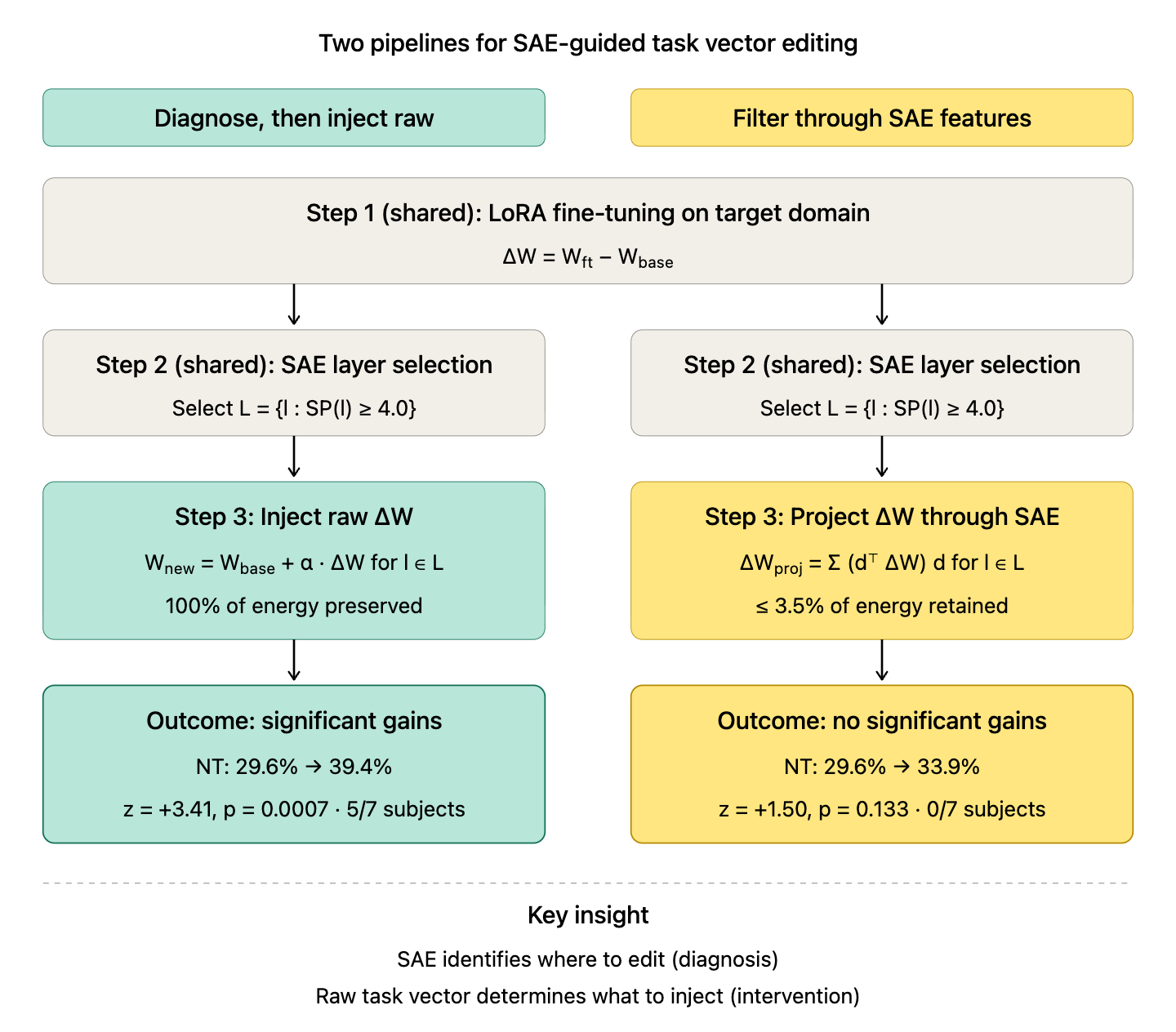
Figure 1: Two pipelines for SAE-guided task vector model editing: the left pipeline diagnoses and injects raw task vectors; the right pipeline projects task vectors through SAE features, causing severe energy loss and minimal functional gains.
Methodology
The method builds on three stages: (1) task vector extraction via LoRA-based fine-tuning; (2) identification of domain-specialized layers with per-layer SAE-derived specificity scores; and (3) selective injection of the raw task vector, with per-layer scaling, into SAE-selected layers only.
SAE-guided layer selection is operationalized using a specificity score, computed for each layer as the maximum feature-wise activation specificity to the target domain. This process robustly highlights layers with concentrated domain specialization, as evidenced by a bimodal distribution centering in mid-to-deep layers.
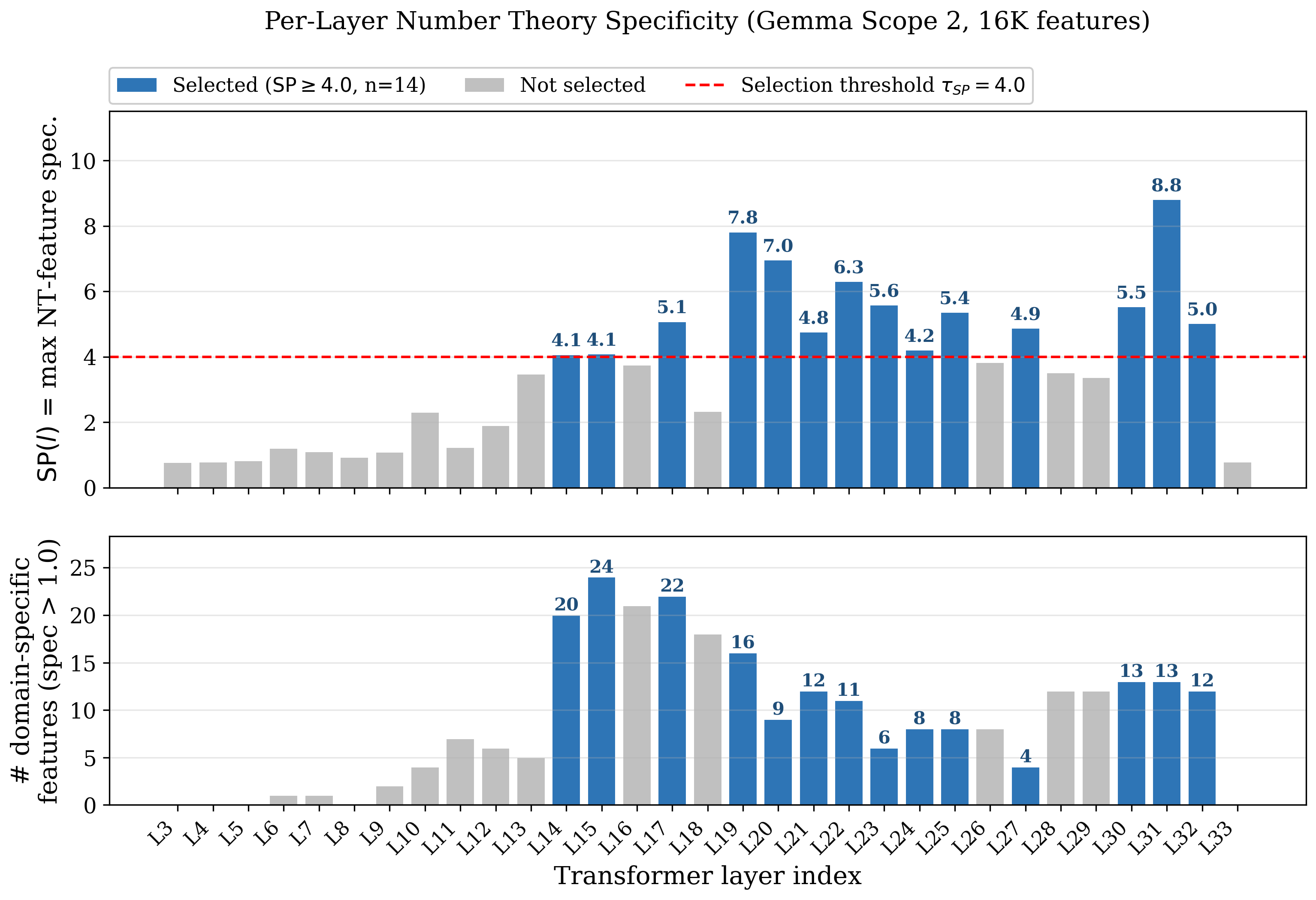
Figure 2: Per-layer specificity scores for Number Theory, showing SAE-identified layers suitable for targeted editing.
The key experimental contrast is between (a) projecting task vectors onto the subspace spanned by high-specificity SAE decoder directions, and (b) directly injecting the unfiltered task vector into layers selected solely by their specificity.
Projection-based editing results in a near-total loss of modification energy (≤3.5% retained) regardless of SAE width, due to a geometric misalignment between activation-space features and weight-space modifications. In contrast, selective raw injection preserves 100% of ∥ΔW∥F in the relevant layers and produces significant improvements in test accuracy.
Experimental Evaluation
The primary testbed is Gemma-3-4B-IT, using Gemma Scope 2 SAEs and a LoRA-trained task vector focused on Number Theory from the Minerva Math suite. Evaluation employs lm-evaluation-harness and rigorous statistical testing over 540 Number Theory items and six additional math subjects.
The raw injection into 14 SAE-selected layers yields a Number Theory accuracy increase from 29.6% to 39.4% (z=+3.41,p=0.0007), with significant gains in five of seven subjects and none significantly degraded. Full LoRA merge and SAE-projection baselines do not achieve significance on any subject, and in some cases cause degradation due to interference. The result is robust to the scaling parameter α, with a broad plateau and rapid dropoff only at high scaling, implying a modification budget proportional to the product of layer count and scaling.
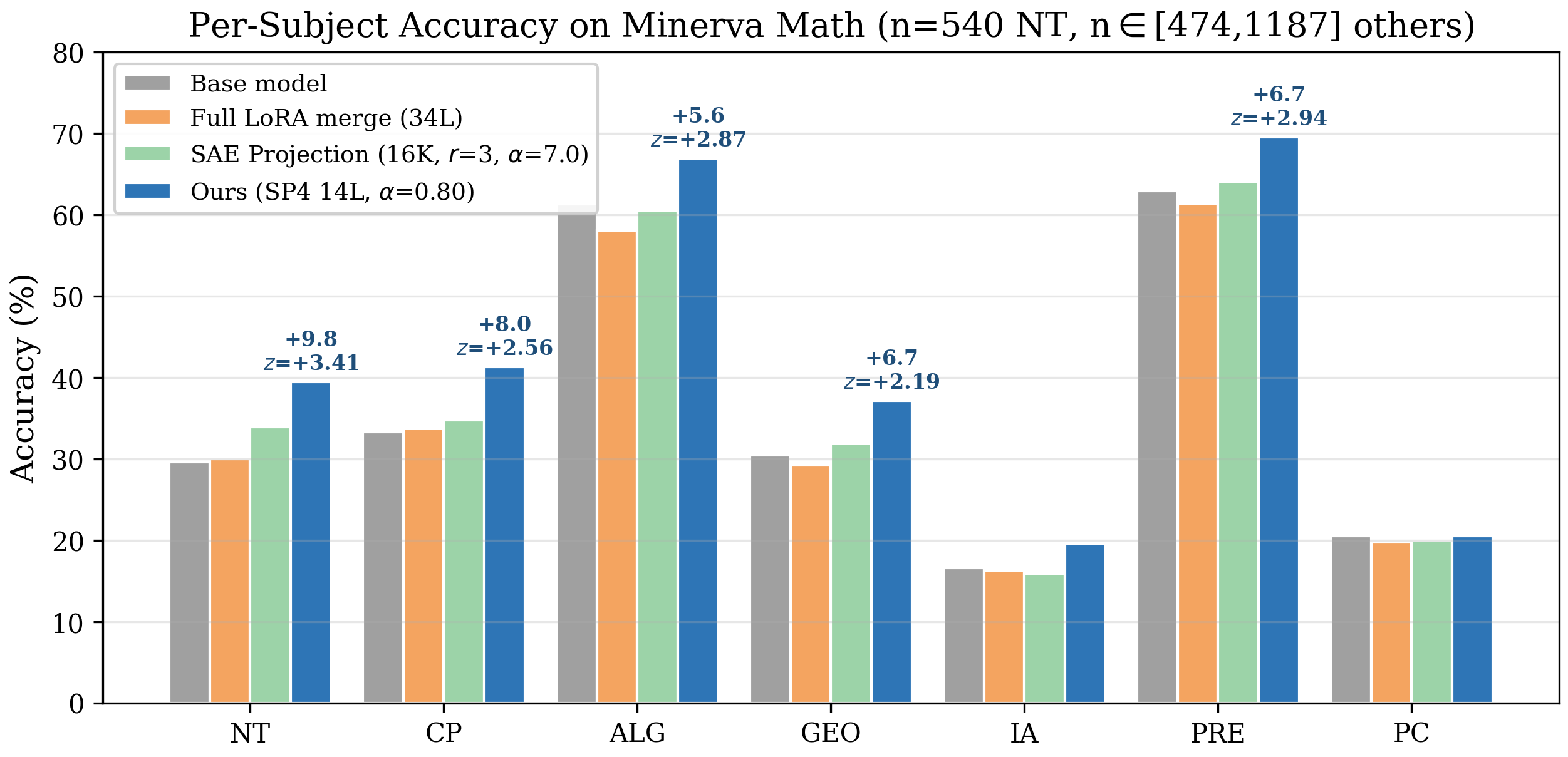
Figure 3: Per-subject accuracy across seven Minerva Math subjects, displaying strong gains for raw-task-vector injection over baselines.
Ablation studies confirm the categorical importance of the specificity threshold for layer selection—layer count alone is not predictive, and omission of layers with high specificity causes collapse. Deep-layer injections encode domain-specific but sometimes interference-prone updates, while hand-crafted mid-layer injections are insufficient.
Projection through the SAE basis, even with 262K features per layer, does not surpass significance thresholds and retains only a minimal fraction of task vector energy.
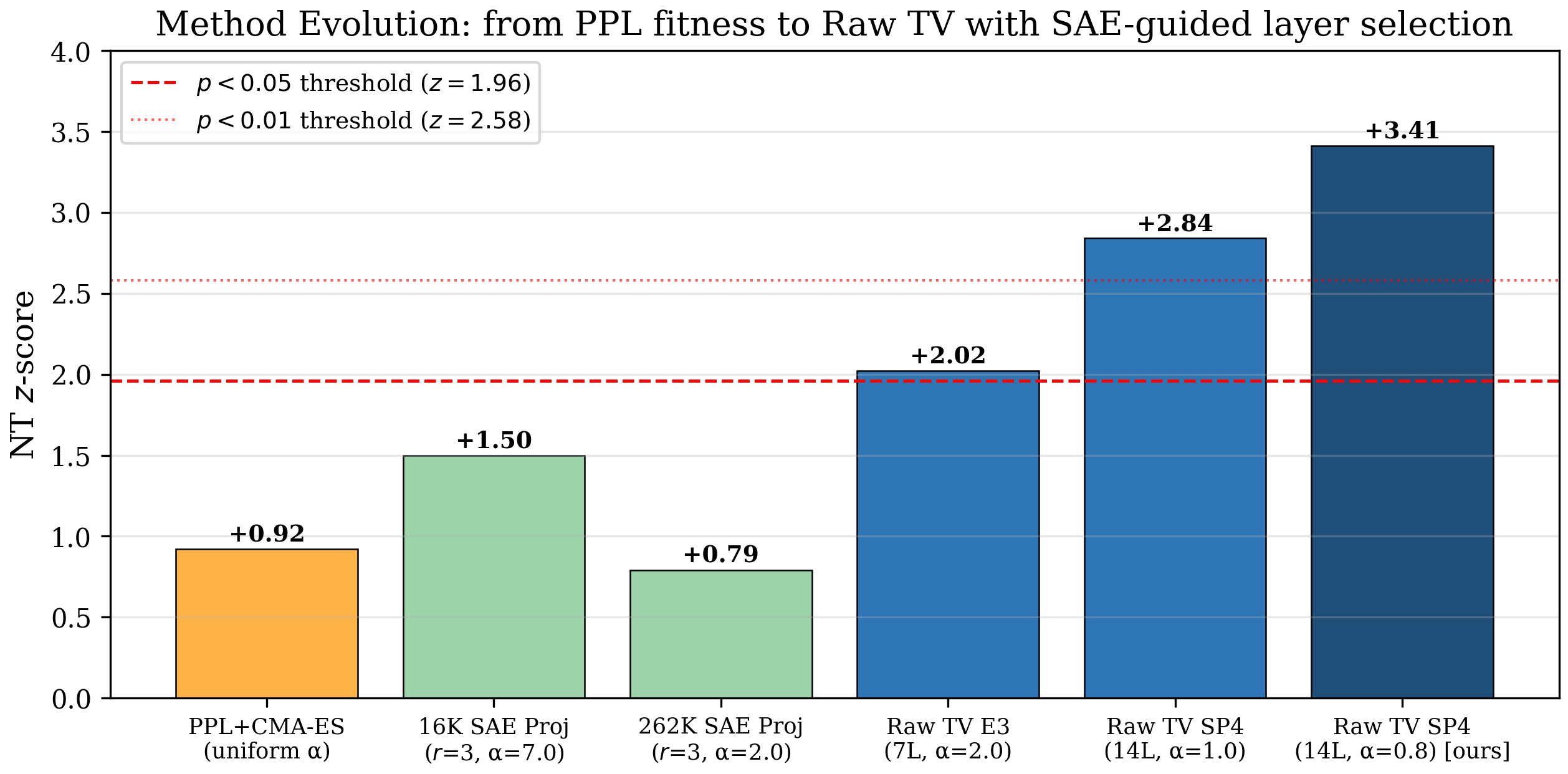
Figure 4: Method evolution trace: only raw task vector injection configurations (blue) achieve significant gains. Crossing the significance threshold coincides with abandoning SAE projection.
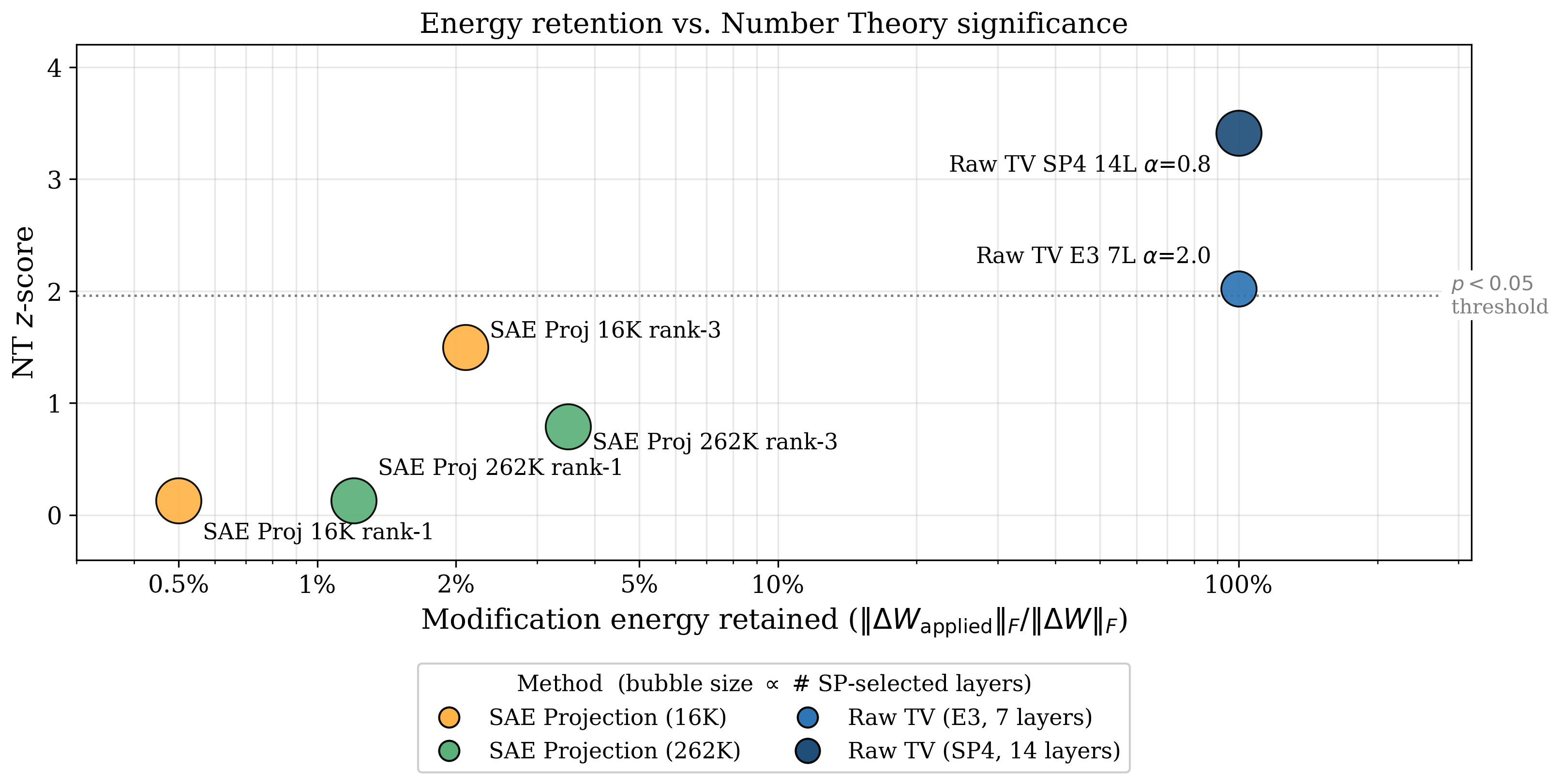
Figure 5: The relationship between energy retention and significance shows a two-order-of-magnitude gap, with significant accuracy gains only at 100% energy retention.
Analysis and Implications
This result elucidates a fundamental geometric incompatibility: SAE feature vectors span activation domains and are unsuited as projective bases for weight-space task vectors. The negative result is consistent with recent critiques of SAE-based interventions—including information loss in reconstruction, fragility as actuators, and indistinguishability from random baselines [sharkey2025open, kantamneni2025sae, heap2025random]. These findings support a strict separation of roles: SAEs as reliable diagnostic instruments for localizing interventions, but not as transformative filters for what is injected.
Further, the practical efficacy of this approach depends on the focus and fidelity of the fine-tuning dataset: larger but mixed-domain task vectors fail to drive target-domain gains, emphasizing that both precise selection and high-content specificity are necessary for successful surgical editing.
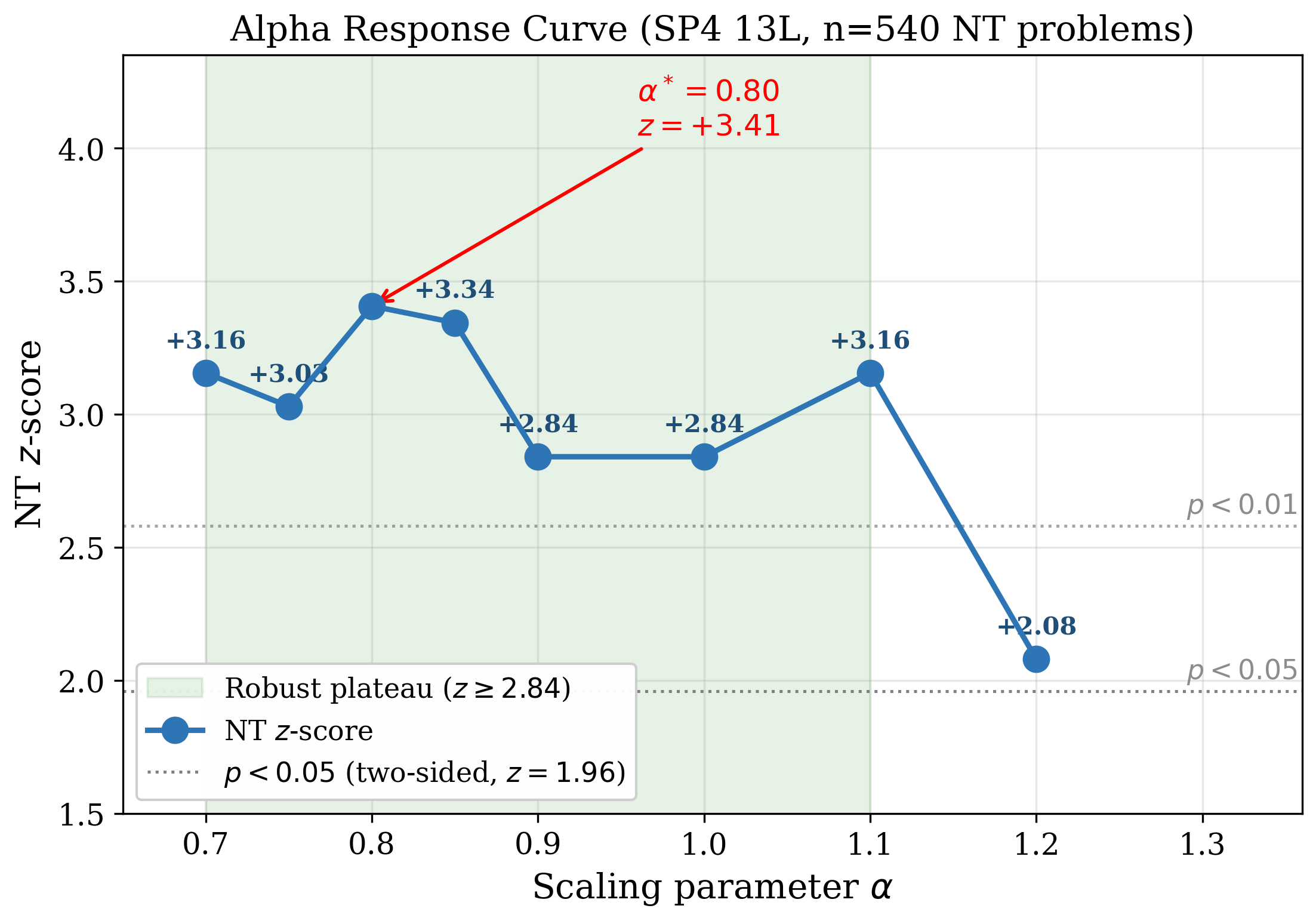
Figure 6: Response curve of Number Theory z-score to α scaling parameter; robust plateau and sharp falloff indicate clear operational guidance for intervention strength.
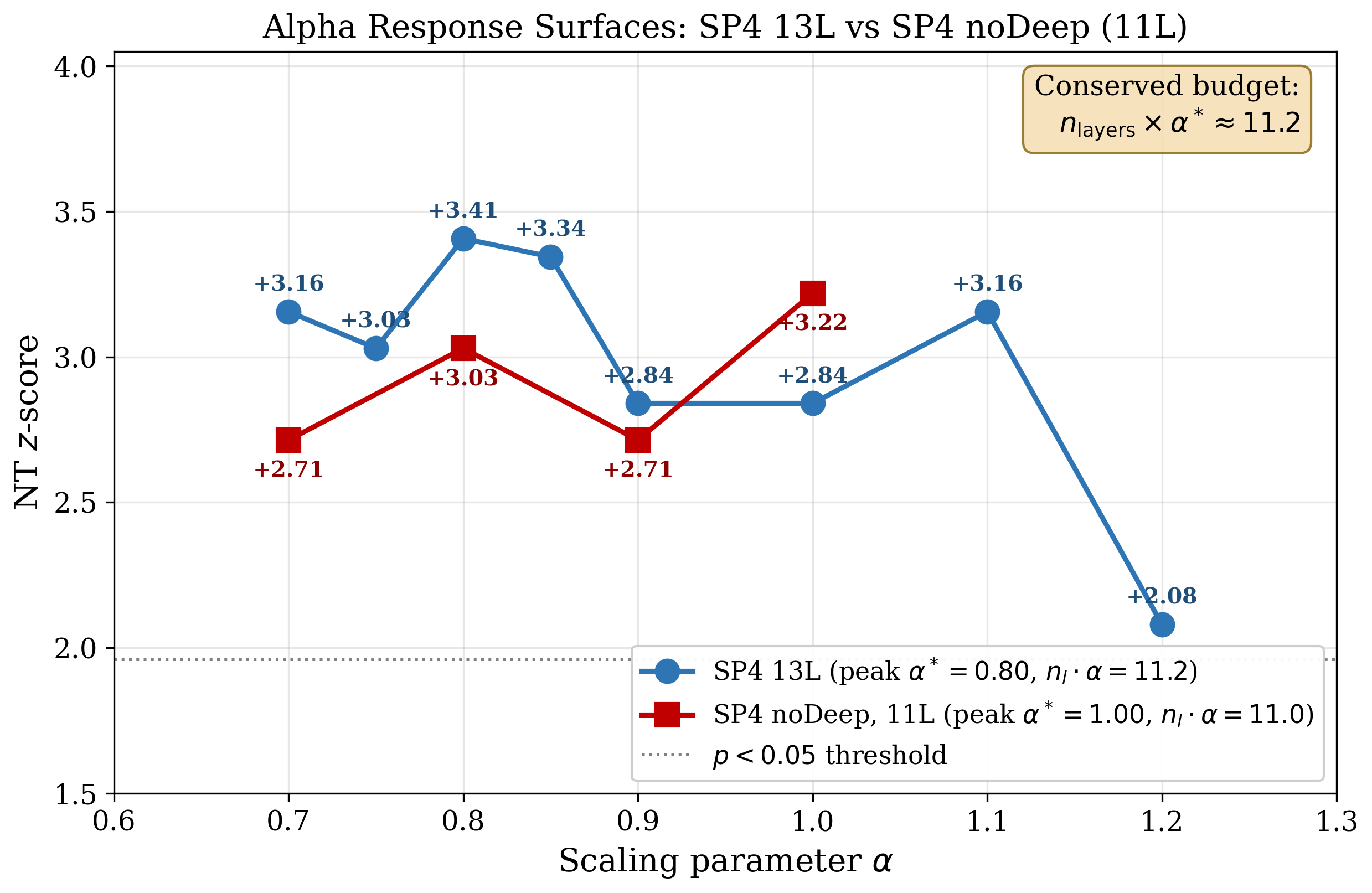
Figure 7: Layer count and optimal α scale as a conserved "modification budget," suggesting design invariances for targeted injection.
Additional experiments reveal that compositional injection of multiple task vectors without interference mitigation causes severe negative interactions, echoing known issues in task-vector arithmetic literature. The implication is that layer selection informed by domain specificity is not sufficient to prevent subspace overlap; more principled composition strategies are needed for multi-domain editing.
Limitations
Empirical findings are restricted to a single base model and domain (Gemma-3-4B-IT, mathematical reasoning). While the geometric argument should extend to other architectures and domains, actual generalization requires further experimentation with models such as Llama using Llama Scope [he2024llamascope]. Effectiveness also hinges on comprehensive SAE coverage at each layer and the availability of precise, domain-focused fine-tuning data.
Conclusion
This research delivers a methodologically rigorous analysis of the intersection between mechanistic interpretability and model editing. The central technical takeaway is that SAEs should be employed for layer-level diagnosis—localizing model regions relevant to domain-specific behavior—while raw, unfiltered task vectors should be directly injected for intervention. Attempting to filter or project these vectors through SAE feature subspaces induces catastrophic energy bottlenecks and fails to transfer task-specific behavior.
These findings suggest a complementary rather than substitutive role for interpretability tools and intervention mechanisms. Future work should address cross-domain robustness, multi-task composition with interference mitigation, and principled characterization of alignment between activation and weight space representations. The broader implication is a call for operational clarity: mechanistic interpretability provides "where," but not "what," for meaningful edits in large-scale networks.