Guiding LLM Post-training Data Engineering with Model Internals from Sparse Autoencoders
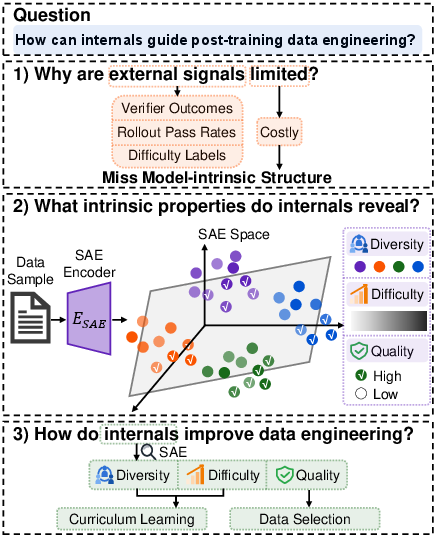
Abstract: Model internals encode rich information about how a LLM processes its training data; however, post-training data engineering largely relies on external signals and ignores rich intrinsic signals lying in model internals. We propose SAERL, a data engineering framework for LLM reinforcement learning (RL). It models three intrinsic data properties: diversity, difficulty, and quality, using model internals extracted with Sparse Autoencoder (SAE), an advanced mechanistic interpretability tool. Each property grounds a concrete data engineering operation: SAE-space clustering with moderate batch mixing for batch diversity control, a difficulty proxy for easy-to-hard curriculum ordering, and a quality probe for data filtering. SAERL improves average accuracy by 3.00% over vanilla GRPO and reaches target accuracy with 20% fewer training steps on Qwen2.5-Math-1.5B, with consistent gains across model scales and RL algorithms. Experiments show that SAE transfers effectively across model families and scales, serving as a lightweight and reusable data engineering tool. These results demonstrate that model internals are a powerful and practical source of signals for post-training data engineering.
Paper Prompts
Sign up for free to create and run prompts on this paper using GPT-5.
Top Community Prompts
Explain it Like I'm 14
What this paper is about
This paper introduces a way to make LLMs learn better after they’ve already been trained once. The authors call their method SaeRL. It uses the model’s own “inside signals” (what’s going on inside the model as it thinks) to choose and organize training problems. The goal is to help the model learn more efficiently and end up smarter, especially at math.
Think of it like designing a study plan for a student: you pick good practice problems, sort them from easier to harder, and mix them in the right way. SaeRL lets the model help design that plan by reading its internal “thought patterns.”
The big questions the paper asks
- Can a model’s internal signals tell us which training examples:
- cover different kinds of skills (diversity),
- are easy or hard (difficulty),
- are trustworthy and well-formed (quality)?
- If we use those signals to pick and order training data, will the model learn faster and do better?
- Can this approach work across different model sizes and families, not just the one it was trained on?
How the method works (in everyday terms)
First, a few simple definitions with analogies:
- Model internals: These are like the “brain activity” of the model—signals inside the network that show which features it’s noticing.
- Sparse Autoencoder (SAE): Imagine you have a smoothie and you want to know which fruits are in it. An SAE separates the blended “smoothie” of internal signals into a small set of clear “ingredients.” Each ingredient (feature) turns on only when relevant, which makes things easier to understand and use.
- Reinforcement learning (RL) post-training: A second phase of training where the model practices solving problems and gets feedback or “rewards” for good answers.
- Curriculum learning: Organizing practice from easy to harder problems so learning builds smoothly.
- Data engineering: Deciding which training examples to use, how to order them, and how to group them into batches.
Here’s the SaeRL plan:
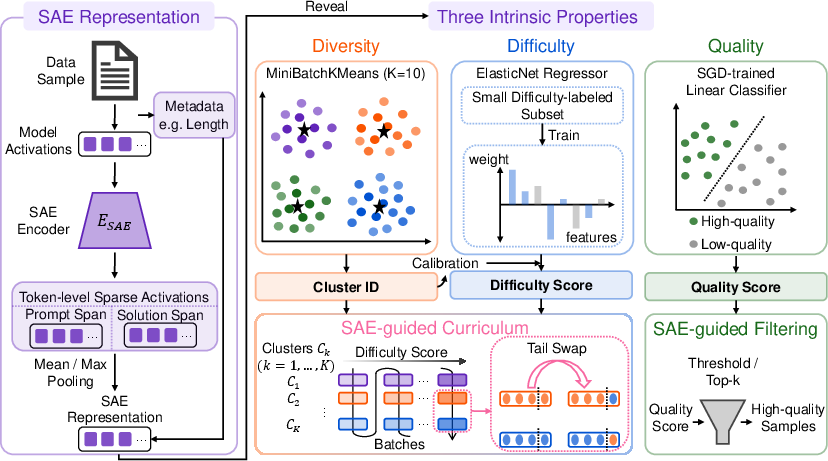
- Create a feature representation of each problem:
- Use SAE to turn the model’s internal signals into about 960 “features” per sample, collected from both the problem text and the solution steps.
- Add a small set of simple stats (like length), called metadata.
- Quality filtering (like a smart spam filter for training problems):
- Train a lightweight classifier on the SAE features to score how “on-target” and well-formed each problem is.
- Keep the high-quality ones for training, drop the noisy ones that don’t match the goal (here, math reasoning).
- Clustering and batch diversity (grouping similar problems, then mixing a little):
- Cluster problems based on the SAE features—similar internal “thought patterns” end up together.
- Build training batches mostly from within a cluster for coherence, but gently swap a small “tail” of problems with a nearby batch to add some diversity.
- This “moderate mixing” balances two needs: stable learning within a theme and coverage across different skills.
- Difficulty-based curriculum (easy-to-hard within each cluster):
- Train a simple difficulty predictor (ElasticNet regressor) using SAE features.
- Sort problems within each cluster from easier to harder.
- Interleave batches from different clusters so the model sees a smooth, varied curriculum.
The authors test this on math models and benchmarks using popular RL training methods (GRPO and DAPO), and even use an SAE trained on one smaller model to guide training for other models.
What they found and why it matters
- Better accuracy: On average, SaeRL improves accuracy by about 3 percentage points compared to a standard RL method (GRPO), and it also beats other data-selection baselines.
- Faster training: SaeRL reaches target accuracy with about 20% fewer training steps in some settings. It can get similar or better results with less effort.
- Lower preparation cost: Building the SAE features and difficulty predictor is much cheaper than methods that need many rollouts or lots of human labels. For example, encoding the whole dataset with SAE took about 0.5 H100 GPU hours, while a rollout-based baseline used around 17.33 H100 hours.
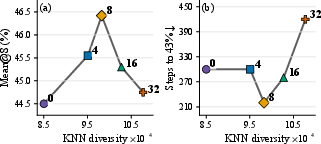
- The “moderate mixing” sweet spot: Mixing too little keeps batches too narrow; mixing too much makes training unstable. A moderate amount of mixing led to the best performance and fastest learning.
- Strong quality filtering: The SAE-based quality probe could pick mostly high-quality math problems from a noisy mix. For example, choosing the top 50,000 by the quality score reached about 99.9% purity from the target math set.
- Signals that transfer: An SAE trained on a different, smaller model still provided useful signals to guide training for larger models, hinting at reusability.
What this could mean for the future
- Smarter training plans: Using the model’s own internal signals to pick and order training data can make learning both faster and better. It’s like letting the student’s brain activity help pick the next set of practice problems.
- Lower costs: Instead of relying heavily on human labels or lots of expensive rollouts, lightweight probes on SAE features can guide data selection and curriculum with less compute.
- More transparency: Because SAE features are sparse and interpretable, you can inspect which “ingredients” drive decisions (difficulty, diversity, quality), making training choices easier to understand and audit.
- Reusable tools: A single SAE trained once might help guide training across different models and sizes, saving time.
A few caveats
- Tested in math: Most experiments are in mathematical reasoning, where it’s easier to verify answers. It’s not yet clear how well this generalizes to code, tools, or open-ended tasks.
- Some supervision needed: The difficulty predictor uses a small labeled set, and the quality probe needs source labels. It’s not fully unsupervised.
- Theory is evolving: The paper explains why mixing helps from an optimization perspective, but it doesn’t prove a strict causal link between specific SAE distances and training dynamics.
Overall, SaeRL shows that looking inside models—using SAEs to read their “thought ingredients”—can guide a practical, effective, and efficient study plan for post-training.
Knowledge Gaps
Knowledge gaps, limitations, and open questions
Below is a single, concrete list of what remains missing or uncertain in the paper, phrased to guide future research.
- Generalization beyond math with verifiable rewards: Does SAE-guided data engineering transfer to code RL, tool-use, agentic RL, or general instruction-following where rewards are noisier or non-verifiable?
- Cross-model and cross-family transfer: The SAE was trained on Qwen3-1.7B layer-27 and applied to Qwen2.5-Math models; does it transfer to different families (e.g., Llama, Mistral), modalities, or multilingual settings?
- Layer and representation selection: How sensitive are results to the SAE’s layer choice (only layer-27 used), sparsity level, number of features (960), and pooling scheme (mean/max over prompt/solution)? Are multi-layer or head-specific SAEs better?
- Stability under training drift: The pipeline uses a fixed, offline SAE; do SAE features remain predictive as the policy’s internal representations evolve during RL? Would periodic re-encoding or online SAEs improve curricula?
- Hyperparameter sensitivity of clustering and mixing: What is the effect of K (fixed at 10), distance metric, initialization, and tail-swap size (mix strength) on performance across tasks and models? Can these be auto-tuned during training?
- Theory–practice link for “moderate diversity”: The paper hypothesizes a concave coherence–coverage trade-off; is there empirical evidence via gradient-level measures (e.g., in-batch gradient cosine similarity/variance) correlated with SAE distances? Can a causal link be established?
- Difficulty proxy supervision: The ElasticNet difficulty model relies on ~3k labeled samples; how does performance degrade with fewer labels, different label sources, or alternative difficulty definitions (e.g., solution entropy, verifier confidence) controlling for confounds like length?
- Unsupervised or self-supervised alternatives: Can difficulty and quality signals be derived without labeled subsets (e.g., clustering-derived hardness, self-calibrated uncertainty, or intrinsic reward proxies)?
- Quality probe validity beyond source artifacts: The DeepMath-vs-Numina experiment may capture dataset/style fingerprints rather than “quality”; does the probe generalize to other noisy mixtures and human-annotated quality labels?
- Downstream impact of quality filtering: While purity/recall are reported, the paper does not quantify how different probe thresholds (e.g., Top-50k vs P95) affect RL performance and generalization; what is the optimal purity–coverage operating point?
- Ordering of pipeline stages: The method filters first, then builds the curriculum; is this ordering optimal? Would joint optimization or interleaved filtering/curriculum updates outperform the proposed sequence?
- Interaction with rollout-based signals: Can internal SAE signals be combined with external signals (e.g., pass rates, verifier confidence, reward variance) for better curricula or selection, and when do external signals override internals?
- Robustness to OOD shifts: Difficulty prediction shows limited transfer to DSR before adaptation; how robust are diversity/difficulty/quality signals under stronger domain shifts, mixed domains, or non-math distributions?
- Batch size and optimizer coupling: The benefit of the curriculum narrows at larger batch sizes; how do batch size, optimizer settings, and learning rate schedules modulate the efficacy of SAE-guided curricula?
- Coverage and fairness risks: Does clustering and filtering disproportionately exclude rare but important skills/topics, harming coverage or long-tail generalization? Can coverage constraints or diversity-aware thresholds mitigate this?
- Interpretability and monosemanticity: To what extent are the high-gain SAE features truly monosemantic? Do causal feature ablations/interventions confirm that identified features drive curriculum gains rather than reflect spurious correlations?
- Scaling to larger datasets/streams: Can the approach handle millions of samples or streaming/continual data, including incremental SAE encoding, drift detection in SAE space, and online curriculum refresh?
- Reward misspecification and noisy verifiers: How does SaeRL behave when rewards are spurious or verifiers are error-prone—does SAE guidance mitigate or amplify reward hacking?
- Curriculum schedule design: Are alternative schedules (e.g., adaptive pacing, per-cluster pacing, replay of hard cases, dynamic batch sizes) superior to fixed-stage interleaving with moderate mixing?
- Ablation completeness: The paper ablates difficulty sorting, clustering, and mixing, but not the quality filtering component; what is the isolated contribution of the quality probe to RL outcomes?
- Broader evaluation breadth: Results are limited to GRPO and DAPO on six math benchmarks up to 900 steps; do gains persist with other RL algorithms (e.g., PPO variants), longer training, hidden test sets, and user-centric metrics?
- SAE training design choices: How do SAE training recipes (architectures, sparsity penalties, dataset used to train the SAE, training seeds) affect downstream data-engineering utility and transfer?
- Automated hyperparameter selection: Can the system learn to choose K, mixing strength, stage size, and thresholds via bandits or meta-learning to avoid hand-tuning per domain/model?
- Safety-aware data engineering: How can SAE-based signals be integrated with safety probes/red-teaming to ensure that efficiency gains do not concentrate unsafe capabilities or bypass safety filters?
Practical Applications
Immediate Applications
The following applications can be deployed now with modest engineering effort by leveraging SAE-driven signals (diversity, difficulty, quality) as described in the paper’s SaeRL framework.
- LLM post-training accelerator for reasoning tasks (software/AI labs)
- What: Integrate SAE-based quality filtering, cluster-first easy-to-hard curricula, and moderate batch mixing into RLHF/RLVR pipelines to boost accuracy and reduce training steps.
- Why: The paper reports +3.00% accuracy over vanilla GRPO and ~20% fewer steps on Qwen2.5-Math-1.5B, with gains across RL algorithms and model scales.
- Tools/workflows:
- SAE feature extractor shared across models; MiniBatchKMeans clustering; ElasticNet difficulty proxy; SGD linear quality probe; dataloader with “moderate tail swapping.”
- Plug-in for popular RL post-training stacks (e.g., TRL-like pipelines) to replace random batching with SAE-driven batchers and curricula.
- Assumptions/dependencies: Access to hidden activations to compute SAE features; a trained SAE (can be trained once on a smaller base model); a small difficulty-labeled subset (≈3k examples) and coarse source labels for the quality probe; best suited to verifiable-reward domains (math/code) in the near term.
- High-precision dataset purification from noisy pools (software, education, finance, healthcare)
- What: Use SAE-based quality probes to recover target-distribution samples from mixed corpora with high purity (e.g., ~99.9% purity at Top-50k in the paper’s DeepMath selection).
- Why: Reduces annotation/spend on weak or off-distribution data; improves alignment and lowers training variance.
- Tools/products: “SAE Purifier” CLI/service that scores and filters raw crawls or vendor datasets before RL/SFT; dashboards to compare pre/post purity and recall.
- Assumptions/dependencies: Requires a trained SAE and a modest amount of source/distribution labels; domain shift may require probe recalibration.
- Curriculum constructor for data-centric ML teams (software, education)
- What: Generate cluster-wise easy-to-hard trajectories using SAE difficulty proxies, then interleave batches with moderate cross-cluster mixing.
- Why: Faster convergence and better final performance than naive or label-only curricula; avoids expensive rollout-based difficulty estimation.
- Tools/workflows: “Curriculum Builder” that ingests datasets, outputs ordered batches/epochs; integrates with dataloaders.
- Assumptions/dependencies: Small labeled difficulty subset; curriculum calibration per cluster; empirical tuning of mixing strength (paper finds a concave trade-off with an interior optimum).
- Batch composition optimizer for RL training (software/AI labs)
- What: Replace random batching with SAE-space cluster-first batching plus moderate tail swapping to balance gradient coherence and coverage.
- Why: The paper shows non-monotonic performance vs. diversity; moderate mixing (e.g., mix8) achieves the best accuracy and fastest threshold crossing.
- Tools/workflows: Dataloader hook that computes in-batch SAE k-NN distances and enforces target diversity ranges; monitoring panel for “diversity vs. convergence” diagnostics.
- Assumptions/dependencies: Needs SAE features at dataset preprocessing time; mixing strength is task-dependent and benefits from light tuning.
- Cross-model, cross-scale data engineering on a budget (software/AI labs, startups)
- What: Train one SAE on a small/cheap model and reuse it to engineer data for larger models and different families.
- Why: The paper demonstrates transfer from a Qwen3-1.7B SAE to Qwen2.5-Math 1.5B/7B; SAE encoding for 103k samples took ~0.5 H100 hr in the study.
- Tools/workflows: “Reusable SAE Encoder” artifact with versioning; CI to revalidate probe calibration when swapping base models.
- Assumptions/dependencies: Transferability is strong in math reasoning; other domains may require light adaptation and cluster-wise calibration.
- Interpretability-informed data audits and dataset governance (policy, compliance, academia, software)
- What: Use SAE clusters and feature importances to audit whether batches/curricula emphasize certain structures (e.g., solution patterns, symbolic complexity), detect off-distribution pockets, and justify data selection.
- Why: Improves transparency for reviewers, customers, and regulators; helps debug regressions and spurious reward exploitation.
- Tools/workflows: “SAE Audit Board” showing cluster composition, difficulty distributions, top features, and per-batch diversity metrics; report templates for reproducibility sections.
- Assumptions/dependencies: Interpretations are correlational (paper notes no causal proof linking SAE distances to gradient dynamics); requires careful human review.
- Lightweight difficulty/quality triage for open-source practitioners (daily life, OSS community)
- What: Run prebuilt SAE probes to sort and filter small fine-tuning sets (math/coding Q&A) for hobbyist models without expensive rollouts.
- Why: Improves small-model training efficiency and stability with minimal compute.
- Tools/workflows: Pretrained SAE + probe weights; simple Python notebook/CLI for “score, filter, order, batch.”
- Assumptions/dependencies: Best results in verifiable-reward tasks; closed models without activation access are out of scope.
Long-Term Applications
These applications will benefit from further research, scaling, or domain adaptation beyond the paper’s current math-centric scope.
- Generalized intrinsic data engineering SDK (software, MLOps)
- What: A commercial/OSS suite that trains SAEs, extracts features at scale, learns difficulty/quality probes, optimizes batch mixing, and provides dashboards and APIs for RLHF/RLVR and SFT.
- Impact: Standardizes internal-signal-based data engineering; reduces reliance on costly rollouts or human labels.
- Dependencies: Robust cross-domain SAE transfer; connectors to major training stacks; privacy-aware activation handling; ongoing probe recalibration.
- Online SAE-guided curricula for agents and tool-use (software, robotics, code assistants)
- What: Close the loop by updating curricula on-the-fly using SAE signals plus reward/logit metrics during training of agentic policies, code agents, or robotics-language policies.
- Impact: Adaptive curricula that target current failure modes and improve sample efficiency in long-horizon tasks.
- Dependencies: Online activation capture; stability under non-stationary data; safe mixing in multi-tool or multi-skill settings; verifiable or proxy rewards beyond math.
- Domain-specialized data curation in safety-critical sectors (healthcare, finance, legal)
- What: Use SAE quality probes and cluster-aware curricula to curate/verifiably improve domain RL/SFT datasets (clinical Q&A, financial analysis, regulatory reasoning).
- Impact: Higher data purity and more stable training; improved compliance and auditability.
- Dependencies: Domain SAEs (trained on de-identified or synthetic corpora), strong governance for privacy/IP, human-in-the-loop validation of probe decisions, careful OOD calibration.
- Education technology: model-informed curriculum sequencing (education)
- What: Leverage SAE-derived difficulty to assemble problem sets and learning paths that match a model’s (and potentially students’) difficulty gradients.
- Impact: Personalized practice trajectories; automated construction of scaffolded materials for tutors and LMS platforms.
- Dependencies: Mapping model-internal difficulty to human difficulty; pedagogy-aligned calibration; guardrails to avoid shortcut biases.
- Data valuation and acquisition strategies powered by internals (software, data marketplaces)
- What: Estimate marginal utility of candidate data using SAE proximity and difficulty signals to drive acquisition bids and active data collection.
- Impact: Lower data spend, targeted growth of gaps in capability space.
- Dependencies: Reliable utility predictors across domains; marketplace acceptance of internal-signal-based valuations; reproducibility standards.
- Safety monitoring: early warning for spurious reward optimization (policy, safety)
- What: Track SAE-feature patterns that correlate with reward hacking or off-policy shortcuts; route suspect samples to human review or downweight in curricula.
- Impact: Reduces reward overoptimization and brittle behaviors in RLHF/RLVR.
- Dependencies: Labeling of spurious behaviors for supervised probes; integration with broader safety evaluation frameworks.
- Cross-model capability alignment and transfer (software/AI labs)
- What: Use SAE spaces as a lingua franca to align datasets/curricula across models and to steer capability shaping (e.g., emphasize underrepresented skills).
- Impact: Faster bootstrapping of new model families; smoother capability targeting.
- Dependencies: Stable inter-model SAE mappings; methods to align layers/spaces; standardized feature vocabularies.
- Robotics and embodied AI curricula (robotics, manufacturing)
- What: Apply SAE-guided difficulty and diversity controls to language-conditioned policy learning, task sequencing, and simulation-to-real transfer.
- Impact: More sample-efficient policy learning and reduced sim2real gaps via well-structured training distributions.
- Dependencies: Access to multimodal (language, vision, proprioception) internal representations; extension of SAE methods beyond text.
- On-device personalization via intrinsic curricula (mobile, edge AI)
- What: Compact SAEs guide lightweight data selection/ordering from user interactions to personalize small assistants or embedded models.
- Impact: Efficient fine-tuning with constrained compute; privacy-preserving local curation.
- Dependencies: Efficient SAE inference on-device; privacy guarantees; robust probes with very small labeled sets.
- Standards and governance for internal-signal reporting (policy, academia)
- What: Recommend reporting SAE-based data curation steps, compute budgets, and diversity metrics in papers and model cards.
- Impact: Improves transparency, comparability, and reproducibility across labs; informs regulatory best practices.
- Dependencies: Community consensus; evaluation suites that include internal-signal metrics; guidance on privacy around activations.
Cross-cutting assumptions and risks to feasibility
- Access to model internals: Closed models or privacy-restricted deployments may not expose activations needed for SAE features.
- Domain transfer: While the paper shows cross-model/scale transfer in math reasoning, other domains (dialogue, multimodal, robotics) will need validation and possibly domain-specific SAEs.
- Supervision requirements: Difficulty proxy needs a small labeled set; quality probe needs source/distribution labels. Fully unsupervised variants are future work.
- Interpretability vs. causality: SAE proximity is a useful proxy, but not a proven causal link to gradient coherence; monitoring and ablations remain important.
- Safety and compliance: Internal signals could inadvertently optimize for unsafe capabilities if not paired with safety filters and human oversight.
Glossary
- ADARFT: A curriculum method that estimates problem difficulty from rollout results in RL. "ADARFT ~\citep{shi2025adarft} estimates difficulty from rollout accuracy"
- Ablation study: An analysis that systematically removes components to assess their contribution. "Ablation results at step 900 on Qwen2.5-Math-1.5B, reported in accuracy (\%)."
- AP (Average Precision): A ranking metric equal to the area under the precision–recall curve. "achieves $0.9911$ ROC-AUC and $0.9910$ AP on the holdout split"
- Avg@8: The average accuracy when evaluating with up to eight sampled attempts. "We report Pass@8 for AIME24 and Avg@8 for the remaining five benchmarks."
- Batch mixing: Exchanging a small portion of samples between batches to increase diversity while preserving coherence. "moderate batch mixing"
- Bias–variance decomposition: A framework analyzing the trade-off between model bias and variance to understand performance impacts. "bias--variance decomposition in Appendix~\ref{app:sae_batch_tradeoff}"
- Cluster-first curriculum: An ordering strategy that first groups data by clusters and then orders within clusters (often by difficulty). "construct a cluster-first easy-to-hard curriculum."
- Cluster purity: A clustering quality metric measuring the extent to which clusters contain a single class or label. "(purity , )"
- Cluster-wise calibration: Adjusting scores per cluster to ensure comparability across clusters. "we apply cluster-wise calibration using a global mapping with shrinkage-based cluster corrections"
- Curriculum learning: Training strategy that orders data from easier to harder examples. "enabling SAE-based curriculum learning and data selection"
- DAPO: A reinforcement learning algorithm used as a baseline for LLM post-training. "Vanilla GRPO ~\citep{shao2024deepseekmath} and DAPO ~\citep{yu2025dapo} serve as RL algorithm baselines without curriculum"
- Decontamination: Removing overlaps with evaluation sets or undesirable content to avoid leakage and noise. "through decontamination, difficulty filtering, and answer-verifiability filtering"
- Difficulty proxy: A learned estimator that predicts how hard a sample is for the model. "a difficulty proxy for easy-to-hard curriculum ordering"
- Distribution shift: A mismatch between training and test data distributions. "retain a positive signal under distribution shift"
- ElasticNet: A linear model with both L1 and L2 regularization used for regression. "we train an ElasticNet \citep{zou2005regularization} regressor"
- GAINRL: A data-selection method that uses compressed hidden-state representations. "GAINRL ~\citep{wang2025angles} selects data via compressed hidden-state representations"
- GRPO: A reinforcement learning algorithm baseline for LLM post-training. "SaeRL improves average accuracy by over vanilla GRPO"
- k-NN distance: The average distance to the k nearest neighbors, used here to quantify batch diversity. "mean in-batch -NN distance ()"
- LightGBM: A gradient-boosting framework based on decision trees used for feature importance analysis. "Among the top-20 features ranked by LightGBM~\citep{ke2017lightgbm} gain"
- Linear probe: A simple linear classifier or regressor trained on fixed representations to test what information they contain. "we train a linear probe to predict topic labels"
- Mechanistic interpretability: The study of deciphering internal mechanisms of models to understand their computations. "Mechanistic interpretability research~\citep{meng2022locating,wang2022interpretability,somvanshi2026bridging} continuously explores how to obtain and understand model internals."
- Mean and max pooling: Aggregation operations that summarize token-level activations by their average and maximum values. "aggregating each via mean and max pooling"
- MiniBatchKMeans: A scalable k-means clustering algorithm that uses mini-batches for efficiency. "via MiniBatchKMeans ~\citep{sculley2010web}"
- NMI (Normalized Mutual Information): A clustering evaluation metric that quantifies the shared information between cluster assignments and labels. "(purity , )"
- OOD (Out-of-distribution): Data drawn from a different distribution than the training data. "Adapted OOD"
- Pass@8: The probability of solving a problem at least once within eight independent attempts. "We report Pass@8 for AIME24 and Avg@8 for the remaining five benchmarks."
- Pearson correlation: A measure of linear association between two continuous variables. "improving test Pearson correlation from $0.2100$ to $0.3715$"
- Quality probe: A classifier that scores whether a sample belongs to the target high-quality distribution. "an SAE-based quality probe filters the data pool toward target-distribution samples"
- Ridge regressor: A linear regression model with L2 regularization. "we train a ridge regressor to predict this score"
- ROC-AUC: The area under the receiver operating characteristic curve, measuring ranking performance across thresholds. "achieves $0.9911$ ROC-AUC and $0.9910$ AP on the holdout split"
- SGD-trained linear classifier: A linear model optimized using stochastic gradient descent. "implemented as a SGD-trained linear classifier ~\citep{bottou2010large} over SAE activations"
- Shrinkage-based cluster corrections: Regularized adjustments applied at the cluster level to stabilize calibration across groups. "shrinkage-based cluster corrections"
- Sparse Autoencoder (SAE): An autoencoder that enforces sparsity in the latent features to yield interpretable activations. "Sparse Autoencoders (SAEs) decompose LLM hidden representations into sparse, fine-grained feature activations"
- Spearman correlation: A rank-based correlation measure assessing monotonic relationships. " denotes Spearman correlation; DM and DSR denote DeepMath and DeepScaleR."
- Token-level activations: Model internal signals computed per token, often pooled for sample-level representations. "Token-level SAE activations are pooled into a shared representation"
- Top-K selection: Choosing the K highest-scoring items according to a scoring function. ""
- Verifiable rewards: Rewards that can be deterministically checked for correctness, common in mathematical reasoning tasks. "mathematical reasoning with verifiable rewards."
Collections
Sign up for free to add this paper to one or more collections.