Thermodynamic-limit dispersion relations on trapped-ion quantum hardware
Published 27 May 2026 in quant-ph and cond-mat.str-el | (2605.28599v1)
Abstract: We run a numerical linked-cluster expansion with a quantum algorithm (NLCE+QA), computing ground-state energies and one quasi-particle dispersions in the thermodynamic limit using a 20-qubit trapped-ion quantum processing unit (QPU). The NLCE+QA framework extracts thermodynamic-limit properties from small-cluster calculations, making it naturally suited for near-term quantum devices. Projector-based block-diagonalization schemes such as projective cluster-additive transformation (PCAT) are essential to NLCE+QA, and they involve matrix inversion and square root operations that amplify measurement noise. A central question is therefore whether current hardware can provide expectation values that are accurate enough to withstand non-linear classical post-processing. We explore this challenge for the transverse-field Ising model (TFIM) in one dimension, on a ladder geometry, as well as in a longitudinal field in one dimension. For the quantum algorithm, we consider adiabatic state preparation (ASP), as well as a variational quantum eigensolver (VQE) trained on a classical device. The final expectation values are obtained from the QPU, using a novel alternative to the Hadamard test that we name the CX-test. We explore the regimes currently attainable on quantum devices and comment on the improvements needed for quantum computers to achieve results beyond classical reach.
The paper introduces a hybrid quantum-classical approach combining NLCE with quantum algorithms on trapped-ion hardware to reconstruct 1QP dispersion relations in the thermodynamic limit.
The method employs PCAT with block-diagonalization techniques via ASP and VQE to enforce cluster additivity and isolate the 1QP sector, addressing noise-induced errors in non-linear processing.
Experimental and simulation results validate the approach in moderate regimes, showing VQE circuits yield stable expectation values, while ASP circuits require significantly lower error rates.
Thermodynamic-Limit Dispersion Relations Computed on Trapped-Ion Quantum Hardware
Introduction and Motivation
This work addresses the critical task of extracting thermodynamic-limit excitation spectra of quantum many-body systems, a regime that remains largely inaccessible with classical methods when dealing with strong correlations and large system sizes. The authors combine numerical linked-cluster expansions (NLCE) with quantum algorithms realized on trapped-ion quantum processors, introducing a methodologically meticulous approach for reconstructing 1-quasiparticle (1QP) dispersion relations in the thermodynamic limit from small-cluster quantum computations. The approach is specifically tailored to exploit the properties of near-term quantum devices—such as limited qubit count and gate fidelity—by leveraging the cluster decomposition inherent in NLCE.
A salient contribution is the demonstration of block-diagonalization within QP sectors using both adiabatic state preparation (ASP) and variational quantum eigensolvers (VQE), going well beyond scalar ground-state energy computation. Of special importance is the ability of their framework to preserve cluster additivity through the projective cluster-additive transformation (PCAT), enabling proper summation over clusters and convergence of the NLCE.
Theoretical Framework and Quantum Algorithmic Implementation
The key objective is the computation of ω(k), the 1QP excitation energies, for translationally invariant spin models such as the transverse-field Ising model (TFIM), using quantum hardware to evaluate cluster properties required by the NLCE. The block-diagonalization procedure isolates the 1QP sector and removes ground-state contributions to ensure intensive quantities, which is accomplished either by ASP (which implements a discretized adiabatic unitary sweep) or by a VQE using the Hamiltonian variational ansatz (HVA).
A critical bottleneck, thoroughly investigated in this work, is the impact of hardware noise on the precision of expectation values required for subsequent non-linear classical processing steps (most notably, matrix inversion and square roots in the PCAT procedure). The cascade of noisy expectation values through these non-linear steps is a nontrivial issue that directly affects the fidelity of thermodynamic-limit observables extracted from quantum hardware.
This challenge is partly met by the introduction of the CX-test as a low-overhead alternative to the Hadamard test for estimating off-diagonal matrix elements in the computational basis; in the specific case of PCAT, global prefactors cancel, enabling efficient overlap estimation without high-depth controlled operations.
NLCE Construction, Cluster Additivity, and PCAT
Within the NLCE framework, thorough attention is paid to the demands of cluster additivity—ensuring that effective Hamiltonians on disconnected clusters remain independent and that the inclusion-exclusion sums converge. The PCAT construction is employed to enforce this property, replacing standard block-diagonalization schemes like Schrieffer-Wolff, which do not always guarantee cluster additivity on finite clusters. The PCAT involves forming modified states (removing ground-state contamination), constructing overlap matrices O~, and applying L\"owdin orthonormalization, which entails matrix inversion and square root operations on hardware-estimated quantities, highlighting the need for careful error analysis.
Error Analysis and Noise Propagation
The interplay between quantum shot noise, gate-level depolarization error, and the non-linearity of the PCAT (and similar block-diagonalization schemes) is quantitatively assessed. The authors systematically examine how uncertainty and bias propagate from hardware-generated data through the non-linear NLCE+QA procedure, employing Monte Carlo error propagation and noisy simulation emulation.
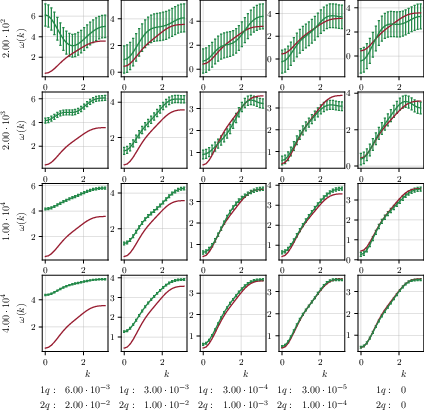
Figure 2: Interplay between shot noise and depolarization noise when computing the dispersion curve, using noisy simulation, for a TFIM chain at J/h=0.8 obtained by NLCE with Nmax.
A strong claim made is that for current QPU error rates, VQE circuits can provide expectation values for which the non-linear processing remains stable and useful, while ASP circuits exceed present-day error thresholds—requiring hardware error rates to be reduced by up to two orders of magnitude for reliable application in this framework.
Numerical Results and Hardware Validation
Experimental data are provided for various regimes of the TFIM in 1D, including at and away from the quantum critical point, with and without longitudinal field, and for quasi-1D ladder geometries. Hardware runs on a 20-qubit trapped-ion AQT device are directly benchmarked against exact diagonalization, analytic solutions, and both noiseless and noisy statevector simulations.
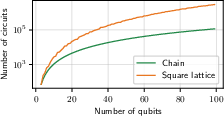
Figure 4: Number of unique circuits to compute the full NLCE+QA scheme, for the pure TFIM model on the chain and on the square lattice (using rectangular expansion for NLCE).
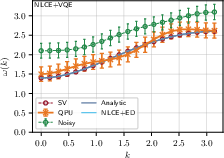
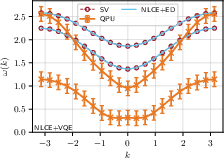
Figure 1: 1QP Dispersion for the one-dimensional TFIM chain in the thermodynamic limit for J/h=0.3.
Dispersion curves extracted from QPU data using the VQE+NLCE+PCAT pipeline closely track analytic or exact diagonalization results for moderate J/h values and sufficiently far from the phase transition, affirming the viability of the approach in these regimes. Notably, experimental results sometimes outperform error models based on conservative depolarization rate estimates, hinting at either underestimation in modeling or hardware-specific improvements.
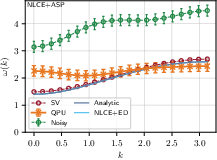
Figure 3: 1QP dispersion for the one-dimensional TFIM model in the thermodynamic limit at J/h=0.3, obtained with NLCE+ASP.
In the context of ASP, circuits at contemporary noise rates do not yield experimentally useful dispersions, but noisy simulations indicate that error rates decreased by 10×–100× would render ASP practical, as anticipated for future hardware generations.
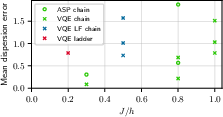
Mean error analyses across parameter sweeps—summarizing multiple experimental runs—reveal a clear increase in dispersion error as the system approaches quantum criticality or when transitioning to the less symmetric TFIM+LF model (with broken Z2 symmetry). The NLCE+PCAT correction for symmetry-broken systems is present but not observable at current sampling budgets due to subdominant magnitude compared to shot noise.
Figure 5: Mean dispersion error, O~0 averaged over O~1, as a function of O~2.
Scalability, Circuit Complexity, and Computational Implications
A detailed enumeration of required unique circuits as a function of cluster size demonstrates that the approach remains polynomial in system size for 1D and quasi-1D geometries and, while challenging, is tractable in higher dimensions on the algorithmic side. However, current per-circuit sampling rates and throughput impose practical limitations for larger system exploration, particularly in 2D and beyond.
Figure 6: 1QP dispersion of the quasi one-dimensional TFIM ladder in the thermodynamic limit at O~3.
Implications, Limitations, and Prospects
The technical results in this work justify the claim that hybrid quantum-classical approaches using NLCE+VQE+PCAT and efficient low-depth overlap estimation can deliver thermodynamic-limit quasiparticle spectra for paradigmatic models on state-of-the-art QPUs, within well-defined noise and circuit complexity regimes. This represents a clear advance in the practical deployment of quantum simulation for many-body condensed matter problems and shows that non-linear classical post-processing can be meaningfully paired with current quantum hardware in the cluster-expansion context.
The work also provides a cautionary outlook: error amplification inherent to matrix inversion/square root operations in PCAT or similar frameworks poses a fundamental limitation imposed by hardware noise, computational budget, and algorithmic structure. Approaches relying purely on linear functions of hardware expectation values evade some aspects of this sensitivity, but at the cost of losing the convergence and additivity properties essential for NLCE.
Future directions include leveraging hardware parallelism and algorithmic advances for circuit reuse and error mitigation, integration with error syndromes and noise learning, and ultimately extending this hybrid paradigm to models intractable for classical solvers—an objective that will heavily depend on further improvements in QPU fidelity, qubit number, and sampling efficiency.
Conclusion
This paper demonstrates a rigorous methodology for extracting thermodynamic-limit 1QP dispersions on trapped-ion QPUs, employing NLCE with block-diagonalization and PCAT non-linear post-processing. It provides both a practical and conceptual analysis of the interplay between quantum hardware limitations, non-linear classical post-processing, and the systematics of cluster expansions in quantum simulation. Numerical findings establish the capabilities and current boundaries of such hybrid quantum-classical computational pipelines for non-trivial quantum matter models, and map out clear milestones for hardware and algorithmic developments to enable quantum advantage for simulation of correlated many-body systems.
“Emergent Mind helps me see which AI papers have caught fire online.”
Philip
Creator, AI Explained on YouTube
Sign up for free to explore the frontiers of research
Discover trending papers, chat with arXiv, and track the latest research shaping the future of science and technology.Discover trending papers, chat with arXiv, and more.