- The paper establishes a framework for analyzing perturbative dynamics and relativistic effects of dyonic charges under Lorentz violation.
- It details key impacts on gravitational Doppler shifts, tidal force reversals, and effective potentials, highlighting boosted damping with increased Lorentz violation.
- Numerical analysis of quasinormal spectra provides constraints on Lorentz-violating parameters via observable signatures like redshift, time delay, and ringdown behavior.
Perturbative Dynamics and Relativistic Effects of a Dyonic Kalb-Ramond Black Hole
Overview and Theoretical Construction
The paper systematically analyzes the perturbative and relativistic properties of a dyonic Kalb-Ramond black hole, formulated in a Lorentz-violating gravitational theory where the background is sourced by an antisymmetric tensor field. The metric contains four physical parameters: mass (M), electric charge (Q), magnetic charge (p), and a Lorentz-violating parameter (ℓ). The charge sector contributes through an effective combination Pℓ2=Q2/(1−ℓ)2+p2/(1−2ℓ), encapsulating both electromagnetic charges weighted by Lorentz violation.
The black hole solution reduces to familiar cases under appropriate limits: Reissner-Nordström (ℓ→0), purely electric or magnetic Kalb-Ramond (p=0 or Q=0), or the uncharged case (Q=p=0). The study is framed within the context of spontaneous Lorentz symmetry breaking, motivated by both string theory and effective gravitational models.
Doppler Effect in Dyonic Lorentz-Violating Spacetime
The relativistic frequency shifts for signals exchanged between freely falling and static observers are explicitly calculated. For infall from spatial infinity, the exterior observer measures the emitter to reach the speed of light at the horizon, yielding an infinite redshift in outgoing signals. Signals from static observers to infalling observers result in a finite ratio, ωff/ωb→1/2 at the horizon.
The role of dyonic charges is nontrivial: as Q0 increases, Q1 augments, shifting the frequency ratio closer to unity and thus lessening the gravitational redshift (Figure 1).
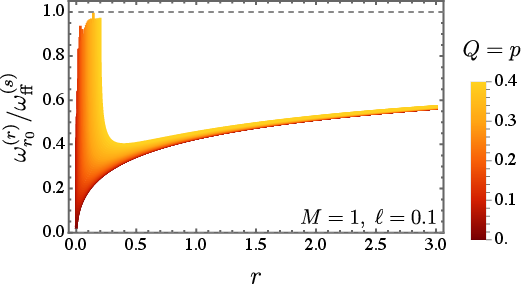
Figure 1: Radial behavior of the gravitational Doppler frequency ratio Q2 for varying dyonic charge, illustrating redshift attenuation as Q3 increases.
Tidal Forces and Structural Reversals
The tidal force analysis reveals characteristic radii where the sign of radial or angular tidal acceleration flips, departing from the standard Schwarzschild pattern. The radial tidal force transitions from stretching to compression at Q4, while the angular tidal component becomes zero at Q5. Both radii shift outward as either charge parameter increases, and the Lorentz-violating factor Q6 further amplifies these effects due to the differential weighting of Q7 and Q8 in Q9.
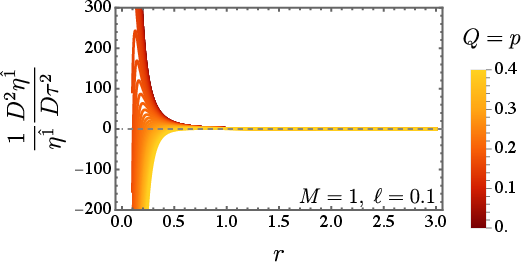
Figure 2: Radial tidal force profile for various dyonic charges, showing stretching-to-compression transition as p0 rises (p1, p2).
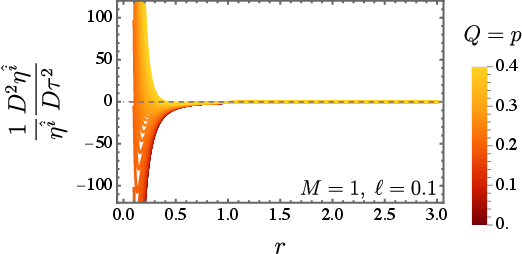
Figure 3: Angular tidal force for different dyonic charges (p3), identifying the radius where compression turns into stretching.
The horizon structure and tidal radii dependencies are mapped against normalized charges in both electric and magnetic sectors, demonstrating the impact of Lorentz violation and charge on the position and hierarchy of characteristic radii (Figure 4).
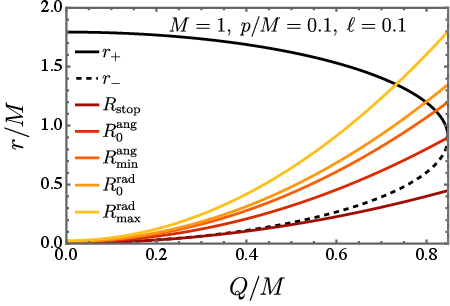
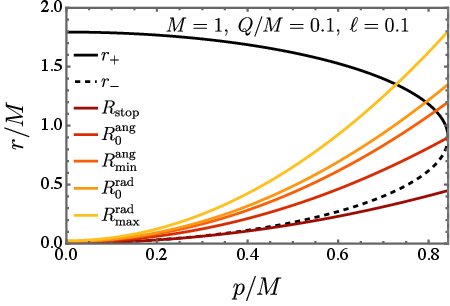
Figure 4: Horizon and tidal radii as functions of charge parameters, with extremal limits marked.
Gravitational Time Delay
Photon time delay in the curved background is computed, subtracting the baseline flat-space result. Both electric and magnetic charge sectors systematically reduce the delay relative to neutral or less charged configurations. Lorentz violation modulates this effect through its weighting of the electromagnetic sector. The charge-induced variation is highlighted by plotting the shifted time delay against p4 and p5 (Figure 5).
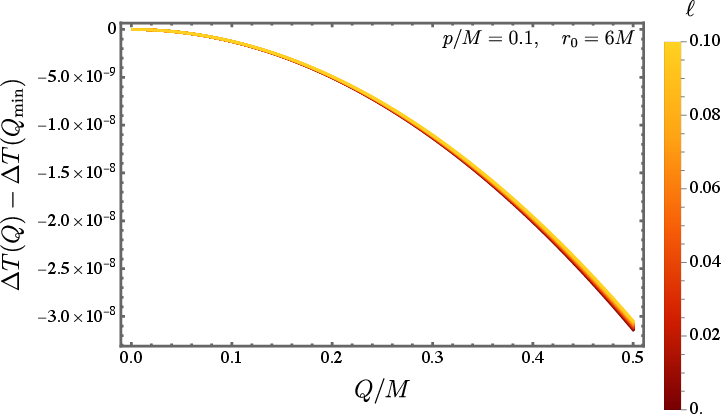
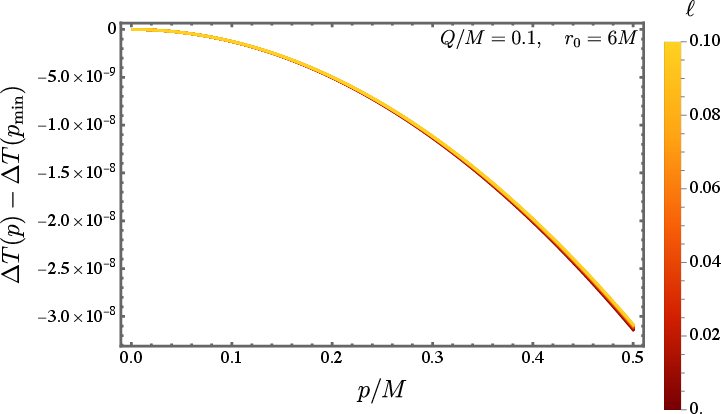
Figure 5: Shifted time delay as a function of normalized electric (top) and magnetic (bottom) charges; higher charge reduces delay.
Perturbations, Effective Potentials, and Quasinormal Spectra
Perturbative dynamics for scalar, vector, tensor, and spinor fields are constructed, with explicit radial effective potentials derived for each spin sector. All inspected cases exhibit a single potential barrier, indicating standard black hole ringdown behavior without echoes or cavity resonances.
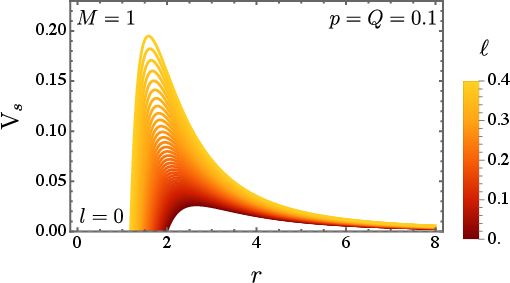
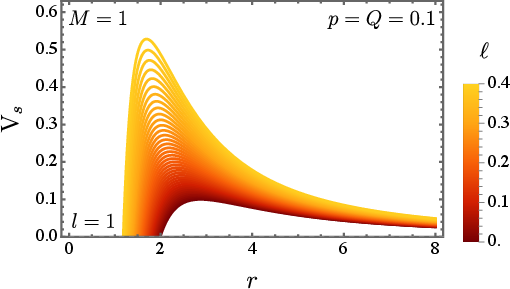
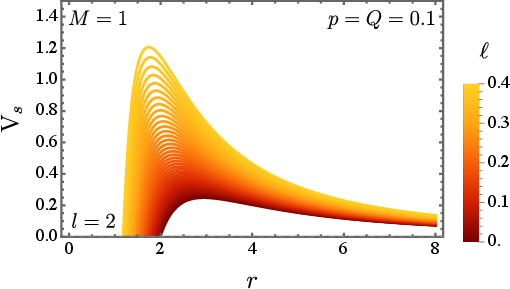
Figure 6: Scalar effective potential p6 for different p7, demonstrating barrier height enhancement.
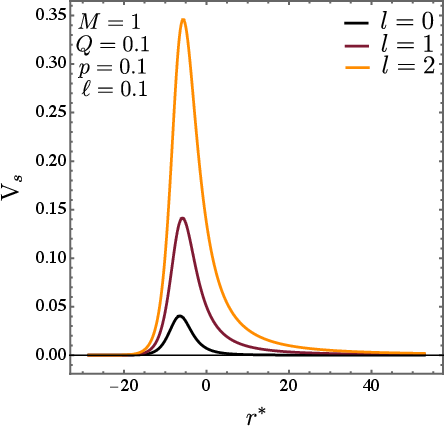
Figure 7: Scalar effective potential in tortoise coordinates; single-peak structure for p8.
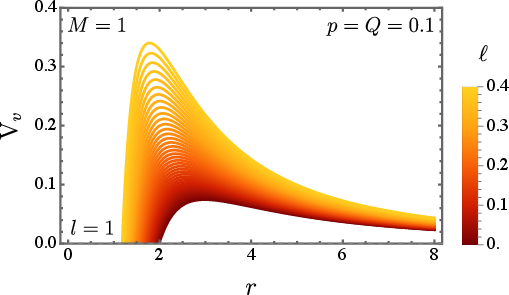
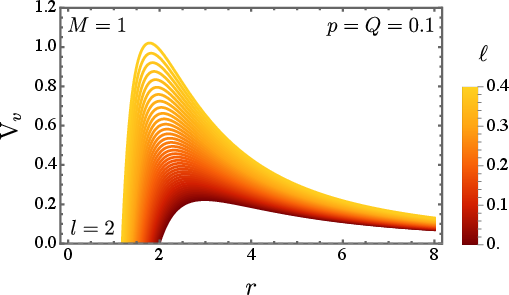
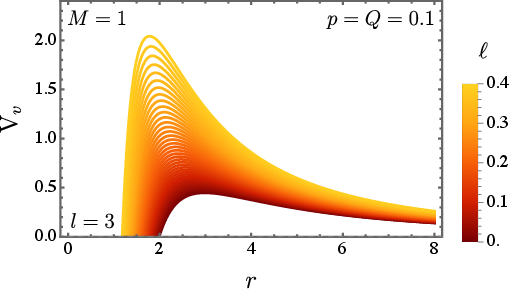
Figure 8: Vector effective potential p9 across ℓ0 and ℓ1 values.
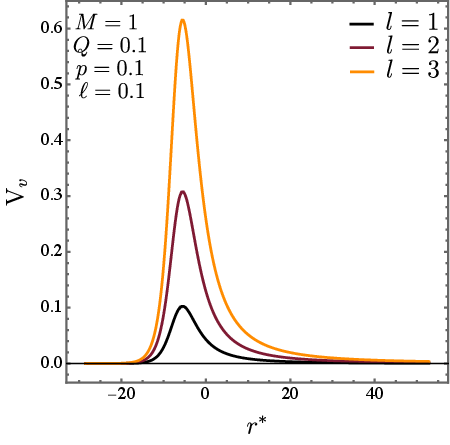
Figure 9: Vector potential in tortoise coordinates; potential barrier increases with ℓ2.
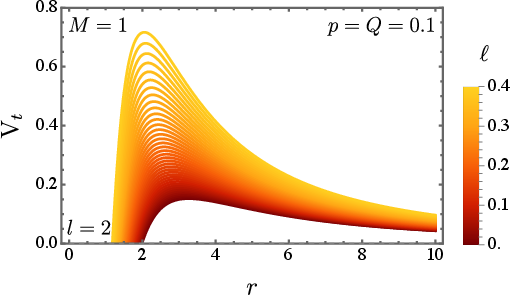
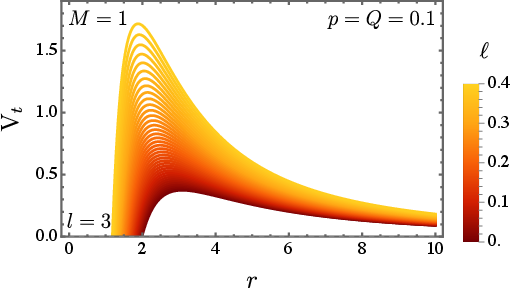
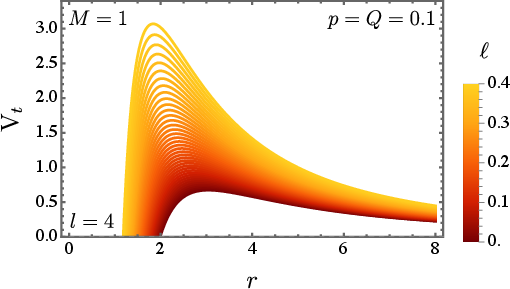
Figure 10: Tensor effective potential ℓ3 for several multipoles and Lorentz violation.
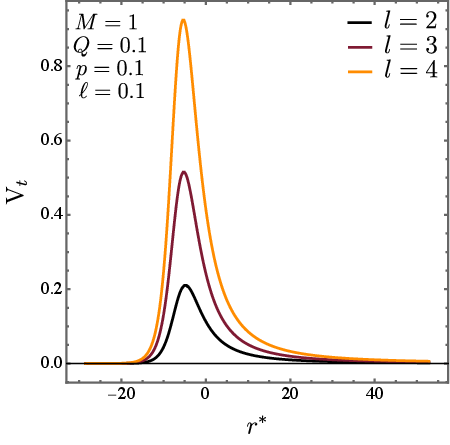
Figure 11: Tensor potential in tortoise coordinates; single maximum for each multipole.
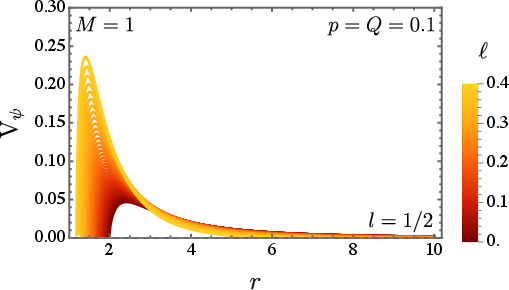
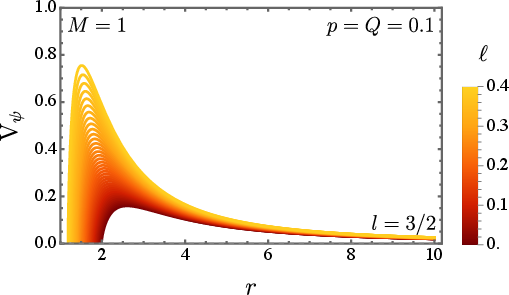
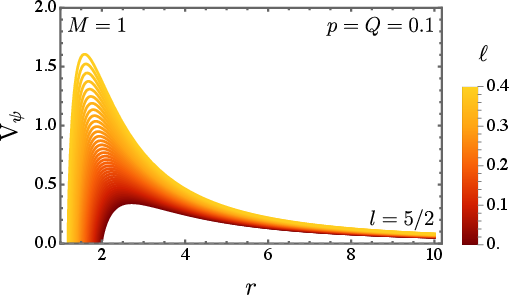
Figure 12: Spinor effective potential ℓ4 for various angular modes and ℓ5.
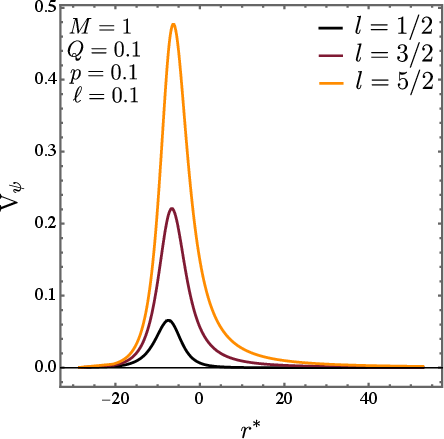
Figure 13: Spinor potential in tortoise coordinates; single-peak structure confirmed.
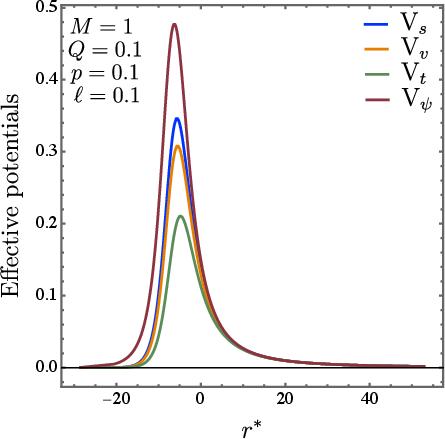
Figure 14: Comparison of potentials for all spin sectors, demonstrating ℓ6.
This structural result precludes the presence of echo signals in the time-domain evolution.
Quasinormal modes are extracted via the sixth-order WKB approximation. Strong numerical results include:
- Lorentz-violating parameter ℓ7 gives the dominant correction: increasing ℓ8 accelerates oscillatory frequency and steepens damping; the impact is more pronounced than that from varying ℓ9 or Pℓ2=Q2/(1−ℓ)2+p2/(1−2ℓ)0.
- Charge-induced corrections are moderate: the spectra shift only mildly with increasing Pℓ2=Q2/(1−ℓ)2+p2/(1−2ℓ)1, Pℓ2=Q2/(1−ℓ)2+p2/(1−2ℓ)2, or both, except for higher multipoles where the effect becomes notable.
- The fundamental modes always have the slowest damping and largest real part within each sector; overtones fade rapidly and contribute primarily in the post-merger phase.
Time-Domain Evolution of Perturbative Sectors
Waveforms evolved numerically for all spin sectors show damped quasinormal ringing, followed by power-law tails, consistent with standard expectations. Lorentz violation shortens the signal lifetime by enhancing damping.
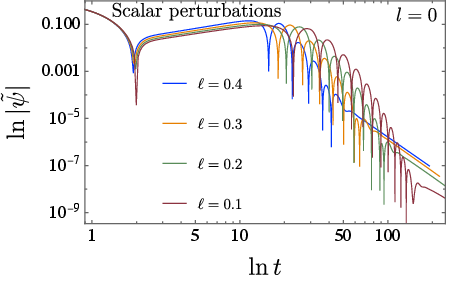
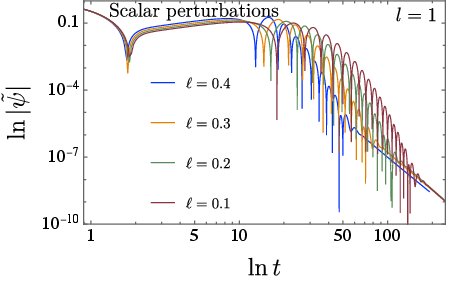
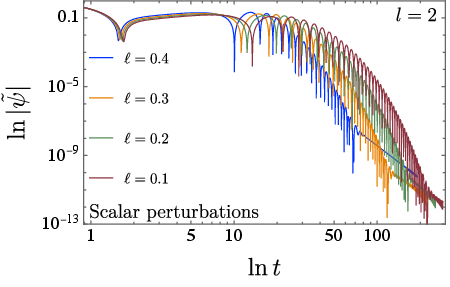
Figure 15: Scalar time-domain response Pℓ2=Q2/(1−ℓ)2+p2/(1−2ℓ)3 for varying Pℓ2=Q2/(1−ℓ)2+p2/(1−2ℓ)4; ringdown accelerates and decays more rapidly as Pℓ2=Q2/(1−ℓ)2+p2/(1−2ℓ)5 rises.
Figure 16: Logarithmic amplitude of scalar signal; increasing Pℓ2=Q2/(1−ℓ)2+p2/(1−2ℓ)6 steepens decay slope.
Figure 17: Late-time scalar tail response in log-log coordinates, showing power-law regime.
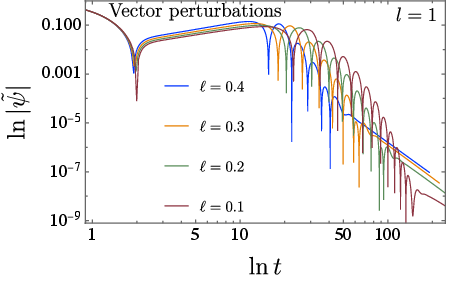
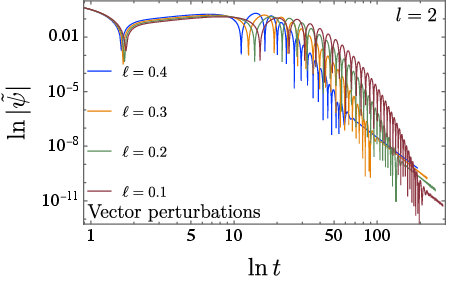
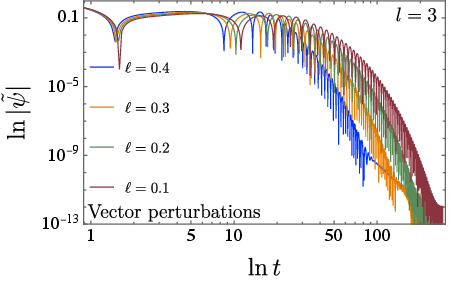
Figure 18: Vector time-domain waveforms for multiple multipoles and Pℓ2=Q2/(1−ℓ)2+p2/(1−2ℓ)7 values; damping and oscillation rate are both enhanced by Pℓ2=Q2/(1−ℓ)2+p2/(1−2ℓ)8.
Figure 19: Logarithmic vector amplitude profiles, with multipole dependence.
Figure 20: Asymptotic vector signals on log-log plots; tail characteristics are evident.
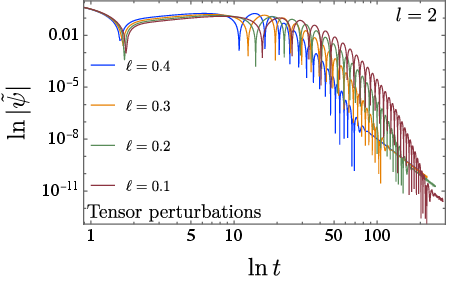
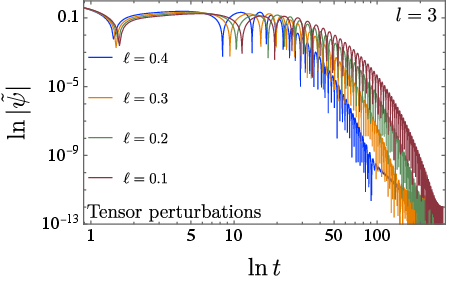
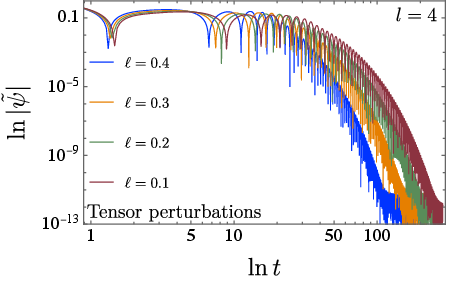
Figure 21: Tensor perturbation time-domain profiles across multipole sectors, showing longer-lived signals relative to scalar and vector.
Figure 22: Logarithmic attenuation profiles for tensor waveforms; Pℓ2=Q2/(1−ℓ)2+p2/(1−2ℓ)9 dependence emphasized.
Figure 23: Tensor tails in log-log form; algebraic decay confirmed.
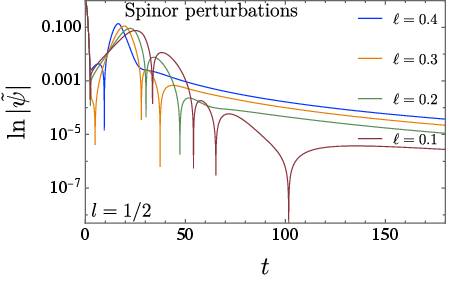
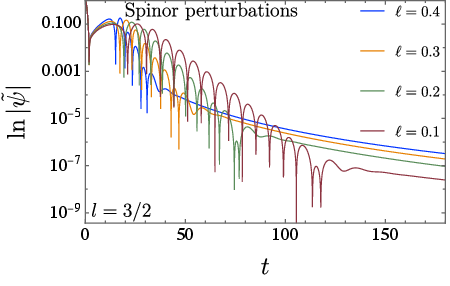
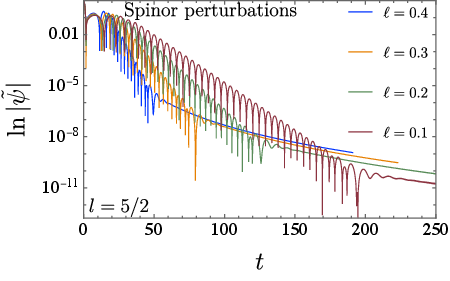
Figure 24: Spinor time-domain response; oscillation and decay rate modulated by ℓ→00 and multipole.
Figure 25: Logarithmic amplitude profile for spinor perturbations; damping rate accelerates with growing ℓ→01.
Implications and Future Directions
The results rigorously quantify how Lorentz violation via a Kalb-Ramond background modifies both static and dynamical properties of charged black holes. Practically, the frequency shift, tidal response, and time delay can constrain Lorentz-violating parameters by cross-comparison with observational data from gravitational waves and black hole imaging (e.g., EHT shadows, LIGO/VIRGO ringdown). The single-barrier structure of the effective potentials suggests that standard ringdown templates remain applicable for these spacetimes, but the enhanced damping and shifted frequencies must be incorporated for accurate model fitting.
Theoretical implications include:
- Lorentz violation introduces non-universal weights to electromagnetic charges (electric vs. magnetic), affecting horizon, tidal, and wave properties distinctly.
- All perturbative sectors display robust Lorentz violation sensitivity, with scalar, vector, tensor, and spinor modes manifesting faster oscillations and stronger attenuation as ℓ→02 increases.
Future research avenues involve gravitational lensing (weak/strong deflection), greybody factors, Hawking particle creation, neutrino propagation, and accretion phenomena, leveraging these results to extend phenomenological bounds on Lorentz-violating parameters.
Conclusion
This paper establishes a thorough framework for analyzing the relativistic, tidal, and perturbative properties of dyonic Kalb-Ramond black holes in Lorentz-violating gravity. The dominant effect of Lorentz violation on spectra and dynamical observables stands out, supplemented by moderate charge-induced shifts. The analysis indicates that observational probes of such compact objects can access Lorentz violation signatures via frequency, damping, tidal force hierarchy, and time delay. Echoes and nonstandard cavity-induced signals are ruled out for the examined parameter regime. Extensions to lensing, particle creation, and accretion processes are anticipated to further increase the scope of these results and their relevance for strong-field gravity tests.

