- The paper presents an analytic and numerical study of effective potentials and ISCO shifts in Kalb-Ramond black holes with nonlinear electrodynamics.
- It demonstrates that increased magnetic charge and Lorentz-violating parameters shrink the photon sphere and shadow radius, aligning with EHT observations.
- The study finds that enhanced gravitational binding and modified Hawking sparsity suggest observable deviations in quasinormal modes and thermal emissions.
Particle Dynamics and Optical Signatures of Kalb-Ramond Black Holes Coupled to Nonlinear Electrodynamics
Introduction and Theoretical Framework
The paper addresses the static, spherically symmetric black hole solution sourced by a Kalb-Ramond (KR) field coupled to nonlinear electrodynamics (NED), with parameters M (mass), q (magnetic monopole charge), and Lorentz-violating coefficients (γ,λ). The KR field (a rank-two antisymmetric tensor field) arises naturally in low-energy string theory formulations and induces spontaneous Lorentz symmetry breaking via non-minimal curvature coupling. The metric recovers known cases: Schwarzschild as q,γ→0, Hayward for γ,λ→0, and a Reissner-Nordström-type configuration (with γ as Lorentz-violating hair) at q=0, λ=1.
The NED sector regularizes electromagnetic field singularities and introduces quantum corrections. Previous work constrains the resulting black hole solutions by demanding physical energy conditions and asymptotic flatness, restricting λ and γ to physically meaningful domains. Analytical treatment is achieved for the geodesic equations, effective potentials, ISCO conditions, shadow radius, and Hawking sparsity parameters.
Massive Particle Dynamics and ISCO Structure
The full Lagrangian dynamics yield closed-form expressions for the effective potential, specific energy, and angular momentum for timelike particles. Stable and unstable circular orbits are distinguished by the curvature properties of q0. Deepening of the potential well is found for increasing q1 and q2, signifying stronger effective gravitational interaction.
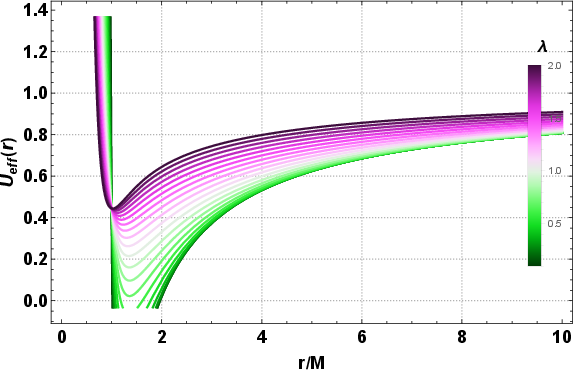
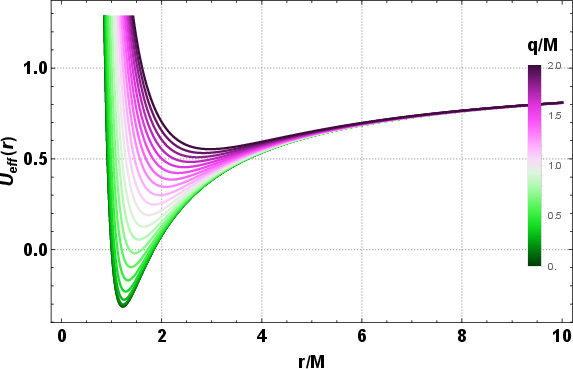
Figure 1: The dependence of effective potential q3 on radial coordinates q4 for varying q5 and q6, showing enhanced gravitational binding with increasing parameters.
The specific energy and angular momentum in circular motion decrease with larger q7 and q8, indicating inward shifts of the ISCO and less energetic requirements for stable orbits.
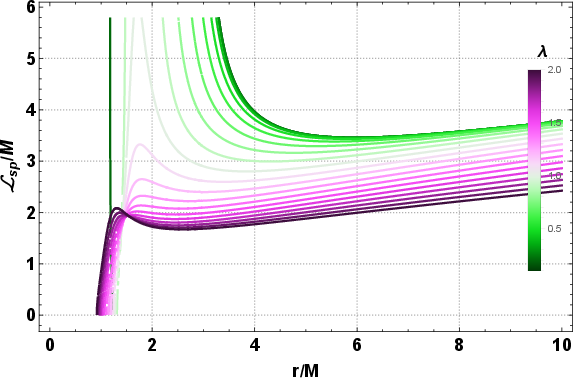
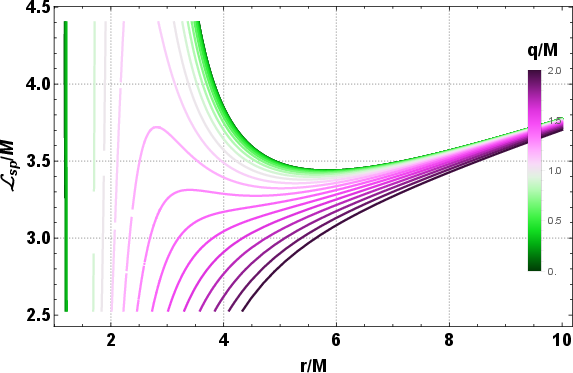
Figure 2: The dependence of the specific angular momentum q9 on the radial coordinate for varying (γ,λ)0 and (γ,λ)1.
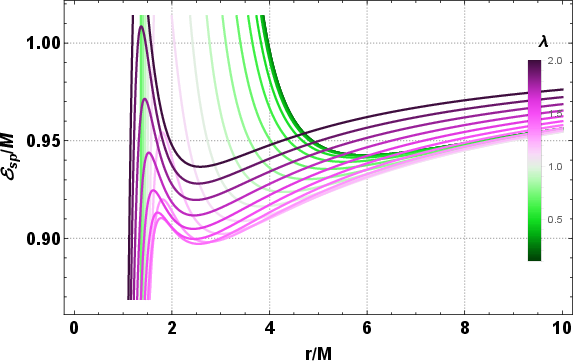
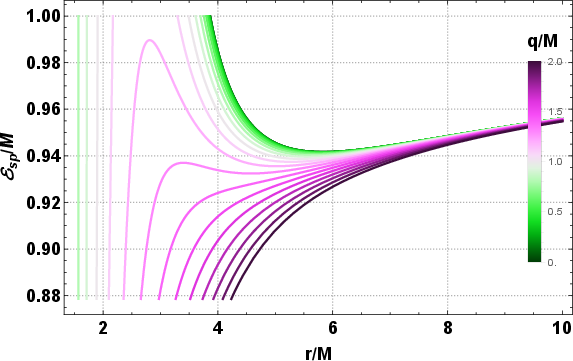
Figure 3: The dependence of the specific energy (γ,λ)2 on the radial coordinate for varying (γ,λ)3 and (γ,λ)4.
Numerical solutions corroborate the analytic ISCO reduction from the Schwarzschild value (γ,λ)5 as (γ,λ)6 or (γ,λ)7 increase. The ISCO radius dependence on black hole parameters is provided, showing that larger magnetic charge and Lorentz-breaking enhance orbital frequency and further shrink stable orbital domains.
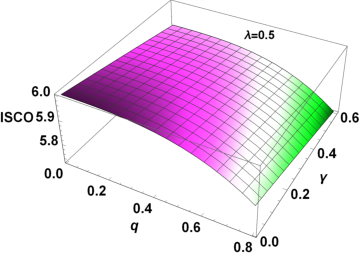
Figure 4: Behavior of the ISCO radius for multiple (γ,λ)8 values, displaying strong (γ,λ)9 dependence and moderate q,γ→00 influence.
Orbital velocity profiles demonstrate weakening with higher q,γ→01 and strengthening with higher q,γ→02.
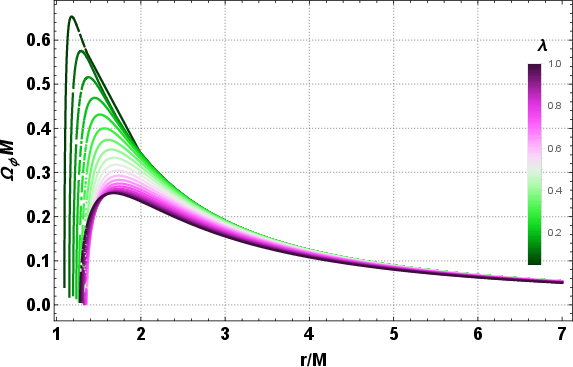
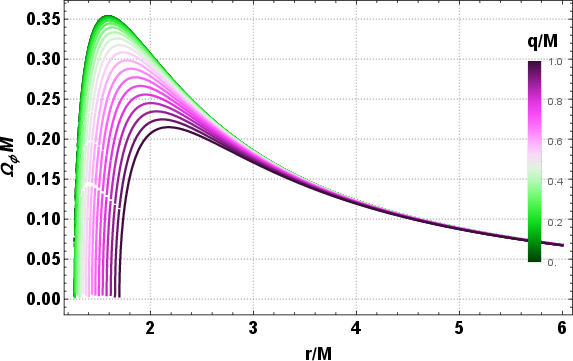
Figure 5: The dependence of the orbital velocity q,γ→03 on radial coordinate for varying q,γ→04 and q,γ→05.
Null Geodesics, Photon Sphere, and Shadow Radius
Null geodesic structure is addressed with explicit effective potential calculations and stability analysis. The photon sphere location and critical impact parameter, which determine the observable black hole shadow, depend strongly on both q,γ→06 and q,γ→07. Enhanced spacetime curvature effects for photons due to KR and NED induce smaller photon sphere radii and shadow sizes compared to Schwarzschild.
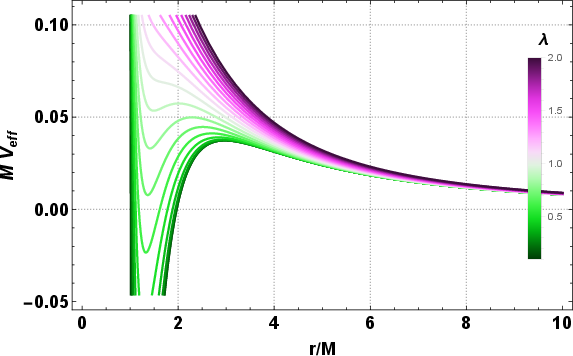
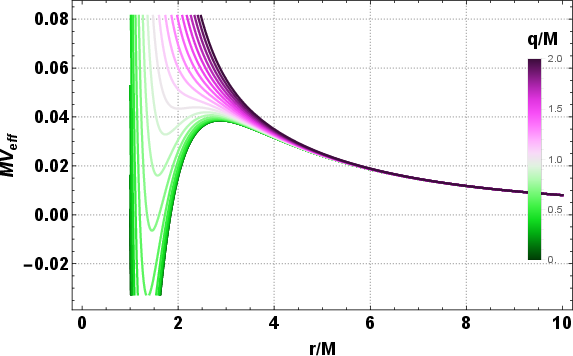
Figure 6: The dependence of the effective potential q,γ→08 on the radial coordinate for photons for varying q,γ→09 and γ,λ→00.
Numerical evaluation across parameter space shows compatibility with Event Horizon Telescope (EHT) shadow measurements for M87γ,λ→01 and Sgr~Aγ,λ→02 within conservative γ,λ→03 bounds, except for large values of γ,λ→04 and γ,λ→05, where restrictions tighten, especially for Sgr~Aγ,λ→06.
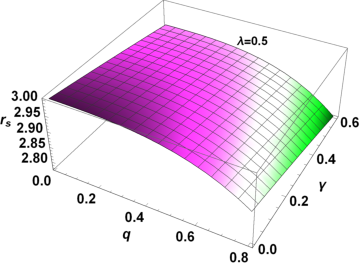
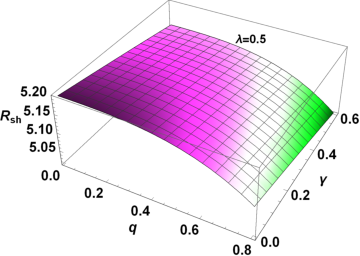
Figure 7: Behavior of the photon sphere γ,λ→07 and shadow radius γ,λ→08 for multiple γ,λ→09 settings.
Stability, Force Profiles, and Eikonal QNMs
The radial force experienced by photons, as well as Lyapunov exponent calculations, quantify orbit instability. Larger γ0 and γ1 raise the effective force, deepening binding, while simultaneously reducing Lyapunov exponents, thus increasing instability timescales for null orbits.
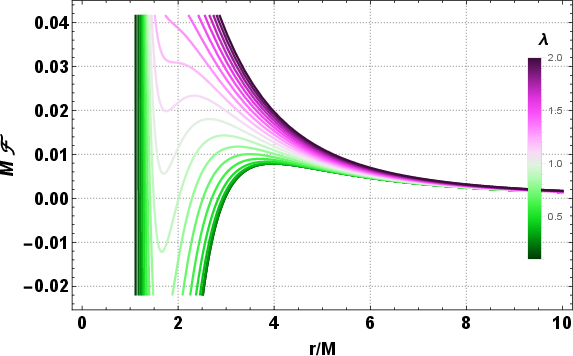
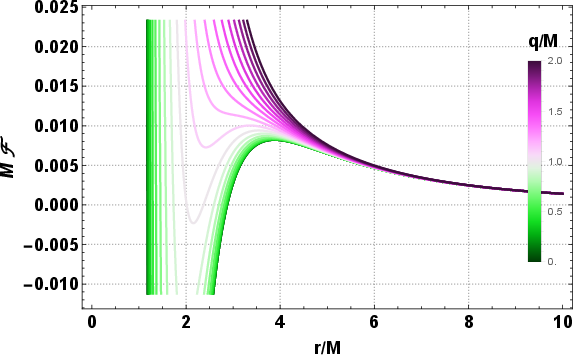
Figure 8: The dependence of the effective force γ2 on radial coordinate for photons for varying γ3 and γ4.
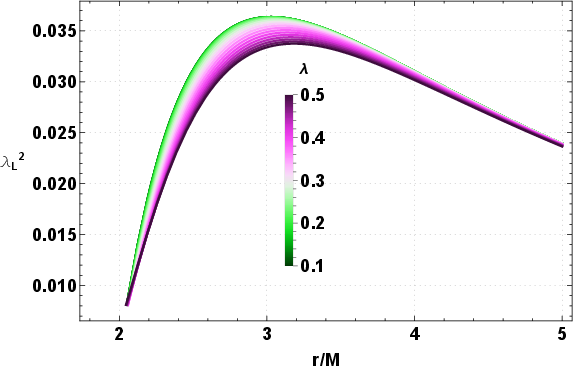
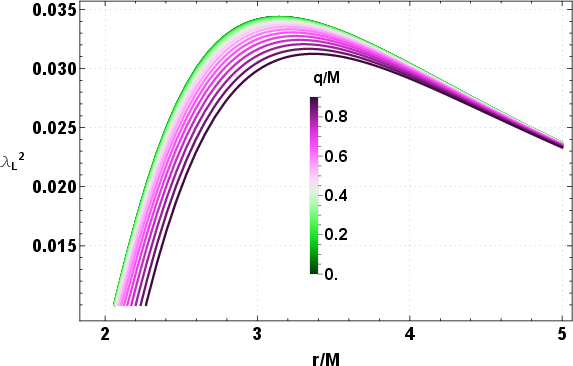
Figure 9: The dependence of the squared Lyapunov exponent γ5 for varying γ6 and γ7, showing the regime of maximal instability.
Eikonal quasinormal mode frequencies, relevant for gravitational wave detection, are computed in terms of the photon sphere properties and instability rates. The real part of the frequencies increases and damping decreases with larger γ8 and γ9, suggesting observable deviations for future detectors.
Photon Trajectories
The explicit orbit equation for null geodesics is derived and numerically integrated, confirming significant changes in photon trajectory morphology as q=00 and q=01 vary, directly linking KR field properties to observable lensing and shadow features.
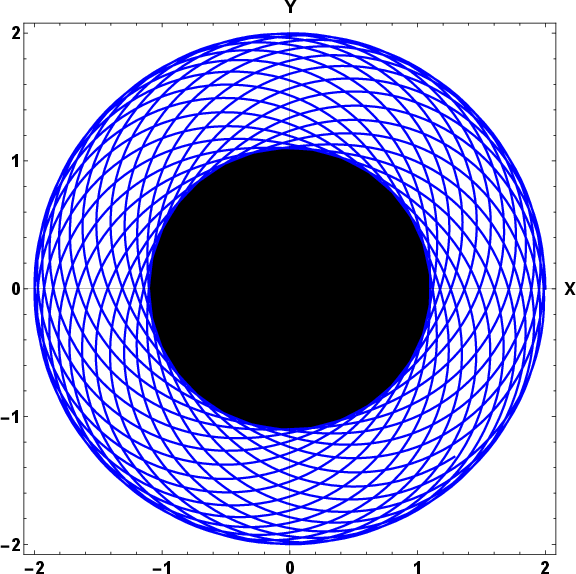
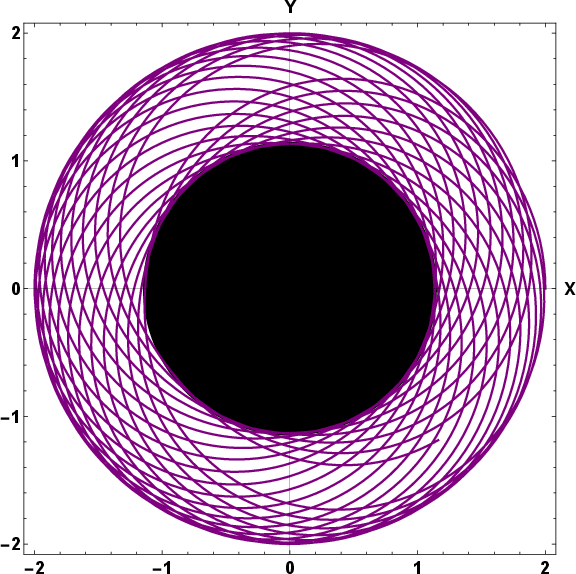
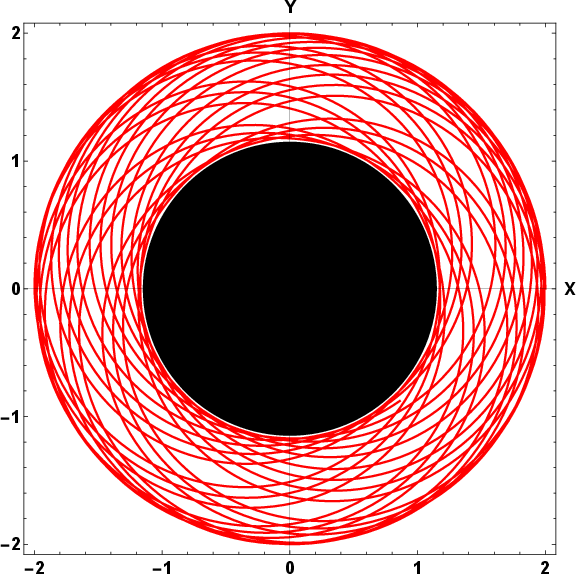
Figure 10: Parametric plots of photon trajectories for different values of q=02 (with fixed q=03 and q=04), illustrating strong dependence on KR field parameter.
Hawking Temperature and Gray–Visser Sparsity
Hawking temperature and horizon area are found to decrease with increasing q=05 and q=06, while the Gray–Visser sparsity parameter q=07 increases substantially (from the Schwarzschild benchmark of q=08 to nearly q=09), leading to an even sparser Hawking cascade. The thermal emission becomes increasingly separated in time, with cooling effects dominated by both the magnetic monopole and Lorentz violation.
Conclusion
The analytic and numerical exploration of a Kalb-Ramond black hole coupled to nonlinear electrodynamics demonstrates significant modifications to both particle dynamics and optical features. The combined effect of magnetic monopole charge and KR-induced Lorentz violation induce inward ISCO migration, reduced shadow radius, and enhanced sparsity of Hawking radiation. All shadow predictions remain viable in the EHT strong-field regime, with model constraints emerging for high values of λ=10 and λ=11.
Theoretical implications include the identification of observable deviations in gravitational wave quasinormal modes, increased sparsity in Hawking emissions, and distinct photon lensing profiles. Practically, the model delivers robust parameter ranges compatible with direct imaging and gravitational wave data. Future directions naturally include rotation (via Newman–Janis construction), comprehensive greybody factor computation, and full time-domain QNM analysis, targeting signal discrimination in upcoming experiments and further elucidation of quantum gravity phenomenology.

