CAREF: Calibration-Aware Regularization for Explanation Faithfulness Without Rationale Supervision
Published 27 May 2026 in cs.LG and cs.CL | (2605.27835v1)
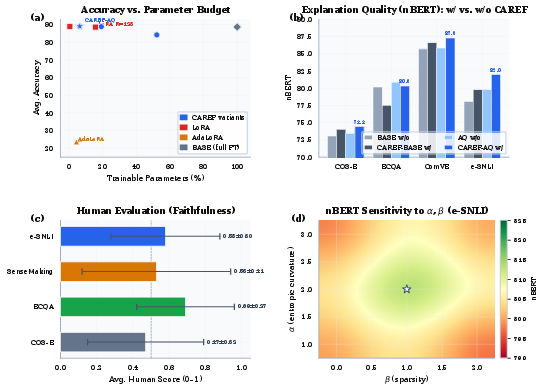
Abstract: We introduce CAREF, a parameter-efficient fine-tuning framework that jointly optimizes predictive accuracy and explanation faithfulness via calibration-aware regularization. At its core, CAREF couples entropy-based calibration with token-level sparsity control through a single unified loss, the Calibration-Aware Regularization for Explanation Faithfulness (LSCED), without requiring rationale supervision. Evaluated on four NLE benchmarks (COS-E, ECQA, ComVE, e-SNLI) with Flan-T5, our lightweight CAREF-AQ variant attains the best average accuracy (89.04) and explanation alignment (81.00 nBERT) using only 6.43% of trainable parameters, outperforming LoRA and AdaLoRA. To our knowledge, CAREF is the first method to unify entropy and sparsity regularization in a single training objective for interpretable LLM fine-tuning.
The paper introduces a novel training objective that combines cross-entropy with calibration and sparsity regularization to enhance natural language explanation faithfulness.
It achieves superior task accuracy and explanation quality, with CAREF-AQ reaching 89.04% accuracy and 81.00 nBERT explanation quality using less than 7% trainable parameters.
The architecture-neutral approach enables adaptable integration across various model architectures, streamlining faithful model reasoning and decision-relevant outputs.
Calibration-Aware Regularization for Explanation Faithfulness Without Rationale Supervision
Introduction
The paper introduces CAREF, a parameter-efficient fine-tuning (PEFT) framework that explicitly targets faithful and causally-grounded natural language explanations (NLEs) in large pre-trained LLMs without relying on rationale supervision. Instead of standard post-hoc rationalization or supervision-intensive rationale annotation approaches, CAREF formulates a calibration- and sparsity-aware training objective operating purely at the predictive distribution level. This approach aims to directly constrain the statistical structure of LLM outputs, encouraging both accurate predictions and faithful, decision-relevant explanations. The method offers adaptable integration across model architectures and fine-tuning paradigms, with a focus on low-resource and limited-parameter settings.
Figure 1: CAREF summary: (a) accuracy vs. trainable parameter budget; (b) nBERT explanation quality; (c) human evaluation; (d) explanation quality sensitivity to α and β on e-SNLI.
Methodology: Calibration-Aware Regularization
Design Motivation
Prior approaches to NLE faithfulness either require token-level rationale supervision (which is expensive and dataset-specific) or are based on post-hoc attribution mechanisms that lack training-time leverage over internal model behaviors. Cross-entropy alone is agnostic to the allocation of vocabulary probability mass, creating a disconnect between task accuracy and the faithfulness or sparsity of generated explanations. CAREF addresses this with a unified regularization scheme targeting both predictive entropy (calibration) and token-level sparsity (selectivity), without architectural changes or auxiliary rationale signals.
Unified Loss: LCAREF
CAREF defines its loss as:
LCAREF=LCE+λSCED⋅LSCED+λKL⋅LKL
Where:
LCE: Standard cross-entropy loss.
LKL: KL divergence from a uniform prior, imposing global calibration.
LSCED: Sparsity-Calibrated Entropic Divergence, the central contribution:
LSCED=t∑v=1∑∣V∣Pt,vlogUvPt,vα⋅(1−Pt,v)β
with Pt,v=Pθ(yt=v∣y<t,x) and Uv=1/∣V∣.
β0 tunes the curvature of entropic penalties (superlinearly penalizing large deviations for β1).
This multiplicative coupling generalizes existing regularizers: for special cases of β3 it recovers standard KL, power-law entropic penalties, or sparsity-weighted losses. The design is agnostic to decoder variants and compatible with all major PEFT strategies, including LoRA, adapters, and prefix tuning.
Experimental Setup
Experiments were conducted on four NLE benchmarks: COS-E, ECQA, ComVE, and e-SNLI, using Flan-T5 as the base model. The evaluation followed the FEB protocol (60 splits of 48-train/350-validation samples), with task accuracy and BERTScore-normalized accuracy (nBERT) to measure explanation alignment. Baselines included full fine-tuning, LoRA at different ranks, AdaLoRA, and (IA)β4. CAREF variants (notably CAREF-AQ, which updates only query projections, and other ablations such as decoder- and key-value-only adaptation) were tested at matched or lower parameter budgets.
Results and Analysis
Across all four datasets and multiple PEFT configurations, CAREF consistently improved explanation faithfulness and task accuracy compared to baselines.
CAREF-AQ achieves the highest mean accuracy (89.04) and nBERT explanation quality (81.00) with only 6.43% of trainable parameters, surpassing both full fine-tuning and LoRA/AdaLoRA baselines. AdaLoRA in particular showed substantial drops in explanation robustness, highlighting the necessity of distributional, not just parametric, optimization for NLEs.
The quantitative improvement is robust across parameter budgets and not confined to high-resource settings.
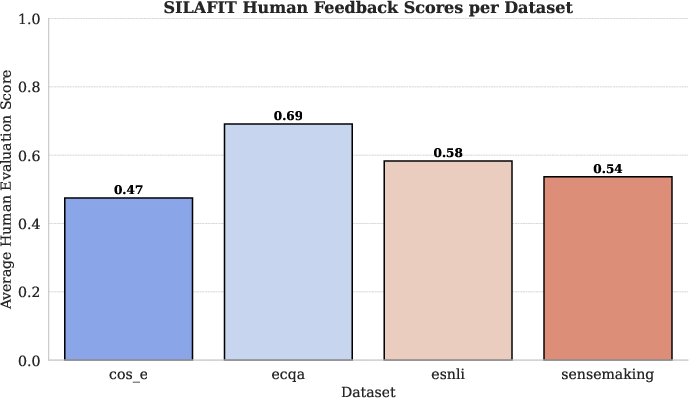
Figure 2: Human evaluation scores indicate CAREF-trained models generate more causally faithful explanations across datasets.
Human evaluation further corroborates automatic metrics, showing superior average scores for CAREF-explanations—most notably on ECQA and e-SNLI, where explanations are grounded in factually constrained or clearly defined entailment structure. Variance in human annotation was largest on SenseMaking, mirroring the inherent subjectivity of the task.
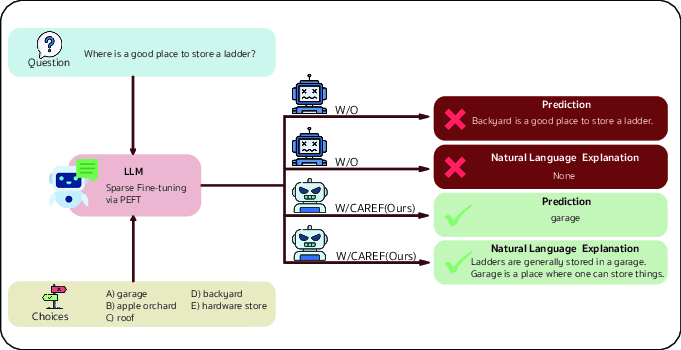
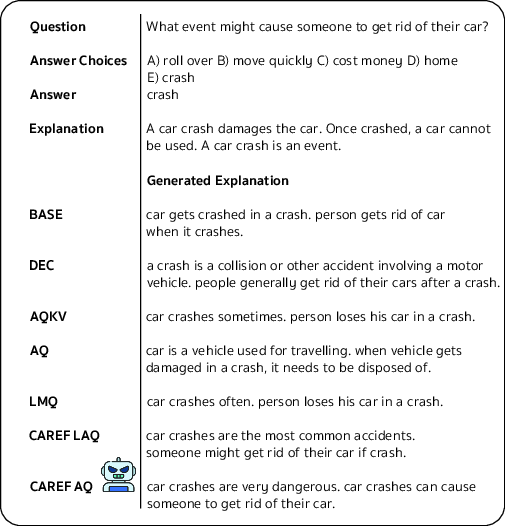
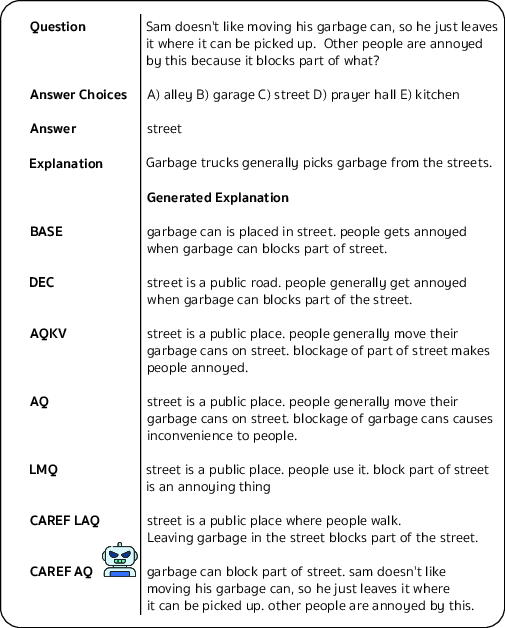
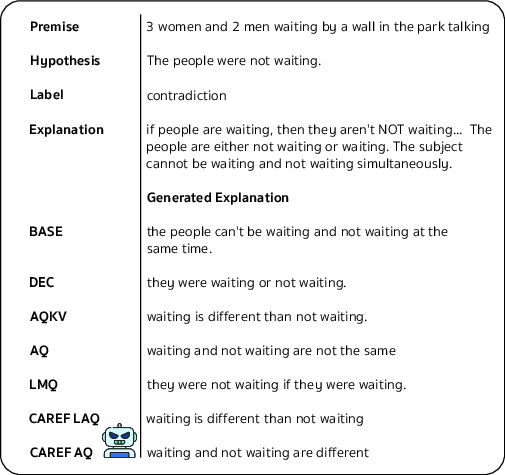
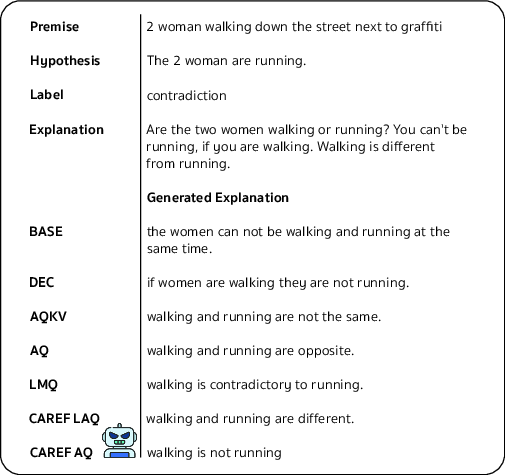
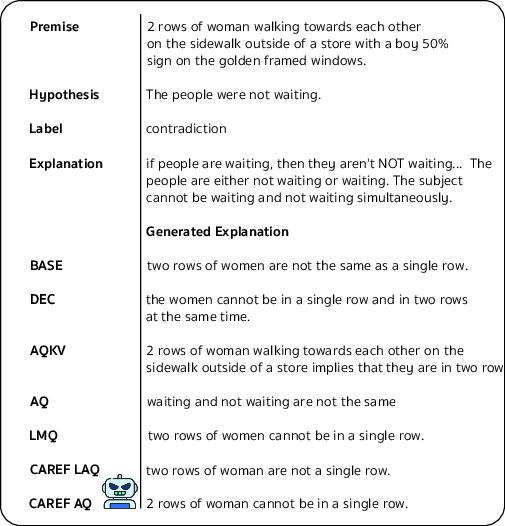
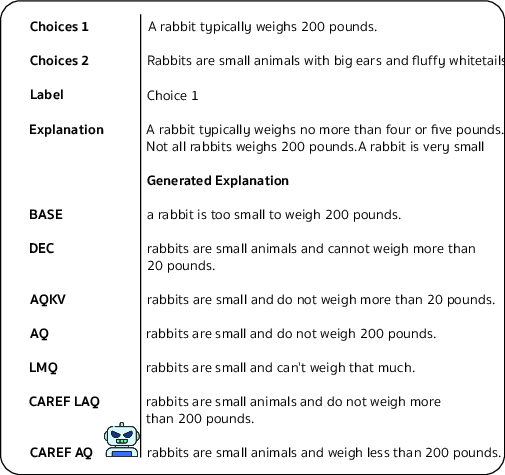
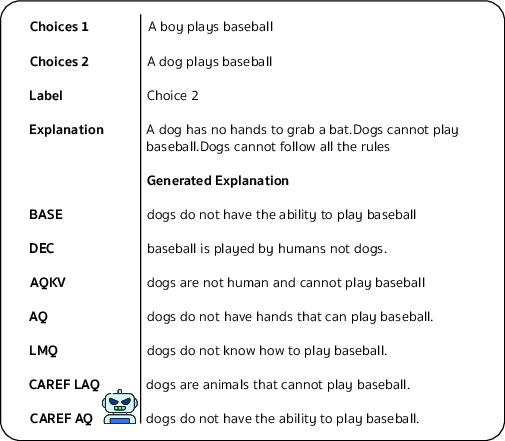
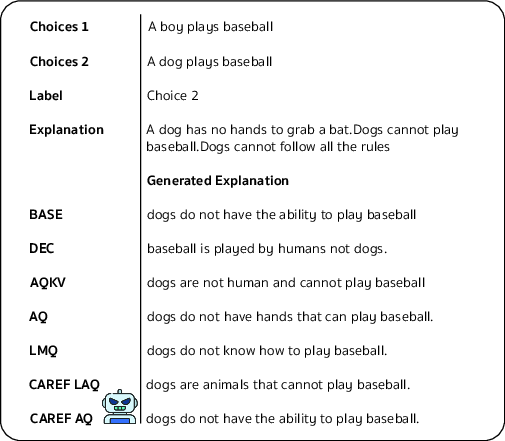
Figure 3: Qualitative example: CAREF generates a granular, grounded rationale, whereas baseline explanations are unfaithful and unsupported.
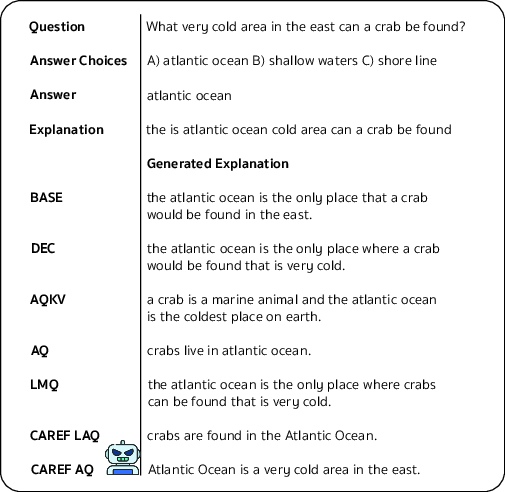
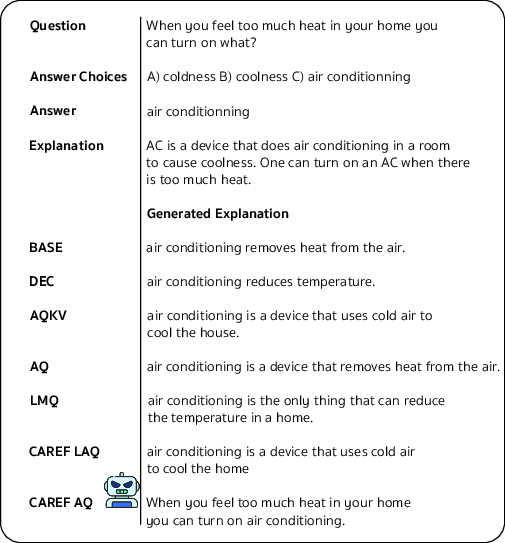
Figure 4: CAREF-AQ provides concise, factually precise explanations on COS-E relative to the baseline.
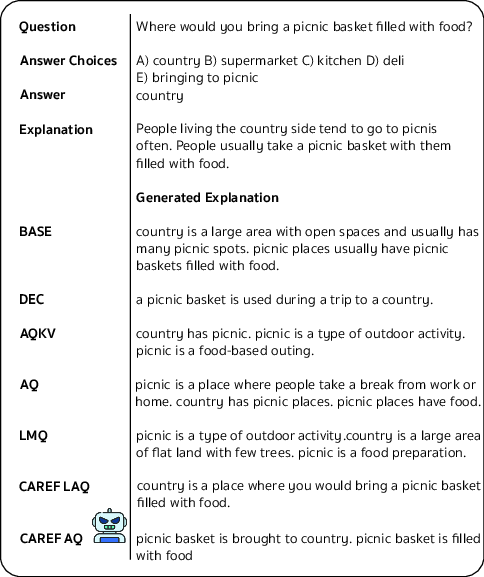
Figure 5: On ECQA, CAREF explanations exhibit improved semantic coherence, reducing redundancy compared to baseline outputs.
Figure 6: On e-SNLI, CAREF explanations directly capture contradiction, while baseline models tend to paraphrase verbosely.
Figure 7: CAREF yields richer, more commonsense-grounded rationales for SenseMaking examples relative to the baseline.
Figure 8: Side-by-side comparisons demonstrate NLE improvements with CAREF-AQ on e-SNLI and SenseMaking.
Ablation analysis demonstrates that the majority of explanation benefit derives from query-projection adaptation in conjunction with β5, confirming that full-model adaptation is unnecessary provided well-designed distributional constraints are in place.
Theoretical Implications
The main theoretical advance is the construction of a distribution-level regularizer that simultaneously induces local sparsity and global calibration, all in a fully differentiable, architecture-free, and tunable manner. This setup avoids the three major weaknesses of alternative strategies: indiscriminate flattening (entropy penalties), harmful uniform redistribution (label smoothing), and problematic non-differentiability (sparsemax/entmax). The unified framework supports a broader regularization spectrum, subsumes prior approaches as limiting cases, and guides learning toward token-selective, stable predictive distributions that better reflect model-internal decision processes.
Broader Applicability and Limitations
The architectural neutrality of β6 enables deployment across both encoder-decoder and autoregressive models (e.g., T5, BART, GPT-series) and with any PEFT protocol. While experiments focused on Flan-T5 for resource reasons, the consistent efficiency gains at <7% tunable parameters strongly indicate generalizability to larger scales and tasks. The main limitation pertains to hyperparameter sensitivity; β7 and β8 values require validation, and further studies are warranted on out-of-domain robustness, transfer settings, and alternative NLE evaluation protocols.
Practical and Theoretical Implications for Explainable AI
Practically, CAREF provides a path to parameter-efficient, explanation-faithful fine-tuning in low-resource environments, without the overhead of rationale annotation. By ensuring that model predictions are grounded in a small, stable, and decision-relevant token subset, it directly addresses key desiderata in post-hoc interpretability and faithful model rationalization. This suggests an expanded role for distributional regularization—not just for calibration, but as a central mechanism for aligning the explanatory interface of LLMs with their internal reasoning structure. The versatility of the approach anticipates broader adoption in various NLE/commonsense reasoning settings as PEFT and data-efficient explainability become increasingly important.
Conclusion
CAREF unifies entropy and adaptive sparsity regularization within a single fine-tuning objective to produce causally faithful, robust natural language explanations without requiring rationale supervision. It achieves strong accuracy-explanation duality with minimal trainable parameter overhead, advancing the state of explanation-oriented fine-tuning for LLMs and exposing new directions for distribution-level supervision in explainability-focused model adaptation. Future work should extend this paradigm across architectures, domains, and rationale evaluation frameworks, refining the theoretical and practical impacts of calibration-aware regularization for trustworthy AI systems.