- The paper provides a rigorous geometric framework for analyzing VQE optimization landscapes, with explicit linear convergence guarantees in both single and product-unitary settings.
- It demonstrates that the strict saddle property underpins global convergence, while establishing clear links between initialization challenges and the barren plateau phenomenon.
- Non-uniform measurement allocation is shown to significantly reduce statistical errors, improving noise robustness in variational quantum eigensolvers.
Geometric Characterization of Variational Quantum Eigensolver Optimization
Introduction
The paper "Geometric Analysis of Variational Quantum Eigensolver" (2605.27795) provides a rigorous geometric framework for analyzing the optimization landscape, initialization guarantees, and noise robustness of the Variational Quantum Eigensolver (VQE). VQE, pivotal in quantum computing for estimating ground-state energies of Hamiltonians, faces significant trainability challenges including barren plateaus (BPs), initialization sensitivity, and noise-induced performance degradation. This work proposes a unified Riemannian geometric approach, analyzing both fixed-ansatz and product-unitary formulations, and elucidates optimization bolstered by explicit convergence rates, landscape structure, initialization feasibility, and measurement allocation efficiency.
Riemannian Landscape Analysis: Single and Product Unitary Settings
Single-Unitary Optimization
The ansatz-free formulation optimizes over the unitary group, yielding a manifold objective f(U)=⟨0∣U†HU∣0⟩. The authors derive explicit linear convergence guarantees for Riemannian Gradient Descent (RGD), parameterized by the spectral gap and Hamiltonian norm. When initialized within an explicit basin (f(U0)−f(U⋆)≤Δ1/2), convergence is linear with rate 1−288∥H∥2Δ12:
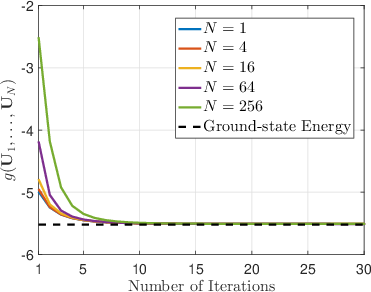
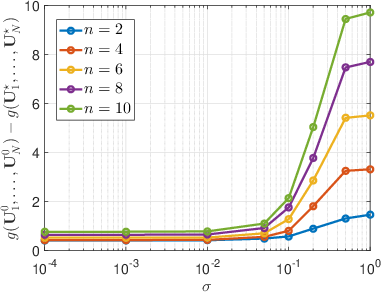
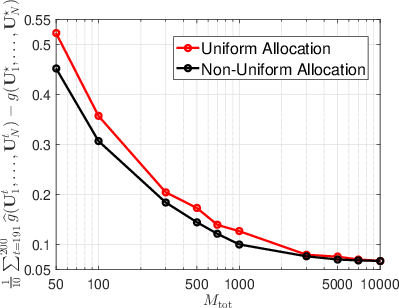
Figure 1: (a) Convergence behavior of RGD for varying N shows slower convergence with increasing depth; (b) initialization error escalates with circuit depth and system size; (c) error reduction via non-uniform measurement allocation under fixed budget.
Theoretical analysis proves that every critical point is either a global minimum or a strict saddle (i.e., the strict saddle property), thereby ruling out local minima that sub-optimalize convergence. However, regions with exponentially vanishing gradients persist when the state overlaps minimally with the ground-state subspace, underpinning the barren plateau phenomenon outside the well-initialized regime.
Product-Unitary Optimization and Barren Plateaus
Extending to layered quantum circuits, each unitary is optimized independently. The landscape retains local linear convergence under initialization guarantees, but convergence rates degrade polynomially with circuit depth N; specifically, 1−32(8N+1)∥H∥2Δ12, which asymptotes as N increases. The product ansatz facilitates universal expressivity, yet inherently incurs the BP phenomenon by exponentially enlarging Hilbert space dimension and required circuit depth for covering target unitary families. The analysis links BP directly to the interplay between Hilbert-space geometry, per-layer expressivity (p), circuit depth (N), and target internal dimension (dtarget). Notably, increasing expressivity per layer alleviates BP only if it scales commensurately with f(U0)−f(U⋆)≤Δ1/20.
Blockwise optimization retains favorable single-unitary geometric structure for each layer but does not guarantee global optimality for the composite system, reflecting the nonseparable nature of the objective.
Initialization Guarantees
The convergence theory relies on practical initialization achievable with high probability. The paper proposes initializing each unitary with a small random Pauli rotation, parameterized by variance f(U0)−f(U⋆)≤Δ1/21. The initialization error bound,
f(U0)−f(U⋆)≤Δ1/22
shows that reduced f(U0)−f(U⋆)≤Δ1/23 and increased reference state fidelity to the ground-state subspace are necessary for feasibility. Larger depth f(U0)−f(U⋆)≤Δ1/24 and system size f(U0)−f(U⋆)≤Δ1/25 require exponentially tighter initialization.
(Figure 1b)
Figure 1b: Initialization error increases with larger f(U0)−f(U⋆)≤Δ1/26 for fixed f(U0)−f(U⋆)≤Δ1/27, and with increased system size.
Noise Robustness and Measurement Allocation
Finite-shot measurement noise induces estimation errors, which the authors analyze quantitatively. The error after optimization is
f(U0)−f(U⋆)≤Δ1/28
where f(U0)−f(U⋆)≤Δ1/29 is the number of measurements per Pauli term. RGD converges linearly in this noise regime, up to a neighborhood determined by the statistical error.
Optimal allocation under fixed measurement budget 1−288∥H∥2Δ120 minimizes error via coefficient-adaptive strategy:
1−288∥H∥2Δ121
yielding strictly lower error compared to uniform allocation unless all coefficients are identical. This allocation is robust across Pauli decomposition in practical Hamiltonians.
(Figure 1c)
Figure 1c: Non-uniform measurement allocation delivers consistently lower statistical error compared to uniform allocation for random Hamiltonians under fixed measurement budgets.
Simulation Results
Numerical experiments corroborate theoretical predictions:
- RGD convergence rate degrades as circuit depth 1−288∥H∥2Δ122 increases.
- Initialization error increases with larger 1−288∥H∥2Δ123 and system size 1−288∥H∥2Δ124.
- Non-uniform measurement allocation outperforms uniform allocation, especially in the resource-limited regime.
Conclusion
This geometric analysis establishes a unified, rigorous foundation for VQE optimization, delineating explicit convergence rates, landscape structure, feasible initialization regimes, and measurement robustness. The strict saddle property and explicit BP mechanism provide actionable insights for circuit design and initialization strategies, while optimal measurement allocation advances efficiency in resource-constrained quantum simulation. The geometric framework generalizes beyond VQE, informing the design of robust, scalable variational algorithms across the quantum computing landscape. Future directions include extending these analyses to parameterized ansatzes with hardware constraints, adaptive optimization heuristics, and hybrid classical-quantum architectures.