- The paper establishes that Rotosolve converges to ε-stationary points under smoothness and to ε-suboptimal solutions under a coordinate-wise PL condition.
- It derives explicit worst-case rates: O(d/ε²) for stationary points and O(d ln(1/ε)) for suboptimality, with shot complexity scaling quadratically.
- Empirical results confirm Rotosolve's superior performance and robustness versus traditional gradient-based and coordinate descent methods.
Convergence Analysis of Rotosolve in Variational Quantum Algorithms
Motivation and Context
Variational Quantum Algorithms (VQAs) are emblematic of near-term quantum computing, leveraging parametrized quantum circuits and classical optimization to tackle tasks ranging from quantum chemistry to machine learning. The optimizer's efficacy is central to VQA performance, yet most commonly used algorithms—both gradient-based (SGD, RCD, Adam) and gradient-free (RSGF, SPSA)—do not exploit circuit structure and lack rigorous convergence guarantees. Rotosolve distinguishes itself by leveraging the inherent sinusoidal structure of quantum expectation values with respect to individual parameters, offering exact minimization along coordinates without requiring step-size tuning. Despite empirical success, its theoretical foundation had remained elusive. This paper provides the first formal convergence guarantees for Rotosolve, resolving a significant open question in the domain.
The optimization task is defined over a parametrized quantum circuit: an initial state ∣ι⟩ is evolved by a sequence of fixed and parametrized unitaries, of which the latter are generated exclusively by single-qubit Pauli matrices. The objective function is the expected value of a Hermitian observable H, parameterized over the gate angles, and is bounded within [−,] by assumption. Crucially, the objective exhibits coordinate-wise smoothness, i.e., gradient variations along each parameter direction are Lipschitz with constants Lj; for Pauli-generated gates, Lj and the aggregate L scale linearly with depth.
The more nuanced Polyak-Łojasiewicz (PL) condition is assumed to locally hold coordinate-wise, implying the function's optimality gap can be bounded below proportionally by the squared gradient norm in each coordinate. This structure is rigorously supported by the sinusoidal parameter dependence proved for univariate slices of the objective.
Theoretical Contributions
- Coordinate-wise PL Condition Validity: The paper establishes that the quantum objective exhibits a coordinate-wise PL condition almost everywhere, an assumption previously only postulated in related analysis.
- Convergence Proofs for Rotosolve: It provides the first rigorous proof that Rotosolve converges to ε-stationary points under merely smoothness, and ε-suboptimal solutions under coordinate-wise PL.
- Explicit Worst-Case Rates: The iteration complexity for Rotosolve is derived as $O(\nicefrac{d}{\varepsilon^2})$ for stationary points and $O(d\ln(\nicefrac{1}{\varepsilon}))$ for suboptimality. Shot complexity is shown to scale at most quadratically in the number of parameters.
- Comparison With RCD: Although worst-case rates are similar to Randomized Coordinate Descent (RCD), Rotosolve is hyperparameter-free, implicitly leverages both first and second derivatives, and always performs coordinate minimization rather than descent.
Algorithmic Insights
Rotosolve operates by sequentially or randomly selecting parameter coordinates, exploiting the sinusoidal dependence for each (due to Pauli generators) and performing exact minimization via closed-form coefficient estimation. For the single-frequency case, each update uses three circuit evaluations per coordinate. Generalizations for multi-frequency settings accommodate more complex generators. The algorithm remains robust in the stochastic finite-shot regime through unbiased estimates with bounded variance.
Rotosolve's updates utilize both gradient and Hessian information, embedded in the coefficient extraction formulas. In comparison, RCD performs coordinate-wise gradient descent steps requiring explicit step-size selection and only exploits first-order information.
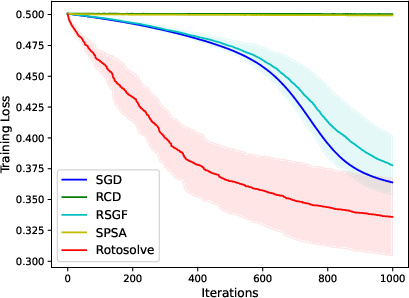
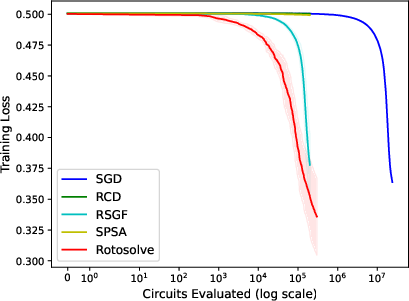
Figure 1: Plot of training loss against iteration count and circuit-executions (log-scale) for SGD, RCD, RSGF, SPSA, and Rotosolve, highlighting superior convergence.
Convergence Rates and Empirical Results
The derived Descent Lemmas establish that Rotosolve's expected objective reduction per iteration is bounded below by the squared gradient norm (minus noise), divided by a constant related to the sinusoidal structure. When only smoothness holds, convergence to an H0-stationary point requires
H1
iterations and suitably bounded noise variance. When the PL condition applies, convergence to H2-suboptimality improves to a logarithmic iteration complexity in the inverse error.
Empirical evaluation on quantum machine learning benchmarks demonstrates stronger numerical performance for Rotosolve—achieving lower losses and faster convergence per iteration and per circuit-execution compared to SGD, RCD, RSGF, and SPSA. A notable feature is increased variance in the stochastic regime, consistent with theoretical predictions.
Practical and Theoretical Implications
The formalization of Rotosolve's convergence ensures reliable optimization for variational circuits, particularly in quantum machine learning, where finite-sum losses are commonplace. The hyperparameter-free nature and implicit use of higher-order information position Rotosolve as a structurally aware alternative to generic optimizers. These guarantees also suggest VQAs can be deployed with stronger assurances, mitigating empirical-only reliance.
The equivalence in worst-case complexity with RCD, paired with practical advantages, motivates further exploration of structure-exploiting optimizers. The analysis reveals the importance of the quantum objective's parameterization and the generator spectrum: extensions to multi-frequency cases or more complex circuit architectures are feasible and warrant detailed study.
Future Directions
Potential avenues include refined convergence analyses to explain empirical superiority, systematic study of Rotosolve variants (e.g., with sparsity or adaptive gate selection), and identification of adversarial objective landscapes that could degrade coordinate minimization performance. Generalizations to broader quantum circuit architectures and other quantum optimization paradigms will further broaden applicability.
Conclusion
This paper provides a rigorous foundation for the Rotosolve algorithm, including the first formal convergence guarantees and explicit rates for variational quantum algorithm optimization. The analysis underscores the value of structure-exploiting methods in quantum learning and optimization, moving beyond generic approaches. Rotosolve's theoretical guarantees, practical benefits, and implicit utilization of higher-order information make it a robust candidate for future quantum algorithmic paradigms.

