Robin holography in AdS and BTZ: double-trace RG flow and exceptional points
Published 26 May 2026 in hep-th | (2605.27641v1)
Abstract: We construct the exact Robin bulk-to-boundary propagator for a Breitenlöhner--Freedman scalar on AdSd+1 and the BTZ black hole, realizing the double-trace RG flow between standard and alternate quantization geometrically as a one-parameter family of bulk boundary conditions. We derive the UV and IR chain expansions of the kernel intrinsically from the boundary-value problem, without an auxiliary-field decoupling, and identify a branch split at each order that separates the local data the boundary CFT observes from finite-bulk-depth structure visible only to bulk probes -- the part of Kf that distinguishes holographic reconstruction from boundary calculation. On BTZ we obtain the closed-form Robin kernel and the corresponding family of quasinormal-mode trajectories, each connecting an alternate-quantization pole at g=0 to a standard one at g→∞. We locate an exceptional-point locus along this family at which two trajectories coalesce into a Jordan block, and show it acts as a non-Hermitian phase boundary for the double-trace flow itself: crossing it reorganizes the global pole-pairing topology of the spectrum. Unlike holographic EPs reached by analytic continuation in momentum or frequency, this transition lives on the interpolation between quantizations and is reachable at finite real momentum and temperature by tuning the physical Robin coupling.
The paper introduces a novel Robin boundary condition that geometrically realizes double-trace RG flows between alternate and standard quantizations.
It derives an exact bulk-to-boundary propagator using UV/IR expansions and chain diagrammatic methods for precise analytic mapping.
The study uncovers exceptional points in the BTZ quasinormal mode spectrum, highlighting non-Hermitian phase transitions with thermal implications.
Robin Holography in AdS and BTZ: Double-Trace RG Flow and Exceptional Points
Introduction and Motivation
This paper systematically constructs the exact Robin bulk-to-boundary propagator for scalars saturating the Breitenlohner–Freedman (BF) bound in AdSd+1 and in the BTZ black hole background, elucidating the geometric realization of double-trace RG flows connecting alternate and standard quantizations via one-parameter Robin boundary conditions, and explores the spectral structure and non-Hermitian physics induced by such deformations, particularly the emergence of exceptional points (EPs) in the quasinormal mode (QNM) spectrum. The analysis leverages the interplay between boundary conformal data and bulk depth-dependent kernels to isolate quantization-induced physical features and to map the RG structure in explicit analytic terms.
Exact Robin Kernel and Boundary-Value Problem Analysis
A canonical scalar field in AdSd+1 with mass m in the BF window admits two consistent quantizations associated with conformal dimensions Δ±=d/2±ν, with ν related to m via ν=d2/4+m2L2. The boundary condition
γϕ(x,ϵ)+ϵ∂zϕ(x,ϵ)=h(x)
interpolates between alternate (γ=−Δ−) and standard (γ→∞) quantization, and intermediate values of d+10 correspond to finite double-trace deformations in the dual CFT. The resulting bulk-to-boundary kernel d+11 is derived explicitly and shown to interpolate smoothly between the undeformed propagators associated with the two fixed points.
The kernel admits convergent geometric expansions in both the UV (d+12) and IR (d+13) regimes:
UV Expansion: Organized in the double-trace coupling, perturbatively around the alternate quantization.
IR Expansion: Organized as an expansion in d+14 around the standard quantization.
The kernel structure admits a split at each order into a boundary-singular branch, encoding the OPE-like data of the boundary CFT, and a bulk-regular branch, which is inaccessible to pure boundary calculations and reveals the finite-bulk-depth structure distinct to holographic reconstruction.
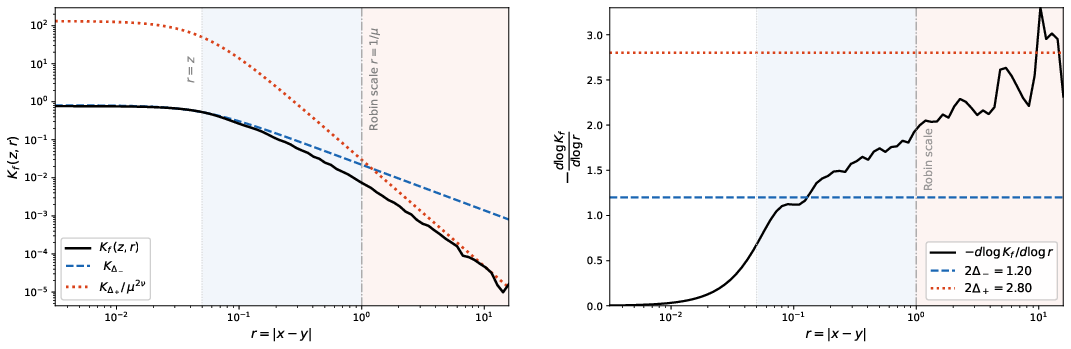
Figure 1: Position-space Robin kernel d+15 in d+16 with d+17, showing the crossover between alternate (d+18) and standard (d+19) quantization scaling as m0 transits the Robin scale m1.
Chain Expansion and Holographic Interpretation
The kernel admits an intrinsic chain expansion, bypassing auxiliary-field or Hubbard–Stratonovich formulations. Large-m2 factorization permits the interpretation of these expansions as boundary chain diagrams: each chain order corresponds to a series of double-trace insertions, with the boundary-regular and bulk-regular branches manifesting differing physical content—local boundary OPE data versus finite-bulk-depth dressing, the latter being invisible to renormalized boundary correlators.
The expansion provides a transparent bulk-bulk UV/IR connection: at bulk depth m3, the UV chain converges; for m4, the IR chain dominates. The bulk RG transition is localized at m5, matching the boundary RG crossover.
RG Flow and Callan–Symanzik Structure
The exact kernel's dependence on the double-trace coupling allows direct formulation of the RG flow equation in mode or position space. The position-space Callan–Symanzik equation is constructed:
m6
with m7 serving both as the observable and as the flow-driving rate. Iterative expansion around either fixed point yields a strict recursion reproducing the chain diagrammatics of the exact solution.
BTZ Quasinormal Spectral Flow and Exceptional Points
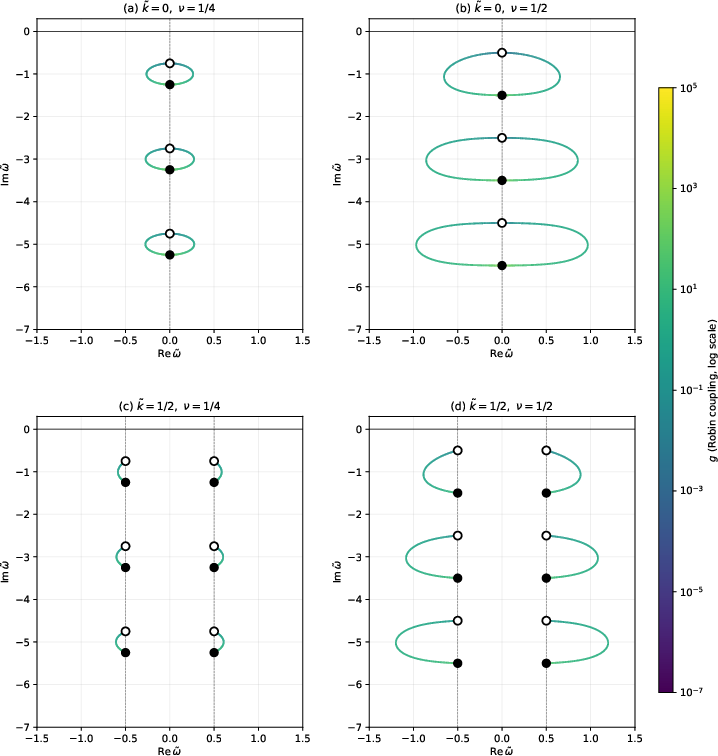
The analysis on the BTZ geometry leverages its hypergeometric solvability. The Robin condition yields a closed-form kernel with QNMs locatable as zeros of the master equation m8, interpolating from alternate (m9) to standard (Δ±=d/2±ν0) quantization.
Figure 2: QNM trajectories in the complex Δ±=d/2±ν1-plane as Δ±=d/2±ν2 is varied, visualizing the double-trace RG flow in frequency space across alternate and standard quantization poles.
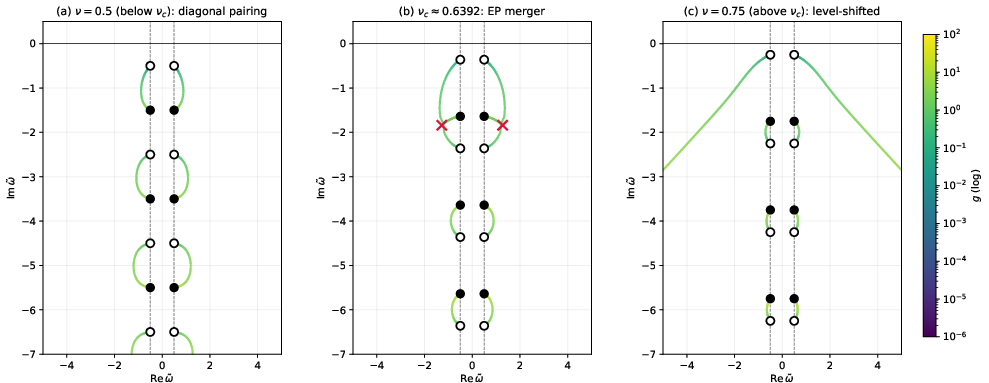
An important feature arises in the spectral flow: increasing Δ±=d/2±ν3 at fixed momentum Δ±=d/2±ν4 causes adjacent QNM trajectories to collide at a critical coupling Δ±=d/2±ν5, manifesting as an exceptional point where two QNMs merge into a Jordan block. The EP acts as a non-Hermitian phase boundary; crossing it reorganizes the global pole-pairing topology.
Figure 3: Exceptional-point transition at Δ±=d/2±ν6, marking the diagonal pairing below Δ±=d/2±ν7, coalescence at the EP, and level-shifted pairing above Δ±=d/2±ν8.
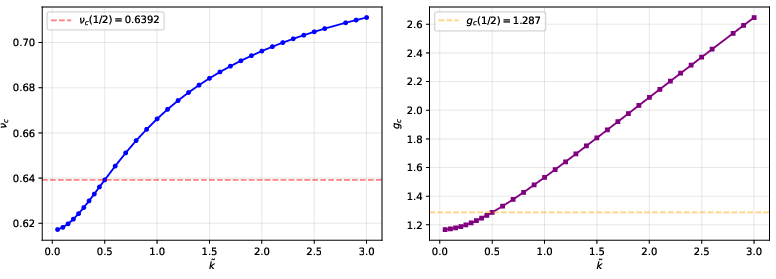
The EP locus in parameter space is charted by Newton continuation:
Figure 4: Exceptional-point locus as a function of dimensionless momentum Δ±=d/2±ν9, with ν0 and ν1 mapping the phase boundary for pole-pairing rearrangement.
At the EP, the retarded correlator accrues a characteristic Jordan-block prefactor, with strong implications for late-time thermal response and open quantum system spectral signatures.
Applications and Implications
The explicit Robin/BTZ propagator offers a closed-form construction for a thermal (1+1)d CFT deformed by a double-trace operator, with direct applications as a benchmark in Luttinger-liquid and quantum Hall edge crossover scaling, as well as in large-ν2 coupled SYK models and traversable wormhole constructions. The spectral mechanism at the EP offers a concrete analytic prototype for non-Hermitian spectral rearrangements, potentially informing finite-ν3 quantum system investigations.
Further, the kernel's role in eikonal OTOC computations in chaotic systems is highlighted. The dependence of the Lyapunov exponentν4 on the Robin coupling remains an open question, and the EP's presence suggests a sharp spectral transition in chaotic response, requiring further exploration.
Conclusion
The work establishes the Robin boundary condition as a precise geometric realization of the double-trace RG flow in AdS and BTZ backgrounds, organizing the exact kernel as chain expansions, clarifying the separation of boundary and bulk data, and mapping the RG structure via Callan–Symanzik recursion. The BTZ QNM analysis reveals the existence of exceptional points as physical phase boundaries accessible via tuning of real momentum and temperature parameters. The explicit closed-form kernel and spectral data provide a versatile mathematical and physical toolkit for investigations of non-trivial RG flows, non-Hermitian transitions, and their implications in higher-dimensional and finite-ν5 settings.
Reference: "Robin holography in AdS and BTZ: double-trace RG flow and exceptional points" (2605.27641)