- The paper demonstrates how analytic continuation of real scalars to imaginary values in supergravity yields traversable wormholes connecting distinct AdS spaces.
- It leverages ghost scalars and periodic trigonometric structures to construct stable, Lorentzian wormhole solutions verified through perturbative spectral analysis.
- The research reveals pseudo-Hermitian and PT-symmetric dual QFTs, highlighting entanglement, computed mutual information, and the emergence of Goldstone modes from symmetry breaking.
Supergravity Flows, Wormholes, and Pseudo-Hermitian Holographic Duals
Overview
The paper "Supergravity flows, wormholes and their pseudo-Hermitian holographic duals" (2605.16168) introduces novel solutions to consistent truncations of maximal supergravity in four and five dimensions, focusing on analytic extensions where real scalar fields are continued to imaginary values while maintaining a real-valued metric. Among these solutions are traversable Lorentzian wormholes connecting two asymptotically AdS spaces, as well as flows with real metrics upon uplift to ten or eleven dimensions. A distinctive feature of these solutions is their correspondence to pseudo-Hermitian and PT-symmetric quantum field theories (QFTs) within the AdS/CFT paradigm, providing advances in holographic dual descriptions of non-Hermitian, entangled states. The paper substantiates the wormhole interpretation both from the gravity and QFT sides, including perturbative stability analysis, computation of mutual information, and identification of Goldstone modes associated to symmetry breaking.
Analytic Extensions in Supergravity: Mechanisms and Examples
The authors consider consistent truncations of supergravity with real scalar fields minimally coupled to gravity. Analytic extensions are achieved by continuing certain real scalars to imaginary values, relying on the symmetry properties of the scalar potential and superpotential to ensure a resulting real metric. This mechanism enables the construction of solutions violating the null energy condition due to the emergence of ghost scalars with flipped kinetic terms.
Several classic domain wall solutions are examined:
- Coulomb branch flows in N=4 SYM and ABJM, with superpotentials featuring hyperbolic functions which, upon analytic extension, become periodic in the imaginary direction.
- Mass deformations in N=1∗ and N=2∗ SYM.
- GPPZ flows, spontaneous R-symmetry breaking SCFTs, and models triggered by boson bilinear vevs.
The analytic extension turns the flows into periodic trigonometric structures, allowing interpolations between distinct critical points in field space. The resulting geometries include:
- Traversable wormholes connecting two AdS regions,
- Flows to singular geometries,
- Flows to asymptotically flat spacetimes with nontrivial real metrics and complex fluxes upon uplift.
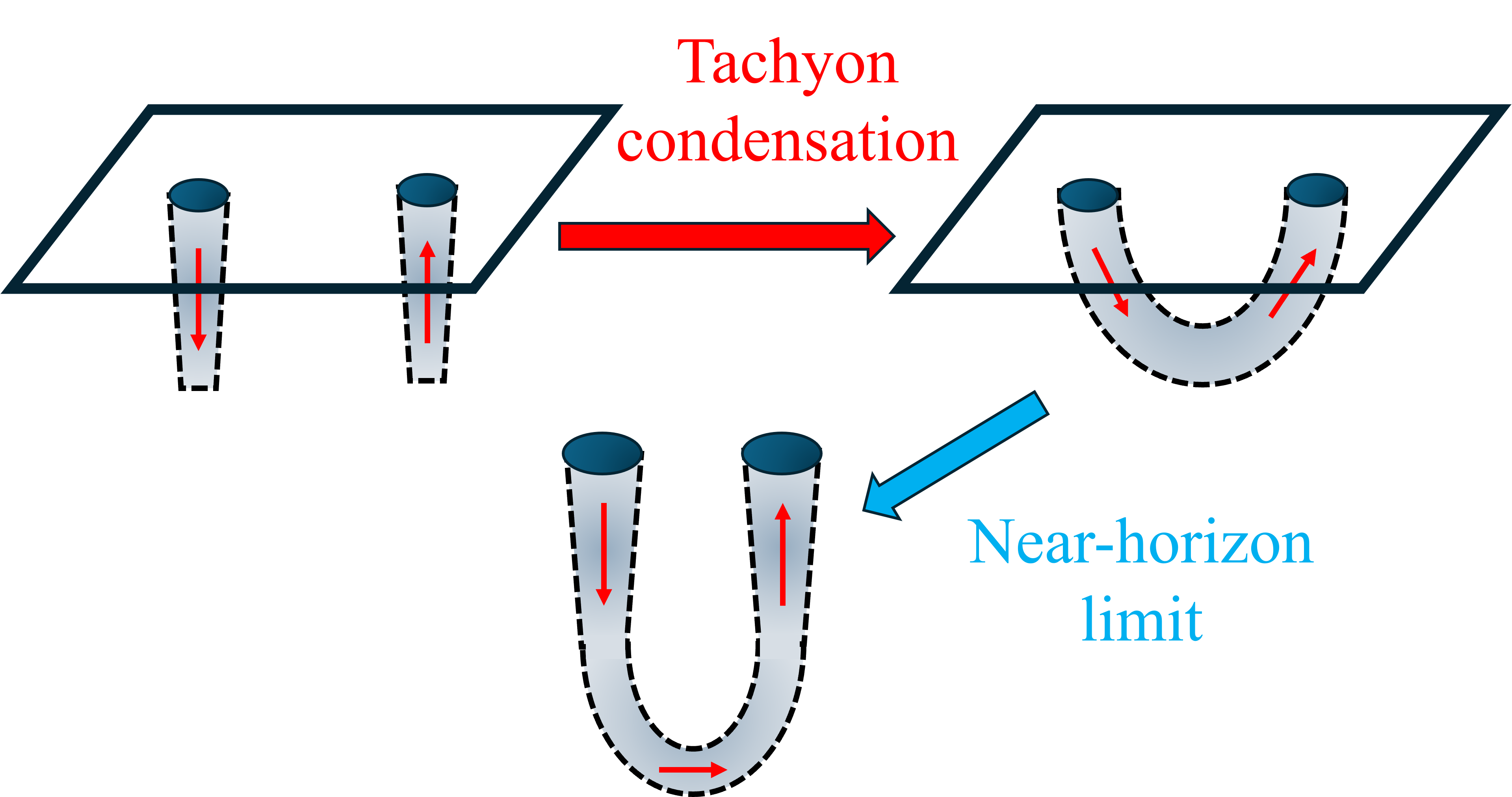
Figure 1: Possible formation of the wormhole—two stacks of branes and anti-branes form throats in flat spacetime, connecting via tachyon condensation and forming a wormhole linking two AdS regions in the near-horizon limit.
Wormhole Solutions and Tachyon Condensation
The constructed wormhole solutions circumvent classical energy condition restrictions by leveraging ghost scalars. These wormholes connect two asymptotic AdS boundaries, each interpreted as a stack of branes or anti-branes with reversed orientations. The low-energy effective theory after tachyon condensation corresponds to two QFTs (on branes and anti-branes) entangled via the wormhole geometry, suggestive of a dual description as a state in the product Hilbert space endowed with imaginary couplings and expectation values.
Detailed analysis confirms the linear perturbative stability of these wormholes despite local violations of the null energy condition. The fluctuation spectrum, especially for ghost scalar modes, reveals localization on each AdS boundary, with vanishing mixed two-point correlators across boundaries—a hallmark of decoupling in the absence of explicit double-trace interactions.
Holographic Duals: Pseudo-Hermiticity and PT-Symmetry
In the dual QFT description, the analytic extension leads to pseudo-Hermitian and PT-symmetric structures:
- Each AdS boundary corresponds to a copy of the deformed QFT, where PT exchanges operators and couplings while complex conjugation is implemented by T.
- Expectation values and couplings in each copy obey PT-symmetric relations, with imaginary values and sign reversal across boundaries.
- The wormhole geometry induces an entangled state, analogous to the thermofield double in Einstein-Rosen bridges but without explicit interactions.
The wormhole solutions are shown to support entanglement between the two QFTs, quantified by mutual information as computed holographically via the Ryu-Takayanagi prescription. The mutual information per unit volume is governed by the minimal area of the wormhole throat, reflecting the extent of entanglement between regions at each boundary:
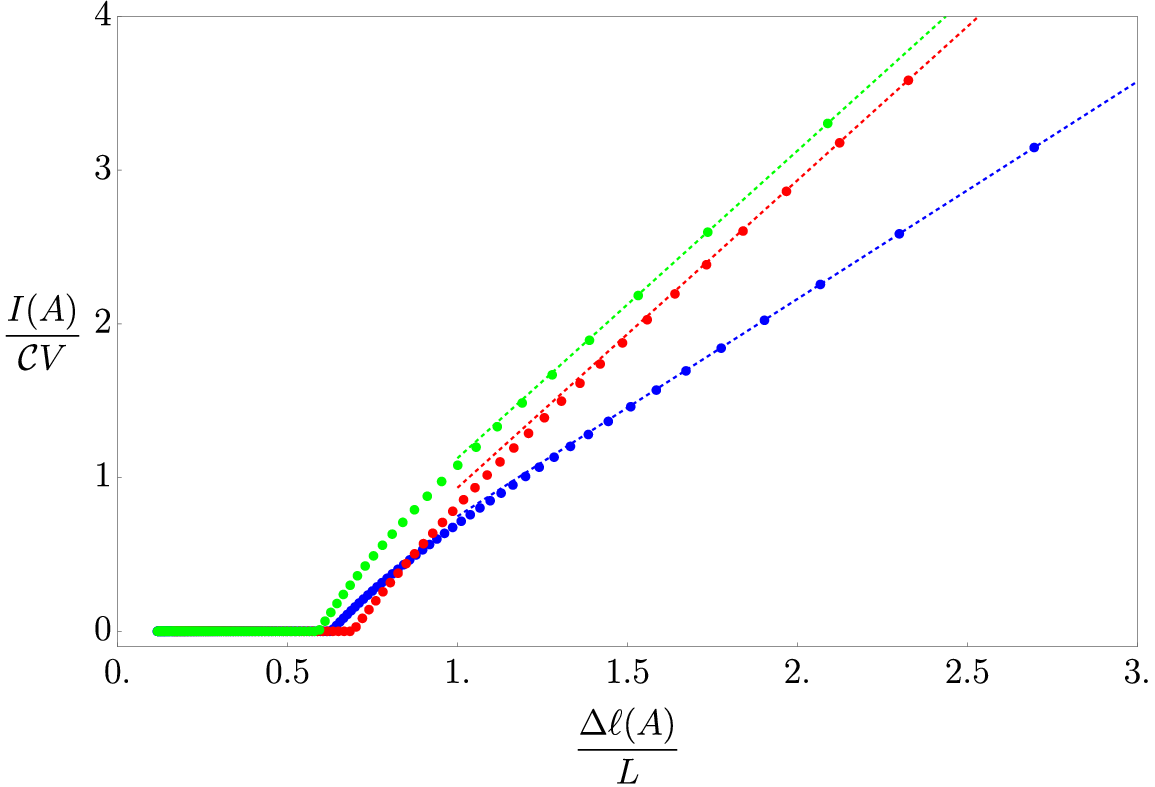
Figure 2: Mutual information of a strip I(A)/(CV) as a function of width, exhibiting vanishing below a critical scale and linear growth at large widths, with slope determined by the wormhole throat area.
This confirms that the entanglement structure is both extensive and controlled by geometric parameters of the wormhole.
Symmetry Breaking and Goldstone Bosons
A salient theoretical implication is the spontaneous breaking of the product Poincaré symmetry N=40 to the diagonal subgroup N=41. The gravity side reveals vector metric fluctuations behaving as Goldstone modes, associated with broken translation and Lorentz generators across the two boundaries. The analysis draws analogies to flavor symmetry breaking in D8-brane configurations and clarifies the role of diffeomorphism Wilson lines in the identification of Goldstone fields.
Stability and Spectrum
The paper provides explicit numerical analysis of the fluctuation spectrum for several wormhole backgrounds, utilizing Sturm-Liouville theory and spectral methods. The lowest-lying eigenvalues for ghost scalar fluctuations are all positive, substantiating perturbative stability. The absence of instabilities is a strong result given the presence of ghost fields, and the splitting of the spectrum for ghost scalars affirms that correlators do not mix the copies—a rigorous check of decoupling.
Implications and Future Directions
Practical Implications
- The construction of traversable, Lorentzian wormholes without explicit double-trace interactions provides a novel paradigm for entangled, non-Hermitian states in holographic duality.
- The ability to uplift to higher-dimensional real metrics with complex fluxes opens avenues for non-standard string theory backgrounds, with implications for compactification and effective field theory.
Theoretical Implications
- Violation of null energy conditions via analytic continuation paves the way for flows interpolating between AdS and de Sitter spacetimes, potentially relevant for quantum cosmology and gravitational path integrals.
- Pseudo-Hermitian holography frames an alternative approach to quantum gravity, factorization, and the resolution of the "factorization problem" in non-interacting QFTs.
- Identification of Goldstone modes for symmetry breaking hints at new mechanisms for emergent symmetry and entanglement in gravitational and field theoretic systems.
Speculation on Future Developments
- Extension to flows between AdS and de Sitter via ghost scalar mechanisms, potentially realizing positive cosmological constant duals.
- Exploration of pseudo-Hermitian holography in non-maximal supergravity and non-supersymmetric contexts.
- Classification and construction of uplifted backgrounds with mixed real/imaginary fluxes beyond existing type IIB and M-theory frameworks.
- Investigating non-perturbative stability and dynamical properties of these wormhole solutions, especially in relation to quantum gravitational path integrals.
Conclusion
This work advances the understanding of analytic extensions in supergravity, the construction and interpretation of traversable wormholes in Lorentzian AdS spacetimes, and their dual descriptions as pseudo-Hermitian, N=42-symmetric QFTs. The rigorous analysis of perturbative stability, mutual information, entanglement, and symmetry breaking underscores both practical and theoretical significance, providing fertile ground for future research in holography, quantum gravity, and string theory.