- The paper demonstrates that nonperturbative functional RG flows dynamically generate an emergent AdS geometry and black hole horizons with exact thermodynamic correspondence.
- It establishes a detailed bulk-boundary dictionary by mapping RG scale evolution to the bulk radial coordinate and computing curvature invariants directly from quantum fields.
- The study verifies that the emergent bulk energy-momentum tensor satisfies local energy conditions and reproduces the Bekenstein-Hawking area law from first principles.
Emergent AdS Geometry and Black Hole Thermodynamics from Functional Renormalization Group
Overview and Context
This work presents a non-perturbative, first-principles construction of holographic duality within the context of the O(N) vector model in d-dimensional Euclidean space, exploiting the functional renormalization group (FRG) to dynamically generate emergent Anti-de Sitter (AdS) geometries and black hole thermodynamics. Unlike prior approaches reliant upon static or truncated backgrounds, this framework establishes a systematic, continuous mapping between RG scale evolution in the boundary theory and the radial coordinate of the dual bulk, allowing a full translation of non-perturbative boundary fluctuations into dynamically backreacted gravitational metrics.
The central results demonstrate that the boundary RG flow organizes the bulk geometry into a regular AdSd+1 space at criticality and, at finite temperature, produces black-hole-like horizons with thermodynamic properties in rigorous correspondence with the boundary theory.
Constructing the Holographic Dictionary via Functional RG
The approach begins with the quantum O(N) vector model, recast by a Hubbard-Stratonovich transformation into a form accommodating large-N analysis. Sequential, infinitesimal Wilsonian RG steps are iterated to integrate out high-energy modes at each scale, yielding effective bulk dynamics for an auxiliary collective field φ(x,z) across the emergent RG coordinate z.
The resulting partition function captures all orders of scale evolution and includes Jacobian contributions from field decompositions. Bulk effective dynamics for φ(x,z) are codified in a second-order action whose Lagrangian density Lbulk is intrinsically non-perturbative, containing both the field and RG-induced quantum corrections.
Crucially, the boundary (UV and IR) conditions for the collective field are derived from the stationarity of the effective action, directly coupling the bulk profile to microscopic boundary data. This ensures the emergent geometry is not arbitrary but strictly dictated by the physical RG flow of the underlying theory.
Emergent Bulk Geometry and Curvature Properties
By analyzing normal mode fluctuations about the saddle-point of d0, the linearized bulk equation aligns with the Laplace-Beltrami operator in a d1-dimensional Riemannian metric. This enables identification of the emergent metric components d2 (radial) and d3 (transverse) as explicit functionals of the boundary Green's functions d4 and d5. The mapping is bidirectional: all geometric curvature invariants can be expressed in terms of the original quantum fields, completing a precise RG/geometry dictionary.
The emergent Ricci scalar d6, Ricci tensor components, and their evolution along the bulk are computed for both the gapped (d7) and critical (d8) regimes:
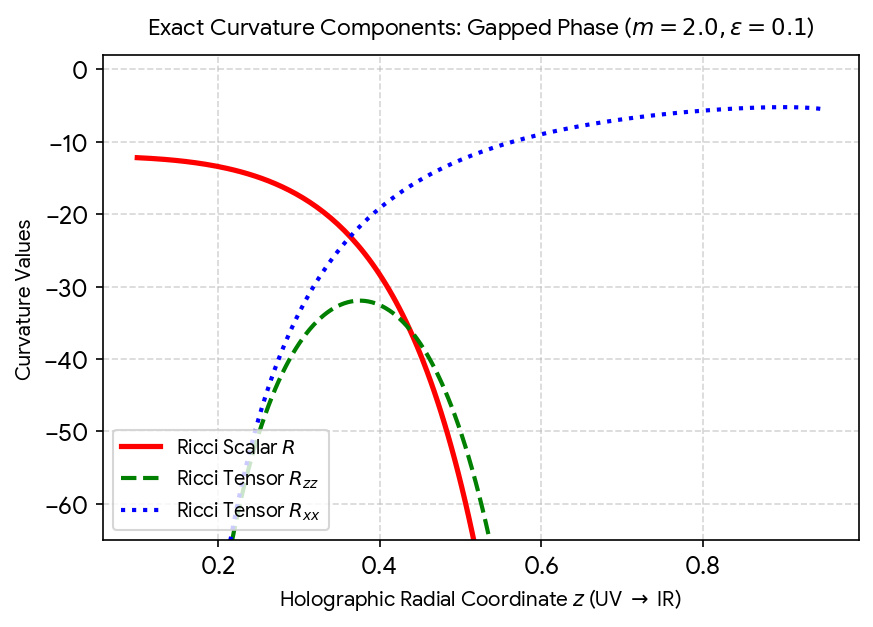
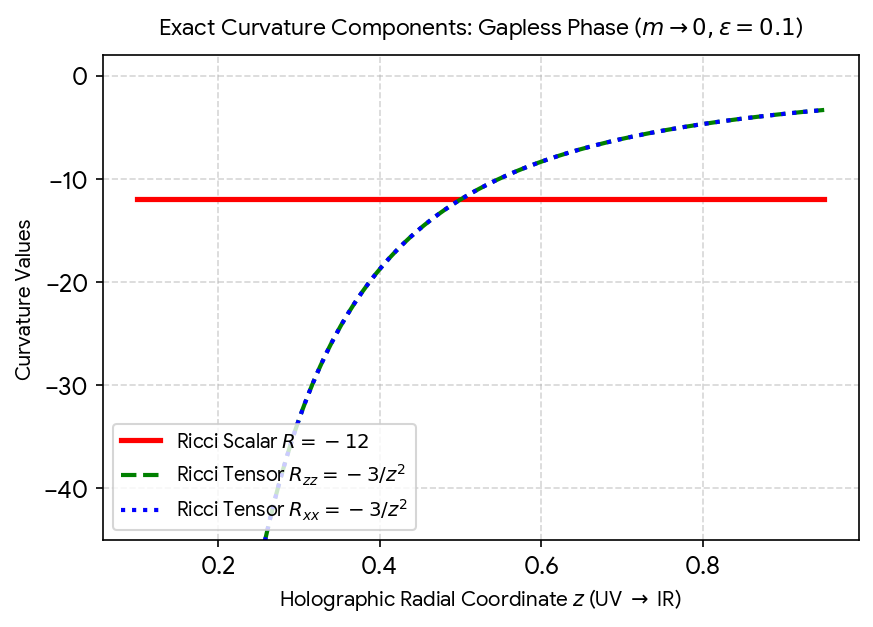
Figure 1: Evolution of the emergent bulk curvature invariants—d9, AdS0, and AdS1—as a function of the holographic radial coordinate AdS2 for both gapped and gapless phases.
In the gapped phase, as the bulk approaches the IR, the matter sector freezes out and the curvature exhibits a singular IR endpoint, geometrically ending the spacetime. Conversely, at criticality, the non-linear RG effects combine to restore maximal symmetry; the geometry becomes that of a smooth AdS3 space with constant negative curvature, exemplified by AdS4.
Bulk Energy-Momentum Tensor and Local Energy Conditions
The study constructs the emergent energy-momentum tensor AdS5 from the Einstein tensor of the induced metric. The tensor’s radial and transverse pressure components are analyzed via the effective fluid variables AdS6, AdS7, and AdS8. Numerical evaluation confirms that, throughout both gapped and gapless cases, the emergent geometry consistently satisfies weakness, strong, and dominant energy conditions. The effective matter content from the RG flow thus produces physically viable, attractive bulk gravity.
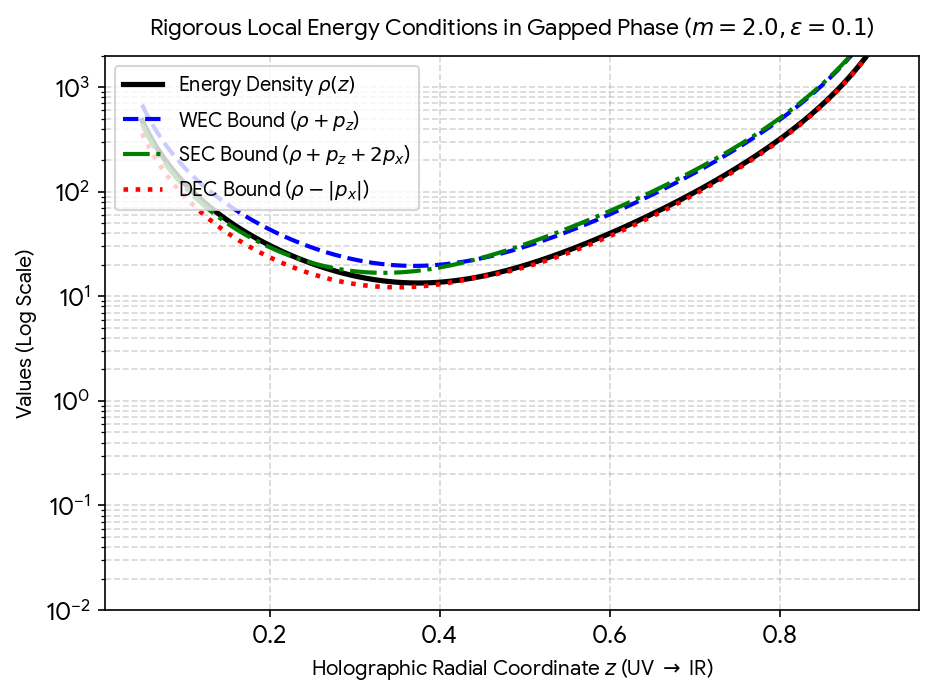
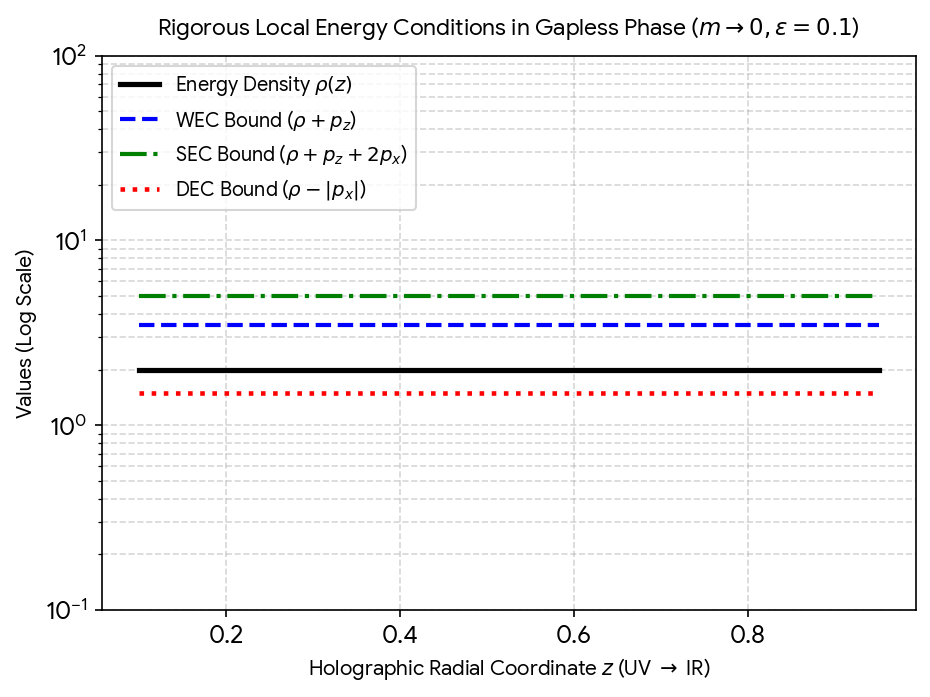
Figure 2: Numerical verification that the emergent bulk fluid variables satisfy all local (WEC/SEC/DEC) energy conditions along AdS9 for both the gapped and critical phases.
Black Hole Thermodynamics and Holographic Consistency
At finite temperature, the IR cutoff of the RG flow becomes the location of an emergent bulk horizon. The framework provides:
- An explicit mapping AdSd+10 relating the RG scale to boundary temperature.
- Proof that the horizon is at infinite proper distance, as expected for a black hole throat.
- Near-horizon (AdSd+11) analysis yields a Rindler metric. Demanding regularity (avoiding a conical singularity) gives the semiclassical Hawking temperature, which exactly matches the boundary theory temperature, AdSd+12, across all regimes without subleading anomalies.
- The horizon area AdSd+13, computed via the spatial metric determinant, enters in the entropy expression.
The entropy and free energy functionals, expressed both in terms of boundary and geometric (bulk) variables, satisfy the relevant thermodynamic identities exactly. The Bekenstein-Hawking area law, AdSd+14, is realized from microscopic field theory data rather than imposed externally:
AdSd+15
The parameter AdSd+16 relating AdSd+17 to AdSd+18 is not free; it is fixed analytically by matching UV and IR data, closing the duality with no arbitrary parameters.
Implications and Future Directions
This work establishes the dynamic emergence of AdSd+19 geometry and black hole thermodynamics from first-principles RG analysis, resolving limitations of earlier kinematic or truncated holographic models which could not capture horizon physics or produced spurious scaling anomalies in the infrared. Key contributions include:
- A mathematically explicit, bidirectional RG/geometry dictionary.
- Nonperturbative, dynamically backreacted horizon formation with fully consistent bulk thermodynamics.
- Exact, anomaly-free identification of boundary and bulk temperatures.
- Derivation of the area law for entropy directly from field theory.
From a practical perspective, this construction supplies a robust, scalable procedure to map boundary RG flows to bulk gravitational physics, opening clear routes for application to more general QFTs. From a theoretical standpoint, the approach clarifies the underpinning mechanism for the emergence of classical gravity and black hole thermodynamics in holographic duality.
Anticipated extensions include generalization to large-O(N)0 matrix and gauge theories, enabling direct first-principles derivations of dual bulk gravitons and higher-spin gauge fields, as well as explorations in supersymmetric sectors to test the universality and exactness of the mechanism. The analytic control over UV/IR matching may also advance understanding in RG monotonicity theorems, quantum information perspectives on holography, and nontrivial checks against supersymmetric localization.
Conclusion
This work delivers a technically complete demonstration that non-perturbative functional RG flows in a large-O(N)1 vector model dynamically generate a bulk O(N)2 geometry at criticality and an emergent black hole with consistent thermodynamics at finite temperature. The bulk metric, curvature, and thermodynamic properties are all directly constructed from boundary field theory quantities with no free parameters, culminating in an exact realization of the Bekenstein-Hawking entropy law. This realization sets a new standard for the rigor and scope of holographic dual constructions rooted in quantum field theoretic renormalization group dynamics.