Published 6 Apr 2026 in hep-th and gr-qc | (2604.05026v1)
Abstract: We construct geometries describing the quantum backreaction of thermal fields in AdS$_3$. The solutions are obtained from branes in a four-dimensional AdS C-metric. They can be viewed as solutions of the semiclassical effective theory on the brane, which couples three-dimensional gravity to the CFT dual to the four-dimensional bulk. This brane construction is related by a double analytic continuation to earlier studies of quantum BTZ solutions. There are two families of solutions, labelled by the asymptotic mass. Solutions with negative mass correspond to the back-reaction of a thermal CFT state on global AdS$_3$. Solutions with positive mass have a horizon for zero back-reaction, which is replaced by a smooth origin in the back-reacted solution. We study the thermodynamics and first law on the brane, which we argue is realised in a two-brane setup where we include both the quantum BTZ brane and our quantum soliton brane.
The paper introduces quantum soliton solutions via constant-tension brane embeddings that fully incorporate thermal CFT backreaction in AdS3.
It employs the AdS C-metric framework to derive horizonless geometries, connecting black hole and soliton sectors through double analytic continuation.
Results reveal non-perturbative quantum gravitational effects that resolve horizon singularities and advance our understanding of holographic thermodynamics.
Quantum Solitons in AdS Braneworlds: A Holographic Realization of Backreacted Thermal States
Introduction and Motivation
This work presents a detailed analysis of new semiclassical solutions in AdS3 gravity, termed "quantum solitons," constructed via the embedding of constant-tension branes in the four-dimensional AdS C-metric. These solutions go beyond previously studied quantum-corrected BTZ black holes by realizing the full non-perturbative backreaction of thermal conformal field theory (CFT) states on three-dimensional geometries. The central technical mechanism remains the brane-world construction, in which bulk AdS gravity with localized branes induces semiclassical Einstein equations for the lower-dimensional geometry coupled to the quantum CFT stress tensor.
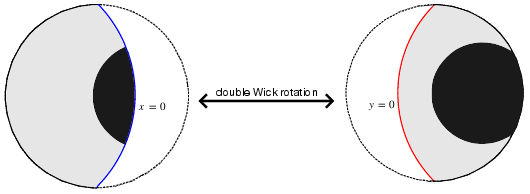
The novelty of the quantum soliton arises from alternative choices of brane location in the C-metric, specifically those that avoid intersecting bulk horizons, thereby generating horizonless, yet backreacted, geometries. An essential observation is the relationship between the quantum BTZ and quantum soliton constructions via double analytic continuation, mapping black hole sectors to soliton sectors. The paper explores the global structure, thermodynamics, and limiting behaviors of these configurations, systematically cataloging root structures and elucidating the implications of brane setups (single and two-brane) for effective theory and holography.
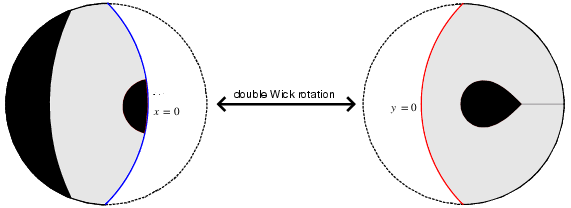
Figure 1: The two choices of brane in the AdS C-metric: on the left, choosing a brane which intersects the black hole horizon gives the quantum BTZ metric; on the right, a brane that does not intersect yields the quantum soliton. The solutions are related by double analytic continuation.
Root Structure and Brane Embedding in the AdS C-metric
The geometry of the AdS C-metric, parameterized by functions G(x) and H(y), dictates the admissible brane embeddings and the nature of the induced metrics. The four relevant cases, determined by the sign of k and ranges of mass and cosmological parameters, yield qualitatively distinct causal and conformal structures. The choice of constant-x or constant-y branes enables the realization of either quantum BTZ or quantum soliton geometries, respectively.
Quantum soliton solutions are obtained by branes localized at y=0, producing metrics of the form
ds2=−r2dτ2+f(r)dr2+f(r)dφ2
with f(r)=r2−κ−λrμ^, sharing the same functional form as quantum BTZ, but crucially differing in global structure and causal properties.
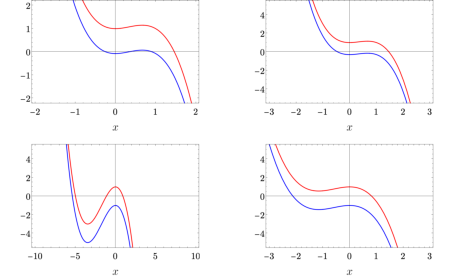
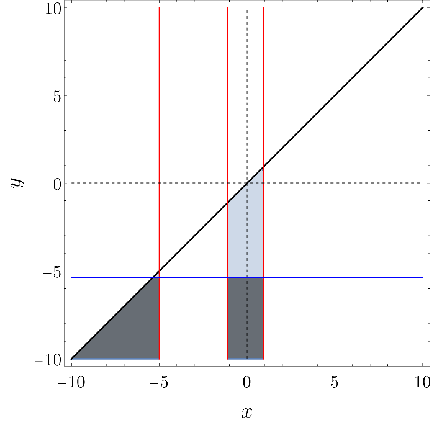
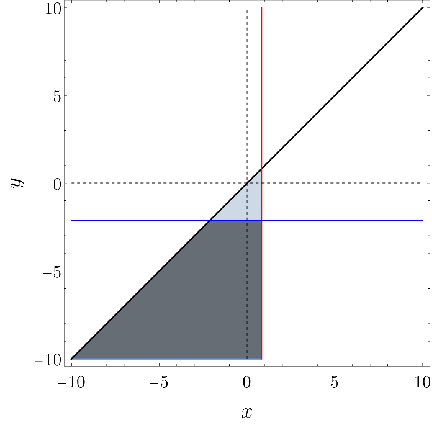
Figure 2: Root configurations of H(ξ) (blue) and G(x)0 (red) classify the domains for possible brane embeddings and horizon structures.
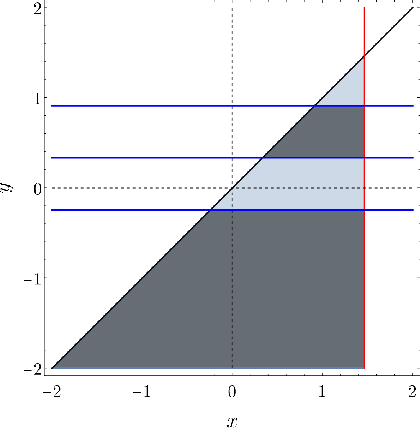
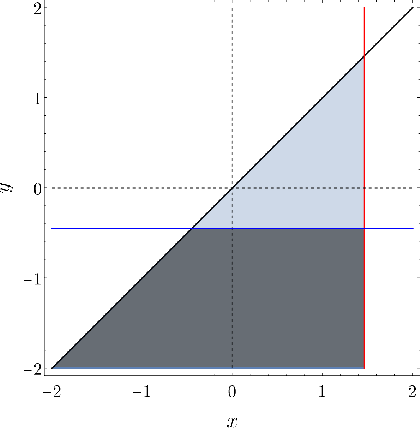
Figure 3: Parameter space in G(x)1 with roots and accessible regions for the four main cases distinguished by G(x)2, G(x)3, and G(x)4.
Physical Interpretation and Quantum Backreaction Effects
For G(x)5, quantum solitons describe the non-perturbative backreaction of the holographic CFT in a thermal state on global AdSG(x)6. The resulting geometry remains horizonless, retaining a smooth origin. As thermal energy increases (governed by parameter G(x)7 or, equivalently, the energy density of the CFT), the geometry interpolates between global AdS mass G(x)8 and a smooth conical deficit spacetime (G(x)9), but retains regularity.
For H(y)0, a central novel feature emerges: the horizon of the unbackreacted geometry (a Rindler-like horizon in AdSH(y)1) is eliminated by the quantum backreaction and replaced by a smooth cap. This "disappearing horizon" is a genuinely non-perturbative quantum gravitational effect that cannot be captured by perturbative expansion in H(y)2. In physical terms, the backreaction of matter at the "wrong" temperature dynamically resolves the would-be horizon singularity by modifying the global structure.
Figure 4: Bulk structure in cases with additional horizons and distinct brane intersection patterns, highlighting the difference between black hole and soliton configurations.
Conformal Boundary and Holographic Interpretation
The geometry on the conformal boundary for single-brane scenarios is generically nontrivial and depends sensitively on bulk moduli, leading to boundary conditions distinct from the unbackreacted (H(y)3 or H(y)4) cases. Of particular interest is the two-brane configuration, in which both H(y)5 and H(y)6 branes are introduced—the conformal boundary is now largely excised, facilitating a clean realization of holographic duality (akin to "wedge holography") without nontrivial induced data from the unbackreacted boundary.
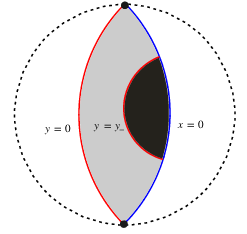
Figure 5: Sketch of the wedge braneworld construction with both H(y)7 and H(y)8 branes, showing the region of interest for boundary calculations and the cutoff surface important for regulated action computations.
Thermodynamics and Euclidean Action
The thermodynamic properties are systematically derived via Euclidean action calculations. A meticulous accounting is necessary in the two-brane setup, involving Gibbons-Hawking-York boundary terms, corner contributions, and suitable holographic counterterms. The resulting on-shell action enables the identification of ADM mass, entropy, and the first law for both quantum soliton and quantum BTZ branches.
A salient result is the mapping between soliton and black hole thermodynamics under the interchange H(y)9, reflecting the underlying double analytic continuation symmetry. Both branches satisfy the expected first law, with quantum solitons representing the backreacted vacuum reference for ensembles with large CFT central charge.
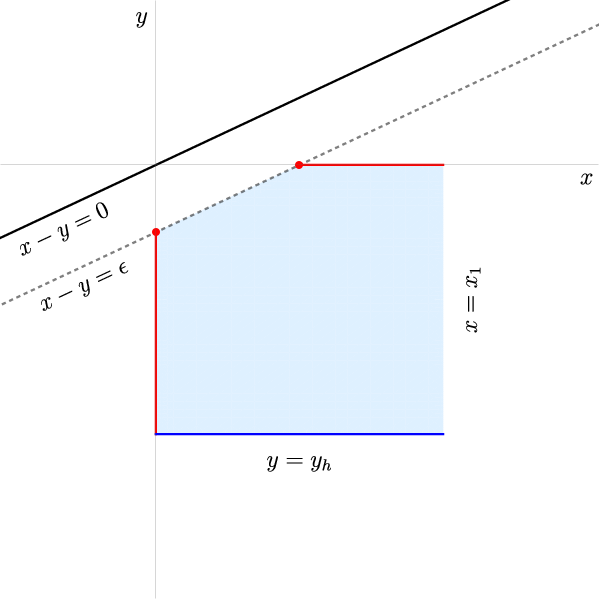
Figure 6: The region for the two-brane Euclidean action calculation in k0 coordinates, delineating branes, asymptotic boundary, horizon locations, and relevant corners for the variational principle.
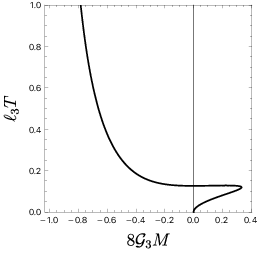
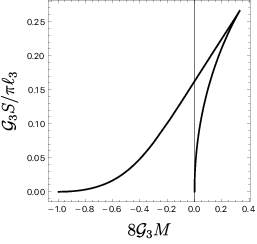
Figure 7: Quantum soliton mass vs temperature (left), showing positive and negative mass branches for k1 and their asymptotics; right: entropy as a function of mass, reflecting smooth thermodynamic behavior through the branch structure.
Theoretical and Practical Implications
The elucidation of quantum soliton geometries broadens the understanding of how semiclassical gravity incorporates non-linear quantum effects in lower-dimensional AdS. Practically, these solutions serve as controlled testbeds for fully backreacted CFT states, offering insights relevant for quantum cosmic censorship and the smoothing of would-be singularities.
The analysis demonstrates that the structure and phase behavior of thermal AdS/CFT ensembles are richer when genuine backreaction is included, challenging the common practice of using undeformed global AdSk2 as the unique reference background in quantum-corrected thermodynamics.
The universal resolution of singularities such as conical defects or mismatched-temperature horizons by quantum backreaction, as manifest in the k3 quantum soliton, suggests a general mechanism in semiclassical gravity/holography where pathological states are dynamically excised from the physical spectrum.
Conclusion
This work offers a comprehensive classification and analysis of quantum soliton solutions in AdSk4 braneworld gravity, mapped out within the AdS C-metric framework. These results constitute a nontrivial extension of holographic quantum gravity, realizing explicit backreacted geometries for non-vacuum CFT states and exposing new mechanisms for the non-perturbative resolution of horizon and singularity pathologies. The interplay between bulk brane configurations, semiclassical effective theory, and boundary holographic conditions is elucidated in detail, with implications for braneworld phenomenology and quantum gravity phase structure.
Further research directions include extensions to charged/rotating C-metrics, systematic exploration of canonical ensemble phase transitions between quantum BTZ and quantum soliton phases, and generalization to higher dimensions—potentially illuminating universal aspects of quantum backreaction and cosmic censorship.
“Emergent Mind helps me see which AI papers have caught fire online.”
Philip
Creator, AI Explained on YouTube
Sign up for free to explore the frontiers of research
Discover trending papers, chat with arXiv, and track the latest research shaping the future of science and technology.Discover trending papers, chat with arXiv, and more.