G3T Up! Gravity Aligned Coordinate Frames Simplify Pointmap Processing
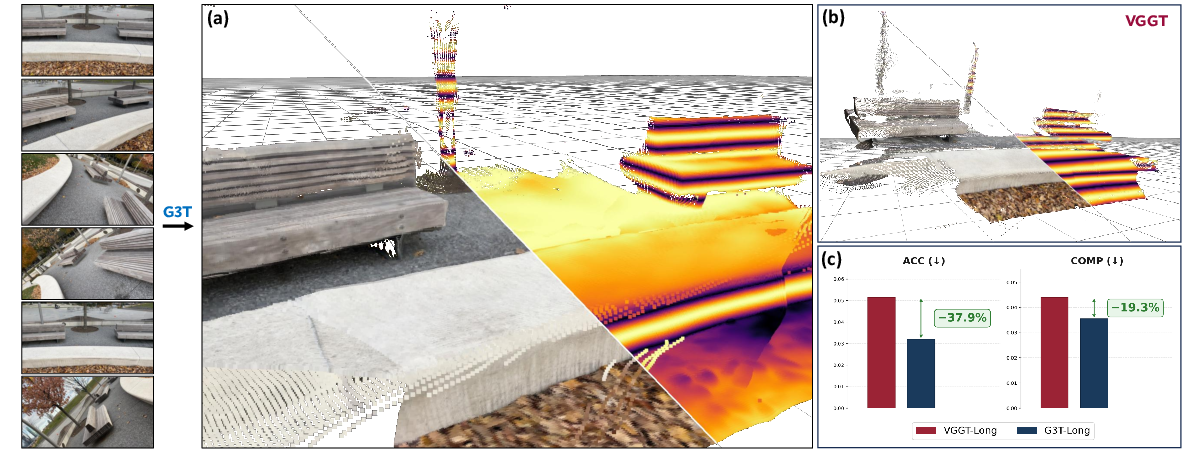
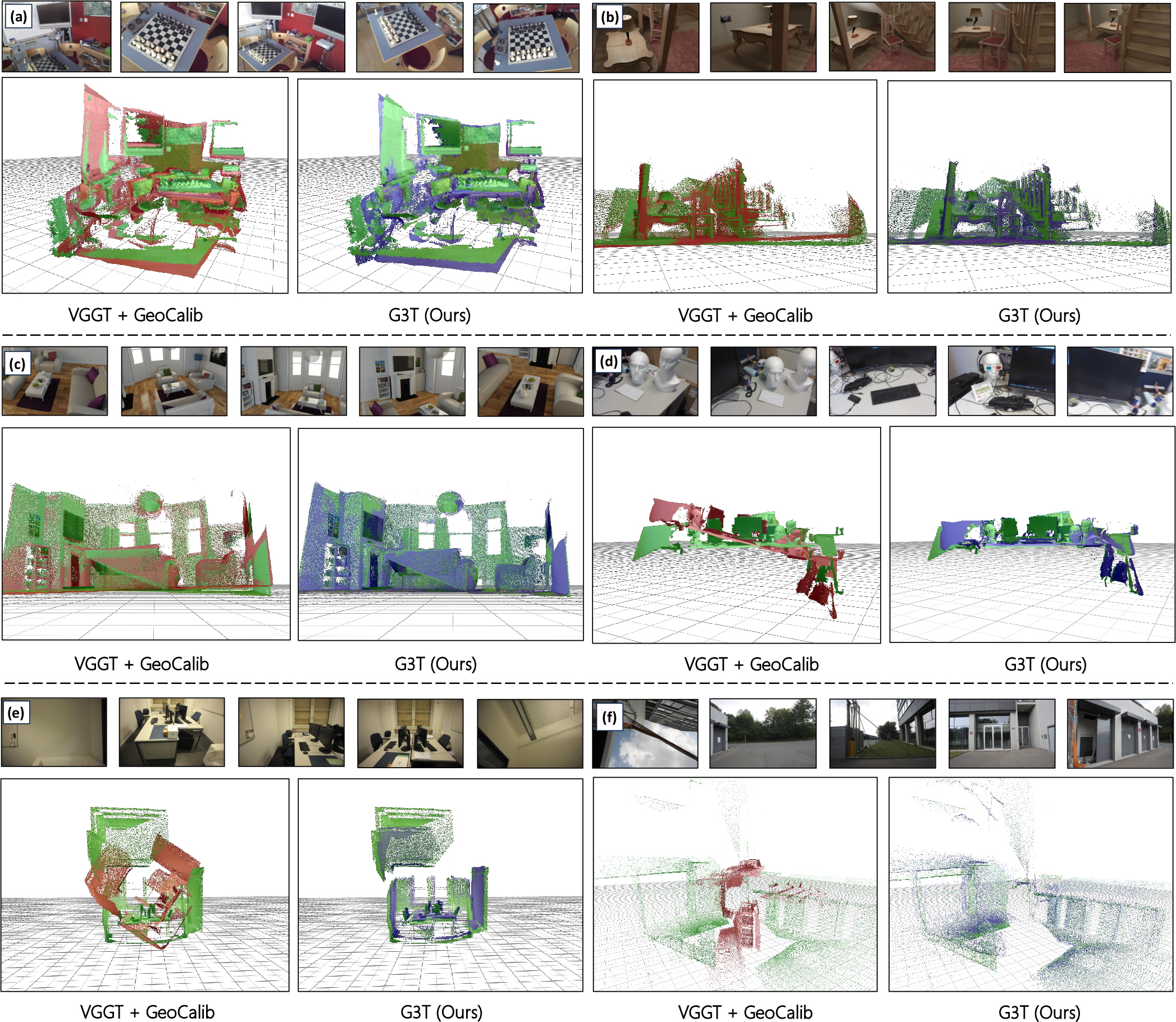
Abstract: Modern feed-forward 3D reconstruction methods like VGGT predict pixel-aligned pointmaps in camera-centric coordinate frames. However, this choice of coordinate frame is not always optimal. We propose instead to predict pointmaps in upright, gravity-aligned frames that exploit strong structural cues present in many real-world scenes. Unlike camera-centric frames, gravity-aligned frames share a common vertical axis across viewpoints, reducing the rotational degrees of freedom needed to relate pointmaps to one another. To this end, we introduce the Gravity Grounded Geometry Transformer (G3T), fine-tuned from existing models on gravity-aligned 3D data. G3T produces highly accurate gravity-aware predictions, including upright pointmaps and camera-to-gravity poses. We further introduce G3T-Long, a submap-based incremental 3D reconstruction pipeline that leverages the reduced rotational degrees of freedom afforded by upright frames to achieve significantly improved reconstruction accuracy.

Paper Prompts
Sign up for free to create and run prompts on this paper using GPT-5.
Top Community Prompts
Explain it Like I'm 14
G3T Up! Gravity-Aligned Frames Make 3D From Images Easier — A Simple Explainer
Overview
This paper is about a smarter way to turn photos into 3D scenes. Most modern systems predict a “pointmap,” which is a 3D point for every pixel in an image. Usually, these 3D points are placed in the first camera’s own “coordinate frame” (its idea of what counts as up, down, left, and right). The authors argue that this is not always the best idea. Instead, they propose predicting 3D points in a coordinate frame that is aligned with gravity — so “up” in the model matches real-world up. Their method is called G3T (Gravity Grounded Geometry Transformer), and they show it makes 3D reconstruction more stable and accurate, especially when combining many images or building large maps over time.
To make the explanation easier, here are a few quick definitions:
- Pointmap: think of it like “a 3D color-by-numbers,” where every pixel in a picture is assigned a 3D point in space.
- Coordinate frame: a consistent way to describe directions (up-down, left-right, forward-backward).
- Gravity-aligned frame: a frame where the vertical axis is real-world up, the same across different cameras and views.
- Yaw, pitch, roll: turn your head left-right (yaw), nod up-down (pitch), and tilt your head sideways (roll).
Key Objectives
The paper asks and answers three simple questions:
- If we predict 3D points in an “upright” frame (aligned with gravity), do the results become easier to combine across many images?
- Can we accurately predict both the 3D points and the camera’s orientation relative to gravity?
- If we process long video sequences in chunks, can this gravity trick reduce errors that build up over time (drift) and make reconstructions better?
Methods and Approach
First, the authors build on an existing powerful model (VGGT) that predicts 3D information from multiple images. They change two main things:
- Predict in an upright frame
- Instead of placing 3D points in the first camera’s tilted frame, G3T puts them in a gravity-aligned frame. This means all images agree on what “up” is.
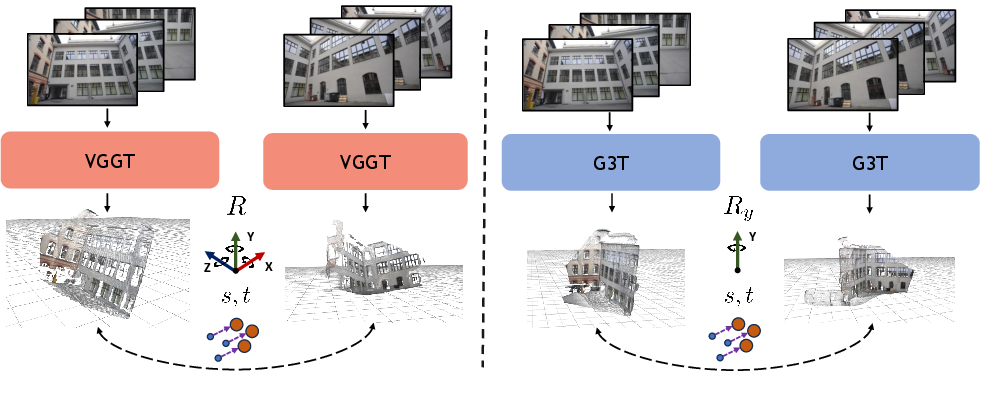
- Because “up” is shared, different pointmaps only need to be rotated around the vertical axis to line up. In plain terms, you only need to “turn left or right,” not also “tilt” or “nod.” That cuts the ways to rotate from three to one, which simplifies alignment.
- Split the camera prediction into two parts
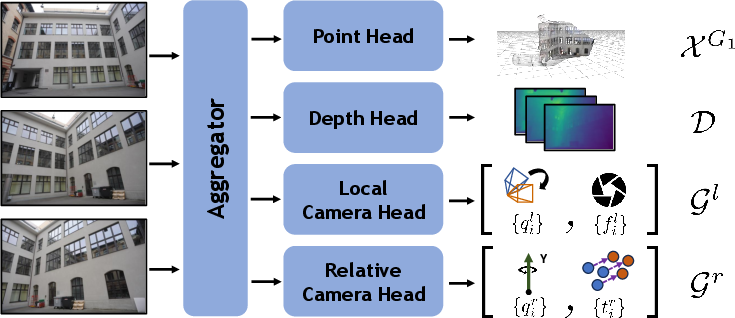
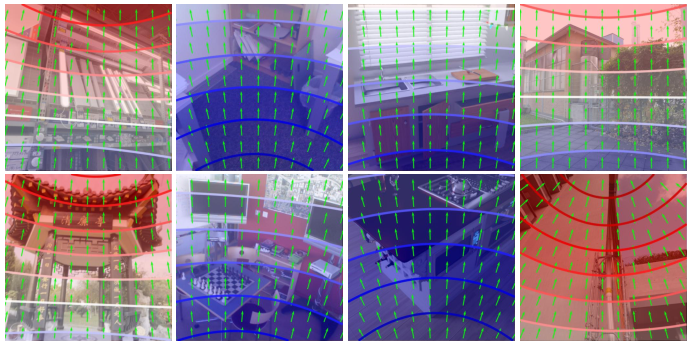
- A local head predicts how each camera is oriented relative to gravity (and its lens settings).
- A relative head predicts how each view rotates around “up” (yaw) and moves relative to the first view.
- Together, these outputs produce upright 3D pointmaps and also tell you how the camera relates to the gravity direction.
Aligning chunks with fewer “wiggles”
- When processing long sequences, they break the images into overlapping “submaps” (small groups of frames) because of memory limits. This is like drawing several small maps and then stitching them together.
- To stitch submaps, they use a version of a classic shape-matching method (Procrustes alignment), but with a gravity-aware twist: they only allow rotation around the vertical axis. Fewer allowed moves = easier, more robust stitching.
- They call the overall long-sequence system G3T-Long, which adapts a prior pipeline by adding this gravity constraint.
Training data and setup
- They fine-tune the existing VGGT model using data that they first “uprighted” using a standard tool, so the ground truth (the correct answer) is aligned with gravity.
- They train on several big datasets so the model learns upright predictions across many scenes.
Main Findings and Why They Matter
The authors test on several datasets they didn’t train on and report three key results:
- Better “uprightness” out of the box
- G3T more accurately figures out the camera’s direction relative to gravity than a popular baseline method that tries to adjust things after the fact.
- The predicted pointmaps are naturally upright, even when photos are taken at odd angles, so flat surfaces like floors look flat and level without extra fixing.
- Strong 3D quality, not just uprightness
- Even though G3T changes the coordinate frame, the quality of the 3D structures (how precise and complete the reconstructions are) stays as good as previous methods.
- Less drift and better reconstructions over long sequences
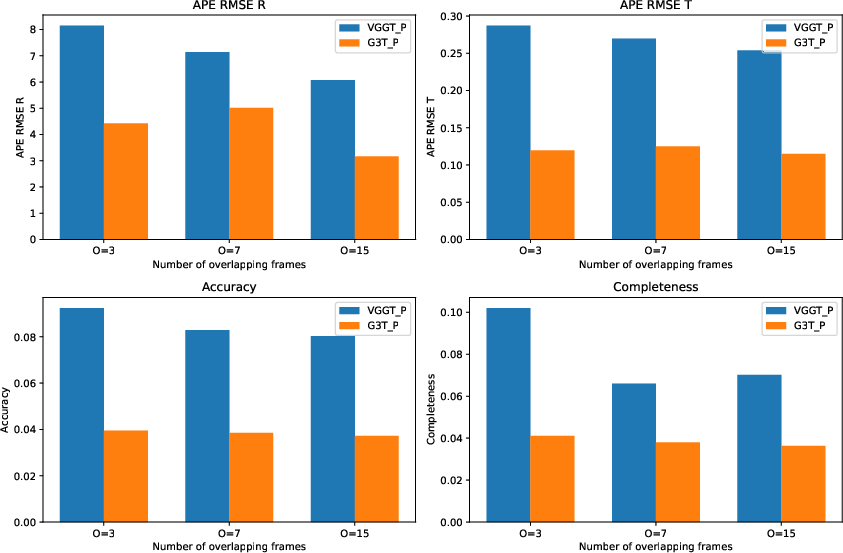
- In the long-sequence setup (G3T-Long), using the gravity constraint leads to more accurate camera poses and cleaner 3D maps, especially with less vertical drift. In other words, the map doesn’t slowly “sag” or “lean” as you keep adding more frames.
Implications and Impact
- Simpler, more robust mapping: By agreeing on “up” from the start, 3D maps from different views line up more easily and reliably. This helps in robotics, AR/VR, and navigation, where a stable sense of up/down matters.
- Better building blocks for other tasks: Once scenes are in a structured, gravity-aligned frame, other algorithms (like those that assume walls are vertical and floors are horizontal) can perform better.
- A general idea that travels: Although the authors build on VGGT, the same gravity-aligned idea can be added to other 3D-from-images systems.
A quick reality check: The method can struggle when images lack clear clues about “up,” like close-ups of flat floors or walls without context. Future work could combine gravity with even richer scene structure, such as “Manhattan frames” (where many lines are aligned with three perpendicular directions, like in typical buildings), or mix global scene frames with local object frames.
In short, G3T shows that choosing a smarter coordinate frame — one that respects how the real world is oriented — makes 3D reconstruction from images easier, more accurate, and more reliable over time.
Knowledge Gaps
Unresolved knowledge gaps, limitations, and open questions
The paper opens several concrete avenues where evidence is missing or the problem remains under-specified. Future work can address the following:
- Quantify label-noise sensitivity from gravity alignment of training data: assess how errors from COLMAP model_orientation_aligner (and Manhattan assumptions) propagate into G3T’s gravity predictions and reconstructions using datasets with ground-truth gravity (e.g., IMU).
- Establish evaluation on diverse, non-Manhattan, and outdoor scenarios: include natural scenes (forests, rocks), sloped terrain/stairs, streets with camber, drone/top-down imagery, handheld images with extreme roll, and moving platforms (boats/cars), and report gravity/structure metrics.
- Characterize ambiguity failure modes: systematically study when structural cues are insufficient (close-up floors/walls, textureless scenes, symmetric/feature-poor environments), and how many/which views are needed to disambiguate “up.”
- Analyze the theoretical benefits of DoF reduction: provide formal error-propagation or identifiability analysis showing how constraining to 5-DoF (Sim_y) impacts estimation variance, convergence, and drift versus 7-DoF (Sim).
- Measure yaw-specific drift and ambiguity: quantify how 1-DoF yaw accumulates across chunks, identify degeneracies (e.g., rotational symmetries), and evaluate global yaw consistency over long loops.
- Improve yaw disambiguation: explore semantic/vanishing-point priors, magnetometer/compass cues, or learned global orientation priors to fix residual 1-DoF ambiguity.
- Address metric scale: evaluate and reduce scale drift across chunks, and test integration of metric cues (stereo baselines, ARKit/LiDAR depth, IMU/gravity magnitude, known object sizes) to recover absolute scale.
- Compare gravity estimation baselines: include multi-view extensions of UprightNet/Perspective Fields, gravity-informed rotation averaging, and other camera-uprighting methods, not just GeoCalib.
- Validate backbone generality: port gravity-aligned frames to alternative feed-forward models (DUSt3R/MV-DUSt3R, Fast3R, DepthAnything3, pi3) and measure the consistency of gains.
- Design gravity-specific training objectives: go beyond gravity-aligned targets to add auxiliary losses (vanishing-point consistency, Manhattan/horizontal-plane priors, semantics-aware “upright” cues) and study their impact.
- Provide uncertainty estimates: learn or infer uncertainties for camera-to-gravity and yaw predictions and propagate them into GA-Procrustes and global optimization (e.g., uncertainty-weighted factors).
- Evaluate intrinsics accuracy: quantify local head intrinsic (FoV) errors, ablate their effect on depth unprojection in gravity frames, and study calibration-mismatch robustness.
- Examine loop-closure effects: analyze whether gravity-aligned frames improve loop-closure detection quality (precision/recall) and global pose-graph stability, not just local chunk alignment.
- Report runtime and scalability: benchmark inference/training cost, GA-Procrustes overhead, and end-to-end throughput; test long sequences (1000+ frames) and compare scalability vs VGGT-Long and SLAM baselines.
- Test robustness to dynamics and sensor artifacts: evaluate scenes with moving objects, rolling-shutter, motion blur, exposure changes, and texture scarcity; propose countermeasures if performance degrades.
- Reduce residual first-frame asymmetry: investigate fully scene-centric canonicalization (estimating a global gravity-aligned frame jointly across views) instead of anchoring to the first image’s gravity frame.
- Develop hybrid/conditional frames: define criteria and detectors for switching between gravity-, Manhattan-, and object-centric frames or composing them, and measure when each choice is advantageous.
- Create gravity-focused benchmarks: curate and release datasets with reliable gravity ground truth (e.g., synchronized IMU) and standardized tasks/metrics for uprightness and gravity-aware reconstruction.
- Strengthen chunk alignment under weak vertical structure: characterize degeneracy of xz-plane projection in GA-Procrustes and design fallback strategies (e.g., soft constraints, partial 3D alignment, robust priors).
- Integrate external sensors: study visual–inertial fusion (accelerometer/gyroscope) for gravity direction and yaw stabilization within the feed-forward and submap optimization pipelines.
- Assess downstream impact: quantify benefits of upright predictions for robotics/AR tasks (navigation, affordance reasoning, simulation, object placement) rather than only geometry-centric metrics.
- Perform comprehensive ablations: vary number of views, chunk size/overlap, confidence weighting schemes, training data composition, fine-tuning strategies (frozen layers, heads), and evaluate sensitivity across datasets.
Practical Applications
Overview
This paper introduces G3T (Gravity Grounded Geometry Transformer) and G3T-Long, which predict gravity-aligned (upright) pointmaps and camera-to-gravity poses from images, and use a gravity-constrained submap alignment (GA-Procrustes) to reduce rotational degrees of freedom during multi-view alignment. This shift from camera-centric to gravity-aligned frames improves consistency across views, reduces drift in long reconstructions, and yields outputs that are immediately usable for visualization, simulation, and downstream geometric reasoning.
Below are the practical applications derived from the paper’s findings, methods, and innovations, grouped by deployment horizon.
Immediate Applications
These can be deployed now with current models and engineering effort similar to integrating existing feed-forward 3D reconstruction pipelines.
- Gravity-aligned 3D scanning in mobile apps and AR platforms
- Sectors: software, consumer AR/VR, real estate, interior design, e-commerce
- Use case: Produce upright point clouds/meshes directly from phone/tablet images, eliminating manual reorientation and enabling plug-and-play placement in engines that assume a known up-axis (e.g., Y-up).
- Tools/products/workflows: “UprightScan SDK” (G3T-based module for iOS/Android), exporters to USD/GLTF with gravity metadata, AR preview apps with stable physics and occlusion.
- Assumptions/dependencies: Typical indoor/outdoor scenes with gravity cues (floors, walls, furniture); sufficient image diversity (not only floor/ceiling close-ups).
- Gravity-aware SLAM/visual odometry back-ends with reduced drift
- Sectors: robotics, drones, logistics, warehouse automation
- Use case: Replace standard Procrustes with GA-Procrustes and optimize in the 5-DoF similarity group (scale, yaw, 3D translation) to constrain submap alignment and reduce vertical drift in long sequences.
- Tools/products/workflows: ROS module for “Gravity-Constrained Submap Alignment,” drop-in back-end for existing VIO/SLAM stacks; integration with G3T-Long for chunked processing.
- Assumptions/dependencies: Gravity-aligned pointmaps available (from G3T) or reliable gravity direction from IMU; loop closures still needed for large loops.
- Faster multi-view reconstruction with yaw-only relative pose constraints
- Sectors: surveying, construction tech, digital twins
- Use case: Use the reduced DoF (yaw-only rotation across viewpoints) to speed up global alignment and improve robustness in indoor/site scans.
- Tools/products/workflows: “GA-Procrustes” library for similarity alignment with yaw restriction; cloud pipeline modules for chunking and global optimization in Sim_y.
- Assumptions/dependencies: Scenes exhibit stable gravity cues; scale ambiguity remains unless metric cues (e.g., LiDAR, known baselines) are provided.
- Upright-ready scene assets for visualization and simulation engines
- Sectors: gaming/film (virtual production), simulation, digital content creation
- Use case: Export gravity-aligned pointmaps/meshes that load with correct orientation in Unity/Unreal/Omniverse without additional transforms; improved default physics and camera rigs.
- Tools/products/workflows: “Upright Exporter” plugins; asset ingestion pipelines that tag gravity axes in metadata.
- Assumptions/dependencies: Up-axis conventions consistent across tools; mixed datasets may need re-normalization.
- Improved single- and multi-image gravity (up-vector) estimation
- Sectors: camera calibration, photogrammetry, drone and mobile camera stacks
- Use case: Use G3T’s local camera head to estimate camera-to-gravity rotation, improving orientation initialization in pipelines and complementing IMUs that suffer yaw drift.
- Tools/products/workflows: “Gravity-Calib” microservice that returns up-vector from images; hybrid fusion with IMU to stabilize orientation over time.
- Assumptions/dependencies: Presence of structural cues; performance degrades on ambiguous views (e.g., textureless floors/walls).
- Better multi-user scan fusion via a shared upright frame
- Sectors: collaborative AR, architecture/design teams, field documentation
- Use case: Users independently scan different parts of a space and fuse them consistently by aligning all submaps to a common gravity axis.
- Tools/products/workflows: “Upright Fusion” cloud service; team scanning apps that auto-merge rooms/floors.
- Assumptions/dependencies: Consistent gravity estimation across devices; sufficient overlap or place recognition for translations and yaw.
- Orientation-aware measurement and documentation
- Sectors: insurance, facilities management, property appraisal
- Use case: Upright reconstructions enable accurate vertical/horizontal measurements (e.g., ceiling height, door clearances) without manual reorientation.
- Tools/products/workflows: Field apps for claims and inspections; automated report generation with height/clearance annotations.
- Assumptions/dependencies: Sufficient scene coverage and texture; metric scale requires known references or additional sensors.
- Dataset normalization and benchmarking utilities
- Sectors: academia, ML infrastructure, open datasets
- Use case: Normalize existing datasets into gravity-aligned frames to improve training stability and enable evaluation metrics tied to uprightness.
- Tools/products/workflows: “Gravity-Normalizer” pre-processing scripts; benchmarks that report uprightness, drift, and structure.
- Assumptions/dependencies: Availability of vanishing point or Manhattan alignment tools for legacy data; not all scenes admit reliable gravity cues.
Long-Term Applications
These require further research, scaling, integration with additional sensors, or standardization.
- Robust gravity-aligned SLAM with IMU/LiDAR fusion at scale
- Sectors: autonomous robotics, drones, automotive, industrial inspection
- Use case: Fuse G3T gravity alignment with inertial and LiDAR cues for city-scale or multi-level facility mapping with minimized drift and stronger global consistency.
- Tools/products/workflows: Next-gen SLAM back-ends with gravity priors; large-scale map maintenance services.
- Assumptions/dependencies: Tight sensor synchronization and calibration; robust handling of yaw ambiguities and dynamic scenes.
- Standardization of gravity-aligned scene coordinates for 3D deliverables
- Sectors: policy, AEC (architecture/engineering/construction), GIS
- Use case: Define and adopt standards that require gravity-aligned frames and orientation metadata in 3D deliverables for permitting, inspections, and asset management.
- Tools/products/workflows: Compliance validators for GLTF/IFC/CityGML with up-axis requirements; government/industry guidelines.
- Assumptions/dependencies: Consensus across standards bodies; backward compatibility with legacy datasets.
- Gravity- and Manhattan-aware reconstruction and reasoning
- Sectors: research, AEC, robotics, simulation
- Use case: Extend beyond gravity to Manhattan frames (when present) for even stronger constraints in reconstruction and semantic scene understanding (e.g., wall/room layout).
- Tools/products/workflows: Hybrid gravity+Manhattan inference modules; structured BA routines with axis-aligned plane priors; procedural model fitting.
- Assumptions/dependencies: Reliable detection of Manhattan frames; fallback strategies for non-Manhattan scenes.
- Digital twin creation with upright semantics and real-time updates
- Sectors: smart buildings, manufacturing, energy/utilities
- Use case: Maintain digital twins where geometry, semantics, and physics operate in a consistent upright frame to support analytics (e.g., vertical clearances, drainage/flow, egress analysis).
- Tools/products/workflows: Twin platforms that enforce gravity-aligned coordinate contracts; automated QA checks for vertical alignment.
- Assumptions/dependencies: Persistent scanning pipelines; interoperability with BIM/GIS models; real-time constraints.
- Gravity-aligned multi-robot and multi-agent mapping
- Sectors: logistics, search and rescue, construction robotics
- Use case: Multi-agent teams map different building areas and fuse maps quickly using shared gravity alignment and yaw-only relative orientation, reducing global optimization complexity.
- Tools/products/workflows: Coordination middleware with gravity-aligned submap exchange; on-robot GA-Procrustes modules.
- Assumptions/dependencies: Communication bandwidth, robust loop closure, consistent scale estimation.
- Physics-consistent AR/VR and training simulations
- Sectors: education, defense, public safety training, sports analytics
- Use case: Author and run simulations that assume known up-axis, improving realism and stability of physics, AI agents, and perception modules in virtual environments derived from real scenes.
- Tools/products/workflows: “Upright Scene Import” for simulation platforms; scenario generators that rely on gravity-aligned assets.
- Assumptions/dependencies: High-fidelity scans; consistent coordinate conventions across engines.
- Automated code and safety compliance checks from scans
- Sectors: policy, AEC, insurance
- Use case: Run automated checks for vertical/horizontal clearances, slope/grade compliance, and accessibility metrics on gravity-aligned reconstructions.
- Tools/products/workflows: Analytics engines integrated with permitting/claims systems; report generation with annotated non-compliances.
- Assumptions/dependencies: Metric scale known; reliable segmentation/semantics; standardized measurement protocols.
- Gravity-grounded foundation for 3D vision benchmarks and architectures
- Sectors: academia, ML research
- Use case: Design benchmarks and neural architectures that natively operate in gravity-aligned frames to exploit structural priors and reduce symmetry-induced failure modes.
- Tools/products/workflows: New challenge tracks evaluating uprightness, vertical drift, and constrained alignment; open-source gravity-aware backbones.
- Assumptions/dependencies: Community adoption; broader availability of gravity-aligned training data.
- Consumer-grade room modeling and furniture layout with consistent up
- Sectors: consumer apps, retail, smart homes
- Use case: Home users capture spaces; apps produce floor plans, elevation views, and auto-snap furniture to floors/walls using gravity-consistent coordinates.
- Tools/products/workflows: “Upright Layout Assistant” integrated into design apps; AR placement with correct gravity-based collision/physics.
- Assumptions/dependencies: Good coverage and texture; standardized device APIs for gravity-aligned outputs.
Key Assumptions and Dependencies (cross-cutting)
- Scene prior: The approach relies on Earth gravity cues and typical structures (floors, walls). Performance degrades in scenes with ambiguous or sparse cues (e.g., textureless surfaces, tight close-ups).
- Yaw ambiguity: Relative yaw remains and must be estimated; loop closures and multi-view constraints still matter.
- Scale ambiguity: Without metric sensors or references, reconstructions remain up-to-scale (Sim3).
- Training data: High-quality gravity-aligned training sets are required; existing datasets may need alignment or augmentation.
- Compute and memory: Chunked processing (G3T-Long) helps, but production pipelines still need GPU/edge resources or cloud back-ends.
- Sensor fusion: IMU/LiDAR/GNSS can boost robustness; success depends on calibration and synchronization.
- Standards and interoperability: Broad impact improves with consistent up-axis conventions and metadata propagation across tools and file formats.
Glossary
- ACC (Accuracy): A structure metric that quantifies how close reconstructed geometry is to ground truth. "accuracy (ACC), completeness (COMP), and normal consistency (NC)"
- Ambient frame: The reference coordinate frame in which poses are evaluated (e.g., camera frame or gravity frame). "We measure the quality of the optimized absolute poses per chunk against ground-truth poses in their respective ambient frame."
- Camera-centric coordinate frame: A coordinate system whose axes are aligned with the camera; predictions expressed relative to the camera viewpoint. "Modern feed-forward 3D reconstruction methods like VGGT predict pixel-aligned pointmaps in camera-centric coordinate frames."
- Camera intrinsics: Internal camera parameters governing image formation (e.g., focal length, field of view). "camera intrinsics parameters in "
- Camera-to-gravity pose: The orientation and position relating the camera to the gravity-aligned frame. "evaluating the uprightness of the camera-to-gravity poses and pointmaps predicted by"
- Confidence map: Per-pixel weights indicating prediction reliability. "where the weights are initialized using confidence maps corresponding to the pointmaps"
- Degrees of freedom (DoF): Independent parameters needed to specify a transformation or model. "a pose that has 7 degrees of freedom (DoF)."
- Depthmap unprojection: Converting per-pixel depth into 3D points using camera parameters. "The depthmap unprojection results additionally validate that the relative yaws predicted by the global head are informative."
- GA-Procrustes: A gravity-aligned variant of Procrustes that constrains rotation to the vertical axis. "GA-Procrustes: Estimate from pointmaps , "
- Geodesic rotation error: The angular distance on the rotation manifold between two rotations. "We use the geodesic rotation error (as defined in~\cite{InterPose}) to measure performance:"
- Gravity-aligned coordinate frame: A coordinate system whose vertical axis is aligned with gravity. "a gravity-aligned coordinate frame"
- Gravity-to-camera rotation: The rotation mapping the gravity-aligned frame to the camera frame. "(gravity-to-camera rotation)"
- Levenberg–Marquardt algorithm: An optimization method for nonlinear least squares problems. "allowing the problem to be solved in an unconstrained manner using the Levenberg-Marquardt algorithm"
- Lie algebra: The vector-space representation associated with a Lie group used for optimization and linearization. "the 7-dimensional Lie algebra of "
- Loop closure: Detecting that the camera has returned to a previously seen place to reduce drift. "chunks constructed across loop closure detections."
- Manhattan alignment: Aligning a scene to orthogonal axes consistent with a Manhattan world assumption. "COLMAP's model_orientation_aligner for Manhattan alignment"
- Manhattan world: A structural prior assuming scene directions are aligned to three orthogonal axes. "Manhattan world stereo"
- Pointmap: A per-pixel prediction of 3D points aligned with image pixels. "Pointmaps have recently become a widespread choice for representing image-centric 3D geometry in learned models."
- Procrustes alignment: A closed-form method to estimate similarity transforms between corresponding point sets. "This objective can be solved in closed form using Procrustes alignment"
- Quaternion: A 4D parameterization of 3D rotations. "rotation quaternion "
- RANSAC: A robust estimation technique that iteratively fits models while rejecting outliers. "we implement a RANSAC loop"
- Root mean squared (RMS): A statistical measure of magnitude used here for distances between points. "(where the root mean squared distance)"
- Rotation averaging: The process of estimating globally consistent rotations from pairwise measurements. "rotation averaging~\cite{pan2024gravity}"
- Sim (Similarity transform group): The set of 3D transformations combining scale, rotation, and translation. ""
- sim (Lie algebra of Sim): The 7D vector-space representation used to optimize similarity transforms. "optimization is performed over (the 7-dimensional Lie algebra of )"
- SVD (Singular Value Decomposition): A matrix factorization used to solve for optimal rotations in alignment. ""
- Submap-based incremental 3D reconstruction: Building a global model by aligning overlapping local reconstructions (submaps) over time. "a submap-based incremental 3D reconstruction pipeline"
- Unprojecting: Mapping image pixels with depth back into 3D space. "by unprojecting the depthmaps using the camera parameters."
- Uprightness: The degree to which predictions are aligned with the vertical direction. "We visualize uprightness using a ground-parallel grid and height-dependent color encoding."
- Vanishing points: Image points where projections of parallel 3D lines converge, revealing scene orientation. "detect vanishing points from single images"
- World-centric coordinate frame: A scene-aligned frame independent of any particular camera viewpoint. "a world-centric, rather than camera-centric coordinate frame."
- Yaw: Rotation about the vertical (up) axis. "(1-DoF relative yaw w.r.t.\ the first frame)"
Collections
Sign up for free to add this paper to one or more collections.