- The paper demonstrates that selecting reasoning traces based on reconstruction capability outperforms traditional post-hoc rationalization.
- The Recon pipeline synthesizes candidate reasoning via a reasoning model and scores them by reconstructing actions with an action model, achieving significant win rates across diverse domains.
- Experiments reveal improved causal interpretability and cross-model trace transfer, underscoring practical benefits for explainable user modeling.
Reconstruction-Guided Reasoning Synthesis for User Modeling
The paper "Recon: Reconstruction-Guided Reasoning Synthesis for User Modeling" (2605.26969) addresses the challenge of reasoning synthesis in user modeling with LMs, particularly under settings where only free-form, unstructured context–action pairs (e.g., natural conversations, responses) are available. Existing approaches often augment the corpus with reasoning traces generated via post-hoc rationalization—conditioning on both the context and action—resulting in explanations that are consistent with the observed action but loosely connected to latent causal decision paths. The paper posits that post-hoc rationalization is insufficient: reasoning traces should be selected based on their predictive power, i.e., the extent to which they enable the action model to reconstruct the observed action given the context.
Recon Pipeline and Methodology
Recon operates by taking a context–action pair (c,a∗), synthesizing N candidate reasoning traces from a reasoning model Mr, and then reconstructing the action using an action model Ma conditioned on (c,candidate reasoning). The alignment between the reconstructed action and the ground-truth action is used to score the reasoning trace. Recon can be flexibly employed in both training-free settings (by selecting the highest-scoring candidate rationalization) and training-based settings (using the reconstruction score as a reward signal for RL fine-tuning of Mr).
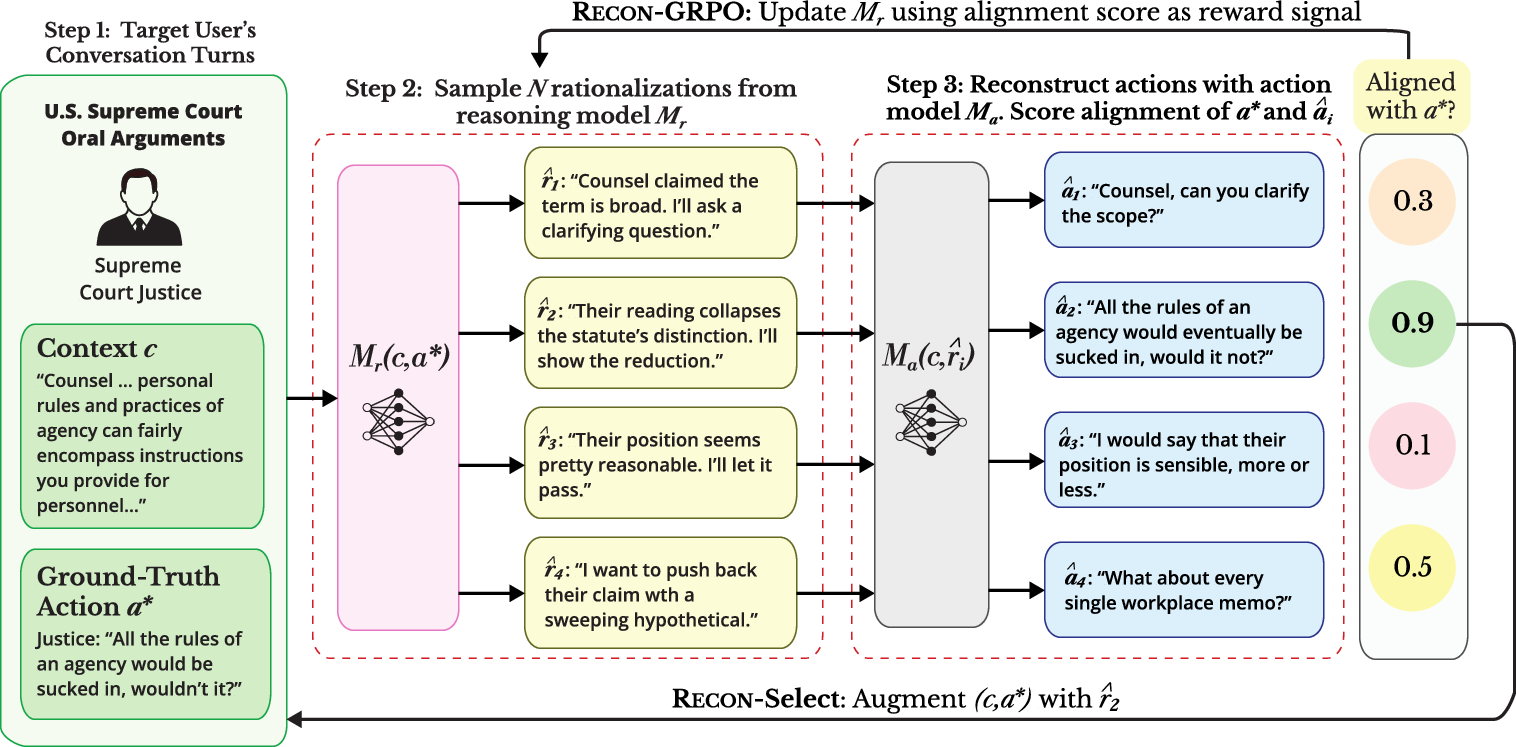
Figure 1: Recon pipeline illustrating candidate rationalization generation, action reconstruction, and selection based on fidelity.
The paper explicitly distinguishes between reasoning (the latent cognitive path prompting the action) and rationalization (post-hoc justification), emphasizing that rationalizations can be arbitrarily consistent with the action without encoding latent causality—a distinction critical for modeling authentic user behavior.
Evaluation Setup
Recon was evaluated across four domains representing diverse interaction styles and modalities: Reddit (informal text), Podcasts (long-form interviews), UK Parliament debates (spoken formal interchange), and US Supreme Court oral arguments (legal spoken interactions). Context consists of prior turns; the action is the individual's next utterance.
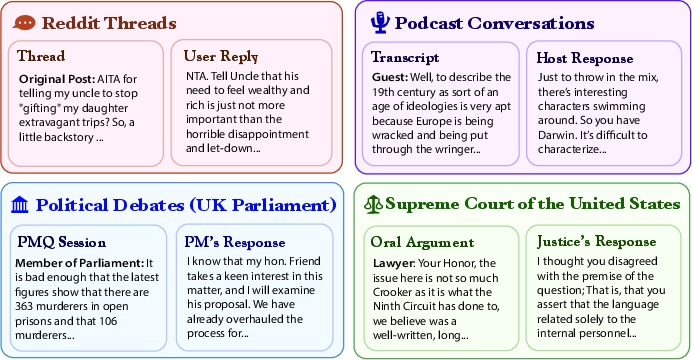
Figure 2: Data domains studied: Reddit, Podcasts, UK Parliament debates, and US Supreme Court oral arguments.
Baselines include Backward Synthesis—standard post-hoc rationalization conditioning on (c,a∗)—and E2E-GRPO, training the reasoning synthesis model directly for action accuracy based on LM-judge reward.
Experimental Results and Analysis
Recon outperformed Backward Synthesis with a 54.7% win rate using Qwen3-8B and 53.5% with GPT-5-mini, with wins distributed across all domains. E2E-GRPO, which optimizes only action reproduction accuracy, underperformed at 38.4%, supporting the claim that reasoning traces should be optimized for causal interpretability rather than action reproduction alone.
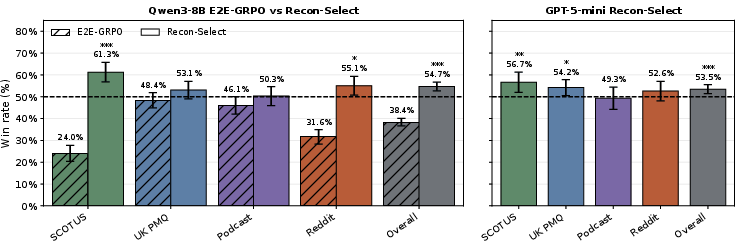
Figure 3: Recon and E2E-GRPO results—overall and per-domain win rates against Backward Synthesis.
A breakdown by alignment dimension (style, intent, values) demonstrated that Recon consistently improved across all latent dimensions, not just surface style, but also intent and value congruence.
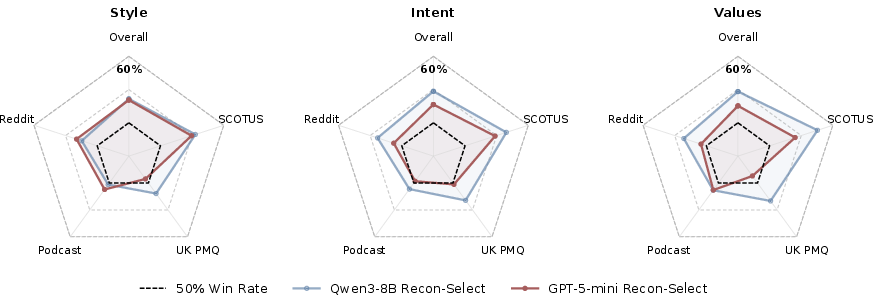
Figure 4: Recon win rates by alignment dimension, showing consistent improvements across style, intent, and values.
Transferability experiments showed that Recon reasoning traces synthesized by a stronger model (Mr) improved downstream action generation when used by a distinct (often weaker) action model (Ma). The performance was asymmetric: traces synthesized by weaker models were less useful for stronger action models, but the reverse held significant gains.
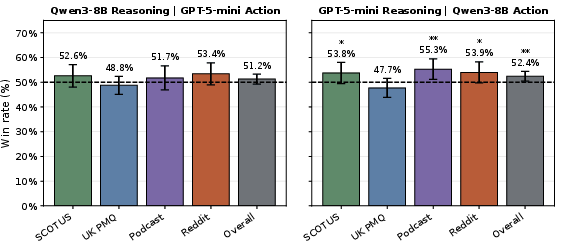
Figure 5: Cross-model transfer results demonstrating significant gains when Recon reasoning traces are transferred from a stronger reasoning model to a weaker action model.
Ablation studies across model sizes (Qwen3-4B, Qwen3-8B, Llama-3.1-8B-Instruct, Qwen3-14B) indicated larger gains for weaker reasoning models, and diminishing utility as the reasoning model improved, suggesting limited headroom for further improvements in high-capacity models.
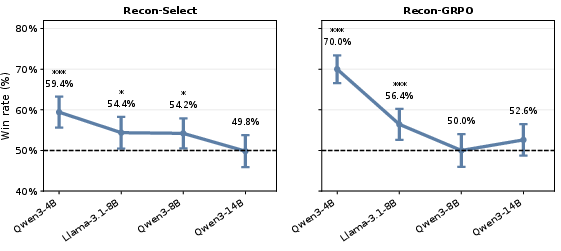
Figure 6: Recon and Recon RL training results across reasoning model families and sizes, with largest improvements for smaller models.
Recon-guided RL training further boosted downstream performance, achieving up to a 70.0% win rate for Qwen3-4B—a substantial improvement over prompt-based selection. The largest improvements were realized in domains and models with greater capacity gaps between reasoning and action generation.
A qualitative analysis highlighted Recon's ability to capture latent communicative stances—in PMQ, Recon identified an intent to attack the opposition, resulting in more aligned action predictions, while Backward Synthesis rationalizations tended toward defensive explanations.
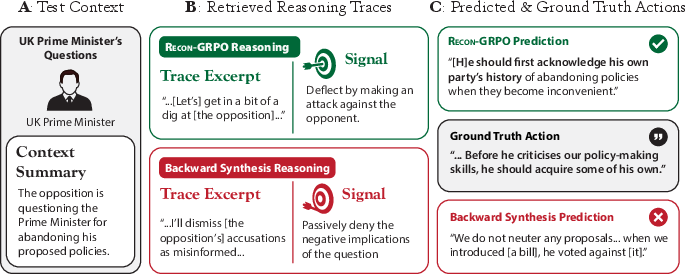
Figure 7: Qualitative example from PMQ—Recon identifies and synthesizes reasoning traces aligned to the communicative intent for action reconstruction.
Implications and Future Directions
Recon's approach demonstrates that synthesized reasoning traces must be evaluated not on surface consistency with observable action, but on their ability to elicit the action from the context—operationalizing a principle that reasoning quality is best measured by causal efficacy. The results generalize across domains of natural language, and the methodology could readily apply to other action spaces (e.g., code, math) where post-hoc rationalization currently dominates.
The transferability of reasoning traces across models and domains suggests that Recon's reconstruction criterion recovers latent user characteristics in a model-agnostic manner—indicating the potential for cross-domain user modeling and explainability.
Future work could explore reasoning generation conditioned solely on context (without access to action), scaling up candidate selection with larger N, extension to verifiable domains, and integration with preference-label-based personalization.
Conclusion
Recon introduces a principled, reconstruction-guided reasoning synthesis method for user modeling, systematically improving downstream action prediction over rationalization-based baselines. It establishes that reasoning traces should be selected for their causal efficacy, not merely their compatibility with observed actions. The approach enables the generation of interpretable and transferable reasoning traces, with demonstrated numerical gains and theoretical implications for the design of reasoning synthesis pipelines in behavioral modeling and explainable AI.

