- The paper demonstrates a multi-tier control architecture that combines per-GPU, per-host, and cluster-level strategies to meet sub-700 ms TSO requirements.
- It employs a deterministic safety-island bypass and real-time C actuation to ensure precise power setpoint tracking and efficient cooling overhead correction.
- Experimental results on NVIDIA V100 hardware show low trigger-to-meter latencies and significant CO2 reduction potential at cluster scale.
GridPilot: Real-Time Grid-Responsive Control for AI Supercomputers
Motivation and Context
GridPilot addresses the emergent challenge of integrating multi-megawatt AI/HPC data centers as flexible loads in increasingly renewable-dominated electricity grids. Contemporary grid frequency stability is predicated on load-side response to frequency excursions, necessitating precise, fast, and deterministic dispatch. Operators are imposing strict requirements on end-to-end facility-level response times for ancillary services like Fast Frequency Reserve (FFR), often below 700 ms. While prior research on power management reports efficiency gains or hardware-level actuation latency for GPUs, measured response from a Transmission System Operator (TSO) trigger to facility-level power change, compliant with published activation budgets, has not been empirically demonstrated by a composed, multi-tier controller.
GridPilot Architecture and Operational Principles
GridPilot composes three control tiers operating at disparate timescales: per-GPU PID (200 Hz), per-host AR(4) predictive coordinator (1 Hz), and per-cluster objective-driven selector (hourly). A deterministic safety-island bypass, implemented in real-time C, directly actuates per-GPU caps based on grid triggers, circumventing the higher-level predictive stack for sub-second response.
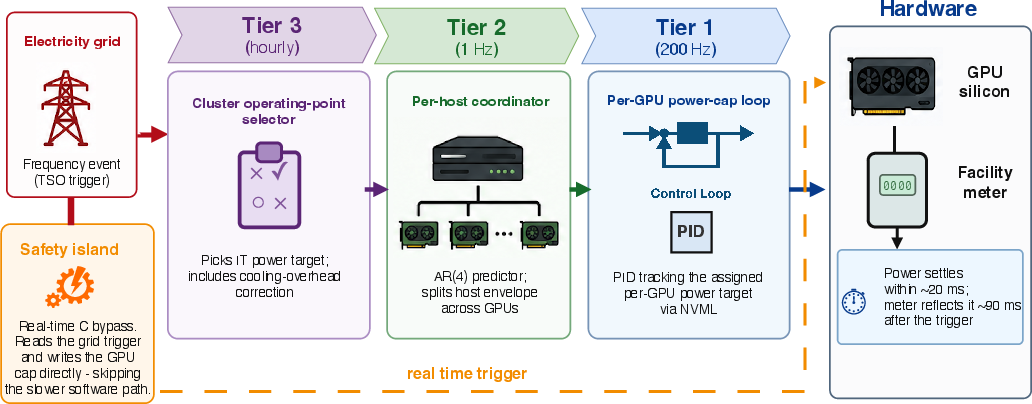
Figure 1: GridPilot architecture: multi-tier controllers with safety-island bypass ensure real-time response to grid events.
The PID controller is tuned for fast actuation in accordance with hardware cap-update latencies, targeting power setpoint tracking with minimal overshoot, and includes thermal fallback. The host-level AR(4) predictor leverages linear regression on recent utilization values to forecast per-node demand, coordinating GPU caps within envelope constraints. The cluster selector optimizes over operating fraction and reserve band for facility objectives, including carbon-free energy (CFE) alignment and FFR quality. The facility-level commitment is corrected by instantaneous PUE modeling, reconciling IT-side dispatch with meter-side settlement by explicitly capturing cooling and miscellaneous loads.
Experimental results on a three-GPU NVIDIA V100 SXM2 testbed demonstrate median end-to-end trigger-to-meter latency well below the strictest European FFR constraints, with ∼× empirical safety margin. Step-down settling times for the PID controller are consistently sub-30 ms. The AR(4) per-host predictor achieves low mean absolute error (MAE), with tracking error diagnostics distinguishing between Tier-1 and Tier-2 absorption of bursty workload residuals.
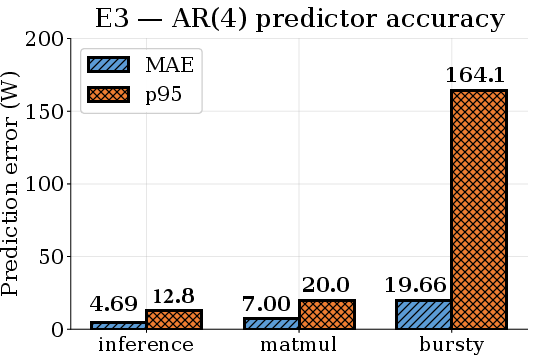
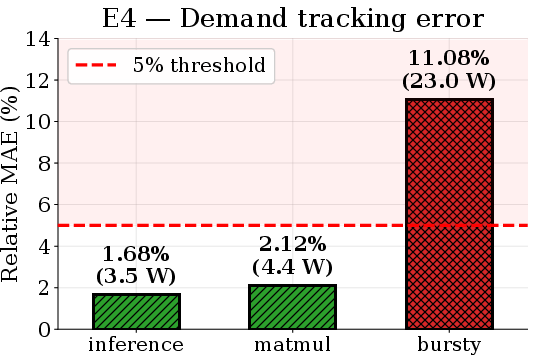
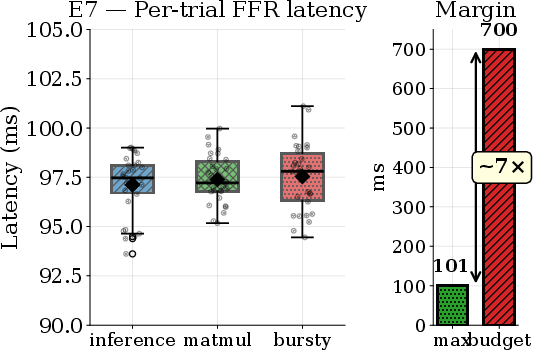
Figure 2: Component validation: predictor accuracy, closed-loop tracking error, and end-to-end actuation latency surpassing Nordic FFR standards.
Closed-loop demand-following tests confirm error within operational acceptance bands for representative workloads, with the bursty trace exceeding diagnostic thresholds, emphasizing multi-tier cascade composition. Without the safety-island bypass, identical experiments via Python exhibit p99 dispatch latencies exceeding 250 ms, disqualifying them from TSO pre-qualification.
Cluster-Scale Simulation and Facility-Level Carbon Savings
Simulations extending the controller to cluster scale (100 hosts) on the German grid validate operating-point selection and tracking at perfect FFR quality with dynamic reserve allocation. Net-savings decomposition at 50 MW scale exhibits operational and exogenous CO2 reductions, demonstrating the practical efficacy of GridPilot's joint frequency-carbon-aware scheduling.
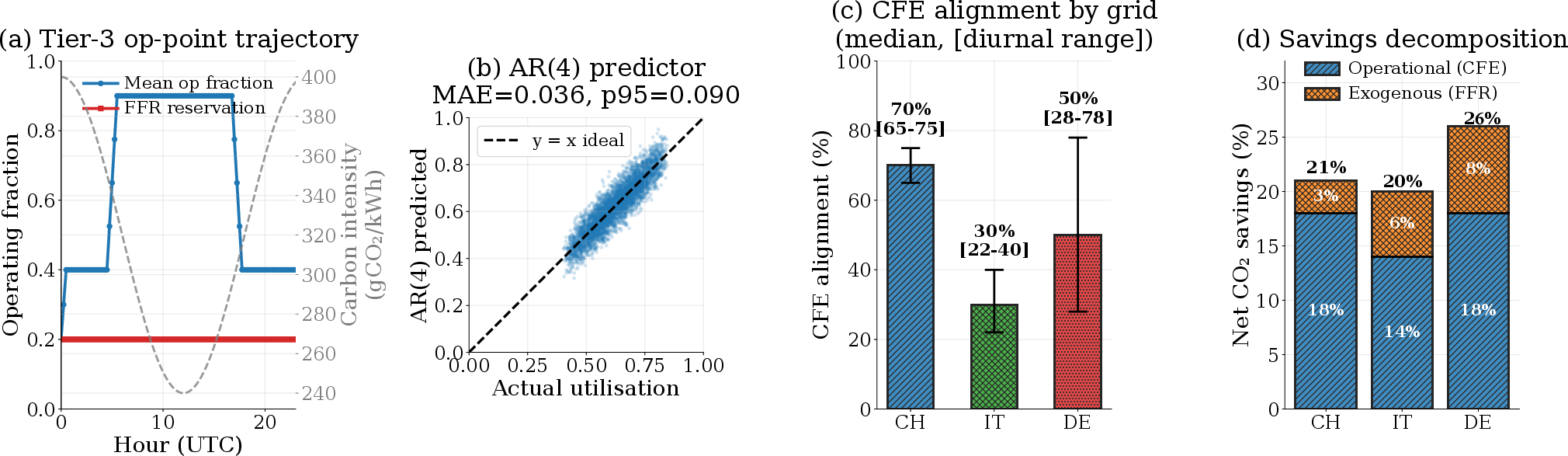
Figure 3: Cluster-scale validation: operating-point trajectories, predictor fit, carbon-free-energy alignment, and net-savings decomposition.
PUE-Aware Control and Cooling-Overhead Drag
Facility-meter accounting remains the binding correctness criterion for grid compliance. The four-component PUE model, incorporating cooling, pumps, air handling, and miscellaneous loads, ensures dispatched reserve matches metered commitment. Multi-country controller sweeps demonstrate closure of 2.5–5.8 percentage points (pp) of cooling-overhead drag across six European grids at 50 MW scale, scaling linearly with PUE design point and grid carbon intensity. The envelope is wider on clean grids as cooling overhead dominates at low absolute IT power.
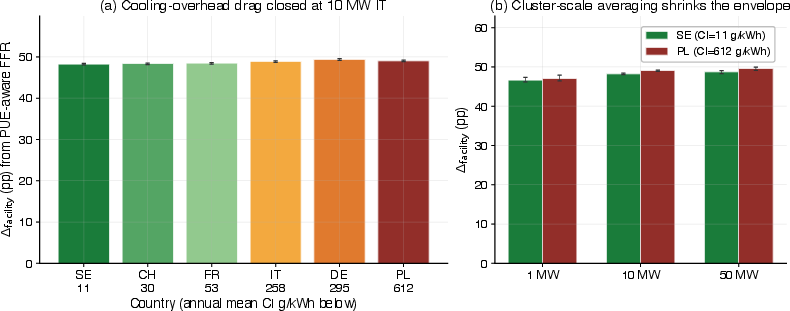
Figure 4: PUE-aware controller: cooling-overhead drag closure across countries and scaling by IT power.
Discussion, Limitations, and Practical Implications
Results reflect direct measurement on V100 hardware; projections to H100/H200/MI300 are pending empirical validation. The deterministic safety-island bypass is crucial for reproducibility. The facility-level accounting, via dynamic PUE adjustment, corrects under-delivery risk inherent to IT-board-centric dispatch. GridPilot's open-source reproducibility toolkit enables rapid transfer and experimental verification in other environments, supporting broader adoption.
GridPilot is architecturally positioned as the outermost grid-responsive layer, vertical-composing with in-cluster power managers (PowerSched, EAR, GEOPM) via the REGALE DDS bus and aligning functionally with the SEANERGYS ecosystem. Future work includes porting to modern GPU architectures, integration with production power management in over-provisioned clusters, and full TSO pre-qualification with real grid triggers.
Conclusion
GridPilot empirically substantiates the claim that AI/HPC clusters can act as deterministic, flexible loads for real-time grid response and carbon-aware dispatch. By composing multiscale predictive controllers with deterministic safety bypass and facility-meter PUE correction, GridPilot achieves sub-second grid compliance and closes cooling-overhead gaps at operationally relevant scale. This framework offers a reproducible foundation for regulatory compliant integration of large computing sites into modern grid ancillary service markets and sets the stage for migration to next-generation accelerators and production-scale deployments.