- The paper demonstrates that flexible scheduling of best-effort data center loads lowers system generation costs by shifting demand to off-peak periods with high renewable availability.
- It employs an hourly economic dispatch model using mixed-integer linear programming on a 2000-bus system to simulate grid constraints and load responses.
- Results show that flexibility reduces transmission congestion and both greenhouse gas and toxic emissions, offering actionable insights for grid planning and decarbonization.
System-Level Impacts of Flexible Data Center Load Scheduling on Power System Cost, Emissions, and Congestion
Introduction
The expansion of large data centers has imposed significant, geographically distributed electric loads on modern power grids. Recent projections point to a steep increase in data center electricity demand, driven primarily by AI and cloud computing workloads. This paper conducts a comprehensive system-level analysis, using the ACTIVSg2000 2000-bus power system, to quantify the operational, economic, and environmental impacts of flexibly scheduling best-effort (BE) data center workloads—those not bound by strict completion deadlines—while maintaining service quality for latency-critical (LC) jobs.
Methodology and System Model
The study implements an hourly economic dispatch (ED) framework over a 24-hour window, incorporating a detailed data center consumption model distinguishing between BE, LC, and auxiliary (fixed) loads. Only the BE component is eligible for flexible intraday scheduling, subject to each center’s daily energy commitment and the system’s physical constraints (generator ramp rates, transmission limits, and nodal power balance).
Economic dispatch is solved as a mixed-integer linear program, minimizing total system cost under DC power flow constraints, including a piecewise-linear generator cost representation. Critically, generator-specific CO2-equivalent and toxic emissions are accounted for in post-simulation analysis, derived from open-source emissions data and mapped onto the ACTIVSg2000 generator fleet.
The system scenario involves 47 data centers (9048 MW total), each assigned empirically realistic siting and power ratings. Centers are grouped into three clusters of approximately equal size, enabling exploration of locational flexibility impacts. Case studies evaluate system behavior under five scenarios: all data centers inflexible, all flexible, and three with only one cluster flexible at a time.
Temporal Load Shifting and Locational Marginal Prices
Flexible BE load scheduling was observed to strongly correlate with load shifting toward periods with lower locational marginal prices (LMPs)—periods also characterized by high renewable availability. This effect is illustrated by the marked reduction in LMPs at Bus 1995 (the highest-rated data center site) during peak demand hours under flexible scheduling.
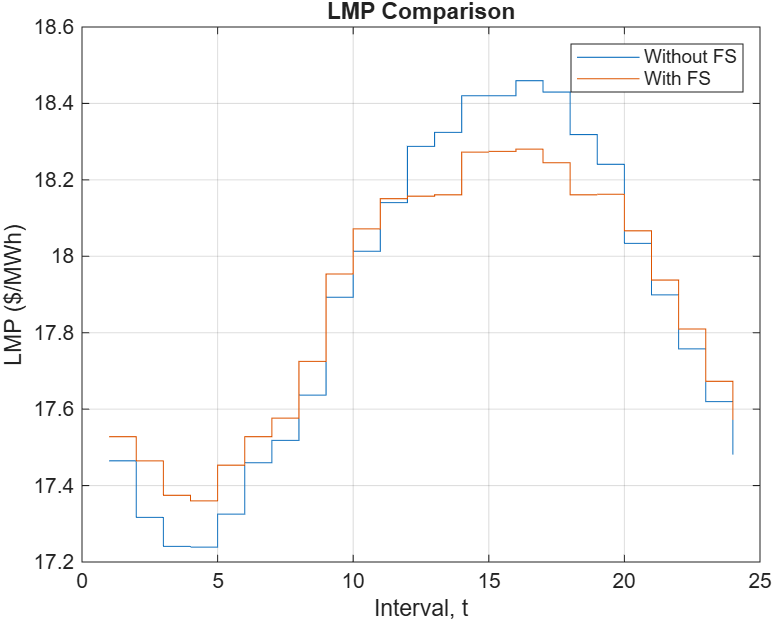
Figure 1: Comparison of LMPs at bus no. 1995, showing LMP reduction during peak periods with flexible scheduling.
At the same site, the hourly profile of data center power demand shows significant peak shaving under flexibility, demonstrating that scheduling alone—absent real-time regulation signals—enables nontrivial demand response.
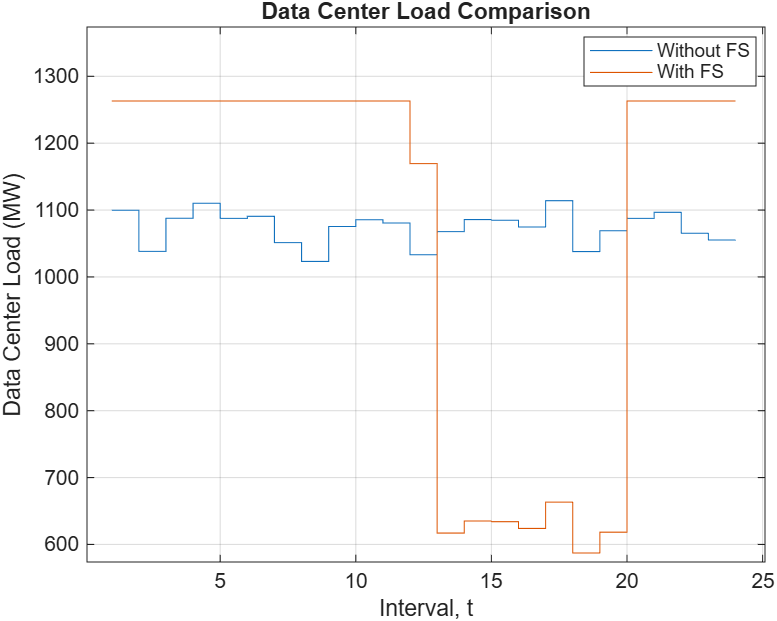
Figure 2: Comparison of hourly load distribution of the data center at bus no. 1995; flexible scheduling achieves effective load redistribution away from peaks.
This pattern synchronizes BE consumption with off-peak hours and high renewables dispatch, as evidenced by the temporal distributions of non-data center load and total renewable generation.
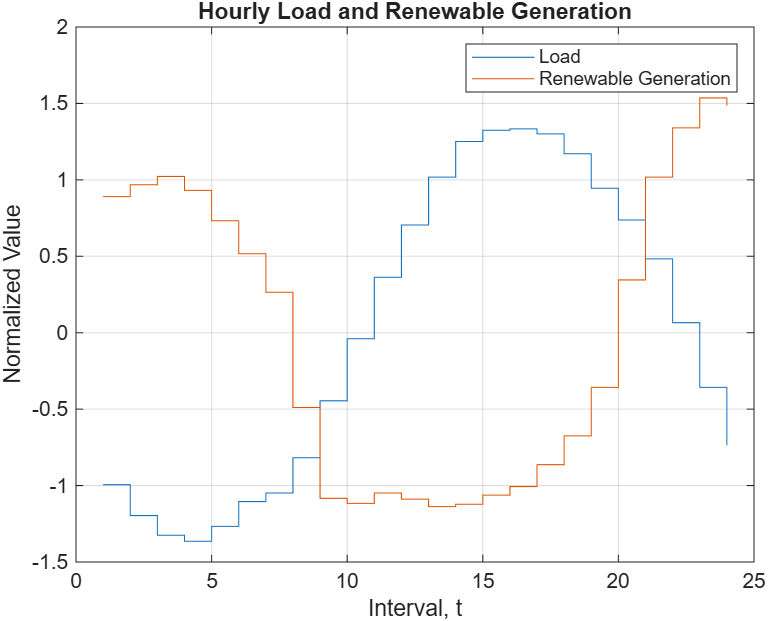
Figure 3: Temporal distribution of load demand (excluding data center loads) and renewable generation, highlighting alignments enabled by flexible BE scheduling.
Cost and Congestion Impacts
Numerical results indicate tangible operating cost benefits: system-wide flexible scheduling produces the lowest total generation cost ($24,302,425), a reduction of$16,329 compared to the fully inflexible scenario ($24,318,753). Partial flexibility (in one cluster at a time) delivers intermediate savings, though the relationship between local congestion metrics and cost reduction is not monotonic.
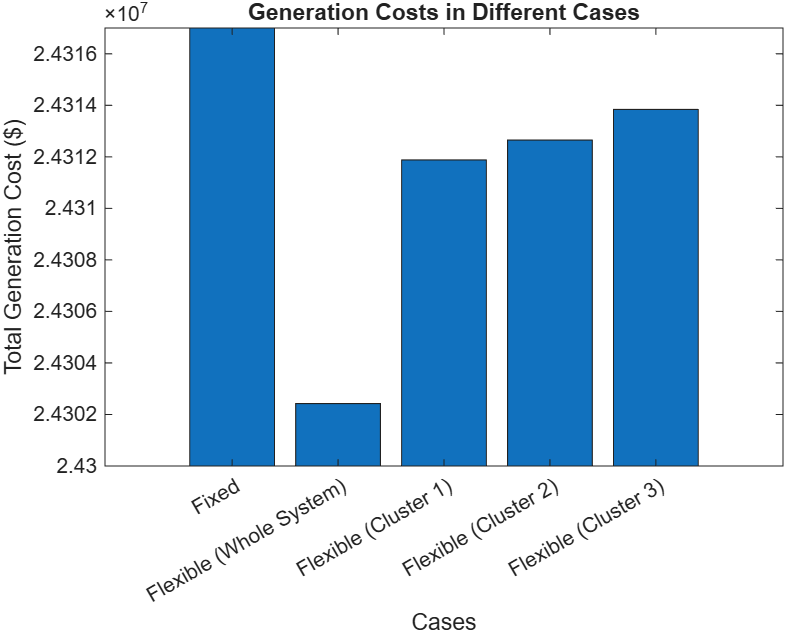
Figure 4: Comparing generation costs for different simulation cases; full system-wide BE flexibility attains maximal cost reduction.
Regarding grid stress, measured as the number of transmission lines operated above 90% of rating, full-system flexibility minimizes congestion (106 lines stressed) compared to the inflexible baseline (128 lines). Partial flexibility provides less consistent improvements, with measurable benefit observed chiefly when applied to clusters with high pre-existing congestion.
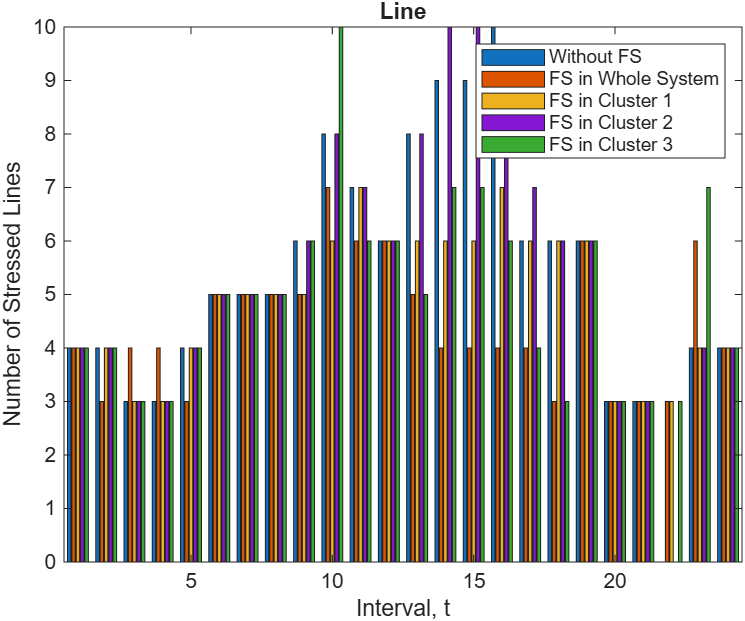
Figure 5: Stressed transmission lines in different cases; system-wide BE flexibility yields minimal overall congestion.
Environmental Outcomes: GHG and Toxic Emissions
Despite not being explicitly optimized for environmental objectives, flexibility in BE load scheduling consistently yields lower greenhouse gas (GHG) emissions. System-level CO₂-equivalent outputs drop by a significant margin under fully flexible scenarios, with all partial-flex cases outperforming the static baseline.
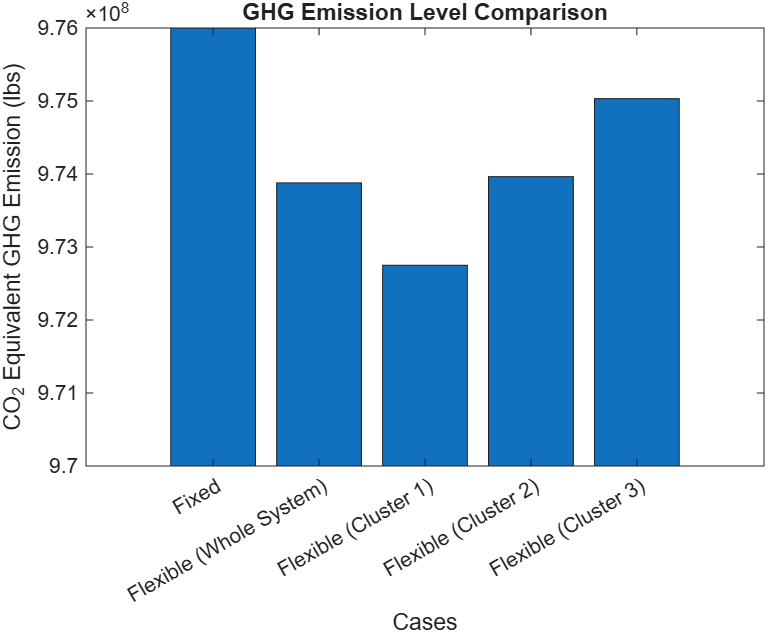
Figure 6: GHG emission in different cases; flexible scheduling of BE loads sharply reduces system-wide CO₂-equivalent emissions.
A parallel trend holds for human toxicity potential (HTP)-weighted emissions (notably from NOx and SO2). The reduction of toxic emissions is a direct consequence of increased dispatch of lower-emission generators during hours of flexibly scheduled demand.
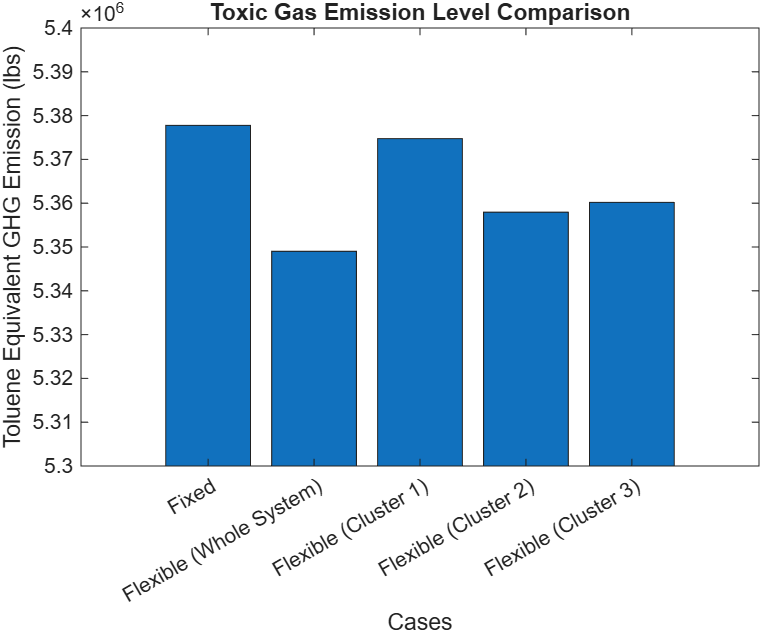
Figure 7: Toxic emission in different cases; flexible BE load scheduling directly reduces aggregate HTP-weighted toxic outputs.
Practical and Theoretical Implications
The demonstrated benefits—cost, emissions, and congestion reduction—occur solely through intraday scheduling of work that is inherently deferrable within the operational constraints of large data centers. The results carry several implications:
- Market Design: Results support increased integration of flexible load products into wholesale market mechanisms to internalize grid-supportive behaviors from data centers.
- Grid Planning: Large-scale deployment of flexibly scheduled BE workloads may enhance renewable integration by complementing variable renewable output, reducing curtailment and increasing overall system efficiency.
- Decarbonization Policy: Flexible demand-side management can yield substantial indirect emissions benefits without explicit carbon pricing, strengthening the case for regulatory incentives or mandates promoting BE load flexibility.
- Data Center Operations Research: The quantifiable benefits motivate further research into dynamic workload management algorithms incorporating grid signals and emissions criteria at scale.
Future Directions
Potential advancements include tighter co-optimization of cost and emissions, consideration of stochastic renewable output and real-time balancing, and analysis under alternative market/regulatory regimes. Incorporating more granular workload flexibility models, probabilistic service level constraints, and interconnection studies on different system topologies would further enrich the findings.
Conclusion
System-level analysis across a realistic 2000-bus power system confirms that flexible scheduling of BE data center loads delivers measurable system operating cost savings, reduces transmission congestion, and yields significant environmental benefits—even absent explicit emissions minimization. The preservation of LC workload QoS ensures these benefits are attained without service compromise. These results provide actionable guidance for utilities, system operators, and the data center industry seeking to harness large-scale flexible loads for enhanced power system sustainability and efficiency.