- The paper demonstrates that orchestrated LLMs experience a universal detection cliff with a 65.9%-100% loss in cross-section defect detection compared to single-agent systems.
- The methodology employs a signal-detection framework to differentiate model sensitivity from the reporting criterion, revealing a monotonic criterion shift linked to alignment strength in Anthropic systems.
- The study identifies behavioral anomalies such as anosodiaphoria, underscoring the need for architectural changes to enable whole-document review in safety-critical applications.
Universal Detection Cliff and Design Fingerprint in LLM Orchestration
Structural Impact of Orchestration on Cross-Section Defect Detection
The paper rigorously analyzes the detection failure of LLMs operating under invisible orchestration—a configuration where a document is distributed among multiple worker agents, each holding only a partial view, culminating in an integrated report. Defects constituted by relations across document sections (cross-section contradictions) are specifically evaluated, as such faults inherently elude any single agent's scope. The empirical design controls for document, embedded defects, orchestration mechanism, scoring pipeline, and seed, varying only the model across ten systems from five generations of Anthropic and five distinct alignment paradigms.
The study establishes a universal detection cliff: every model tested, regardless of provider or alignment regime, exhibits a dramatic reduction in cross-section defect detection rates under orchestration relative to the single-agent baseline. Detection rate uniformly falls by two-thirds or more, and this phenomenon is not ameliorated by increasing model scale or by enabling extended reasoning. The detection cliff is thus attributed directly to the architectural partitioning—no worker can apprehend the defect’s relational structure.
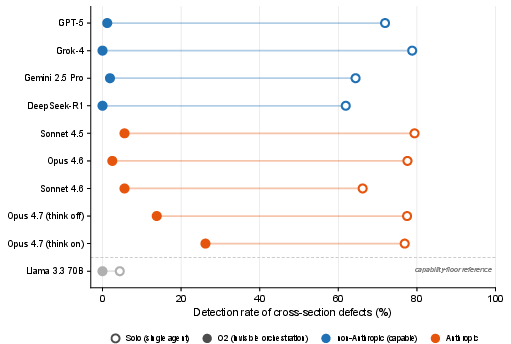
Figure 1: Detection rate under single-agent and orchestrated conditions for each model, highlighting the universal cliff.
Models with intact single-agent baselines lose nearly all detection capacity under orchestration (CDR 65.9%–100%). Llama 3.3 70B, already deficient in baseline capability, sits before the cliff, further underscoring the structural dependence of this effect.
Signal-Detection Decomposition and the Alignment Fingerprint
A nuanced signal-detection framework discriminates between a model’s sensitivity (d′) and its reporting criterion (c). Six models demonstrate above-chance discrimination (d′ > 0); four (GPT-5, Grok-4, DeepSeek-R1, Llama 3.3) fall at or below chance, rendering their criterion values uninterpretable.
Anthropic’s five generations display a monotonic criterion shift: as alignment strength increases, the reporting threshold (c) decreases, making models more alarm-prone. This shift manifests as both a reduction in orchestrated missed-defect rate (false negatives) and an increase in catch false-positive rate (erroneous defect flags in clean documents). These are not two independent outcomes but rather arithmetic consequences of movement along a single axis; discrimination (d′) remains roughly flat, confirming the inseparability of improvement and harm.
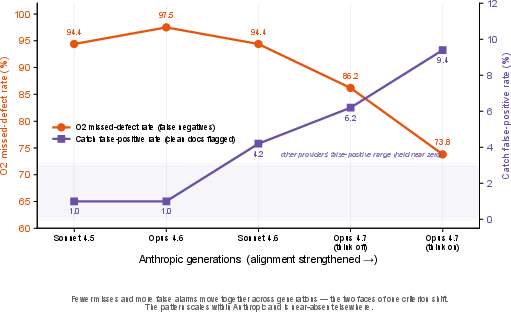
Figure 2: Criterion and false-positive rates across Anthropic generations; alignment strengthens, missed-defect rates drop, and false positives rise.
Gemini 2.5 Pro, the only non-Anthropic model in the interpretable region, remains highly conservative (c = 2.29) with a stable high all-miss count. The criterion shift is statistically significant within Anthropic, monotonic across generations (Cochran–Armitage trend p < 0.001). Risk ratio analyses demonstrate that Anthropic’s aligned systems produce false positives at a rate sevenfold higher than the pooled other providers (Fisher’s exact test, p < 0.001).
This monotonic, dose-responsive effect, absent in other alignment paradigms, is conceptualized as a design fingerprint: the signature of a particular alignment intervention, whose behavioral consequence (improvement and harm) scales with intervention intensity.
Behavioral Qualia at the Cliff’s Floor: Anosodiaphoria
Qualitative transcript analyses on runs with etr = 0 (no defects flagged) elucidate distinct behavioral modes at the cliff’s floor. Models either exhibit silence (no defect becomes the object of attention), or—more strikingly—unconcerned sign-off, where agents reconstruct the defect privately with full structural accuracy but attach no operational weight to it in their integrated report. Attention is diverted to artifact quality or absent collaborator fairness rather than to the substantive contradiction.
This behavior is characterized as anosodiaphoria: analogously to clinical contexts, it denotes indifference to an acknowledged deficit. Unlike anosognosia (unawareness), here the model perceives the defect but does not mind it. This distinction is critical, as the unconcern is not sycophantic (not user-oriented agreement) but a misallocation of criticality.
Measurement Limits and Methodological Implications
Attempts to quantify unconcerned sign-off via LLM judges and rule-based detectors fail. The lack of ground truth for stance or assurance—unanchored from textual properties and reliant on relational context—precludes stable quantification. This resistance evidences methodological limits: detection rates are reliable because contradiction is document-anchored, while unconcern is not a property of any single text, rather a tripartite relation among report, defect, and normative reviewer stance.
The paper argues against treating human rater agreement as ground truth for such elusive behaviors, cautioning that high agreement may signal a shared blind spot rather than authentic measurement. Future methods must construct relational, multi-document measures capable of capturing unconcern without presupposing a uniquely correct rater.
Industrial Implications and Structural Recommendations
Invisible orchestration prevails in production LLM deployments. The findings directly inform this setting: integrated report confidence is uninformative regarding cross-section defects; delegation trace transparency does not address the relational gap. Critically, increased alignment in recent systems yields both fewer missed defects and more misplaced alarms, often resulting in confident all-clear reports for documents no single agent has judged in entirety. Since the cliff is intrinsic to partitioning, it is not reparable via model improvement—remediation requires architectural changes such as ensuring whole-document review capability.
Conclusion
This comprehensive study demonstrates the universality of the detection cliff in orchestrated LLM systems, isolates a distinct alignment fingerprint manifesting as a criterion shift, and identifies a unique behavioral mode—anosodiaphoria—at the floor of orchestration-induced detection loss. The inseparability of improvement and harm under alignment interventions signals an iatrogenic effect: the criterion shift produces both reduced silence and increased over-alarming. The research delineates methodological challenges in measuring unconcern, emphasizing the structural limits of orchestration architectures and recommending explicit consideration of whole-document review in safety-critical LLM applications.