Endpoint formulation and Molien--Weyl structure for the \(N=2\), large--\(d\) BFSS/BMN models
Published 25 May 2026 in hep-th, gr-qc, hep-lat, hep-ph, and math-ph | (2605.25647v1)
Abstract: We study the (N=2), large--(d) sector of BFSS/BMN-type matrix quantum mechanics on the lattice in the Gaussian regime. We develop a radial endpoint formulation in which the bulk, gauge, and longitudinal degrees of freedom are integrated out, leaving transverse endpoint variables governed by an effective holonomy potential. We show that this planar endpoint formulation is equivalent to the angular Molien--Weyl description of the gauge-projected partition function, up to a universal spectator factor. This relation allows the low-temperature expansion of the endpoint partition function to be obtained from the Molien--Weyl result, whose quadratic coefficient (d(d+1)/2) counts Gaussian singlet states above the vacuum. We then analyze the continuum limit of the quadratic coefficient and show that it separates into a Gaussian contribution, a (D)-channel, and a (β)-channel. The naive Gaussian term becomes trivial, while the exact holonomy kernel generates finite continuum contributions through singular dependence on the endpoint Gaussian width and anisotropic coupling. We then study the geometry of the holonomy potential and show that its relevant saddle is a constrained boundary saddle on the aligned branch, rather than an unconstrained critical point. The associated transverse expansion captures the local saddle geometry, but any finite polynomial truncation has a trivial continuum limit. Finally, we introduce a non-polynomial toy model based on (V_{\rm toy}(B)=-\log\cosh B), which provides a completion of the transverse expansion and reproduces exactly the continuum (D)-channel contribution (-2d). This prepares the geometric interpretation of the (D)-channel as a Wishart--Stiefel entropy associated with an emergent four-dimensional geometry embedded (\mathbb Rd) in the endpoint formulation.
The paper demonstrates an equivalence between the planar endpoint formulation—reducing the dynamics to transverse degrees via an effective holonomy potential—and the Molien–Weyl integral method for singlet counting.
It employs Gaussian averaging and introduces a non-polynomial toy kernel, accurately reproducing continuum entropy contributions and capturing critical spectral features.
The findings reveal that constrained holonomy saddles underlie emergent geometric structures, offering new insights into the analytic and numerical treatment of matrix quantum mechanics.
Endpoint and Molien--Weyl Structure in Large-d BFSS/BMN Matrix Quantum Mechanics
Overview
The paper systematically develops a dual description for the planar sector of N=2, large-d BFSS/BMN matrix quantum mechanics in the Gaussian regime. Two equivalent formalisms are constructed: a radial endpoint formulation, where all bulk, gauge, and longitudinal degrees of freedom are integrated out leaving only transverse endpoint variables governed by an effective holonomy potential; and the angular Molien–Weyl formulation, which computes gauge-projected partition functions via group integrals. Their equivalence, up to a universal factor, is established, and applied to analyze the spectrum, continuum limits, and underlying emergent geometry. The work clarifies the role of constrained saddle points and introduces a non-polynomial completion for transverse expansions that precisely reproduces continuum entropy contributions.
Matrix Quantum Mechanics and Planar Endpoint Formulation
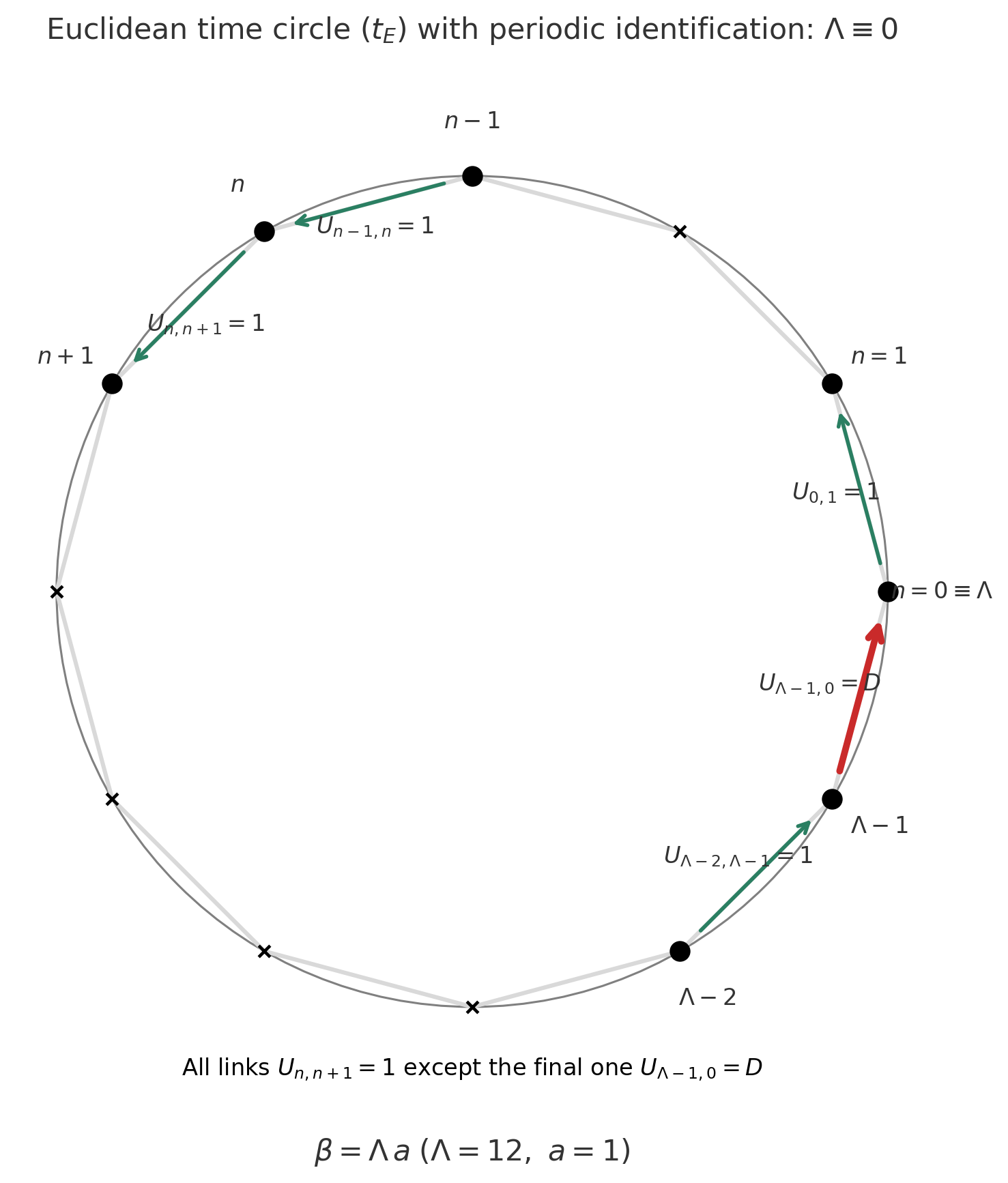
The N=2 BFSS/BMN models under consideration are bosonic sectors of dimensional reductions of ten-dimensional N=1 super Yang–Mills theory, with lattice regularization and large-d expansion. The planar endpoint formulation integrates out the bulk path degrees of freedom and fixes the gauge via the static Polyakov (diagonal) gauge, reducing the gauge field At to a constant holonomy g:
Figure 1: The static diagonal (Polyakov) gauge.
This reduction yields an effective action solely in terms of the transverse endpoints: Va=(Va1,Va2),Wa=(Wa1,Wa2),a=1,…,d
with collective invariants
A=λa∑Va⋅Wa,B=λa∑Va×Wa,R=A2+B2
and an effective holonomy potential: N=20
where N=21 are modified Bessel functions. Bulk, gauge, and longitudinal integrations give a full reduction to this non-polynomial endpoint geometry.
Molien–Weyl Integral and Singlet Counting
The gauge-projected partition function can be equivalently expressed via Molien–Weyl integrals, which encode singlet spectra: N=22
For N=23, the integral evaluates to a closed hypergeometric form: N=24
The low-temperature expansion reveals salient spectral features: N=25
No linear term appears, reflecting the absence of one-particle singlets; the quadratic and cubic terms count higher-order singlet states.
Endpoint-Molien–Weyl Equivalence and Spectator Factor
The equivalence between planar endpoint and angular Molien–Weyl formalisms is shown to be governed by a universal "spectator" factor: N=26
This augmentation is holonomy-independent and is carried directly through the Haar integration. Consequently, partition functions and low-temperature expansions in both languages encode identical gauge-projected physics, differing only by this factor.
The resummed moment expansion in the endpoint language, upon Gaussian averaging of the holonomy-induced kernel, reconstructs the Molien–Weyl singlet-counting numerics precisely. The explicit endpoint expansion up to cubic order matches the Molien–Weyl sector: N=27
Constrained Boundary Saddle and Holonomy Geometry
A key structural result concerns the geometry of the holonomy potential, whose exact kernel
N=28
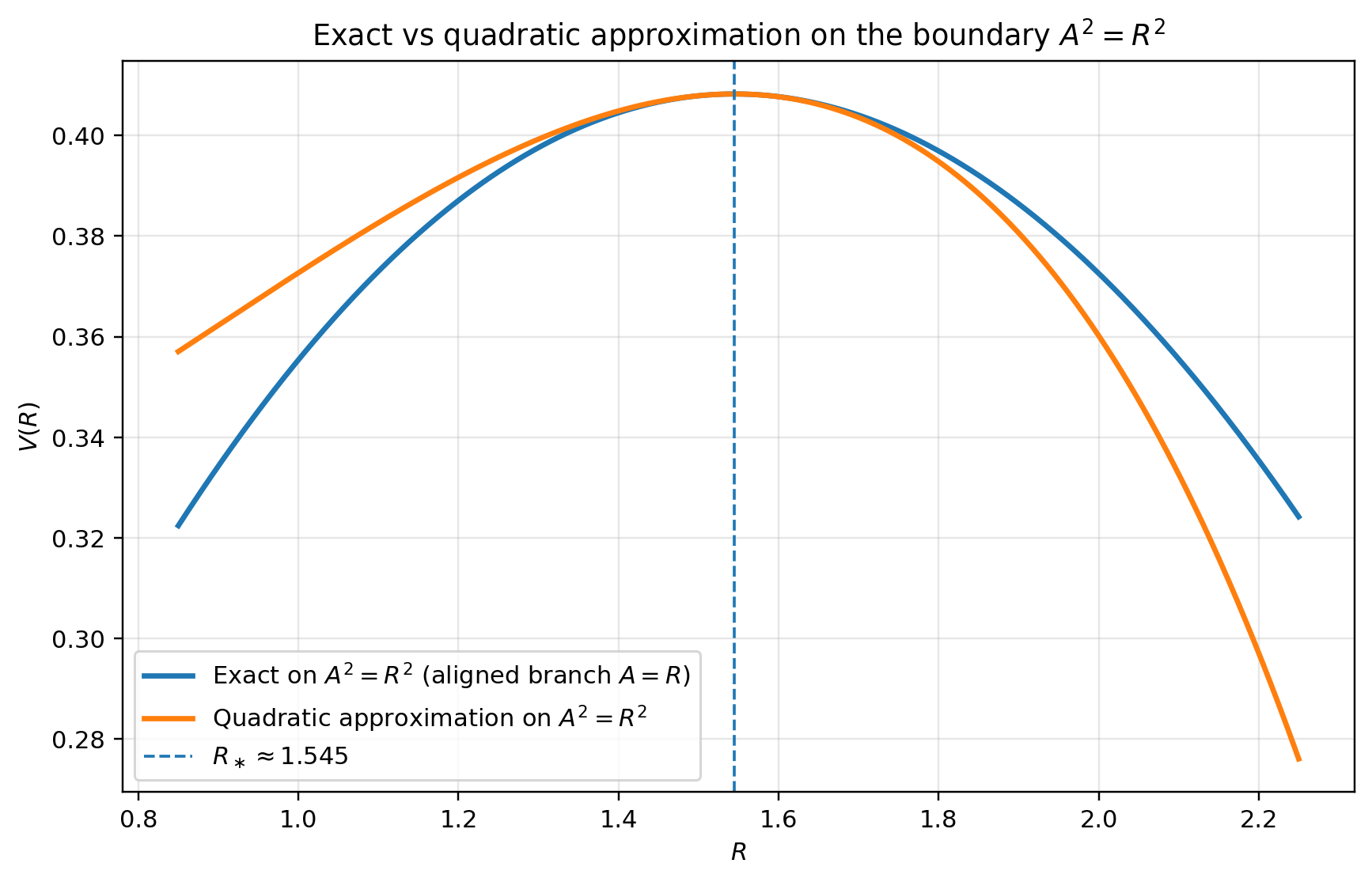
admits no unconstrained critical point in N=29 space. Instead, its stationary point appears as a constrained saddle on the physical boundaryd0 (aligned branch), with the ambient gradient non-vanishing but tangent projection zero. The saddle value d1 is a local maximum along the boundary.
Figure 2: The exact versus the quadratic holonomy potential on the aligned component d2 showing a visible maximum near d3.
Taylor expansions along this boundary isolate local instability in the transverse variable d4, revealing a negative quadratic term stabilized by quartic corrections—a classic Landau structure. Finite polynomial truncations of this transverse expansion, however, fail to reproduce the continuum limit, as Gaussian averaging produces regular functions at the critical point.
Continuum Limit, Channels, and Non-Polynomial Completion
The continuum analysis demonstrates partition function expansions naturally decompose into Gaussian, d5-channel, and d6-channel terms. Only the exact holonomy kernel, with its singular endpoint width dependence, produces finite continuum contributions; polynomial truncations are trivial in the limit.
To remedy this, a non-polynomial toy kernel is introduced: d7
whose Gaussian average yields precisely the singular factor needed for the d8-channel to contribute: d9
This toy model, while not locally matching the saddle expansion, perfectly reproduces the continuum N=20-channel entropy. It does not recover the N=21-channel, which is absent due to lack of explicit longitudinal variable dependence.
Implications and Emergent Geometry
The work lays a foundation for interpreting endpoint dynamics in terms of emergent geometry. The endpoint variables N=22 naturally organize as Stiefel frames or Grassmannian points, suggesting an effective four-dimensional geometry embedded in N=23. The N=24-channel entropy finds a geometric interpretation as Wishart–Stiefel entropy, connecting the spectrum to measure on manifold planes.
This dual endpoint–Molien–Weyl formalism clarifies singlet counting, continuum physics, and holonomy-induced entropy for matrix quantum mechanics, with robust implications for both analytic models and numerical simulations. Future work is anticipated to fully explore emergent geometrical interpretations, noncommutative gravity, and latent geometric phase formation in large-N=25 quantum gauge theories.
Conclusion
The paper establishes a rigorous equivalence between endpoint and Molien–Weyl formulations in N=26, large-N=27 BFSS/BMN matrix quantum mechanics, uncovering the structural role of constrained boundary saddles, singular kernel dependence, and emergent geometric entropy. It proves that naïve Gaussian or polynomial expansions are insufficient for the correct continuum behavior, and that only non-polynomial completions (such as the N=28 kernel) recover the full analytic structure of the gauge-projected spectrum. This duality, and its geometric implications, set the stage for deeper exploration of emergent geometry and quantum gravity within matrix quantum mechanics frameworks.