- The paper establishes a convergent gravitational path integral by replacing Euclidean metrics with Lorentzian manifolds containing codimension-2 conical singularities.
- It employs a rigorous Picard-Lefschetz analysis to select the physically relevant complex saddles in the presence of charge and angular momentum quantization.
- The work delineates temperature-dependent regimes where either saddle or endpoint contributions dominate, offering deep insights into black hole quantum statistics.
Lessons from the Lorentzian Gravitational Path Integral: Black Hole Saddle Selection and Convergence
Introduction
This paper provides a comprehensive analysis of the Lorentzian gravitational path integral for black hole partition functions, focusing on AdS4 Einstein-Maxwell and AdS3 Einstein-Hilbert (BTZ) gravity. The authors address a long-standing divergence in the sum over complexified black hole saddles arising due to charge and angular momentum quantization. By treating the path integral as a sum over Lorentzian metrics with codimension-2 conical singularities—rather than the ill-defined set of all Euclidean metrics—they employ Picard-Lefschetz theory to precisely select which saddles contribute at finite temperature, showing that the sum converges and explaining the underlying physical mechanism.
Quantization, Complex Potentials, and Divergence Puzzle
Gravitational partition functions with chemical potentials for charge and angular momentum must respect the periodicity implied by quantization of these charges. In AdS4 Einstein-Maxwell theory, this introduces an infinite family of complexified black hole saddles, shifted in chemical potential by 2πin/(eβ). The naive semiclassical sum over these solutions for fixed Euclidean boundary conditions diverges at finite inverse temperature β, as observed previously. The core puzzle is thus how to define a physically meaningful semiclassical partition function consistent with charge quantization and periodicity.
Lorentzian Contour Prescription and Conical Singularities
The central conceptual advance is the replacement of the ambiguous Euclidean path integral by a Lorentzian contour defined by integrals over Lorentzian-signature metrics, admitting spacetimes with codimension-2 conical singularities at bifurcation surfaces. The authors use a construction where stationary black hole spacetimes are cut along two surfaces related by time translation and glued to form a time-periodic geometry, with a singularity at the identification locus.
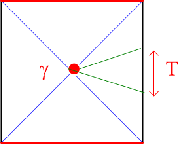
Figure 1: Conformal diagram of an AdS-Schwarzschild black hole, with two cut-surfaces at time separation T identified to form a Lorentzian spacetime with a codimension-2 conical singularity.
The gravitational action on these singular geometries is defined by analytic continuation and a complex regulator, resulting in an additional imaginary contribution proportional to the area of the singular surface. This framework provides a well-defined stationary phase expansion for the partition function as an integral over real Lorentzian configurations, sidestepping the conformal factor pathology of unrestricted Euclidean gravity.
Picard-Lefschetz Analysis and Saddle Selection
Applying Picard-Lefschetz theory to the integral over the conical defect area reduces the problem to identifying which (possibly complex) black hole saddles are relevant—i.e., have their Lefschetz thimbles intersect the chosen integration contour. For AdS4 Einstein-Maxwell theory in the spherically symmetric sector, the partition function reduces at leading semiclassical order to a sum over integer shifts n in the imaginary part of the chemical potential, with each term involving an explicit integral over horizon area and charge:
Z(β,μ)=n∑∫dAdQeA/4e−β(E−μnQ),
with μn=μ+2πin/(qβ). All classes of black holes (outer/inner horizons) are included; their Lorentzian quotient procedure is extended naturally to both.
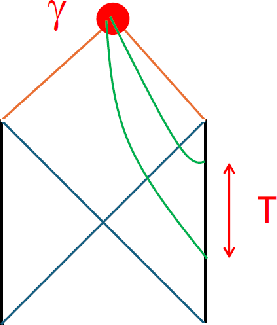
Figure 2: Conformal diagram for an AdS-Reissner-Nordstrom black hole. Identification of two cut-surfaces stretching from the inner horizon γ to infinity yields a conical singularity at γ, essential for including inner horizon contributions.
A nontrivial outcome is that, except in special cases (e.g., the BTZ case or in the strict β→∞ limit), only a finite subset of complex black hole saddles contributes for fixed β, and the total partition function is consequently convergent. The explicit selection criterion arises from the intersection structure of the ascent/descent contours in the complex area plane; at large enough ∣n∣, all complex saddles become inaccessible to the original integration contour, leaving only bounded endpoint (“boundary”) contributions.
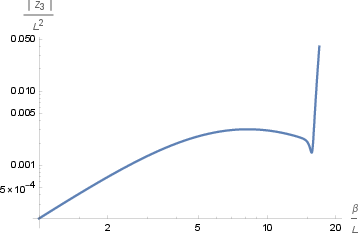
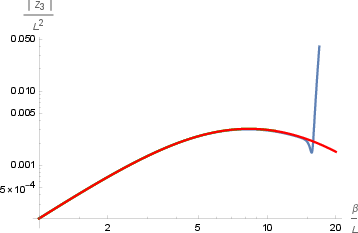
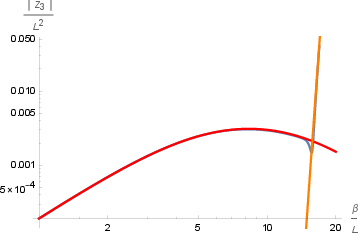
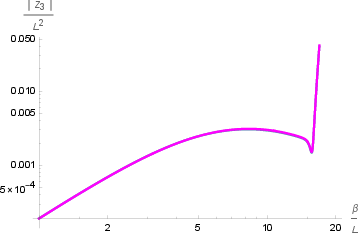
Figure 3: Numerical computation of Z3. As β increases, the dominance transitions from endpoint to saddle-point contributions. The selection of relevant saddles is reflected in the Lefschetz thimble structure depicted.
Endpoint vs. Saddle Contributions: Temperature Regimes
The authors present a careful analytic and numerical study of the respective contributions of bulk saddle points versus endpoint (integration boundary) terms, emphasizing that which dominates can change non-monotonically as a function of β and chemical potential. For ∣μ0∣≥1, the number of relevant complex saddles grows linearly with β, and the standard large black hole saddle dominates in the low temperature (large β) regime. For ∣μ0∣<1, only a finite β-dependent set of saddles contribute, and for β→∞, only endpoint contributions survive.
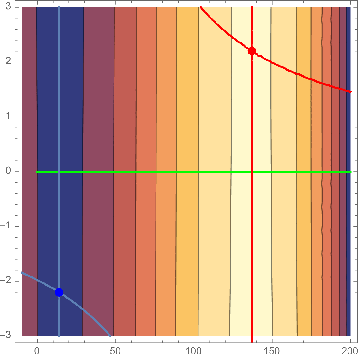
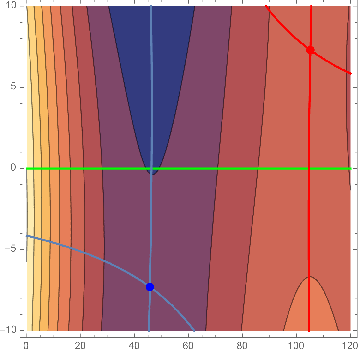
Figure 4: Real part of the exponent u for μ0=0.9 across different βL values, illustrating how the intersection pattern of steepest ascent lines with the positive real axis determines saddle relevance.
The explicit dependence of the onset of saddle dominance, the transition temperatures, and the connection to phase structure (Hawking-Page–like transitions) is mapped out and supported by detailed thimble analyses. The result is a partition function valid across wide parameter ranges, avoiding the divergence that plagues naive semiclassical sums.
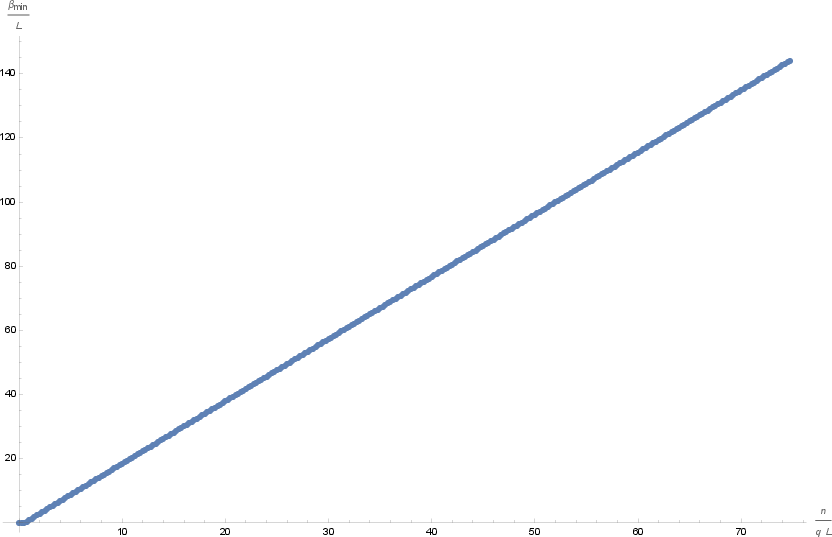
Figure 5: Minimal inverse temperature β for which a saddle labeled by shift n contributes, illustrating that the number of relevant saddles grows with β for μ0=2.
AdS3 (BTZ) Case and Angular Momentum Sectors
For the AdS3 BTZ black hole, a similar analysis shows that the sum over angular momentum shifts converges at all β, but in this case, all saddles contribute. The action can be written as a purely quadratic function in the area variable, and even at large shifts the functional form of the 1-loop determinant ensures convergence. The result completes the picture: convergence at finite temperature is a generic property of the Lorentzian conical defect prescription, not spoilt by additional rotational or U(1) structure.
Implications and Relation to KSW and Other Criteria
A significant aspect is the explicit demonstration that the so-called Kontsevich-Segal-Witten (KSW) condition—requiring matter path integrals to converge on complex saddles along real field contours—is neither necessary nor sufficient for saddle relevance in gravitational path integrals with complex codimension-2 defect geometries. The Picard-Lefschetz approach, which intrinsically accounts for contour deformation and intersection, provides a more robust criterion for saddle selection. The presence of endpoint-dominated phases and the nontrivial behavior of saddle relevance under parameter changes (Stokes phenomena) highlight the physical necessity for a fully defined integration contour, not merely the selection of “nice” complex geometries.
Future Directions and Theoretical Significance
The paper’s method is directly applicable to partition functions with additional symmetries (e.g., angular momentum, higher charge sectors), supersymmetric indices, and refined spectral partition functions. It sets the stage for precise comparisons with holographic duals, the analysis of more complicated conical/“helical” singularities, and the study of phase transitions in the black hole ensemble. The prescription is compatible with, but not limited to, Euclidean continuation; the Lorentzian perspective is central for a nonperturbative definition. The analysis also motivates careful future treatment of one-loop and higher corrections, particularly in sectors where endpoint contributions dominate.
Conclusion
Through a rigorous Lorentzian contour prescription, the gravitational path integral for charged AdS black holes is rendered well-defined and convergent. The Picard-Lefschetz analysis singles out the physically relevant saddles for the semiclassical expansion, with the integration regime depending crucially on both the inverse temperature and the chemical potential. This framework resolves previously identified divergences, clarifies the structure of the gravitational ensemble, and provides a pathway for systematic study of black hole quantum statistics in AdS gravity and related systems.

