- The paper introduces a generalized BU method that corrects unphysical soft continuum contributions in the 2+1D Gross-Neveu model.
- It employs a Φ-derivable framework to map Gaussian fluctuations, ensuring thermodynamic consistency and sharper Mott transition signatures.
- Numerical results show that the gBU approach notably reduces entropy density fluctuations, aligning with excitonic and chiral transition phenomena.
Generalized Beth-Uhlenbeck Treatment of the (2+1)D Gross-Neveu Model
Introduction
The (2+1)-dimensional Gross-Neveu (GN) model has established itself as a paradigmatic relativistic quantum field theory for understanding collective phenomena such as dynamical mass generation, critical phenomena, and Mott transitions, particularly in the context of two-dimensional Dirac materials like graphene. This work systematically explores the thermodynamics of the GN model beyond the mean field by implementing a generalized Beth-Uhlenbeck (gBU) approach, emphasizing the entropy density contributions from collective Gaussian fluctuations. The analysis quantitatively contrasts the standard and generalized formulations, highlighting the impact of two-particle correlations and their back-reaction on thermodynamic observables.
The starting point is the (2+1)D GN Lagrangian with a four-fermion interaction, formulated with vertices selected to respect the relevant symmetry structure of graphene-inspired systems. The partition function is constructed by the standard Hubbard-Stratonovich transformation introducing auxiliary bosonic fields for each symmetry channel, and expanded to quadratic order around the mean field to isolate Gaussian fluctuations. The thermodynamic potential then decomposes additively into mean field and fluctuation contributions.
Key to the subsequent analysis is the mapping of the fluctuation thermodynamic potential into the Beth-Uhlenbeck-type spectral representation, wherein the frequency- and momentum-dependent phase shifts for each correlation channel encode the full fluctuation spectrum, both bound state and continuum. The standard BU formalism yields, for the entropy density,
Sfl,BU=i∑∫(2π)2d2q∫−∞∞2πdω∂T∂g(ω)δi(ω,q),
where δi(ω,q) is the phase shift and g(ω) is the Bose-Einstein distribution.
However, a major technical challenge is the anomalously large entropy contributions from soft, low-energy scattering states (notably the Landau-damping region), which can become competitive with or even overwhelm the mean field term. This signals the breakdown of the naive expansion scheme and demands a more careful, self-consistent treatment of correlation back-reactions.
To address the issue of overcounting low-energy continuum (especially Landau-damped) correlations, the paper implements a generalized Beth-Uhlenbeck (gBU) approach derived from the Φ-derivable framework. Here, the entropy density is modified by a phase shift subtraction term:
Sfl,gBU=i∑∫(2π)2d2q∫−∞∞2πdω∂T∂g(ω)(δi(ω,q)−2sin(2δi(ω,q))).
This subtraction suppresses the spurious thermodynamic weight of weakly correlated continuum states but leaves contributions of genuine bound excitons intact. As shown in (Figure 1), the gBU procedure suppresses small phase shifts associated with continuum scattering while enhancing the effect near π, corresponding to true bound states.
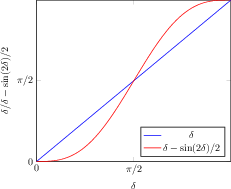
Figure 1: The generalized Beth-Uhlenbeck phase shift prescription suppresses the contribution of small phase shifts while preserving the bound-state effect near δ=π.
Numerical Results: Entropy and Composition Analysis
The numerical investigation utilizes a symmetry-adapted four-channel GN model parameterized for the emergent excitations in graphene. Fluctuation entropy densities in pseudoscalar and scalar channels (Beth-Uhlenbeck and generalized versions) are compared across a range of temperatures and cutoffs (Figure 2).
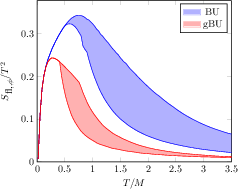
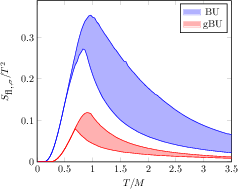
Figure 2: Entropy density fluctuations in the pseudoscalar (a) and scalar (b) channels for BU (blue) and gBU (red) approaches.
The gBU formalism leads to a pronounced reduction in entropy density fluctuations, especially at intermediate temperatures T∼M (where M defines the model’s intrinsic scale). Both approaches coincide at low temperature, where bound excitons dominate and the subtraction vanishes, and at high temperature, where the mean field contribution is restored as collective fluctuations melt.
Aggregate normalized entropy densities further underscore this effect (Figure 3). The gBU formulation yields distinctly lower total entropy in the crossover regime, with only marginal differences at the temperature extremes.
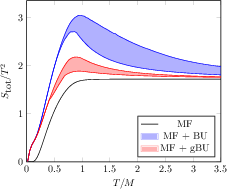
Figure 3: Total normalized entropy density comparing BU (blue) and gBU (red) across temperature.
A detailed composition analysis (Figure 4) reveals the temperature-dependent fraction of entropy carried by scalar, pseudoscalar, and fermionic degrees of freedom. Most notably, the transition from bound excitonic to unbound fermionic dominance becomes markedly sharper under the gBU prescription, mirroring the signature of a Mott transition as discussed in the context of ionization in two-dimensional plasmas and exciton systems.
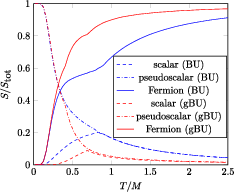
Figure 4: Fractional entropy composition for scalar, pseudoscalar, and fermionic channels as a function of temperature (gBU, cutoff Λ).
Theoretical and Practical Implications
This work delivers several notable theoretical clarifications:
- Elimination of Unphysical Thermodynamic Contributions: By implementing the back-reaction correction, the generalized BU method resolves the pathological dominance of soft Landau damping modes inherent to the naive BU scheme.
- Sharp Mott Transition Signature: The gBU entropy profile manifests a significantly sharper crossover in the effective degrees of freedom, in better qualitative alignment with Mott physics in strongly coupled Dirac materials than the standard approach.
- Thermodynamic Consistency: The use of a δi(ω,q)0-derivable (two-particle irreducible) framework guarantees conservation laws and a proper accounting of correlations in the thermodynamic limit.
Practically, this technique provides a well-controlled computational framework for modeling temperature-driven dissociation phenomena (e.g., excitonic breakdown, chiral or gap transitions) in two-dimensional materials and their analogs in correlated quantum matter. It also serves as a template for improved effective field theory treatments of QCD-like or condensed matter systems, especially in modeling the transition from bound composite to deconfined states.
Limitations remain—particularly the treatment of back-reaction on the mean field beyond quadratic (Gaussian) order, residual dependence on the collective mode cutoff, and the restriction to zero chemical potential. Future directions include fully self-consistent solutions incorporating higher-order corrections, non-local couplings, and finite density effects which are expected to capture the full density-driven Mott transition.
Conclusion
The generalized Beth-Uhlenbeck approach to the (2+1)D Gross-Neveu model developed here offers a thermodynamically consistent prescription for including collective fluctuations and their back-reaction, principally via an improved spectral subtraction for the entropy density. The method suppresses unphysical soft continuum contributions, yields sharper transitions in effective degrees of freedom, and aligns more closely with theoretical expectations for Mott physics in two-dimensional correlated systems. This framework holds significant promise for the systematic description of fluctuation-dominated quantum phase transitions in both relativistic and condensed matter contexts.