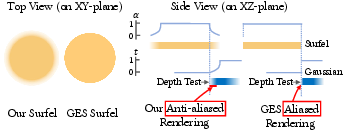
- The paper introduces DP-GES, which integrates depth peeling of semi-transparent surfels with sort-free Gaussian compositing to eliminate aliasing artifacts and support differentiable optimization.
- The methodology employs a two-stage rendering pipeline with three-layer depth peeling, achieving accurate per-pixel occlusion ordering and high performance on standard benchmarks.
- Empirical evaluations show that DP-GES outperforms prior methods in key quality metrics such as LPIPS and SSIM while sustaining high frame rates on advanced hardware.
Depth Peeling for High-Fidelity Gaussian-Enhanced Surfel Rendering: An Authoritative Analysis
Context and Motivation
Novel view synthesis, a central problem in computer graphics and vision, has seen advances from neural radiance fields (NeRF) to 3D Gaussian Splatting (3DGS). NeRFs provide superior photorealism via volumetric ray marching but incur prohibitive runtime due to dense neural inference. 3DGS achieves real-time rendering through rasterization of anisotropic Gaussian primitives, which still suffers from view-inconsistent blending artifacts ("popping") due to global sorting approximations. Recent developments, such as Gaussian-Enhanced Surfels (GES), introduced a bi-scale representation combining opaque surfels and sort-free Gaussian splats to eliminate popping and occlusion leakage; however, GES is limited by residual boundary aliasing and non-differentiable surfel geometry, leading to suboptimal joint optimization.
DP-GES Representation and Rendering Pipeline
DP-GES introduces a representation comprising 2D surfels with semi-transparent boundaries and surrounding 3D Gaussians. The opacity of each surfel smoothly decays from the center toward the boundary to mitigate depth-testing aliasing. Transmittance values are calculated for joint surfel-Gaussian compositing, facilitating full differentiability.
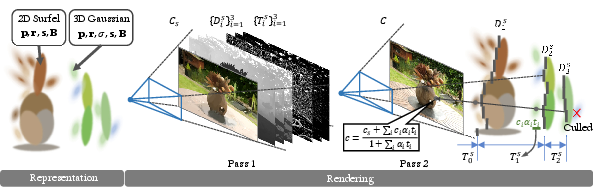
Figure 1: DP-GES representation and rendering pipeline combining depth-peeling surfel layers and sort-free splatting of modulated Gaussians.
Rendering proceeds in two stages. The surfels are rasterized with three-layer depth peeling to obtain depth, color, and transmittance maps per layer; these layers are composited in front-to-back order for alpha blending. Subsequently, 3D Gaussians are splatted without sorting, querying transmittance maps to modulate their weights per corresponding depth layer. Gaussians with zero transmittance or beyond the last peeled layer are culled. This pipeline ensures accurate per-pixel occlusion without global sorting and facilitates differentiable joint optimization by linking surfel and Gaussian parameters.
Comparison with Prior Art
DP-GES inherits the bi-scale philosophy from GES and addresses its limitations by:
Numerical Evaluation
Across four datasets—Mip-NeRF360, Deep Blending, Tanks & Temples, and NeRF Synthetic—DP-GES matches or outperforms state-of-the-art baselines in PSNR, SSIM, and LPIPS metrics. Notably, DP-GES achieves LPIPS scores as low as 0.196 and SSIM up to 0.827 while maintaining high frame rates (472 FPS) on RTX 4090 for Mip-NeRF360.
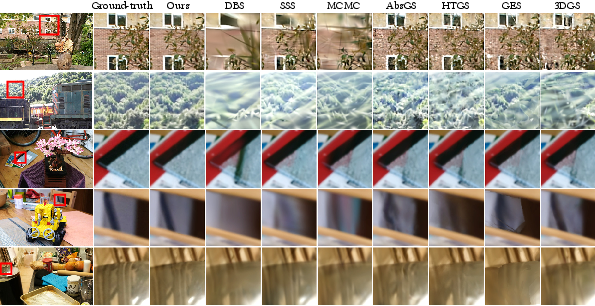
Figure 3: Qualitative scene comparisons showing DP-GES's preservation of rich details and absence of boundary artifacts.
DP-GES demonstrates faster rendering than high-quality baselines, with minor overheads attributed to depth-peeling texture fetching. It also exhibits robust view-consistency, with modest increases in optical-flow-based warping metrics owing to high-frequency view-dependent effects.
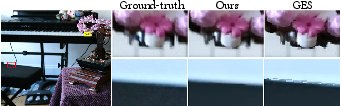
Figure 4: DP-GES avoids aliasing artifacts and improves boundary smoothness compared to GES.
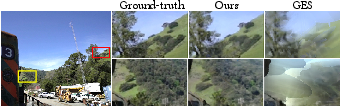
Figure 5: DP-GES enables harmonious surfel-Gaussian appearance, eliminating protruding surfel occlusions prevalent in GES.
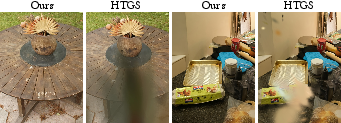
Figure 6: DP-GES avoids high-opacity floaters characteristic of the hybrid transparency method (HTGS).
Ablations and Architectural Choices
Ablation studies show:
- Peeling Layer Count: Three-layer depth peeling achieves a superior tradeoff, eliminating background leakage and maintaining speed; increasing to four layers provides negligible quality gains and impacts performance.
- Transmittance Gradients: Coupling surfels and Gaussians via transmittance gradients yields sharper details and avoids the small surfel artifacts of GES. Disabling this pathway degrades reconstruction.
- Loss Design: Incorporating surfel scaling and transmittance regularization is critical for geometric uniformity and background occlusion.
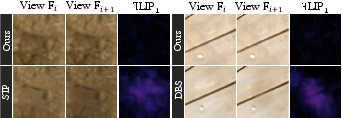
Figure 7: DP-GES prevents popping artifacts during view transitions.
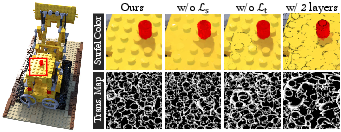
Figure 8: Ablation—lack of proper surfel loss leads to geometry omissions and background leakage.
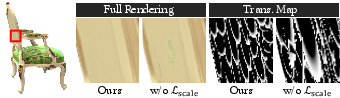
Figure 9: Surfel scaling loss regularizes surfel spatial distribution, avoiding color leakage.
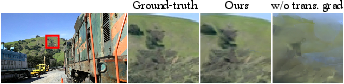
Figure 10: Stopping transmittance-mediated gradients increases boundary blurring and surfel artifacts.
Implementation and Optimization
DP-GES utilizes efficient OpenGL-based rasterization for real-time deployment. Depth-peeling and surfel ID buffer support accurate layer composition, avoiding issues in interleaved surfels. Gaussian splitting is applied during training to prevent artifacts from oversized primitives post-DBS-based initialization.
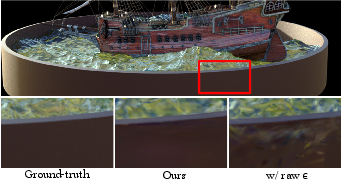
Figure 11: Improved depth margin strategy reduces occlusion leakage in adjacent surfel regions.
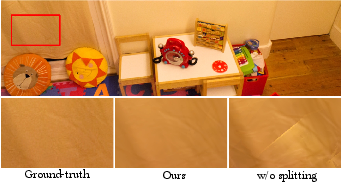
Figure 12: Gaussian splitting avoids large-Gaussian depth-test truncation artifacts.
Limitations and Forward Outlook
DP-GES retains limitations in transparent scene elements due to mostly opaque surfels but demonstrates improved handling compared to predecessors. The surfel representation, while spatially regularized, is less flexible than fully translucent variants such as 2DGS, requiring additional initialization and extended convergence. Spherical Beta color encoding enhances view-dependent effects but increases susceptibility to overfitting.
Potential future directions include leveraging surfels as coarse geometric proxies for mesh extraction, interaction modeling, and physics-driven rendering tasks.
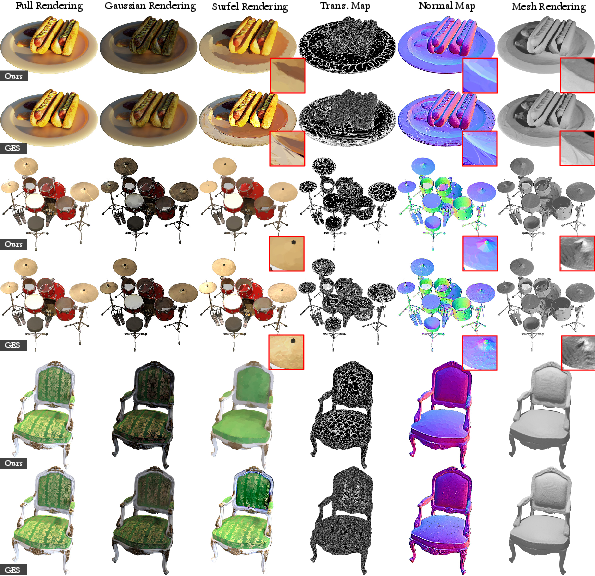
Figure 13: DP-GES achieves uniform surfel distribution and geometry regularization compared to GES, improving mesh extraction for downstream applications.
Conclusion
DP-GES advances the state-of-the-art in real-time radiance field rendering by integrating semi-transparent surfel boundaries and depth-peeling for per-pixel occlusion ordering, coupled with sort-free Gaussian compositing. The resulting pipeline delivers high-fidelity, popping-free, and alias-free novel view synthesis while supporting fully differentiable optimization of joint appearance and geometry. Its practical efficiency and robustness position DP-GES as a compelling approach for scalable, real-time, photorealistic scene synthesis and interactive graphics. Future work should further extend surfel utility, refine initialization, and address remaining transparency challenges.
(2605.25345)