- The paper introduces a novel softmax-based competition mechanism that blends overlapping Gaussians to reduce view inconsistency and boundary diffusion.
- It employs learnable sharpness control via a generalized exponential function, enabling fine-tuned transitions between smooth blending and crisp boundaries.
- Empirical validation on synthetic and real-world datasets shows improved PSNR and efficiency with fewer primitives compared to traditional 3D Gaussian Splatting.
Unified Rendering with Softmax-GS: Flexible Control of Blending and Boundaries
Motivation and Problem Analysis
The 3D Gaussian Splatting (3D GS) paradigm dominates view-synthesis and dense scene reconstruction for its training and rendering efficiency, outperforming classical NeRF approaches. However, 3D GS exhibits two severe limitations rooted in its foundational assumptions: (1) the imposition of non-overlapping Gaussians, which induces order-dependent view inconsistency ("popping effect"), and (2) the inherent boundary diffusion of Gaussian kernels, necessitating excessive primitive density to approximate sharp edges or color transitions (Figure 1).
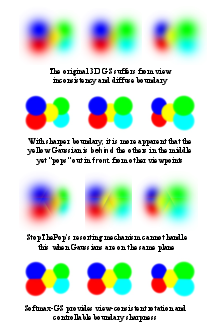
Figure 1: Comparison under viewpoint rotation showing how 3D GS suffers from boundary diffusion and popping, while Softmax-GS achieves sharp, consistent transitions.
Prior mitigations include bounded kernel modification for sharper edges (GES, 3DCS, DisC-GS, SSS), and resorting (StopThePop, LC-WSR) to address the popping effect, though the latter fails for coplanar or overlapping splats. Direct integration (EVER) with ellipsoidal primitives achieves physically plausible density composition but sacrifices computational efficiency and forfeits sharpness control.
Softmax-GS: Methodological Contributions
Softmax-GS introduces a principled, unified rendering framework that concurrently addresses boundary diffusion and view inconsistency by relaxing the non-overlapping Gaussian assumption and enabling learnable softmax-based competition for color composition between overlapping splats (Figure 2).
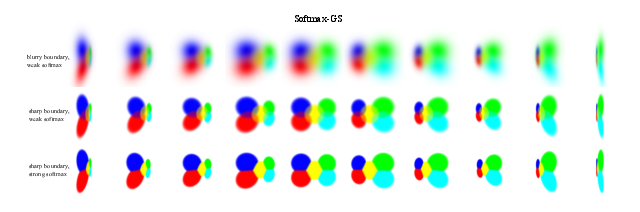
Figure 2: Softmax-GS implements viewpoint-consistent softmax color-merging with adjustable blending or winner-take-all boundaries.
Rendering Equation Generalization
Starting from the classical volume rendering equation, Softmax-GS substitutes the standard summation over non-overlapping kernels with a competition-weighted summation, where each Gaussian ok is modulated by a softmax weight wk reflecting its dominance relative to other overlapping candidates:
wk(x,l,p)=∑jexp(βpj)exp(βpk)
where β tunes the sharpness of the competition (Figure 3), and pk is the Gaussian exponent. For β=0, color blending is uniform; for large β, winner-take-all boundaries emerge. The competition is further modulated by a decay parameter γ that governs locality along the ray, ensuring smooth spatial transitions.

Figure 3: Softmax-ed values and integrals for two identical Gaussians demonstrate exponential decay of overlapping influence, enabling interpolation between blending and separation.
Boundary Sharpness Control
To achieve control over both individual splat boundaries and their mutual competition, Softmax-GS incorporates the Generalized Exponential Function (GEF, as in GES):
exp(−∣∣x∣∣2α)
with α as a learnable parameter controlling kernel sharpness (Figure 4).
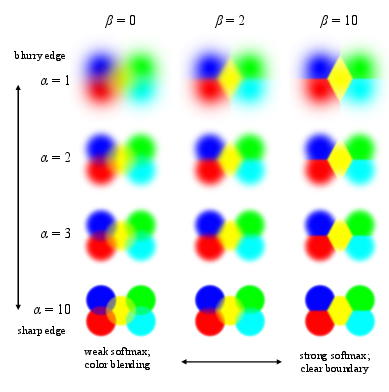
Figure 4: Parameter wk0 modulates Gaussian boundary sharpness, wk1 modulates inter-Gaussian competition, covering the continuum from soft blending to crisp separation.
Efficient Forward and Backward Pass
Despite relaxing the ordering assumption, Softmax-GS retains linear complexity by treating the sequentially sorted Gaussians as composite entities for competition at each processing step. To preserve computational efficiency in both forward and backward traversals, competition is limited to the foremost wk2 Gaussians per image patch, with all necessary intermediates cached within CUDA arrays.
Empirical Validation
Synthetic Geometry Fitting
Softmax-GS is empirically validated in controlled settings where only boundary sharpness or only softmax competition is enabled. Results demonstrate that neither achieves optimal fidelity in isolation; only their joint operation yields substantial gains (see Figure 5).
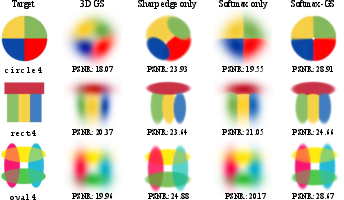
Figure 5: Optimization with Softmax-GS vs. ablations, showing synergistic improvement—neither sharpness nor softmax alone suffices.
As the density of Gaussians is increased, vanilla 3D GS can asymptotically approach the quality of Softmax-GS, but remains inefficient and struggles at sharp corners (Figure 6).
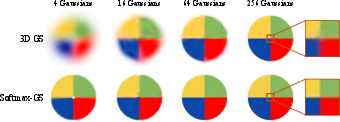
Figure 6: 3D GS gradually approximates sharp borders as Gaussian count increases but fails to resolve corners robustly compared to Softmax-GS.
Real-World Reconstruction
Softmax-GS is benchmarked on standard datasets (Mip-NeRF360, Tanks and Temples, DeepBlending) and compared to multiple recent baselines, both sparse and dense (StopThePop, GES, 3DCS, EVER). The method exhibits strong PSNR gains (>1dB under tight sparsity constraints) and achieves state-of-the-art fidelity with fewer Gaussians. Notably, the Softmax-GSwk3 variant achieves performance comparable to standard 3D GS with only half the primitives.
Key qualitative improvements are observed for thin structures (radiators, antennas, building details), where both sharpness and viewpoint consistency are readily visible due to the joint effect of boundary control and consistent competition (Figure 7).
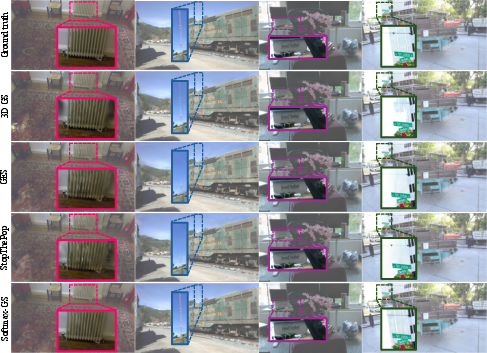
Figure 7: Qualitative comparison on real-world scenes highlighting fidelity in thin and complex structures with Softmax-GS.
Depth and Intersection Visualization
Pixel-wise depth rendering demonstrates smooth transitions at Gaussian boundaries, indicating physically plausible volumetric composition (Figure 8, Figure 9). In scenarios where Gaussians intersect non-coplanarly (crossing at wk4), Softmax-GS eschews the abrupt popping artifacts of vanilla GS and achieves a continuous, differentiable surface representation (Figure 10).
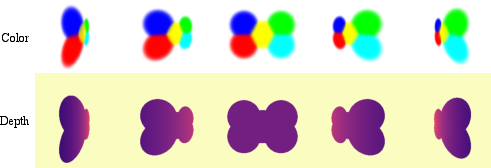
Figure 8: Pixel-wise depth rendering of synthetic pattern showing boundary transition.
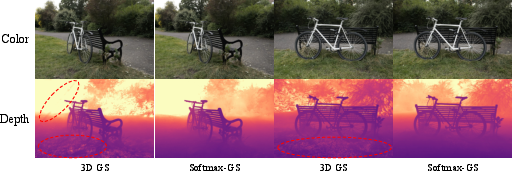
Figure 9: Depth rendering comparison highlighting improved boundary handling via Softmax-GS.

Figure 10: Intersection at wk5 visualized—Softmax-GS produces flicker-free, smooth color transition at the crossing.
Practical and Theoretical Implications
Softmax-GS offers substantial improvements for practical scene reconstruction: reduced Gaussian count, enhanced rendering fidelity, improved boundary control, and superior robustness to sparsification. These advantages directly translate to faster inference and lower resource consumption. The theoretical contributions—the order invariance and transmittance maintenance mechanisms—ensure the output is consistent and physically plausible across all overlapping regimes. The generalized rendering framework is agnostic to the choice of sharpness mechanism, such that future improvements can be integrated while retaining the softmax competition principle.
Limitations include incomplete coverage when restricting competition to a fixed number of Gaussians per ray and lack of strict order invariance when three or more distinct color splats overlap. Extensions to more complex permutation-invariant competition schemes and improved handling of semi-transparent Gaussians remain open for further research.
Future Directions
Future developments may include:
- Extending order-invariance to fully symmetric handling of wk6 overlapping Gaussians;
- Adaptive coverage schemes for backward pass complexity control;
- Integration with large-scale city or mesh-based reconstruction frameworks, exploiting the flexibility of the softmax competition;
- Better handling of semi-transparency and physically accurate optical properties.
Conclusion
Softmax-GS constitutes a rigorous, unified approach that addresses the fundamental bottlenecks of standard 3D Gaussian Splatting. By combining user-controllable boundary sharpness and softmax-based color-merging competition, it achieves efficient, consistent, and high-fidelity volumetric rendering, enabling flexible trade-offs between visual smoothness and sharpness under practical constraints. The framework stands as a new general basis for real-time view synthesis and robust, sparse scene reconstruction (2604.27437).